Editorial — Conall Redspear son of Daimine — Death
Welcome to the Emerald Archives Gazette. In today’s issue we look back at the latest additions to the archive. Saint Comgall — Saint Comgall of Bangor is remembered as an early Irish monastic founder associated with Bangor, in what is now County Down. The surviving evidence in the supplied sources places him in the sixth and early seventh centuries and links him especially with the monastery of Bangor, his death or repose being recorded in the annals. Because the evidence comes through annalistic notices, later saintly texts, and modern summaries, it is best to keep to what the sources directly support: Comgall was a monk, abbot, and founder remembered in connection with Bangor and with a wider network of Irish ecclesiastical memory.…
Dateline
The Day in Irish History
Welcome to the Emerald Archives Gazette. In today’s issue we look back at the latest additions to the archive.
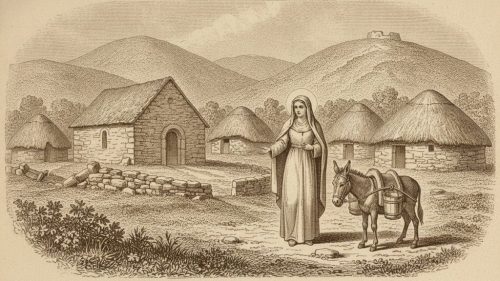
Saint Comgall — Saint Comgall of Bangor is remembered as an early Irish monastic founder associated with Bangor, in what is now County Down. The surviving evidence in the supplied sources places him in the sixth and early seventh centuries and links him especially with the monastery of Bangor, his death or repose being recorded in the annals. Because the evidence comes through annalistic notices, later saintly texts, and modern summaries, it is best to keep to what the sources directly support: Comgall was a monk, abbot, and founder remembered in connection with Bangor and with a wider network of Irish ecclesiastical memory.…
Saint Munchin — Saint Munchin is a shadowy early Irish saint whose historical outline is difficult to recover with confidence. The surviving evidence does not provide a secure contemporary biography, and no firm dates for his birth or death can be established from the sources available. What can be said with caution is that he belongs to the devotional history of Limerick, where his name has long been preserved in parish and institutional traditions.Historical MemoryIn the later history of Limerick, Saint Munchin became one of the city’s most familiar local saints. A parish in medieval Limerick bore his name, and the dedication continued…
Dynastic Killings — Year DatingThe evidence for 607 CE is not arranged identically across the annals. In the Annals of Tigernach, the entry numbered T607 records the slaying of Sechnusach son of Garbán by Domnall son of Aod and the death of Conall Redspear son of Daimine, with the rest of Lugaid following in the same entry. In Inisfallen, AI607 records the slaying of Aed Sláine, Aed Rón, and Aed Buide, then notes that Aed Allain held the kingship. The Ulster text places related material under a different year label.The notices around 607 are deaths and killings, but the year labels differ from…
Saint Kilian — Saint Kilian, also known in tradition as the Apostle of Franconia, is remembered as an early Irish missionary bishop and martyr associated with Wfcrzburg. The surviving evidence is uneven and largely shaped by later hagiographical writing, so some details are best treated as traditional rather than fully secure. Even so, the main outline in the supplied sources is clear: Kilian was probably born about 640, likely in Ireland, and died at Wfcrzburg on 8 July, probably in 689.Irish OriginsThe supplied evidence identifies Kilian as an Irish bishop and missionary. Deutsche Biographie gives his place of birth as Mullagh in County…
Royal Slayings — Year NoticeThe annalistic record for 604 CE is brief and clustered around deaths and slayings. In one version, the year is marked by the repose of Gregory of Rome, the repose of Saint Sinech, the death of king Suibne son of Colmán Mór, and the repose of Senach abbot of Cluain Ferta Brénainn. Another version places a different set of notices under the same chronological span, showing that the year is preserved through short annal entries rather than a continuous account.The same year is also represented in the Annals of Ulster as AD 603, where several deaths and slayings are…
Saint Fridolin — Saint Fridolin is remembered as an early medieval missionary and monastic founder associated above all with Säckingen on the Upper Rhine. Yet almost everything told about him comes from later hagiography rather than from contemporary evidence. The historical Fridolin, if he can be recovered at all, is therefore best approached as a figure at the boundary between memory, devotion, and regional identity.Origins TraditionLater tradition presents Fridolin as an Irishman, sometimes styled an Irish missionary who travelled among the Alamanni in the age of the Merovingians. The exact details of his birth are uncertain. Some modern ecclesiastical summaries place his birth…
Sillán’s Repose — Year RecordThe explicit year-entry for 603 in the Annals of Inisfallen is brief and unadorned. It records the repose of bishop Sillán and the repose of Cainnech moccu Dálann. The wording gives deaths, or the language of religious repose, rather than a battle, raid, eclipse, famine, or change of kingship. On this evidence alone, 603 is marked by two clerical obituary notices and nothing more specific.Nothing in that annal line adds a date beyond the year label itself, and nothing in it identifies a place, a ruler, or an immediate cause. The secure facts are limited to the two named…
Saint Canice — Saint Canice, also known in Irish tradition as Cainneach and in later English usage as Kenny, is remembered as an early Irish saint whose life belongs more to the world of ecclesiastical memory than to securely documented contemporary record. The surviving accounts place him in the sixth century, but the details of his birth, education, travels and death are not firmly established by modern historical standards. What can be said with confidence is that he became one of the best-known Irish saints associated with Ossory and Kilkenny, and that his name remained attached to churches, devotional traditions and local memory…
Aedán’s Death — Year LabelsThe excerpts do not present 606 CE as a single, stable point across the annals. In Annals of Tigernach, the year labeled T606 includes the death of Fiachra the One-eyed son of Baetán and the repose of Eochaid. In the Annals of Ulster, the year labeled U606 includes the repose of Beóguin, the death of Aedán son of Gabrán, and a notice about Pope Gregory. The Annals of Inisfallen place a cluster of deaths under AI606, while the Annals of the Four Masters begin a separate entry under the Age of Christ 606.These headings also show that the same…
Máedóc of Ferns — Saint Máedóc of Ferns is known through the Life of Maedoc of Ferns, a text that preserves a sequence of stories about his birth, early miracles, and foundation at Ferns. The surviving account presents him as a figure of Connaught by origin and of Ferns by association, with a life marked from the beginning by signs of divine favour. What remains is a traditional saint’s narrative, set out in episodes that explain how his holiness was understood in the sources.Birth SignsThe life says that a rich nobleman in Connaught named Sétna, son of Erc, had a wife named Eithne of…
Cúil Battles — Year FrameThe surviving notices do not give a continuous account of 605 CE. Instead, the year appears as a short annalistic cluster in which one compilation places several deaths and battles under 605, while another assigns nearby events to 604, 605, or 606. In Annals of Inisfallen, AI605 lists the repose of Comgall of Bennchor and then three battles: Cúil Caíl, Slemain, and Echros. The Annals of Ulster preserves a calendrical frame and distributes related notices across adjacent year labels, showing that the manuscripts do not align perfectly on the year line.The most secure point is that 605 is an…
Carthage of Lismore — Early LifeSaint Carthage of Lismore is identified in the available evidence as Carthach, also called Mo-chuda. The surviving account links him first with Offaly and later with Lismore. The diocesan history says that Lismore enters Irish church history with the arrival from Offaly of a Kerryman named Carthach and his group of monks in the year 636. It also says that Carthach survived one year in Lismore and that the monastery he founded was to become one of the outstanding monasteries of medieval Ireland. Lewiss Topographical Dictionary gives a related account and says that St. Carthagh fled for shelter to…
Applied Names — Applied NamesIn the annal excerpts, names are repeatedly linked with added explanations. One entry says a cognomen continued to be applied to Fiacha, and another says a king first caused gold chains to be worn by kings and chieftains. A later notice explains that one ruler had first been called Eochaidh and only afterwards received the name Ollamh Fodhla. These are direct statements about naming, not broad commentary on identity.The same passage pattern appears elsewhere in the annals. Finnachta is said to have had another name at first, Elim, and the reason for the later name is given in the…
Bairche Storm — Year EvidenceUnder the label CS610, Chronicon Scotorum records the death of Áed son of Colgu, king of Ind Airther, while on pilgrimage at Cluain moccu Nóis. The same entry records the death of Sillán moccu Minn, abbot of Bennchor, and of Aedán, described as the anchorite. It also names Mael Umai son of Baetán among the dead. The entry opens with the words “Kalends fifth feria” and includes a short verse in the notice concerning Áed. These are the named deaths and accompanying details presented within that chronicle entry.The same annalistic sequence also records a disturbance in Bairche. In Tigernach…
Saint Fursa — Saint Fursa, also known as Fursey or Furseus in Latin tradition, was an Irish monk and missionary of the seventh century. The surviving evidence identifies him in a Life of St Fursey in Harley MS 5041, a parchment codex in the British Library. From those sources, a limited sequence can be stated with confidence: he was from Ireland, he gained patronage in East Anglia, he later moved to northern France, and the Life was copied in the eighth century.Irish OriginsBecause the sources differ in level of detail, it is safest to keep the biographical statement brief. Fursa is represented as…
Clonmacnois Pilgrimage — Year RecordThe year 608 in the Annals of Tigernach survives as a compact cluster of notices rather than a continuous story. The entry records the death of Aodh son of Colgu, described as king of Airgiall and the Oriors, and places that death at Clonmacnois in pilgrimage. The same year also includes separate notices for the deaths of Sillán son of Cumaine, abbot of Bennchor, and Aedán the anchorite.Tigernach also lists the deaths of Mael-umai son of Baetán and Colgu son of Fiachne, though the surviving excerpt breaks off after Colgu's name. The preserved passage therefore shows a year framed…
Bairche Thunder — Year NoticesTigernach places a compact group of notices under its internal heading T609. It names an army of the Ulaid in Bairche being struck, the death of Mael-dúin son of Aline, the repose of Colmán Ela, Aed Róin and Aed Laigen, and Neman, abbot of Lismore. These are notices printed under that particular heading. The wording must be distinguished from an independently reconciled date of 609 CE, because the other annals preserve different chronological labels for related material.In Tigernach, the notices gathered under T609 are brief and varied. The sequence begins with an army of the Ulaid in Bairche struck…
Saint Adamnán — Adomnán of Iona, also found in manuscripts as Adamnán, was abbot of Iona and is best known as the author of the Vita Columbae. He also wrote De Locis Sanctis and Cáin Adomnán. Various prayers and poems are attributed to him, most later than the 8th century, and some later material associated with his name has been accepted by some scholars and rejected by others. The surviving notices present him as a figure remembered in monastic, literary, and legal traditions.Life OfficeThe surviving notices connect Adomnán with the Cenél Conaill of the N. Uí Néill, and also with his mother’s N.…
Public Trust — Munster Continuity — Manuscript RecordThe Annals of Tigernach are presented through manuscript description rather than narrative commentary. One witness is dated to about the eleventh century and linked with Clonmacnoise, while another manuscript from the fourteenth century preserves fragments of the same work alongside the Irish World-Chronicle. The edition history also names earlier scholarly work and later electronic preparation. These details show a text known through copying, fragmentary survival, and editorial reconstruction rather than through a single complete book.The opening material for the Annals of Tigernach also identifies the electronic edition as a restricted academic resource, compiled from earlier translation work and proof…
Irish Technology — Early Collections — Early CollectionsThe earliest institutional frame in these records begins with the Royal Dublin Society, founded in 1731 to encourage husbandry, manufactures, and other useful arts. Its collecting first included modern agricultural and industrial machinery. Later accounts add classical archaeology, plaster casts, geological minerals, and other material used for teaching. The picture is of a mixed collection, practical and learned at once, rather than a single, narrow category of technology.A later museum history says that, before the National Museum of Ireland was established in 1877, the core of its collections came from the Royal Dublin Society, the Royal Irish Academy, and…
Customs Records — Travel CustomsThe travel collection presents customs as one recurring subject within a broader set of travel concerns. Its introductory note says that international visitors wrote about geography, life, local customs, and contemporary politics, and that this tradition reaches back to the medieval period. The same page points to individual accounts, including a 1517 French record of an accidental royal visit to Kinsale that is said to shed light on Irish costume and dress. On this evidence, customs appear as something observed in travel writing rather than as a separate standalone genre.The page also groups later travel accounts that explicitly touch…
Galway Neolithic — Galway BurialsThe Galway records preserved here centre on prehistoric burials and a prehistoric structure rather than on a single site. One report from Annaghkeen describes a short cist in Co. Galway with an inhumation, a vase, a flint blade, and pig bones. Another from Carrowntober East records a short cist near Athenry with an inhumation, a cremation, and an inverted vase. A third report, from Lettershea, concerns a prehistoric hut site with later discussion of quartz and lithics.Across these reports, the evidence is strongest for burial practice and associated objects, but weaker for exact dating. Annaghkeen is identified as Early…
Carers Allowance — Policy SettingThe documentary trail begins with a 1996 report prepared for the Joint Oireachtas Committee on Women’s Rights. Its stated purpose was to provide an evaluation, including appropriate recommendations, of current and potential forms of support for female carers of older people and people with disabilities in the context of medium-term demographic change, including consideration of the role of the carer’s allowance. The study was based on estimates of the supply and demand of carers derived from relevant population projections. The report also notes that, despite the importance of carers in Irish society, there had been little official concentration on…
Nations Rugby — Origins FormativeOfficial tournament histories trace the championship to 1883, when England, Ireland, Scotland, and Wales played the inaugural Home International Championship. Another summary places the first rugby union international in 1871 and then identifies the 1883 series as the start of the older championship structure. Read together, these accounts show a progression from early international matches to a four-team annual contest that later became the basis for the modern championship.The same historical summaries note early championship results without extending beyond what is stated there. England won the first series, while Ireland won in 1894, and Wales won in 1893 and…
Ashes Controversy — Public DisputeContemporary newspaper coverage places the controversy in early 2000, when a New York-based Limerick man placed an advertisement inviting people to bring copies of Frank McCourt’s Angela’s Ashes to a book-burning ceremony. The report says the organisers objected to the way the novel and the film treated Limerick, and records their intention to hold the event outside a bar on Long Island. McCourt is quoted responding that books were sacred to him and that burning them recalled the 1930s.The same report shows that the protest was framed as a deliberate public act rather than a private complaint. It also…
John Eriugena — John Eriugena was one of the most original intellectuals of ninth-century Europe. Usually called John Scotus Eriugena, he was an Irish scholar active in the Carolingian world and was already known by contemporaries as “the Irishman”. His life dates are uncertain, though modern scholarship commonly places him around c.800 to c.877. He belongs to the early medieval period in which Irish learning travelled widely and found a place at continental courts and schools.Irish OriginsAlmost everything securely known about his early life is limited. The surviving evidence points to Ireland as his homeland, and the surname Eriugena was understood in later…
Slemain Battles — Dating FrameThe surviving year notices do not line up in the same way. In the Annals of Ulster, the heading marked AD 601 is followed by entries for the kalends of January and then by notices placed under U602, which is explicitly marked AD 601. In the Annals of the Four Masters, M601 is headed as the Age of Christ, 601. The comparison is direct: one witness labels the material one way, while the other places the year at 601 without that shift.The same comparison also shows that the Ulster chronicle preserves a short block of notices under AD 601…
Sedulius Scottus — Sedulius Scottus was a ninth-century Irish scholar who made his career in Carolingian Europe, probably in the region of Liège in what was then Francia. His surviving works show him as a teacher, Latin grammarian, biblical commentator, poet, and compiler of learned excerpts. The evidence for his life is fragmentary, so his exact birth and death dates are uncertain; what can be said with confidence is that he was active roughly between 848 and 860.Irish OriginsModern reference works describe Sedulius Scottus as an Irish teacher, Latin grammarian, and scriptural commentator. His surviving record is fragmentary, and it does not securely…
Thank you for reading today’s Gazette. Follow any of the links above to read the full article and explore its sources.