Nollaig na Garma1351 CE
In 1351, Irish politics combined unstable lordship, royal administration, warfare and cultural patronage. Aodh Ó Conchobhair regained Connacht’s kingship through hostages and support, but conflict following Aodh Ó Ruairc’s capture devastated Moylurg. Other deaths and killings reflected continuing regional feuds. Thomas Rokeby’s October ordinances sought to reinforce English law, frontier security, labour regulation and land recovery, revealing the lordship’s weaknesses after plague and war. A Franciscan foundation at Ross Errilly was traditionally dated to this year, though evidence is late. At Christmas, Uilliam Buide Ó Ceallaigh hosted Ireland’s learned classes, using hospitality to proclaim wealth, authority and cultural prestige publicly.

Dateline
In 1351, Ireland’s political life was conducted in several overlapping worlds. In the lordship governed for Edward III, Sir Thomas Rokeby’s administration tried to make English royal law effective in a country where its reach had become uneven. In Connacht, rival branches of the Ó Conchobhair dynasty struggled for the kingship, while the capture of a returning pilgrim triggered warfare that devastated Moylurg. Yet the year is also remembered for a very different display of power: Uilliam Buide Ó Ceallaigh’s Christmas gathering for Ireland’s learned classes. Taken together, these events show a country in which force, law, faith, learning and hospitality were inseparable instruments of lordship.
Connacht’s Restored King
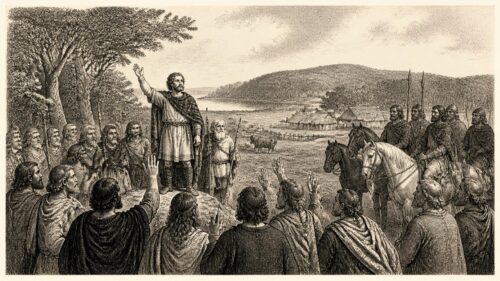
The clearest political reversal recorded for 1351 occurred in Connacht. Aodh, son of Toirdhealbhach Ó Conchobhair, returned to the province, received the hostages of Connacht and drove out his rival, Aodh son of Feidhlimidh, for a year. The language is important. Hostages were not merely prisoners: they were guarantees, supplied by subordinate rulers and leading families to demonstrate that they would observe an agreement or accept a claimant’s authority. Their delivery therefore marked a practical restoration of Aodh son of Toirdhealbhach’s position, even if it did not create a settled or uncontested kingdom.
The reversal had a close background. In 1350, the same Aodh had been displaced by Mac William Burke and by the people of Connacht’s tuatha, or territorial communities, in favour of Aodh son of Feidhlimidh. The annals’ report for 1351 consequently records more than one lord’s return from exile: it reveals how the leading Gaelic and Hiberno-Norman powers of Connacht could determine, sustain or remove an Ó Conchobhair king. Kingship here was not a single hereditary office automatically transmitted from father to son. It depended upon kin, military following, alliances and the acceptance—or compelled submission—of other regional rulers.
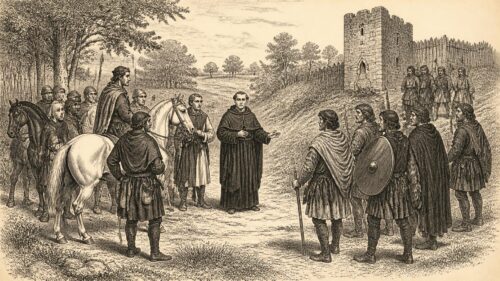
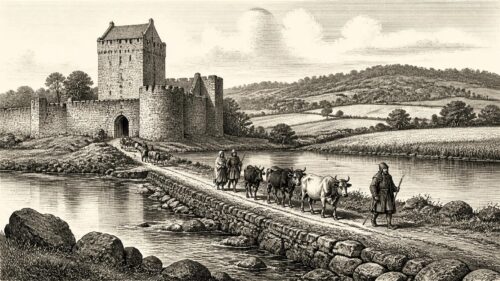
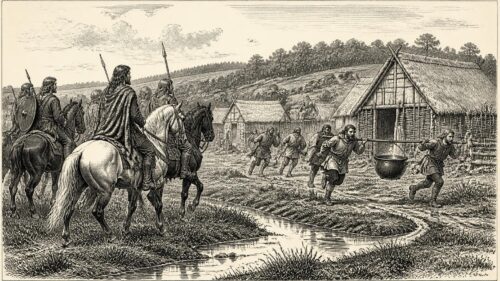
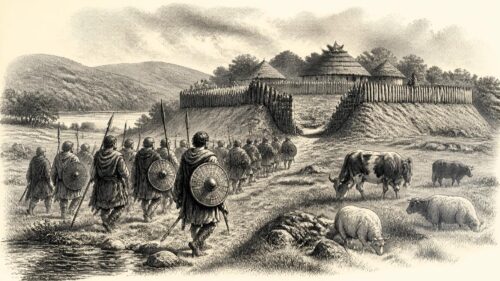
The restoration did not end violence. Aodh Ó Ruairc was captured while returning from the pilgrimage shrine of Croagh Patrick by the son of Pilib, son of Uilliam Burke, a member of the Mac Philibin or Mac Philbin branch of the Burkes. Fergal Mac Diarmata took the field in response, and Annála Connacht says that general war spread across Connacht, leaving Moylurg “stripped bare”. Moylurg, centred on the region around modern Lough Key in County Roscommon, was Mac Diarmata territory. The phrase should not be reduced to a picturesque flourish: it points to the practical warfare of raiding—seizing cattle and stores, burning crops or buildings, and making ordinary households bear the cost of elite rivalry.
That Aodh Ó Ruairc had been travelling from Croagh Patrick gives the episode a further dimension. Pilgrimage was a recognised religious journey, but the roads and routes of a politically divided country offered no immunity from capture. Sacred observance, kinship obligations and secular conflict occupied the same landscape. The annals also note the deaths of Pilib Mag Uidir, chief of Muintir Fheadacháin in Fermanagh, and Éanna Ó Flannacáin, chief of Tuath Rátha, as well as the killing of Eoghan Mac Suibhne by Maghnus Ó Domhnaill. These brief notices do not describe island-wide upheaval, but they underline how succession, feud and lordly mortality continued from Connacht to the north-west.
Rokeby’s October Ordinances
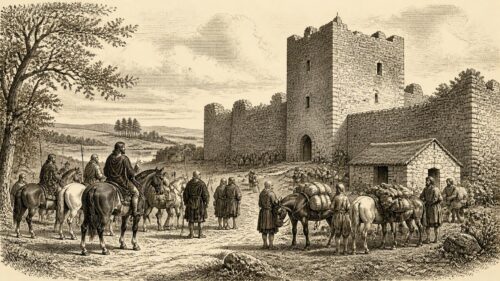
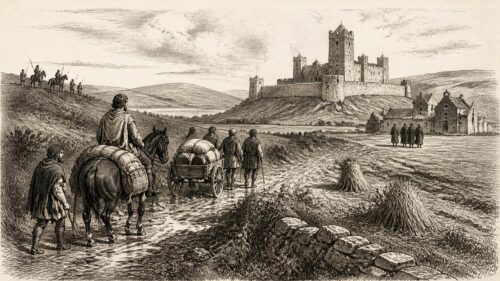
While Connacht was shaped by shifting lordships, the English administration attempted to strengthen the lordship’s institutions. Thomas Rokeby, the king’s justiciar in Ireland, presided over great councils at Dublin and Kilkenny in October 1351. The ordinance made at Kilkenny was later copied into the statutory tradition, and a surviving chancery enrolment of 10 November ordered that the measures be read publicly in the Irish exchequer and observed. This is unusually firm evidence that the programme was intended to move beyond a meeting of magnates and into routine administration.
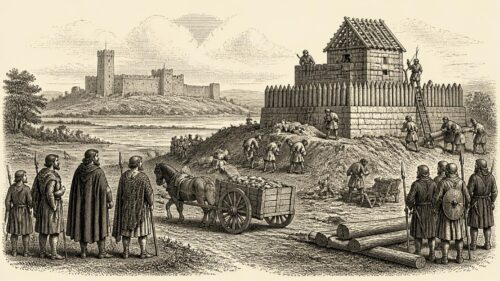
The measures addressed the colony’s insecurity and internal fragmentation. They envisaged one peace and one war throughout Ireland, sought to curb private dealings with enemies, required those who held frontier lands to maintain the marches, and dealt with robbers, felons and those who sheltered them. Other provisions called for wardens of the peace in each county and tried to ensure that sheriffs, royal officers and franchise-holders could pursue offenders across jurisdictional boundaries. Such clauses reveal the difficulty of rule rather than its success. The administration could legislate against local truces, private alliances and protected raiders precisely because these practices persisted.
One especially revealing provision required English people to use common law rather than Brehon law or march law in disputes between themselves. Brehon law was the body of learned Gaelic legal custom, while march law referred to practices of the frontier. The ordinance did not mean that either disappeared in 1351; its wording instead shows that settlers and colonial elites had found local legal methods useful enough for royal government to regard them as a problem. The better-known Statute of Kilkenny of 1366 would echo several of these concerns, but the 1351 ordinance should be understood in its own right, as an early and substantial attempt to police a porous cultural and political frontier.
Its economic provisions were equally shaped by recent calamity. The statute of labourers was to be sent to sheriffs, mayors and other officers for public proclamation in Ireland. The English statute on which it drew had attempted to restrain wages and compel able-bodied people without an independent livelihood to work, responding to labour scarcity after plague mortality. Ireland’s records do not allow a simple calculation of its effects in every region, and enforcement must not be assumed. Nonetheless, applying the measure to the lordship demonstrates that officials considered labour, cultivation and wages urgent questions in 1351.
This was the aftermath of the great pestilence recorded in Irish sources for 1349 and still feared in a contemporary 1350 marginal note. The scale and local distribution of mortality remain difficult to reconstruct, but the crisis had plainly not become a distant memory. Rokeby’s programme also proposed recovering and recolonising cultivated land that had fallen into the “land of war”. In a society already dealing with population loss, warfare and weak government, that aspiration was ambitious. It pointed to the administration’s ideal of restored settlement and revenue, not to a securely recovered countryside.
Personnel changes likewise mattered. On 18 October 1351 Robert de Embleton became chief baron of the Irish exchequer. His return was striking because he had earlier been removed from the treasurership amid grave accusations and had subsequently cleared himself in an ecclesiastical court. His appointment placed an experienced, if controversial, royal clerk at the head of the exchequer’s judicial business. It also illustrates the small, mobile circle of administrators upon whom the lordship depended, even after conflict between them and the justiciar’s government.
A Franciscan Date in Question
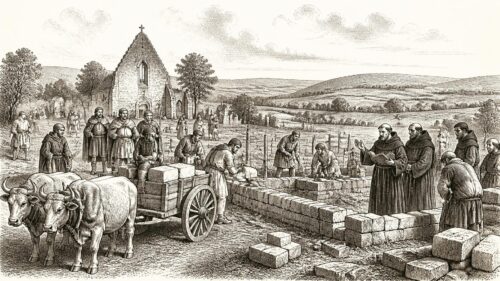
The Annals of the Four Masters place the erection of a Franciscan monastery at Ros-Oirbhealagh, in the diocese of Tuam, in 1351. The site is generally identified with Ross Errilly near Headford, on the Galway–Mayo border. This is a valuable connection for the year, but it needs careful handling. The Four Masters were compiled in the seventeenth century, and modern investigation has shown that their foundation date rests on a chain of later Franciscan historical writing rather than on a surviving contemporary foundation charter. Thus 1351 is a traditional and long-standing date associated with Ross Errilly, not a securely documented day of construction or proof that the surviving fabric belongs to that exact year.
Even with that reservation, the entry is historically suggestive. Franciscan houses connected preaching, confession, burial, patronage and prayer with the towns and lordships around them. A new or newly recognised house in the Tuam diocese would have depended upon local protection and resources. It belongs beside, rather than apart from, the political story of Connacht: religious foundations could express the status of patrons and provide durable institutions within territories exposed to dynastic change and war.
The Invitation Christmas
The year’s most memorable cultural event came at Christmas, when Uilliam Buide Ó Ceallaigh, lord of Uí Mháine, issued a general invitation to the schools of poetry of Ireland. The annalist calls it an “Invitation Christmas”, Nollaig na Garma. The Four Masters expands the company beyond learned people to include travellers, the poor and indigent, noble and non-noble alike, and says that they were satisfied by Uilliam and his son, Maelsechlainn. The gathering was sufficiently remarkable to be recorded in more than one annalistic tradition.
It was not simply a generous meal. In Gaelic lordship, hospitality was a public duty and a political language. To feed poets, jurists, clerics, entertainers, travellers and the poor demonstrated command of cattle, grain, household labour, storage and safe space. It also created obligation and reputation. Uí Mháine lay in the broad zone between Connacht and the midlands, and the Ó Ceallaighs ruled there amid powerful neighbours, including branches of the Burkes and Ó Conchobhairs. A gathering that drew learned visitors from across Ireland announced that this lordship possessed wealth, connections and cultural authority despite the disruptions visible elsewhere in the year.
Gofraidh Fionn Ó Dálaigh commemorated the occasion in the praise poem Filidh Éireann go haointeach, “the poets of Ireland in one house”. The poem’s celebratory voice must not be mistaken for an administrative record, but it preserves important cultural evidence. It imagines special accommodation and distinct spaces for different kinds of learned and performing visitors, conveying the scale of preparation expected of a renowned host. The precise site called Fionngháille in the tradition remains uncertain, so it is safer to locate the event within Ó Ceallaigh territory than to attach it confidently to a particular modern village or castle.
In 1351, then, Ireland was not moving in one direction. Rokeby’s ordinances attempted to bind the English lordship to common law, disciplined labour and a unified policy of war. In Connacht, authority changed hands through hostages and armed support, while raiding brought deprivation to Moylurg. At Christmas, Uilliam Buide Ó Ceallaigh turned abundance into prestige by gathering the custodians of poetry and learning. The contrast is the point: medieval Irish power rested not only on castles, courts and armed men, but also on the ability to protect pilgrims, command labour, endow religious life and offer an unforgettable welcome.
Primary Sources
- Annála Connacht: Annal 1351
- Annals of the Four Masters: Annal M1351
- The Annals of Ulster: plague reaches Ireland
- A Tract on the Plague
- Annalium Hiberniae Chronicon ad annum MCCCXLIX (The Annals of Ireland)
- Statute Law Revision Act 2007, Schedule 2
- Close Roll 25 Edward III (1351–1352), Item 13
- Rokeby, Thomas
- Embleton, Robert
- The Statute of Kilkenny Preceded by the Ordinances of 1351
- Forthcoming: The Statute of Kilkenny
- The Anglo-Irish Colony Under Strain, 1327–99
- Index to Bardic Poems and Sources
- William Buide O’Kelly and the Late Medieval Renaissance of the Uí Maine Lordship
- How Medieval Irish Elites Feasted and Fought at Christmas
- The Last Kings of Ireland: Material Expressions
- The Franciscan Friary of Ross Errilly
- Materials for the History of the Franciscan Province of Ireland, A.D. 1230–1450
- Liber Primus Kilkenniensis
- The Statute of Laborers, 1351