Carlow Exchequer1361 CE
In 1361, Lionel of Antwerp, Edward III’s son and earl of Ulster, arrived in Ireland as royal lieutenant with troops to reinforce the threatened English lordship. Landing at Dublin in September, he campaigned in Leinster, where Gaelic rulers remained powerful. Irish annals recorded the deceptive seizure and subsequent custodial deaths of Art Mac Murchadha and Domnall Riabach, though details remain uncertain. Lionel transferred the Exchequer to fortified Carlow, creating a forward administrative and financial base without displacing Dublin’s importance. Meanwhile, the widespread epidemic Cluiche an Rí, probably pestis secunda, intensified economic and military pressures, demonstrating the limitations of royal intervention.
Dateline
In 1361, the English lordship of Ireland received an unusually conspicuous intervention from across the Irish Sea. Lionel of Antwerp, second surviving son of Edward III and earl of Ulster through his wife Elizabeth de Burgh, arrived as the king’s lieutenant with an army, a reforming brief and the prestige of a royal prince. His coming did not unite Ireland beneath a renewed administration. Instead, it exposed the practical limits of English power, particularly in Leinster, where Gaelic dynasties were formidable neighbours rather than distant enemies. The year is also marked by a renewed epidemic remembered in Irish as Cluiche an Rí, or ‘the King’s Game’, an ominous reminder that political and military calculations unfolded amid recurrent mortality.
A Royal Answer to a Colonial Crisis
Lionel’s appointment belonged to a crisis that had been building for years. In 1360, representatives of the English community in Ireland had told Edward III that the lordship was endangered: revenues were inadequate, frontier warfare was persistent and the Dublin administration struggled to defend its territories. Their appeal did not describe all Ireland. The king’s government exercised direct authority chiefly in towns, castles, manors and counties concentrated around Dublin and across parts of Leinster, Meath, Munster and Connacht. Beyond, and often immediately beside, those jurisdictions, Gaelic lordships retained their own rulers, military followings, legal specialists, churches and networks of allegiance.
Edward III’s response in 1361 was exceptional. Lionel was not merely a professional official sent to occupy the justiciar’s place. He was the king’s son, possessed substantial Irish claims through the de Burgh inheritance, and could bring English magnates and paid troops with him. He was appointed lieutenant in July. His enterprise therefore combined royal policy with dynastic interest: it aimed to defend the English lordship generally while strengthening the position associated with the earldom of Ulster and the de Burgh inheritance. The expedition was costly and conspicuous, but it also reflected a grim truth. A force arriving by sea could reinforce the colony; it could not simply erase the political geography of Ireland.
Landing at Dublin
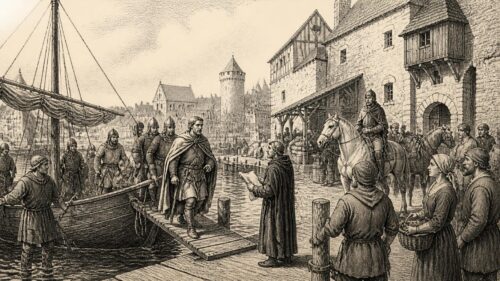
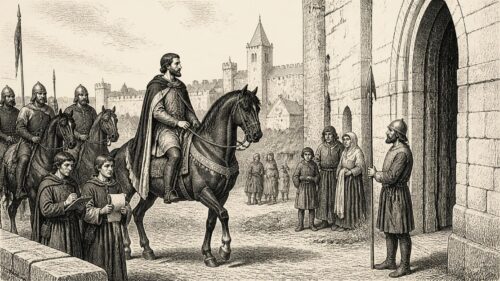
Lionel disembarked at Dublin on 15 September 1361. Contemporary administrative preparations and later historical reconstruction make the date unusually secure. He arrived with English soldiers and officials, while lords holding lands in Ireland had been ordered to accompany him for the defence of the lordship. Yet the expedition was not composed exclusively of newcomers from England. Records of its paymaster, Walter Dalby, show Irishmen being retained and paid in royal service. That detail matters. The divisions of fourteenth-century Ireland were real and often violent, but they were not a simple division between an English army and a uniformly opposed Irish population. Service, protection, lordship, marriage and local rivalry could all produce alliances across cultural and political boundaries.
The immediate strategic focus was Leinster. The mountains and wooded districts south of Dublin gave local rulers opportunities to raid, withdraw and reappear, while the routes between Dublin, the Barrow valley and the southern lordship required protection. Lionel was campaigning in Wicklow by 28 September. The speed of this movement indicates both urgency and confidence: the new lieutenant meant to demonstrate that the royal government could take the field rather than merely receive alarming reports in Dublin Castle.
The Seizure of Leinster’s Rulers
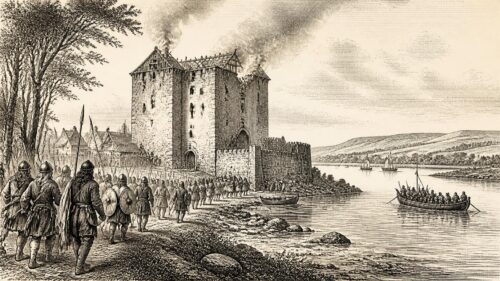
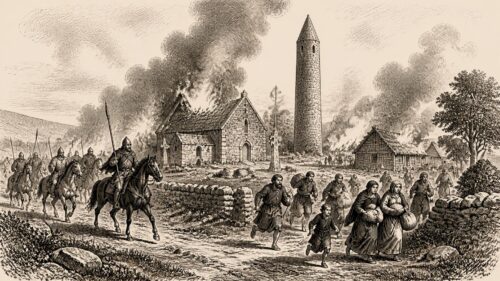
The most striking event assigned to 1361 by the Irish annals was the capture of Art Mac Murchadha, described as king of Leinster, and Domnall Riabach, called a prospective king of Leinster. The Annals of Connacht and the Annals of Loch Cé say that the two were seized per dolum—by deceit—in Art’s own house by the king of England’s son, and that they died in custody. The phrase reflects the annalists’ moral judgement as well as their information, but it is important evidence for how the episode was remembered in Gaelic Ireland: not as an open-field victory but as a treacherous removal of rulers.
Official evidence confirms the central fact of detention, while also urging caution over the compressed annalistic narrative. A royal inquiry into the deaths was ordered in May 1363; the prisoners had been held by Roger Berde, constable of Trim Castle. Thus the capture belongs firmly to Lionel’s first Irish campaign, but the available evidence does not permit every stage of the prisoners’ treatment or the precise date of each death to be reconstructed confidently. What can be said is that Lionel’s arrival quickly produced a direct assault on Mac Murchadha leadership in Leinster.
Such an action could disrupt a dynasty, but it could not settle Leinster. Kingship in Gaelic Ireland was not a unitary office passed automatically from father to eldest son. It rested on a wider ruling kindred, military capacity, clientship and negotiation. Removing prominent men might create a temporary advantage for the Dublin government, yet it might also deepen hostility, invite rival claims and encourage raids. The episode shows the harsh methods available to the lieutenant; the later history of Leinster shows their limits.
Government Moves to Carlow
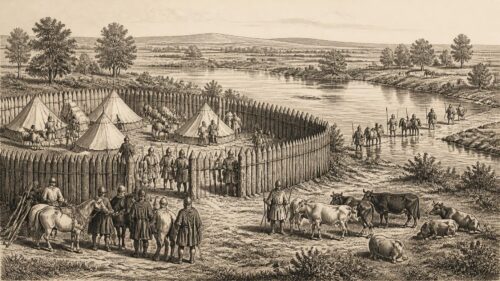
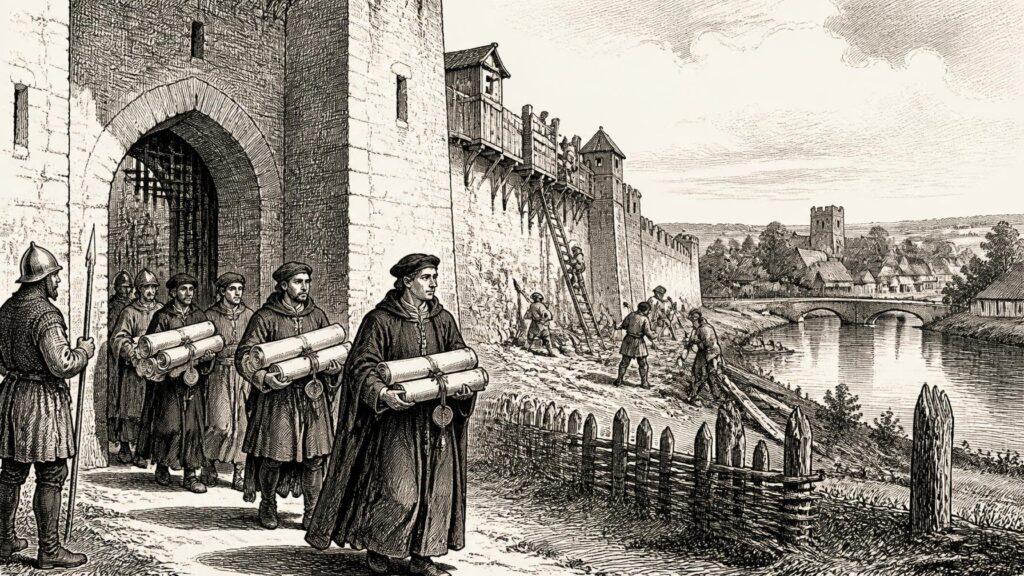
Lionel’s most durable act in 1361 was administrative as well as military. The government’s financial centre was shifted towards Carlow, a fortified town on the Barrow and a more practical base for operations against the Mac Murchadhas of Leinster and the Gaelic lordships of Laois and Offaly. By 30 September, the Irish Exchequer was sitting at Carlow, with a small force assigned to defend the town. The move placed royal accountancy, revenue collection and the machinery of payment closer to the frontier that Lionel intended to press.
This was not a transfer of the whole capital in a modern sense. Dublin remained the principal port, the location of Dublin Castle and the chief centre of urban government. Chancery business continued there, while the relocation of Exchequer and Common Bench business gave Carlow an unusual administrative importance. Still, the decision reveals how government worked under pressure. The Exchequer was responsible for receiving and auditing royal revenue; moving it meant moving clerks, records, seals, writs and the routines through which soldiers, sheriffs, landholders and creditors encountered the king’s authority.
For inhabitants of Carlow, the immediate effects would have been tangible. The town required defence, accommodation, supplies, transport and labour. Its castle and walls acquired a new strategic value, while the surrounding Barrow corridor became more closely tied to military movement and official finance. Yet Carlow’s new role also testified to insecurity. It was chosen precisely because the frontier was close. The government was seeking not a comfortable administrative centre but a forward position from which to sustain a contested lordship.
‘The King’s Game’
Against this backdrop came disease. The Connacht and Loch Cé annals report Cluiche an Rí as widespread throughout Ireland and name Richard Savage among those who died from it. Modern scholarship identifies this outbreak with the second great wave of plague mortality, often termed the pestis secunda, which affected Britain and continental Europe in 1361–62. The Irish name’s origin is uncertain. Translating it simply as ‘the King’s Game’ is useful, but it should not conceal the uncertainty surrounding the expression or the experience of illness.
The annals do not give a demographic total, nor do they describe symptoms or provide a national map of infection. Their statement that the sickness was widespread is nevertheless significant, especially after the Black Death of 1348–50. Recurrent disease could remove household heads, tenants, labourers, clergy and fighting men; it also disturbed rents, inheritance, cultivation and the capacity of communities to meet military demands. The named death of Savage shows that social rank offered no assured protection. At the same time, the survival of other names in the annals should never be mistaken for evidence that lesser-known people escaped. Medieval record keeping disproportionately preserved rulers, clerics and prominent landholders.
Reading a Difficult Year
The evidence for 1361 must be handled carefully. The Annals of Connacht and Annals of Loch Cé give the year a detailed chronological heading and connect Lionel’s intervention, the Leinster captives and the epidemic within the same annal. Other annalistic compilations sometimes place related material under differently calculated year headings. The Annals of Ulster, for example, contain an entry headed 1361 but supply an internal calculation corresponding to 1364 for several recorded deaths. Such discrepancies are not a reason to discard the annals; they are a reminder that annal headings, compilation dates and modern calendar years must not be treated as identical without checking.
What remains clear is the shape of 1361. A royal prince landed at Dublin in September, campaigned rapidly in Leinster, and oversaw the relocation of the Exchequer to Carlow by the end of that month. Irish annalists recorded the seizure and custodial deaths of Leinster leaders in language of betrayal, while they also recorded an epidemic spreading widely through the island. The year therefore joined royal intervention, frontier coercion, administrative adaptation and public vulnerability. Lionel had brought exceptional resources to Ireland, but the Ireland he encountered was politically plural, militarily resilient and repeatedly altered by forces no government could command.
Source References
Hover over a number to see the source. Select it to open the source.

- [1] Annála Connacht: Annal 1361
- [2] Annála Connacht: Irish Text, Annal 1361
- [3] Annals of Loch Cé: Annal 1361
- [4] Annals of Loch Cé: Irish Text, Annal 1361
- [5] The Annals of Ulster: Year U1361
- [6] Annals of Ulster: Irish Text and Chronological Entries
- [7] Annals of the Four Masters: Text, 1352–1361
- [8] Lionel (‘of Antwerp’)
- [9] MacMurrough (Mac Murchadha), Art
- [10] Burnham, John
- [11] Ireland
- [12] ‘Hobbes’, ‘Dogs’ and Politics in the Ireland of Lionel of Antwerp, c. 1361–6
- [13] Lordship and Principality: Colonial Policy in Ireland and Aquitaine in the 1360s
- [14] The Medieval Irish Plea Rolls – An Introduction
- [15] The Irish Chancery, c. 1230–1509
- [16] Lionel of Clarence and Ireland: 1361–66
- [17] County Carlow Urban Archaeological Survey 1990
- [18] The Identification of Some Pestilences Recorded in the Irish Annals
- [19] ‘Unheard-of Mortality’: The Black Death in Ireland
- [20] 14th Century Yersinia pestis Genomes Support Emergence of Pestis Secunda within Europe
- [21] Patent Rolls, Edward III (1361 to 1364)
- [22] Printed Primary Sources: Calendar of Patent Rolls
Primary Sources
- Annála Connacht: Annal 1361
- Annála Connacht: Irish Text, Annal 1361
- Annals of Loch Cé: Annal 1361
- Annals of Loch Cé: Irish Text, Annal 1361
- The Annals of Ulster: Year U1361
- Annals of Ulster: Irish Text and Chronological Entries
- Annals of the Four Masters: Text, 1352–1361
- Lionel (‘of Antwerp’)
- MacMurrough (Mac Murchadha), Art
- Burnham, John
- Ireland
- ‘Hobbes’, ‘Dogs’ and Politics in the Ireland of Lionel of Antwerp, c. 1361–6
- Lordship and Principality: Colonial Policy in Ireland and Aquitaine in the 1360s
- The Medieval Irish Plea Rolls – An Introduction
- The Irish Chancery, c. 1230–1509
- Lionel of Clarence and Ireland: 1361–66
- County Carlow Urban Archaeological Survey 1990
- The Identification of Some Pestilences Recorded in the Irish Annals
- ‘Unheard-of Mortality’: The Black Death in Ireland
- 14th Century Yersinia pestis Genomes Support Emergence of Pestis Secunda within Europe
- Patent Rolls, Edward III (1361 to 1364)
- Printed Primary Sources: Calendar of Patent Rolls