The Six Burnings1360 CE
Dateline
For Ireland, 1360 is remembered most clearly through a stark cluster of fires. The Annals of Connacht record “great burnings” at Roscommon, Devenish, Sligo, the monastery of Lisgoole, Fenagh and Drumlease. The entry gives no date within the year, no named commander and no narrative explaining whether these were connected attacks, separate raids, or destruction arising from several local conflicts. That silence matters. It would be unsafe to turn the notice into a single, neatly organised campaign. Yet its geographical reach, from Connacht into Fermanagh and the north-west, makes it an unusually vivid indication of insecurity in a year otherwise known chiefly through deaths, depositions and short notices of violence.
Reading a Difficult Year
The Irish annals are indispensable for fourteenth-century Ireland, but they must be read with care. Their terse entries preserve names, places and memorable events that official English records often ignore; at the same time, the surviving compilations were copied and continued over long periods, and their year-headings do not always align perfectly with a modern calendar. The Connacht annalist expressly places the burnings, the killing of Diarmait Mac Diarmata, the deposition of Diarmait Ó Briain, the death of Sir Robert Savage and several learned men under 1360. These notices therefore provide the firm core of the year’s history.
Other annals place further deaths and conflicts beneath 1360, but their internal chronology can be less secure. The Annals of Ulster, for example, preserve a notice of a great wind that broke houses and churches and sank many boats, but the calendar calculation attached to that section is problematic. It should not be presented confidently as a weather event of the calendar year 1360. The distinction is important: Ireland’s medieval historical record is rich precisely because it contains independent regional voices, not because every entry can be converted automatically into an exact modern date.
A Chain of Burned Places
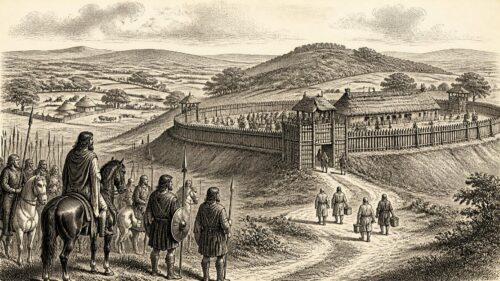
The six burnings recorded in Connacht’s annals touched places with religious, political and economic importance. Roscommon was a major Ó Conchobair centre in central Connacht, with a castle, settlement and Dominican friary close to the old royal landscape. Sligo was a developing town whose Dominican priory had been established in the thirteenth century. Devenish, on Lough Erne, was an old ecclesiastical centre with a long tradition of learning and worship. Lisgoole, also in Fermanagh, was specifically described as a monastery. Fenagh and Drumlease in what is now County Leitrim likewise stood in districts marked by ancient churches, local lordship and routes between Connacht, Breifne and Ulster.
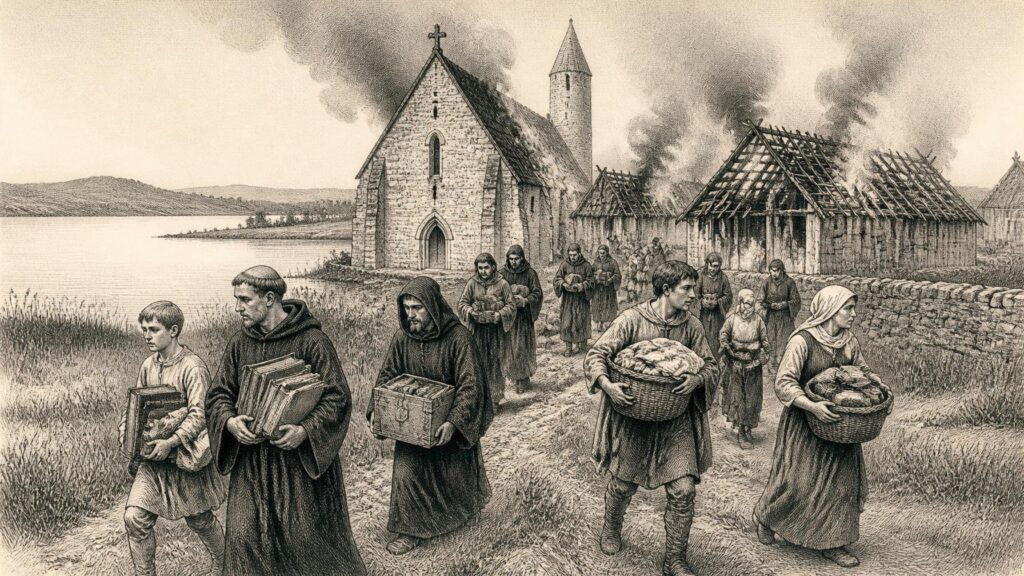
To burn such places was to strike more than buildings. Churches and monasteries held food stores, livestock, books, liturgical objects and the labour of religious communities; towns and fortified settlements concentrated people, markets and movable wealth. Fire could destroy roofs and timber structures quickly even where stone churches, towers or castles survived. It could also force communities to divert resources into repair, replace lost goods, and seek the protection of neighbouring rulers. None of this proves the precise scale of damage at any one site in 1360, and the annalist does not report casualties. But the choice to list these burnings together shows that their effects were considered significant enough to deserve remembrance.
The entry also cautions against treating religious houses as isolated refuges beyond politics. Medieval Irish monasteries were embedded in local society. They depended upon patrons, tenants, hereditary officers, pilgrims and nearby settlements, while their churches and storehouses could become targets in warfare. The burnings of 1360 therefore expose the vulnerability of institutions that were at once sacred places, landholders, repositories of learning and centres of hospitality. The fires were not an abstract symbol of disorder: they threatened particular communities across a wide western and northern zone.
Succession and Local Violence
Political authority in Ireland was dispersed among Gaelic lordships, Anglo-Irish families, ecclesiastical jurisdictions and the Crown’s shrinking areas of effective control. The year’s annalistic notices show that local contests could be as consequential as any policy made in Dublin or Westminster. Diarmait, son of Donnchad Riabach Mac Diarmata, was killed by Cathal Óg Ó Conchobair. The record gives no full account of the quarrel, but the names locate it in the competitive political world of Connacht, where the Mac Diarmatas of Moylurg and branches of the Ó Conchobair dynasty pursued authority through alliance, rivalry and force.
In Thomond, Diarmait Ó Briain was deposed by the son of his own brother. The brief wording conveys a fundamental fact of Gaelic kingship: succession was not automatically determined by eldest-son inheritance. Seniority, military backing, kinship, hostage-taking and the support of leading families could all decide whether a ruler retained power. A deposition did not necessarily mean the end of a dynasty’s rule; it marked an internal reordering of power within a ruling kindred. For those living on contested lands, such changes could bring fresh demands for service, tribute and provisions, or new rounds of raiding as rivals tested the altered balance.
The northern annals add further evidence of lethal competition. They note the death of Aed Mag Uidhir, king of Fir Manach, and the killing of Maghnus, son of Aed Ó Domnaill, described as a man expected to become king of Tír Chonaill. They also record the death in custody of Tadhg Mac Conshnamha after his capture by Cathal, son of Aed Ó Conchobair of Breifne. Taken together, such entries reveal a political landscape in which captivity, assassination and sudden succession were recognised instruments of lordship. They should not be read as proof of universal chaos, but they do show how insecure rank could be, even for powerful families.
Church, Learning and Music
Two deaths in 1360 illuminate the religious and cultural connections of medieval Ireland. Richard FitzRalph, archbishop of Armagh, died at Avignon in November. Born at Dundalk and educated at Oxford, he had become one of the most prominent Irish churchmen and theologians of his generation. His final years were closely bound to the papal curia, where he argued fiercely over clerical authority, poverty and the claims of the mendicant orders. His death abroad did not lessen his Irish significance. As archbishop of Armagh, he stood at the head of Ireland’s leading ecclesiastical province; as a scholar, preacher and controversialist, he linked Irish religious life with Oxford and Avignon.
The same annalistic year records the death of Gilla na Naem Ó Conmaigh, called ollam of Thomond in music. The title was not casual praise. An ollam was a master in a learned art, and the notice demonstrates the status accorded to specialist musical knowledge. Another recension identifies his accomplishment with timpán-playing, a term associated with a plucked-string instrument but not safely reducible to a modern instrument without qualification. His obituary is valuable because annalists usually reserved space for rulers, clerics and leading learned figures. It shows that musical practitioners could hold recognised rank within the cultivated networks of Gaelic society.
The deaths of FitzRalph and Ó Conmaigh belong to different worlds, but they should not be forced into a contrast between an international church and an exclusively local Gaelic culture. Both were products of a connected island. FitzRalph’s career depended on travel, universities and papal administration; Ó Conmaigh’s standing depended on patronage, professional training and the transmission of music within Thomond. The annals preserve both because medieval Ireland contained several overlapping cultures of authority and learning.
The English Lordship’s Uncertain Horizon
Sir Robert Savage also died in 1360. He was a leading Anglo-Irish landholder in the Ards of County Down and had served as seneschal of Ulster. His career had been shaped by the long weakening of the earldom of Ulster after the early fourteenth century, when Gaelic expansion, local feuds and the after-effects of war had narrowed the dependable reach of English government in the north. Savage’s death removed an experienced regional magnate from a politically fragmented area; he was buried at the Dominican friary in Coleraine.
One apparent event must, however, be excluded from a strict account of 1360. The Annals of Connacht place the arrival of “the King of England’s son” in Ireland under this year. Modern evidence shows that Lionel of Antwerp, earl of Ulster, was appointed lieutenant only in July 1361 and arrived in September 1361. The annal’s notice is therefore a chronological displacement, not proof that a royal expedition reached Ireland in 1360. It is nevertheless revealing: the compiler associated the burnings with the imminent intervention of the English Crown, a reminder that later political developments could shape how a year was remembered.
Thus 1360 stands not as a prelude to one simple conquest or reform, but as a year of exposed communities and shifting lordship. Its most secure image is the annalist’s roll-call of places set alight: Roscommon, Devenish, Sligo, Lisgoole, Fenagh and Drumlease. Around those fires lay struggles for succession, the death of regional leaders, and the continued work of churchmen and musicians whose reputations crossed local boundaries. The evidence is fragmentary, but it is enough to show an Ireland in which political power remained intensely local, sacred institutions were materially vulnerable, and culture endured amid loss.
Primary Sources
- Annála Connacht
- Annála Connacht
- The Annals of Ulster, Year U1360
- Annala Uladh: Annals of Ulster otherwise Annala Senait, Annals of Senat
- Annals of Loch Cé A.D. 1014–1590
- Annals of the Four Masters
- Annala Rioghachta Eireann: Annals of the Kingdom of Ireland
- Annales Breves Hiberniae
- FitzRalph, Richard
- Richard FitzRalph
- Lionel (‘of Antwerp’)
- Savage, Sir Robert
- Irish Annals Chronology: Synchronisms
- Exploring the Irish Annals
- Roscommon Dominican Friary
- Sligo Abbey
- Roscommon Castle-South West Tower
- Lordship and Principality: Colonial Policy in Ireland and Aquitaine in the 1360s
- Richard FitzRalph of Armagh (d. 1360): professor-prelate-saint
- The Annals of Ulster