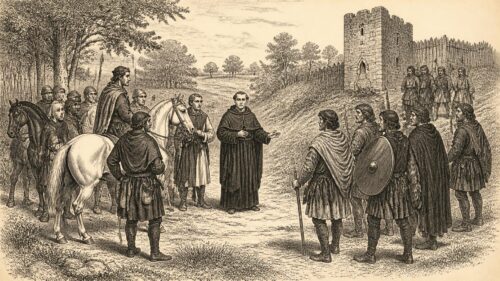
Feidlim’s Athenry Army1316 CE
In 1316, Ireland endured Scottish invasion, provincial conflict, destructive warfare and famine. Edward Bruce, supported by Ulster allies, claimed kingship but controlled chiefly the former earldom of Ulster; his Leinster raid exposed divisions among Anglo-Irish magnates without establishing rule. In Connacht, Feidlim Ó Conchobair defeated rival Ruaidrí, built a broad coalition and attacked Anglo-Irish lordships. On 10 August, William de Burgh and the Berminghams crushed Feidlim’s army outside Athenry, killing Feidlim and leaders, and destabilising Connacht anew. Meanwhile, famine compounded military devastation. Carrickfergus surrendered to Bruce in September, yet no power secured Ireland: regional rivalries, hunger and contested lordship persisted.

Dateline
In 1316 Ireland was caught in crises that reinforced one another: a Scottish intervention in the north, bitter contests for provincial lordship, destructive campaigning, and the continuing food emergency now known as the Great Famine. The year cannot responsibly be reduced to a contest between an English colony and a united Irish resistance. Alliances crossed linguistic, cultural and political boundaries. Gaelic rulers fought one another; some joined forces with Anglo-Irish magnates; and Edward Bruce’s Scottish army depended upon Irish allies while also consuming and devastating Irish lands. The most decisive battle fought in Ireland that year, at Athenry on 10 August, did not include Edward Bruce’s field army at all.
A King Whose Kingship Was Contested
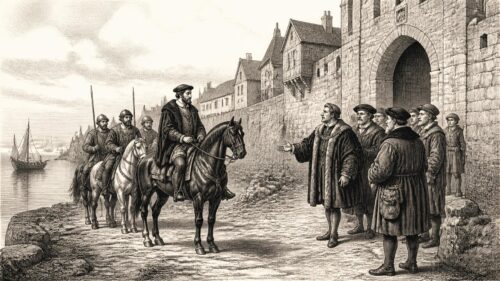
Edward Bruce, brother of Robert I of Scotland, had landed in north-east Ulster in May 1315. By 1316 he held a formidable northern base and was treated by his followers as king of Ireland. The precise moment and form of his inauguration remain uncertain. One Dublin annalistic account places his elevation soon after 1 May 1316, while the Annals of Connacht had already reported in 1315 that Ulstermen and other Gaelic supporters called him king. A surviving Scottish governmental document of September 1316 also used the royal style. These are strong grounds for saying that Bruce claimed and exercised a kingship in 1316; they are not grounds for presenting a particular coronation ceremony, location or date as securely established.
That claim was ambitious but geographically limited. Bruce’s effective control was concentrated in the former earldom of Ulster, and his army’s reach depended on rapid marches, local cooperation and seizure of provisions. It was a threat of the first order to the administration of King Edward II in Dublin, but not a settled all-Ireland monarchy. His supporters had their own aims: the Ó Néills of Ulster sought advantage against rivals and against the English lordship, while Scottish strategy also opened a western front in Robert Bruce’s war with England. The political language of a kingdom could therefore coexist with intensely local calculations of lordship, hostages, cattle, land and military protection.
Winter Fighting in Leinster
Early 1316 showed both Bruce’s mobility and the weakness of coordinated resistance. A Latin chronicle records his march through the central and southern lordship, taking in places around Kells, Granard, Kildare, Castledermot and Athy before an encounter at Skerries, near Ardscull in modern County Kildare. The engagement is traditionally dated 26 January. Edmund Butler, the justiciar, and leading Anglo-Irish lords had assembled against the Scots, yet the account says that quarrels among the magnates prevented effective action and that the royal force withdrew. The episode should not be inflated into a clear-cut Scottish conquest of Leinster: Bruce could raid deeply, but he did not take the principal walled towns or establish durable administration there.
Nevertheless, the campaign exposed a structural problem in the lordship of Ireland. Great landholders had their own affinities, rivalries and military followings; central government had limited money; and defence depended on agreement among men who did not always trust one another. For people living beside the roads and river crossings used by armies, the distinction between a raid, a royal counter-expedition and private warfare could bring little immediate comfort. Livestock, grain stores, carts, horses and labour were all vulnerable. Castles and walled towns offered points of refuge and resistance, but the countryside that supplied them was difficult to protect.
Connacht’s Brief Recovery
The most closely dated political change of the year occurred in Connacht. On 24 February, Feidlim Ó Conchobair defeated and killed his rival Ruaidrí, son of Cathal, on the moor of Tochar Mona Conneda. The Annals of Connacht portray the encounter as a clash between rival Connacht coalitions, not as a simple ethnic war. Feidlim’s force included Gaelic followers, the Mac Feorais or Berminghams, and other men described as Galls, while Ruaidrí had the support of Diarmait Gall Mac Diarmata of Moylurg and gallowglasses. The annalist’s attention to armour, household troops, foster-kin and named local rulers shows how power was assembled through personal and territorial relationships.
Feidlim followed victory with an attempt to restore an expansive Ó Conchobair authority. He took hostages from neighbouring dynasties, installed Ualgarg Ó Ruairc over Uí Briúin Bréifne, and asserted a kingship extending in the annalist’s language from Assaroe to Slieve Aughty. He then attacked the Anglo-Irish interest in western Connacht. Ballylahan was burned; prominent men including Stephen d’Exeter were killed; and the country between the castle of Corran and the River Robe was plundered. Feidlim also damaged Meelick castle. These actions were directed at strategic lordships, settlement centres and fortified sites, but their consequences extended far beyond elite politics: crops, animals, dwellings, church property and stores were all part of the usable wealth of war.
Feidlim’s achievements made him the most powerful Gaelic ruler in Connacht for a few months. Yet they also brought him into direct confrontation with the de Burgh–Bermingham interest, which was recovering from the shock of the Scottish invasion. William de Burgh had returned to Connacht from Scotland, and Feidlim summoned a notably broad coalition to expel him. The annals list Donnchad Ó Briain of Thomond, the king of Meath, Ó Ruairc of Bréifne, Ó Fergail of the Conmaicne, Tadc Ó Cellaig of Uí Maine, and many sons of kings and chiefs. The gathering demonstrates both the scale of Feidlim’s appeal and the continuing importance of regional rulers: an army could be large without becoming a permanent national force.
The Field Before Athenry
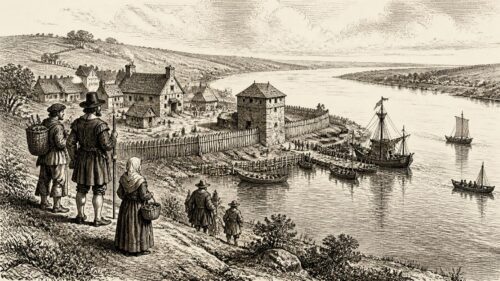
That coalition marched on Athenry, a fortified Anglo-Irish town on the frontier of east Galway. The date is firm: the Annals of Connacht place the battle on the feast of St Laurence the Martyr, 10 August. Outside the town, Feidlim’s army met William de Burgh, Mac Feorais and the other Connacht Galls. The Gaelic force was decisively defeated. Feidlim, only twenty-three according to the annalist, was killed, as was Tadc Ó Cellaig, king of Uí Maine. The roll of losses includes the Connacht tánaiste Magnus Ó Conchobair, rulers and claimants from Leyney, Moylurg, Uí Diarmata, Tethba and elsewhere, the Ó Conchobair brehon Eoin Mac Aedacain, a standard-bearer and many unnamed men from Munster and Meath.
The long casualty list is more than lament. It records the destruction of a political generation: men entitled to kingship, heirs, legal officers, military retainers and the household around a provincial king. Later accounts sometimes offer dramatic numerical totals, but the contemporary annals themselves make the safer point: losses were extensive and reached across several regions. Athenry was therefore a crushing setback to Feidlim’s coalition and a major recovery for the Anglo-Irish lordship in Connacht. It did not end disorder. Rather, it removed the one leader who had briefly united much of Connacht against de Burgh power.
Succession immediately became unstable again. Ruaidrí na Fed Ó Conchobair was made king after Athenry, but the Annals of Connacht say he was deposed by Mac Diarmata after ruling only a short time. Later in the year he was treacherously killed by Cathal, son of Áed Ó Conchobair. The sequence is an important corrective to any idea that the battle simply restored a settled political order. De Burgh military power had been vindicated, but Connacht remained a landscape of contested kingships, negotiated submission and recurrent violence.
Famine, Siege and Ordinary Survival
All this unfolded during the Great Famine of 1315–17. Modern climate research identifies exceptionally wet conditions across Ireland and north-western Europe in the years around 1314–16, conditions highly damaging to grain harvests, haymaking, transport and animal health. Irish sources record severe hardship in 1315 and explicitly describe a great famine throughout Ireland in 1317; a near-contemporary Latin chronicler calls 1316 a dreadful famine year. It is sensible to connect 1316 directly to the crisis, but not to attach a precise island-wide mortality total to it. Records are uneven, and the most harrowing retrospective annalistic statements should be read as testimony to catastrophe rather than as statistical reports.
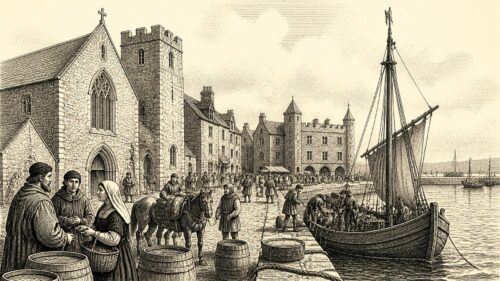
For ordinary households, bad weather and war worked together. Wet ground could compromise sowing and harvest; armies stripped districts of food and livestock; burned barns and broken local markets reduced the margin for recovery. The movement of armed men also made journeys to mills, fairs, churches and neighbouring settlements more dangerous. Religious houses and churches retained spiritual and social importance, yet they were not immune from requisition or plunder. In this environment, holding a castle, a river crossing or a walled market town mattered because it controlled access to shelter, supplies and communication.
Ulster remained the centre of Bruce power. Carrickfergus Castle, which had resisted for more than a year, finally surrendered in early September 1316. Its fall gave the Scots an important harbour fortress and marked the completion of their immediate domination of the old earldom of Ulster. Yet even this success reveals the limits of Bruce’s position. His army could compel a hard-pressed garrison, but it had not converted raiding capacity into secure authority across Ireland. The famine made provisioning his men more difficult as well as making civilian populations more vulnerable.
Thus 1316 ended without a single victor. Edward Bruce possessed a royal claim and a northern stronghold; the Dublin government still endured; and Athenry had preserved the Anglo-Irish position in Connacht at enormous human cost. The death of Feidlim Ó Conchobair had changed the balance in the west, while hunger and devastation weakened every side. Ireland’s politics remained plural, regional and armed. In the following year Robert Bruce himself would arrive to aid his brother, but the events of 1316 had already shown how difficult it was to turn invasion, alliance and battlefield success into a durable kingdom.
Primary Sources
- Annála Connacht
- The Annals of Ulster
- Annals of the Four Masters
- Part 15 of Annals of the Four Masters
- Part 83 of Annals of Inisfallen
- Annales Hiberniae
- CELT project: Annales Hiberniae
- CELT project: Annales Breves Hiberniae
- The Bruces in Ireland, 1315–18
- Bruce, Edward
- Burgh, Richard de
- Documents on the early stages of the Bruce invasion of Ireland, 1315-1316
- Bruce Invasion
- Athenry Town Walls Conservation and Management Plan
- A quantitative hydroclimatic context for the European Great Famine of 1315–1317
- From Boom to Bust: The Lordship of Ireland and the European ‘Commercial Revolution’
- Famine in Ireland: 1300-1900
- Edward Bruce
- The Coronation of Edward Bruce, 1315
- The Scots under Bruce invade Ireland, Bruce crowned King of Ireland, (1315)
- Athenry – Detailed History
- Medieval Irish chronicles reveal persistent volcanic forcing of severe winter cold events, 431–1649 CE