Faughart and Dysert1318 CE
In 1318, defeats at Dysert O’Dea and Faughart reshaped Ireland without bringing peace. Richard de Clare’s death ended his family’s attempt to dominate Thomond, enabling Gaelic rulers to regain regional control. Edward Bruce’s death near Dundalk ended the Scottish-backed invasion, though it exposed weaknesses within English lordship. Warfare intensified the Great Famine’s effects: requisitioning, ruined crops, disease, disrupted trade and severe weather produced acute hardship. Political alliances crossed Gaelic, settler and Scottish communities, reflecting local interests rather than national divisions. Connacht remained unstable amid dynastic conflict. Alexander de Bicknor arrived as Dublin’s archbishop and justiciar, inheriting a weakened, impoverished lordship.
Dateline
Two firmly dated battles made 1318 a decisive year in Irish history, though neither produced peace. On 10 May Richard de Clare, the Anglo-Norman lord attempting to establish a durable lordship in Thomond, was killed at Dysert O’Dea in what is now County Clare. On 14 October Edward Bruce, brother of Robert Bruce of Scotland and the Scottish-backed claimant styled king of Ireland by his adherents, was killed at Faughart near Dundalk. The first defeat ended the de Clares’ effective bid to dominate Thomond; the second ended the Bruce military intervention that had convulsed Ireland since 1315.
These were not simple contests between an ‘English’ and an ‘Irish’ side. Gaelic Irish rulers, settler magnates, townspeople, Scottish soldiers and the mixed-descended political communities of the lordship made alliances according to local interests. The year also unfolded amid the last acute phase of the great subsistence crisis of the later 1310s. Annalists associated Bruce’s campaigns with famine, killing and social disorder. Their language is often rhetorical and must not be read as a statistical record, but it preserves a compelling contemporary judgement: military requisitioning, destroyed crops and livestock, bad harvests, disease and disrupted trade had together made ordinary survival precarious.
Thomond’s Turning Point
Richard de Clare’s death was the first great reversal of the year. His family’s claim to Thomond rested on a royal grant made to his father, Thomas de Clare, in 1276. From Bunratty, the de Clares had tried to build a colonial lordship along the River Fergus, encouraging settlement and exploiting divisions within the Uí Bhriain, or O’Brien, ruling kindred. Yet their authority remained contested. Thomond was not an empty frontier: it was a densely peopled political landscape in which O’Brien kings depended upon subordinate lordly families, including the Mac Conmara, Ó Dea, Ó Conchobhair of Corcomroe and Ó hAichir.
The immediate background was a bitter struggle within the O’Brien dynasty, in which de Clare had successively supported and opposed rival branches. By 1318 Muircheartach Ó Briain of Clann Tadhg had gained the advantage over his rivals. Richard de Clare advanced against Conchobhar Ó Dea at Dysert O’Dea, apparently intending to break one of Muircheartach’s important local supporters and recover the initiative from Bunratty. The surviving narrative tradition offers a dramatic account of an ambush and pursuit; its detailed choreography cannot all be treated as contemporary fact. What is secure is the outcome. De Clare and several named knights were killed, while his force was routed by Muircheartach’s coalition of Thomond rulers and vassal chiefs.
The consequences were immediate and regional. De Clare’s followers abandoned Bunratty and burned what they could not remove. This was a practical military decision, denying stores and a strongpoint to enemies, but it also marked the collapse of the family’s local position. The defeat did not mean that the English crown ceased to claim authority in Thomond, nor did it expel every settler or churchman connected with the lordship. It did, however, remove the mesne lord whose armed presence had pressed most directly upon the kingdom. In the longer term, Gaelic rulers recovered control across much of the area later known as County Clare. The outcome illustrates an important feature of fourteenth-century Ireland: royal claims and grants could be formidable on parchment, while effective power still depended on food supplies, armed followings, negotiated loyalties and command of particular river crossings, churches and settlements.
Bruce’s Last March
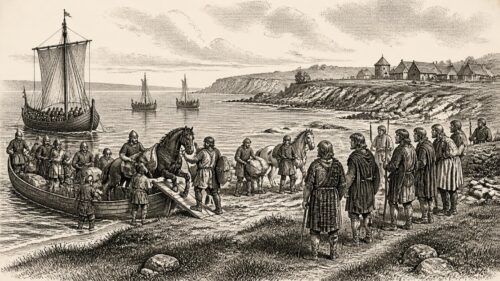
Far to the north-east, Edward Bruce remained a source of insecurity. He had landed near Larne in May 1315, supported by Scottish veterans and aided by Domhnall Ó Néill and other Irish allies. His supporters presented his cause as one of Irish liberation from English lordship, and Bruce himself used royal language. But historians caution against treating this as control of Ireland. His strongest position lay in the former earldom of Ulster, and his campaigning depended heavily on movement, raids and the extraction of supplies from territories through which his army passed.
By 1318 the political promise of the Scottish intervention had badly diminished. The Bruces had failed to take Dublin in 1317, had withdrawn from their Munster expedition, and had not secured a stable all-Ireland coalition. Gaelic lords could welcome Scottish aid against particular enemies without accepting a lasting Scottish supremacy; Anglo-Irish magnates, meanwhile, could be divided among themselves but still unite against an invading army. Hunger made every allegiance more brittle. Armies consumed grain, cattle, fodder and labour at precisely the moment when households had least to spare.
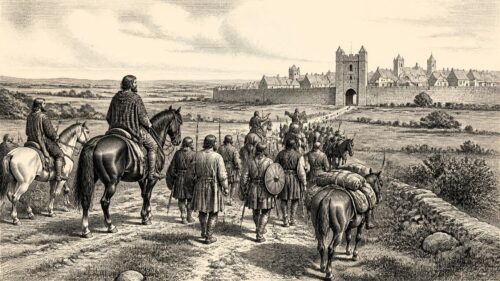
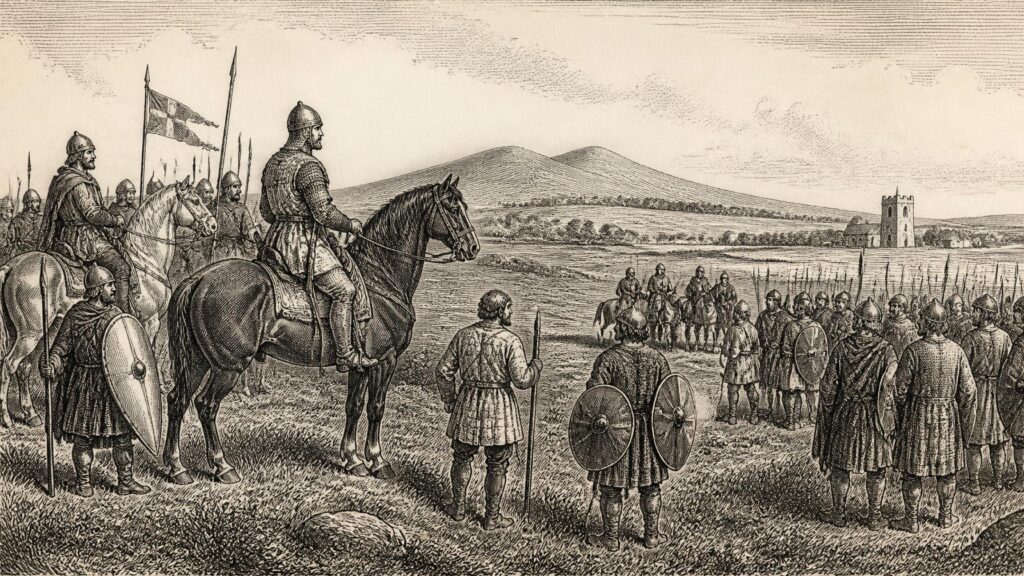
In October Edward Bruce led another force south from Ulster. On 14 October it met an Anglo-Irish army at Faughart, north of Dundalk. The date and Bruce’s death are firm. The fuller stories of the fighting, recorded later, need more caution: numbers, individual combats and tactical details vary between accounts, and cannot be reconstructed with confidence. What can be said is that forces associated with John de Bermingham and Edmund Butler defeated Bruce’s army. Bruce was killed, as were notable Scottish and Isles allies, including Ruaidhrí Mac Ruaidhrí of the Hebrides and a Mac Domhnaill leader of Argyll, according to the Annals of Connacht.
The victory was politically important beyond Louth. Bruce’s body was dismembered after the battle and his head sent to Edward II: a grim but conventional assertion that a rebel or enemy claimant had been conclusively defeated. John de Bermingham was later rewarded with the earldom of Louth. More consequentially, the Scottish-held position in Ulster was left without its commander, and Carrickfergus Castle returned to Anglo-Irish hands in December. The invasion had not erased English lordship, but it had exposed how thin its military and financial resources could be. Bruce’s death removed an external challenger; it did not repair those weaknesses.
Famine, Snow and the Cost of War
The most sobering testimony for 1318 comes from the annals. Annála Connacht describes Bruce as the ruin of both Galls and Gaels—settlers and Irish alike—and says that falsehood, famine and homicide had filled the country during his three and a half years in Ireland. It adds the notorious claim that people ate one another. This should be handled carefully. Annalistic writing used extreme language to communicate catastrophe, and the statement cannot establish how widespread such acts were. Nevertheless, it indicates that observers believed the normal moral and material safeguards of life had broken down under exceptional pressure.
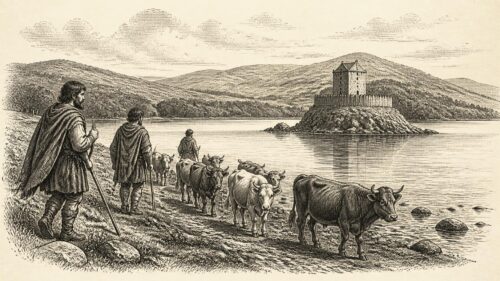
The distress cannot responsibly be assigned to one cause. The Great European Famine had begun with severe weather and harvest failures in 1315, and Ireland’s food systems were already vulnerable because transport, storage and markets were unevenly developed. The war magnified that vulnerability. Raiding armies seized or destroyed food, livestock and seed-corn; threatened communities hid stores, moved animals or fled; local trade routes became unsafe; and landlords and rulers could not easily sustain their retainers. A reported price for wheat in 1318, though not sufficient to construct a full price series, points towards exceptionally dear grain. For poorer households, whose diets depended on cereals, dairy produce and access to common resources, scarcity meant reduced meals, indebtedness, exposure to illness and, in some cases, displacement.
The Connacht annalist also recorded snow unmatched for many years. The entry supplies no exact season, locality or measurable depth, so it cannot prove an island-wide weather event. Yet it accords with the broader picture of hard conditions in northern Europe. Severe snow mattered not simply as scenery. It could limit travel, impede military movement and communications, reduce winter grazing, increase demand for fodder, and make an already lean season more dangerous for people and animals.
Connacht’s Unsettled Politics
Neither Faughart nor Dysert settled the island’s own political contests. Annála Connacht records a substantial coalition gathered by Máelruanaid Mac Diarmata of Moylurg against Cathal, son of Domnall Ó Conchobair, at Fása Choillid. The coalition included Toirrdelbach Ó Conchobair, then king of Connacht, Ualgarg Ó Ruairc of Bréifne, Conchobhar Ó Cellaig of Uí Maine and Tomaltach Mac Donnchada of Tírerrill. Cathal resisted within his stronghold. Conchobhar Ó Cellaig and other important men were killed, and Cathal subsequently raided Mac Diarmata’s lands, displaced Toirrdelbach and claimed the Connacht kingship.
This sequence is a useful corrective to any idea that Ireland’s history in 1318 was merely a struggle between two national camps. Kingship in Connacht was disputed within the Ó Conchobair dynasty and depended on alliances with neighbouring dynasties and with the Connacht settlers, or Galls. Cathal’s decision to place himself under William Burke and the Connacht Galls shows that Gaelic and settler political worlds were intertwined. Protection could be sought across cultural and linguistic boundaries when it offered an advantage in an immediate succession struggle.
Other annalistic notices convey the same fragmentation. Ó Cerbaill inflicted a defeat on the Galls in Ely; in Derry, a son of Domhnall Ó Néill was killed by Aodh Ó Domhnaill, with further deaths by drowning; and Sefraid Ó Fearghail, long-standing chief of Annaly, died after thirty-six years of rule. Such entries rarely describe the labour of rebuilding fields, restocking herds or restoring households. But they show a country in which local lordship remained intensely active even while wider war and scarcity reshaped every calculation.
A New Governor in Dublin
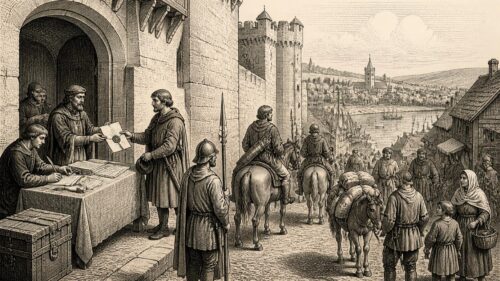
Late in the year, Alexander de Bicknor arrived in Dublin to take office as archbishop of Dublin and justiciar, having been appointed by Edward II in August. The evidence places his arrival in September or October; a precise arrival day is less secure than older chronologies sometimes imply. His dual role united ecclesiastical authority with the crown’s chief governmental office in Ireland at a moment of emergency. Dublin had escaped capture in 1317, but its administration had endured extraordinary expense and disruption during the invasion.
Bicknor’s arrival did not inaugurate a rapid recovery. His government inherited a lordship weakened by famine, ruined estates, depleted revenue and insecurity on multiple frontiers. Yet the events of 1318 changed its immediate horizon. With Bruce dead and de Clare’s Munster lordship broken, the central problem was no longer one invading claimant’s bid for an Irish kingdom. It was how competing Gaelic and Anglo-Irish powers, royal government, towns and churches would live with the durable consequences of war, hunger and regional realignment.
Primary Sources
- Annála Connacht: Annal 1318
- The Annals of Ulster
- Annals of the Four Masters
- Annalium Hiberniae Chronicon ad annum MCCCXLIX
- The Bruces in Ireland, 1315–18
- The Impact of the Bruce Invasion, 1315–27
- From Boom to Bust: The Lordship of Ireland and the European ‘Commercial Revolution’
- Famine in Ireland: 1300–1900
- Bruce Invasion
- The Battle of Dysert O’Dea and the Gaelic Resurgence in Thomond
- Clare, Richard de
- Bicknor, Alexander
- Mapping and Measuring the Impact of the Bruce Invasion
- The Bruce Invasions of Ireland
- The Remonstrance of Irish Princes, 1317
- The Battle of Dysert O'Dea, May 10, 1318
- Materials for the History of the Franciscan Province of Ireland, A.D. 1230–1450
- Burgh, Richard de
- Bermingham, William de
- Revealing the Corrupt Record in 14th-Century Ireland
- Crises and Opportunities: Irish Royal Towns During the Bruce Invasion
- The Irish Annals