Drumlane and Bannockburn1314 CE
In 1314, Ireland experienced instability across Gaelic lordships and the English administration rather than a single national turning point. Ruaidhrí Ó Conchobair defeated the O’Reillys at Drumlane, while killings within leading families, including Matha Mac Tigernáin’s murder by his foster-son, exposed contested authority. Bishop Matha Mac Duibne died, and Niall Ó Néill, heir to Cenél nÉogain, was lost. Theobald de Verdon governed the lordship as Edward II sought Irish money and soldiers for war. Robert Bruce’s victory at Bannockburn altered Irish Sea strategy, encouraging later ambitions without causing Edward Bruce’s 1315 invasion. Famine was not attested in Ireland during 1314.
Dateline
For Ireland, 1314 is best understood not as a year of one island-wide turning point but as a year in which several political worlds became visibly unstable at once. In Breifne and Connacht, dynastic rivalries produced killings, a local defeat and a bishop’s death. In the north, the loss of a prominent O’Neill heir altered the balance within Tyrone. In the administration of the English lordship, the changing justiciarship and the Crown’s continuing military demands showed the island’s connection to a wider war. Above all, the Scottish victory at Bannockburn in June transformed the strategic atmosphere across the Irish Sea. It did not bring a Bruce army to Ireland in 1314: Edward Bruce’s landing belongs firmly to May 1315. But Bannockburn made that later venture more imaginable, and made Ireland more consequential to both Scottish and English plans.
A Year with Difficult Evidence
The principal Irish annals do not offer a single, mechanically consistent chronology. Their compilers worked from differing records, and some annalistic sequences are known to be displaced by several years. That matters especially here. The Annals of Connacht, under a clearly marked 1314, record events in Connacht, Breifne, Ulster and Scotland. The Annals of the Four Masters, compiled much later but drawing on earlier material, preserve a largely corresponding group of Irish notices. By contrast, the Annals of Ulster place events now securely dated to 1317 under their entry headed 1314–17. Its notice of “great dearth” therefore cannot responsibly be treated as proof of an Irish famine in calendar year 1314.
This caution is more than technical. The famous food crisis usually called the Great Famine began in much of north-western Europe in 1315 and deepened thereafter. Palaeoclimatic research indicates unusually wet growing seasons across broad European regions in the years immediately before and during the crisis. Yet no securely dated Irish annal entry allows us to say that famine had already gripped Ireland in 1314. The year should be seen as standing immediately before that wider catastrophe, not casually folded into it.
Breifne’s Fractured Borderlands
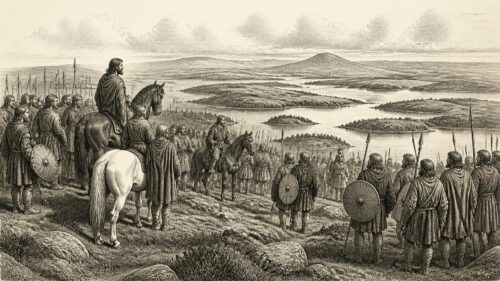
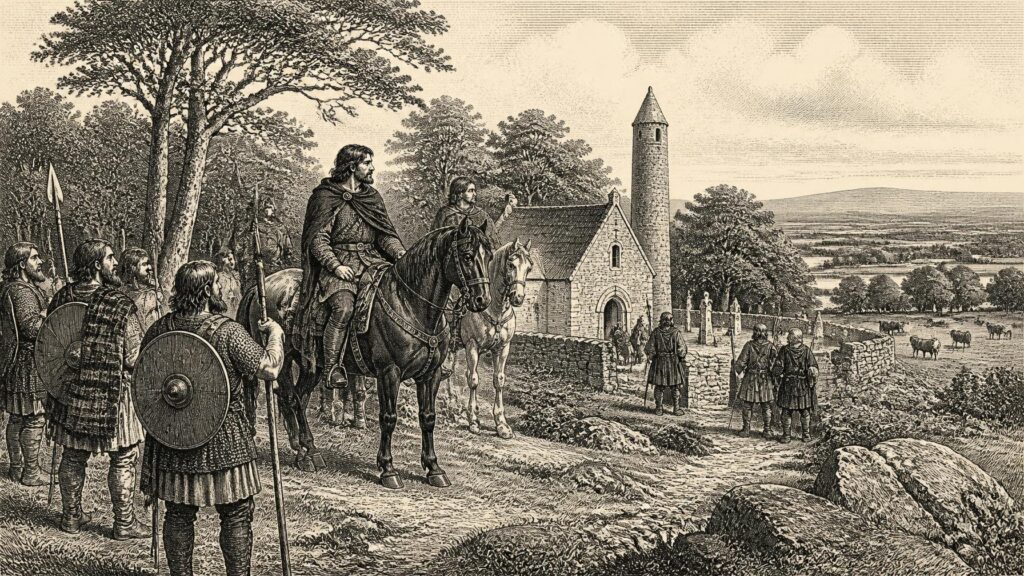
The firm Irish events of 1314 are concentrated in the politically divided regions of north Connacht and Breifne. Ruaidhrí, son of Cathal Ó Conchobair, defeated the Uí Raghallaigh, or O’Reillys, at Drumlane. Drumlane lay in east Breifne, near the boundary between rival lordships and within reach of important ecclesiastical lands. The annals do not describe a large territorial conquest, and it would be unsafe to invent one. What the notice does show is that the Ó Conchobairs of Connacht could project armed force into Breifne, while the O’Reillys remained vulnerable to pressure from neighbouring dynasties.
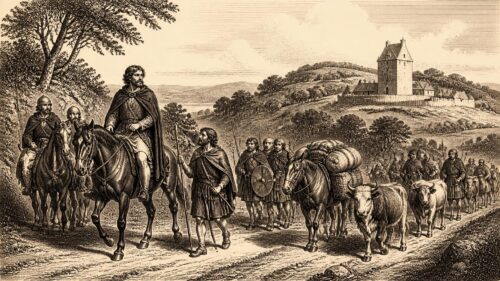
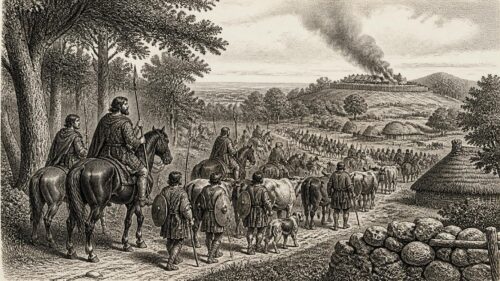
Such encounters were not marginal disturbances in an otherwise settled country. Lordship depended upon the ability to protect people, livestock and routes, to exact submissions, and to reward followers. A defeat could damage a ruler’s standing even if it did not permanently redraw a frontier. Fighting also moved through a landscape in which monasteries, churches, small settlements, pasture and cultivated ground stood close together. The political geography of Gaelic Ireland was therefore intensely local, but never isolated: a contest at Drumlane formed part of the wider competition between the kindreds of Connacht, Breifne, Ulster and the English lordship.
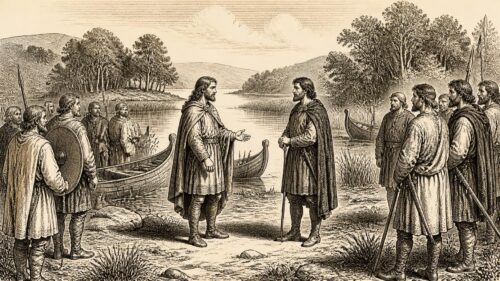
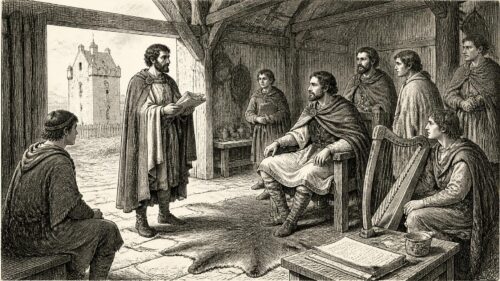
Violence within ruling families was equally important. Magnus, son of Domhnall Ó hEaghra, was killed treacherously by Magnus, son of Uilliam Ó hEaghra. Roalb Mac Mathghamhna was killed by his own kinsmen. Matha Mac Tigernáin, chief of Tullyhunco in east Breifne, was killed by Cathal Ó Ruairc, described in the Annals of Connacht as his foster-son, on the floor of his own house. The language is strikingly precise: the killing was both an act of treachery and a breach of a relationship created by fosterage. Fosterage linked elite families through upbringing and obligation; it was a political as well as a domestic institution. Its violation reveals how succession struggles could override bonds that contemporaries considered exceptionally weighty.
Deaths, Church and Local Authority
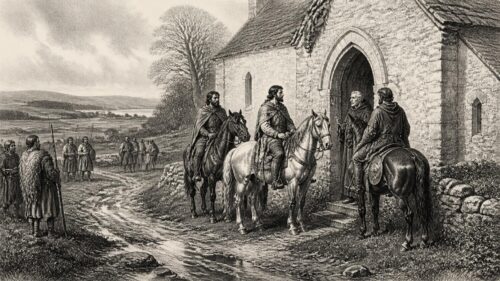
Deaths recorded in 1314 illuminate the institutions that gave this fractured society continuity. Matha Mac Duibne, bishop of Breifne, died. His diocese, centred on Kilmore, extended through a region where the O’Reilly and O’Rourke dynasties competed and where secular violence was frequent. A bishop’s death was therefore not merely an ecclesiastical matter. The succession could affect local alliances, access to church revenues and the standing of influential clerical families. The annals also note the deaths of Gilla an Choimded Ó Gormghaille, erenagh of Elphin, and his wife Gormlaith Mac Branáin. An erenagh was the hereditary lay or clerical custodian of church lands and temporal interests. Their inclusion reminds us that diocesan and monastic life rested upon households embedded in local society, not upon bishops alone.
The death of Niall, son of Brian Ó Néill, had wider political implications. The Annals of Connacht call him the king’s son and praise him as exceptionally generous and wealthy, adding that his governance, law and rule were the best in Ireland. The Four Masters similarly style him heir presumptive of Cenél nÉogain. Such praise is conventional and should not be read as a statistical measure of wealth or an objective survey of government. Still, it indicates that Niall was regarded as a major prospective ruler in Tyrone. His death removed a figure associated with orderly lordship at a moment when northern politics were becoming increasingly consequential.
Other notices are brief but meaningful. Niall Ó Domhnaill was killed by Aodh Ó Domhnaill, an indication of conflict among the leading dynasty of Tír Chonaill. Mathghamhain Mac in Chaich, chief of Fid na Saitne, died. Across the island, authority was dispersed among many such lordships, ecclesiastical offices and kin-groups. The annals’ attention to named individuals can obscure ordinary people, whose labour sustained cattle-herding, tillage, fishing, transport and hospitality. Yet the kinds of events recorded—raids, feuds, elite deaths and church succession—directly shaped the security of those communities.
The English Lordship and Scottish War
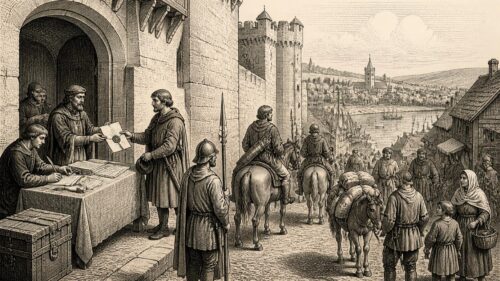
The English Crown’s authority in Ireland remained substantial in the towns, castles, ports and lordships of the east and south, but it was neither uniform nor self-financing. Theobald de Verdon was acting as justiciar during 1314, the Crown’s chief governor in Ireland. Royal business continued through Dublin’s courts, exchequer and chancery, as surviving inquisitions and administrative records show. Land transfers, inheritance and the management of estates did not stop because Gaelic lordships were fighting nearby. Ireland was a patchwork of jurisdictions rather than a country divided into two neat blocs.
Its relationship with England also brought obligations. Edward II’s government sought military assistance and revenue for the continuing war against Robert Bruce. Evidence associated with the 1314 Scottish campaign shows Irish magnates and their retainers being drawn into the king’s wider military effort, while the Irish revenue was already being used for royal purposes beyond the island. This did not mean that the English lordship could simply command all Ireland’s resources. Gaelic rulers retained their own priorities, and even Anglo-Irish magnates had local interests that could conflict with those of Westminster. Nevertheless, the Irish Sea was a military corridor, not a defensive moat.
Bannockburn’s Irish Meaning
The battle called Srub Liath in the Annals of Connacht is the Battle of Bannockburn, fought on 23 and 24 June 1314. Robert Bruce’s Scots defeated the larger army led by Edward II. The Connacht annalist described it as a battle for possession of Scotland and stressed the death of many English earls, knights and other men, particularly Gilbert de Clare, earl of Gloucester. That an Irish chronicle recorded the battle in these terms shows that it was recognised immediately as a major event in the politics surrounding Ireland.
Bannockburn did not automatically create a united Gaelic response in Ireland, nor did it destroy the English lordship. Irish rulers remained divided by local rivalries, while Anglo-Irish families retained formidable lands and military resources. But the victory weakened Edward II’s prestige, reduced his freedom to project force, and demonstrated that a determined opponent could defeat an English royal army. Robert Bruce’s family had connections across the Gaelic world of western Scotland, the Isles and Ulster; those connections became more strategically valuable after the battle.
It is tempting to treat Bannockburn as the opening scene of the Bruce invasion, but chronology must be respected. Edward Bruce did not land in Ulster until 26 May 1315. The subsequent campaign was not the inevitable outcome of the Scottish victory, and its support within Ireland was neither universal nor permanent. What 1314 supplied was a changed horizon of possibility. The defeat of Edward II encouraged calculations among Scottish leaders and Irish dynasts alike, while the English government had fresh reason to worry about the security and usefulness of its Irish lordship.
On the Edge of Crisis
By the end of 1314, Ireland had not yet experienced the devastating Scottish campaign, the island-wide destruction associated with it, or the worst years of the Great Famine. Those belong to the years ahead. Yet the year already contained the elements that would make the coming crisis so destructive: contested successions, regional warfare, vulnerable borderlands, obligations to distant royal wars, and a politically connected Irish Sea. Drumlane’s local defeat, the killing of a foster-father by his foster-son, the death of an O’Neill heir, and the news from Bannockburn belong together not because they formed a single coordinated event, but because each exposed a world in which authority was personal, competitive and precarious.
For contemporaries, 1314 was not a quiet prelude. It was a year of bereavement, treachery, military defeat and administrative business, lived village by village and lordship by lordship. In retrospect, its greatest significance lies in the fact that the political landscape was already unsettled when the shock from Scotland arrived. Ireland entered 1315 divided, connected to its neighbours, and ill placed to escape the conflicts and shortages that soon followed.
Primary Sources
- The Annals of Connacht
- Annála Connacht
- Annals of the Four Masters, Part 15
- The Annals of Ulster, Part 117
- Annales Hiberniae
- Butler (le Botiller), Edmund
- Bruce, Edward
- O'Neill (Ó Néill), Domhnall
- O'Neill, (Ó Néill), Aed Buide
- O'Rourke (Ó Ruairc), Ualgharg
- Battle of Bannockburn (BTL4)
- The Bruces in Ireland, 1315–18
- Bruce invasion of Ireland (1315–1318)
- Edward II and the revenues of Ireland in 1311-12
- Irish Parliaments in the Reign of Edward II
- Inquisitions and Extents of Medieval Ireland
- English Rule in Ireland, c.1272-c.1315
- A Quantitative Hydroclimatic Context for the European Great Famine of 1315–1317
- Famine in Ireland: 1300-1900
- Bruce Invasion: 1315/2015, A Scottish King of Ireland?
- The Bruces and Ireland
- The Bruce Invasions of Ireland