Dublin’s Scorched Suburbs1317 CE
In 1317, at the height of the Bruce invasion, Robert Bruce joined his brother Edward in Ireland and marched through Meath towards Dublin. Fearing siege, Dublin’s citizens burnt western suburbs, demolished the Liffey bridge and religious buildings for defensive stone, and detained the earl of Ulster. The Bruces bypassed the fortified city, campaigned unsuccessfully in Munster, and retreated north; Robert departed in May. Famine, worsened by military requisitioning, afflicted Ireland amid warfare, dynastic struggles and castle destruction. Connacht changed kings, while learned legal culture suffered a loss. Irish leaders’ Remonstrance to Pope John XXII sought support, but Edward’s kingship endured.

Dateline
In 1317 Ireland stood at the most dangerous point of the Bruce invasion. Edward Bruce, brother of Robert I of Scotland, had landed in Ulster in 1315 and was accepted by important Gaelic allies as king of Ireland; yet his authority was never secure beyond a shifting military zone. The invasion had already exposed the weakness of the English lordship and intensified rivalries among Irish and Anglo-Irish lords. In 1317, Robert Bruce himself crossed from Scotland with reinforcements. The brothers’ advance towards Dublin, their march into Munster, the crisis of food supply and a remarkable appeal to the papacy made this a year in which military action, urban self-defence and political argument were inseparable.
Robert Bruce Comes to Ireland
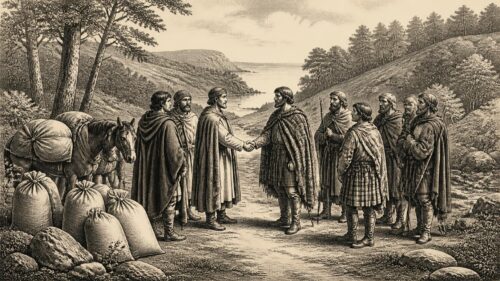
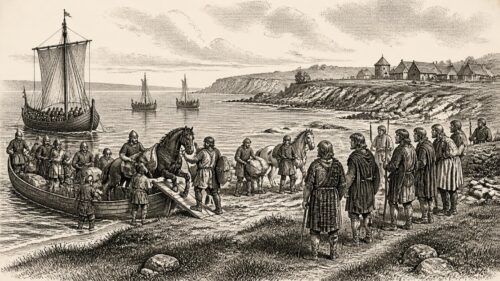
The annals place Robert Bruce’s arrival in Ireland in 1317, saying that he came with a large force to aid Edward and to drive the Galls—the foreign or English settlers—from the island. The exact date and the size of his force remain uncertain, and medieval narratives differ in their emphasis. What is clear is that Robert’s personal intervention gave the Scottish enterprise fresh weight. Edward Bruce commanded the continuing occupation in Ulster; Robert brought the prestige of the Scottish king whose victory over Edward II at Bannockburn had transformed the wider war of the British Isles.
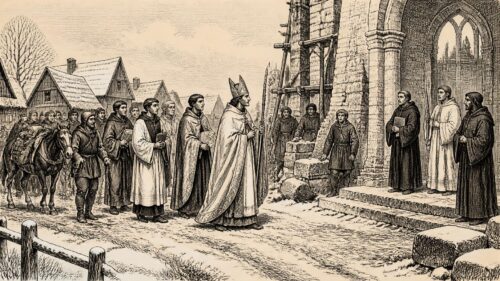
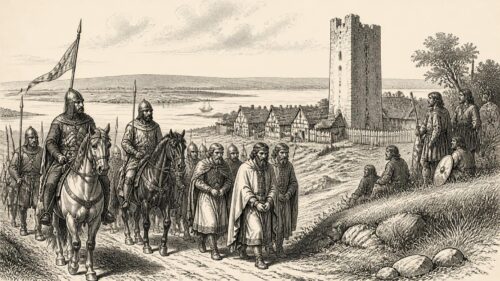
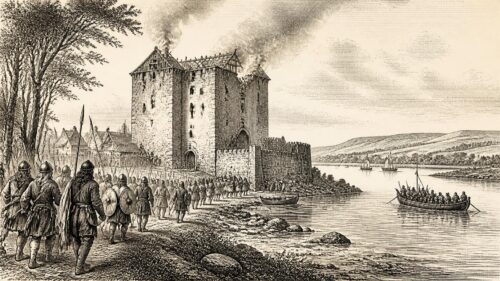
In February the Bruce brothers moved south through Meath towards Dublin. Their army reached Castleknock, within sight of the city’s defences. Dublin was not merely a large town: it was the seat of royal administration, the chief port of the English lordship and the point from which revenue, orders and communications radiated. Its loss would have been an immense political and practical blow. Fear of that possibility produced drastic measures within the walls. The citizens burned the western suburbs so that an attacker could not use them for cover or supplies. They broke the bridge over the Liffey and pulled down parts of religious buildings, notably the Dominican priory of St Saviour north of the river, to obtain stone for strengthening vulnerable defences.
These actions show how war entered urban daily life. Suburbs contained homes, workshops, inns, gardens and storehouses as well as churches and religious houses; their deliberate destruction was a sacrifice made in expectation of a siege. The city authorities also imprisoned Richard de Burgh, earl of Ulster, suspecting him of sympathy with the Scots. That suspicion reflected the tangled kinship of the conflict: Robert Bruce was married to the earl’s daughter Elizabeth de Burgh. Political loyalty in Ireland was not neatly divided between people described as “English”, “Irish” or “Scottish”; family connections, local interests and old disputes could pull in different directions.
The City Survives, Munster Suffers
The Bruces did not attack Dublin. Their reasons cannot be reduced to a single explanation: a well-defended walled city was a formidable target, supplies were scarce, and the royal government’s forces under Edmund Butler followed and shadowed their movement. Rather than attempt a prolonged siege, the brothers turned south. Their purpose appears to have been to join or encourage allies among the O’Briens of Thomond and to widen the war in Munster. They passed through a countryside already strained by poor harvests and by the requirements of armies, which consumed food and fodder, seized transport animals, and made normal cultivation and marketing perilous.
The hoped-for southern combination did not materialise. The Scottish army moved through Munster, reaching the Limerick region, but could not establish a lasting position. By the spring’s end it was retreating north. Robert Bruce returned to Scotland in May, leaving Edward to maintain the struggle in Ireland. This was a decisive limitation on the project. Robert had demonstrated that the Scots could penetrate deep into the lordship, and Dublin’s response revealed how grave the threat had been; but the expedition had not taken the administrative centre, secured Munster, or gained a reliable supply base. Edward Bruce remained a king in the claims of his supporters, but his capacity to turn that title into island-wide government had diminished.
Munster’s own politics remained violent after the Scots had gone. Donnchad Ó Briain, called king of Munster in the annals, was killed in August near Corcomroe Abbey during the bitter contest for Thomond. His death must not be treated simply as an episode in the Bruce war. It arose from an Ó Briain dynastic struggle in which rival claimants and their allies pursued their own advantage. Yet the Scottish incursion had disturbed the balance of power and sharpened the consequences of every local decision. In 1317, an external invasion and internal Irish rivalries fed one another without becoming the same conflict.
Famine and the Burden of War
Annála Connacht records bluntly: “Great famine this year throughout Ireland.” The entry belongs to the wider Great Famine of 1315–17, a crisis felt across north-western Europe after repeated harvest failures. The annals do not provide a national harvest account for 1317, nor do they allow a precise calculation of mortality. They do, however, establish that contemporaries understood hunger to be widespread. In Ireland the scarcity was made more destructive by campaigning. The Bruces’ men needed provisions; the forces pursuing them needed provisions too; livestock, seed grain and stored food could be taken or destroyed. People who might normally have relied on a local market, a landlord’s stores, a monastery’s hospitality or a neighbour’s help faced war-driven disruption on top of an already failing food economy.
The impact cannot be measured only in battle casualties. Famine weakened travellers and labourers, reduced the capacity of households to pay rents or dues, and made military service, raiding and forced hospitality heavier impositions. It also narrowed political choices. A lord who could feed followers could retain them; one who could not was vulnerable to desertion or displacement. This helps explain why the apparently grand contest between the Bruces and the English lordship repeatedly resolved itself into movement, foraging, burnt settlements and the search for secure provisions rather than into a single conclusive campaign.
Connacht’s Fractured Kingship
While the Bruces campaigned in the east and south, Connacht remained a theatre of its own conflicts. Early in the year Toirrdelbach Ó Conchobair was made king by the men of Connacht, replacing the insecure Ruaidrí Ó Conchobair. The change followed the disastrous defeat of Connacht forces at Athenry in 1316 and the pressure exerted by the de Burgh interest. It illustrates a central reality of medieval Irish politics: kingship was not an automatic hereditary succession but depended on support from leading kin-groups, military capacity and the ability to command recognition.
The annals also record the killing of Meyler de Exeter, lord of Ballylahan, at Drumcliff, and the destruction of the castle of Ballymote. In Bréifne, a defeat at Kilmore cost the followers of Mac Ruaidrí heavily, including many gallowglasses. These notices are brief, but their accumulation is revealing. Violence in 1317 was not confined to the road taken by Robert and Edward Bruce. It involved castles, lordship, captives and professional soldiers across the western and northern midlands. The destruction of a castle mattered because such places were bases for local control, storage, refuge and the assertion of seigneurial authority.
Law, Learning and an Appeal Beyond Ireland
Amid the notices of killing and capture, the annalists marked the death of Mael Ísa Ruad Mac Aodhagáin, described as a master Brehon in the ancient law. The Mac Aodhagáins belonged to hereditary learned families who maintained legal expertise in Gaelic Ireland. His commemoration is a reminder that political society rested on more than armed followings. Judgements, compensation, inheritance, agreements and status all required skilled interpreters of law. Even in a famine year, the loss of a renowned jurist was considered an event worth preserving in the historical record.
Later in 1317 Domhnall Ó Néill of Tír Eógain and associated Irish leaders addressed their Remonstrance to Pope John XXII. The document was a carefully constructed petition, not a neutral report. It set out a long historical case against English rule, alleged grave injustices against Irish people and churchmen, challenged the way English authority had been exercised, and asked the pope to recognise the justice of resistance. It also presented Edward Bruce as the ruler whom the petitioners had called to their aid. Its rhetoric drew on genealogy, Christian kingship, legal grievance and the papacy’s claimed responsibility for Ireland.
The Remonstrance did not bring the military victory its authors sought, and papal support was not forthcoming. Its importance in 1317 lies instead in its ambition. At the moment when the Scottish campaign was faltering, Irish leaders sought to make their cause intelligible in Avignon, the centre of Latin Christendom. The appeal shows that diplomacy, literacy and legal argument operated alongside warfare. By the close of the year, Dublin had survived, Robert Bruce had departed, famine still afflicted the country, and Edward Bruce’s kingdom depended on a narrower and more precarious coalition. Ireland’s crisis was far from over, but 1317 had demonstrated both the reach and the limits of the Bruce challenge.
Primary Sources
- Annála Connacht: Annal 1317
- Annals of the Four Masters: Annal M1317
- The Annals of Ulster: Year U1317
- Remonstrance of the Irish Chiefs to Pope John XXII
- Remonstrance of the Irish Chiefs to Pope John XXII: Section 13
- The Bruces in Ireland, 1315–18
- The Irish remonstrance of 1317: an international perspective
- The Impact of the Bruce Invasion, 1315–27
- Bruce, Edward
- O'Neill (Ó Néill), Domhnall
- Mortimer, Roger (1287–1330)
- O'Connor (Ó Conchobair), Toirrdelbach
- O'Brien (Ó Briain), Brian Bán
- Bruce Invasion, 1315/2015
- Documents on the Early Stages of the Bruce Invasion of Ireland, 1315–1316
- The Bruce Invasions of Ireland
- Bruce Invasion of Ireland (1315–1318)
- Annála Connacht: Annal 1315
- An Irish Account of Bruce's Invasion, Entitled 'The Battle of Fochart of St. Bridget'
- The Bruce Intervention in Ireland, 1315–1322