Glenmalure and Gaveston1308 CE
In 1308, John Wogan’s defeat at Glenmalure exposed the vulnerability of royal power near Dublin, although administration continued. Piers Gaveston, Edward II’s controversial favourite, arrived as king’s lieutenant, combining political exile with military responsibility. Later campaigns against Wicklow opponents, including the Ó Byrnes, sought to restore authority through coercion and infrastructure. In Connacht, raids, broken peace agreements and failed hostages involved Ó Conchobair branches, Mac Diarmata, Ó Dubda and Anglo-Irish forces, demonstrating unstable alliances and dynastic violence. Stormy weather damaged people and cattle, while lightning struck Roscommon’s Dominican friary. The year revealed an uneven landscape where powers constrained royal government.
Dateline
The Irish year 1308 was marked by a sharp demonstration of the limits of royal authority near Dublin, the arrival of one of Edward II’s most controversial servants, and a sequence of conflicts in Connacht which reveal how quickly agreements, hostages and kinship could fail. It was not a year in which one power controlled the island. The English lordship had its governmental centre at Dublin and substantial influence in towns, shires and lordships, while Gaelic rulers, mixed lordships and regional dynasties retained decisive local power. The surviving records are especially rich for Connacht and the eastern lordship, but they must be read with care: annals use the political language and prejudices of their compilers, and some later chronicles compress events that unfolded over more than one year.
A Reverse in Glenmalure
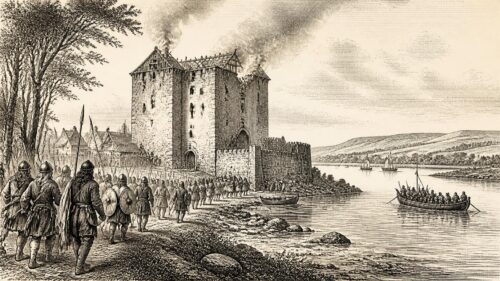
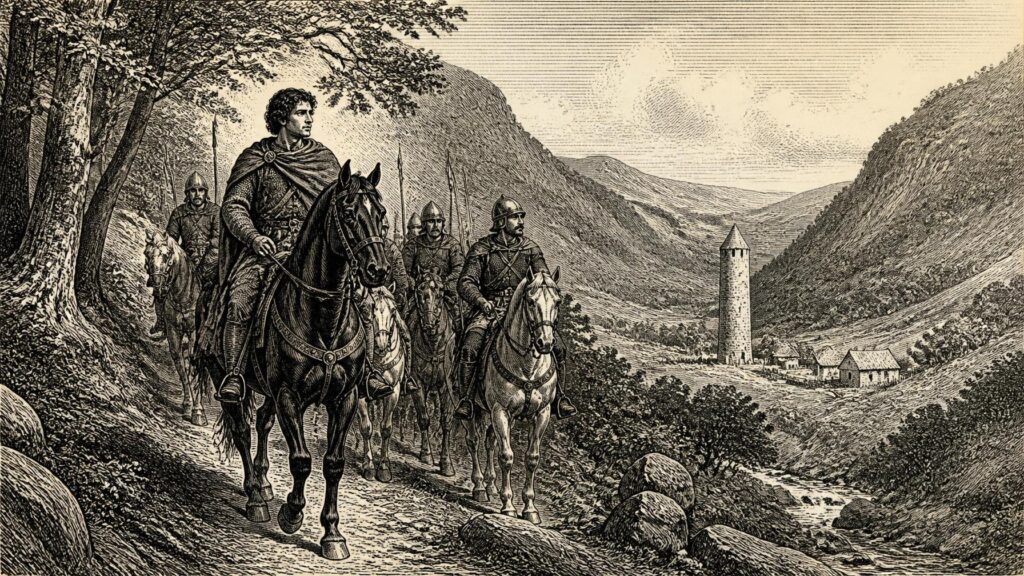
The most immediately alarming event for the Dublin administration occurred in the Wicklow mountains. A Latin annal places the defeat of John Wogan, justiciar of Ireland, at Glenmalure in June 1308. Wogan and his force were driven into flight by Irish opponents; John de St Howgelyn, John Northon, John Brereton and many others were said to have been killed. The same tradition records the subsequent burning of Donloughan, Tipper and other neighbouring settlements in July. The named places cannot all be identified beyond doubt today, but the broad setting is clear: the fighting lay in or near the difficult uplands south of Dublin.
The word “rebels” used by the Latin chronicle is the language of the lordship, not a neutral description. For the royal government, armed Irish communities resisting its officers were rebels; for those communities, the expedition was an intrusion into country in which the reach of Dublin was neither automatic nor secure. Glenmalure was an important warning because control of routes through Wicklow mattered to the security of the capital, its surrounding settlements and communications towards Wexford. Wogan had been justiciar since 1295 and was an experienced royal administrator, but his long service had not removed the military problem presented by the Wicklow lordships.
The defeat should not be inflated into the collapse of the lordship. Dublin’s courts, exchequer and officials continued to operate. Yet it exposed a practical truth of early fourteenth-century Ireland: government depended on armed escorts, local allies, supplies and the willingness of magnates to cooperate. A defeat in mountain country could endanger farms and villages nearby, impose losses on settlers and landholders, and make the claims of royal justice look decidedly fragile beyond defended centres.
The King’s Lieutenant Arrives
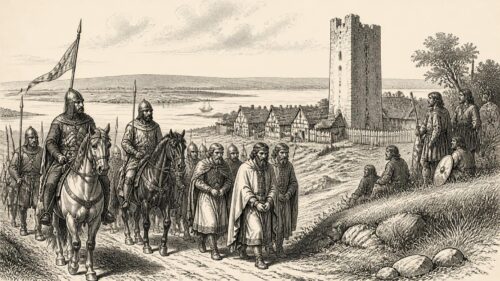
Later that month the balance at the top of the administration changed. Piers de Gaveston, earl of Cornwall and favourite of Edward II, was appointed the king’s lieutenant in Ireland on 16 June and arrived in the lordship on 25 June. His appointment was inseparable from politics across the Irish Sea. English magnates had demanded his removal from the king’s company; sending him to Ireland allowed Edward to retain Gaveston’s service, status and income while presenting the move as an exile. Irish annalists noticed the political dimension, describing Gaveston’s coming as that of the king’s deputy against the wishes of the English barons.
Gaveston did not replace Wogan in every respect. Wogan remained justiciar and continued to carry much of the judicial and administrative burden. Gaveston’s position, however, ranked above his, and his principal role was military. This division was revealing. The crown did not send a blank slate to Ireland: it inserted a politically valuable courtier into an existing governmental system, at precisely the point where that system had recently suffered a conspicuous reverse in Wicklow.
The arrival also connected Ireland directly to the crisis of Edward II’s new reign. Gaveston’s presence was not merely a matter of Dublin Castle ceremonial or personal refuge. He came with royal authority, while English observers followed his Irish tenure as part of the larger struggle between king and baronage. For people living in the lordship, however, the immediate test was less the controversy surrounding his friendship with Edward than whether the new lieutenant could protect settlements, punish raiding and restore confidence in royal arms.
War, Roads and Authority
Evidence for Gaveston’s first months is concise but significant. Biographical reconstruction from administrative and chronicle material places successes against Wicklow opponents between September 1308 and the New Year. A notorious outlaw was hanged; an Ó Dímmusaig was killed at Tully; and the Ó Byrnes were defeated in Wicklow. A Latin Irish chronicle also credits Gaveston with killing Ó Dímmusaig and, more broadly, with building castles, bridges and paved works before his recall to England in the following year. That last statement should not be treated as proof that every work was begun or completed during 1308: the annalist telescopes achievements of his whole lieutenancy. It does, nonetheless, show what contemporaries considered the proper visible work of royal government—fortification, passable routes and coercive action.
These operations were limited victories, not a permanent conquest of Wicklow. They nevertheless offer a useful corrective to the old image of Gaveston as simply an unwanted court favourite sent away from England. In Ireland he held a serious military commission, and he responded to a dangerous situation close to the lordship’s centre. The sequence from Wogan’s June defeat to campaigning later in the year suggests a determined attempt to reassert royal authority. It also demonstrates that castles and roads were not merely architectural improvements: they were instruments through which a government sought to move troops, levy resources and connect defended places.
Connacht’s Broken Understandings
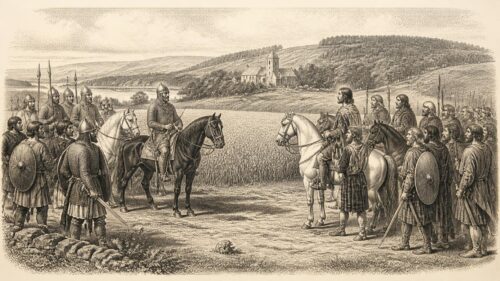
While the Dublin government confronted Wicklow, the annals of Connacht record a dense series of raids and reversals. Máelruanaid Mac Diarmata made a major raid on the sons of Domnall Ó Conchobair in Carbury. Brian Ó Dubda and the Galls—foreign or Anglo-Irish forces—of Leyney and Tireragh also raided them. Then Clann Muircheartaigh, despite having made peace and delivered hostages, attacked them in turn. The giving of hostages was a recognised means of binding an agreement, but the entry’s force lies in its insistence that it offered no guarantee when political advantage changed.
The sons of Domnall withdrew to Slieve Dáen with horses, armour and stud-horses, according to the annalist. Their sparse baggage is striking, though it should not be romanticised: the wording may describe a rapid, mobile force rather than refugees. When the Galls of Leyney and Tireragh pursued them to the mountain, Domnall’s sons and Mac Donnchada turned on their pursuers. They routed them and chased them as far as Lecc Esa Dara. Tomag Mac Walter, constable of Bunfinne, his brother and many others died. This was not a simple Gaelic-versus-English encounter. It brought together branches of the Ó Conchobair kindred, Mac Diarmata, Ó Dubda, Clann Muircheartaigh and locally based Galls in a shifting contest for security, livestock, influence and territory.
Another entry records Áed son of Cathal Ó Conchobair raiding his own brother Ruaidri in retaliation, and the killing of Magnus son of Magnus Ó Conchobair. Such notices convey the human cost of dynastic politics without giving enough evidence to reconstruct every motive. They do establish that violence within a ruling family was a central fact of Connacht’s politics in 1308. The death of Domnall Ó Conchobair, archdeacon of Elphin, in the same annal also reminds us that ecclesiastical office, learned families and ruling dynasties were closely interwoven in regional society.
Storms and a Friary Struck
The annals also preserve a rarer view of conditions beyond warfare. Easter fell in March that year, and the Connacht annalist noted “destruction of men and cattle” alongside very stormy weather. The phrase is too brief to identify a particular disease, famine or storm episode, so it would be unsafe to assign a precise cause. It does show that weather and losses of livestock were serious enough to be recorded beside political events. In an economy in which cattle were stores of wealth, sources of food and objects of tribute, their destruction could deepen the effects of raiding and insecurity.
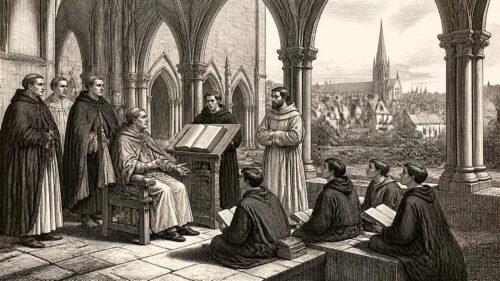
On the night of St Stephen’s Day, after Christmas, a fiery thunderbolt was said to have fallen on the friars’ convent at Roscommon and damaged it. The incident was memorable precisely because the house mattered. Roscommon’s Dominican priory had been founded in 1253 by Felim Ó Conchobair, king of Connacht, and stood within a religious landscape supported by Gaelic patrons as well as serving a developing town. The annal does not describe the scale of the damage, reconstruction or casualties; it records the shock of the strike. Its inclusion beside raids, deaths and weather gives a glimpse of a society in which a friary was both a spiritual institution and a prominent physical landmark.
An Uneven Island
By the end of 1308, no single development had resolved Ireland’s competing political pressures. Glenmalure had shown the vulnerability of royal expeditions near Dublin; Gaveston’s arrival brought new authority and renewed military activity; Connacht’s raids showed the volatility of alliances and hostages; and the Roscommon lightning strike entered the record as an unexpected disaster in a major Dominican house. The year is therefore best understood not as a neat national turning point but as a sequence of local crises connected by mobility, violence, institutional resilience and weather. Ireland’s political map remained uneven, and 1308 made that unevenness unmistakable.
Primary Sources
- Annála Connacht
- Annals of the Four Masters, Part 14
- Annals of Inisfallen, Part 82
- Annales Breves Hiberniae
- Annales Hibernie ab anno Christi 1162 usque ad annum 1370
- Dominican Annals of Roscommon
- Gaveston, Piers de | Dictionary of Irish Biography
- Wogan, John | Dictionary of Irish Biography
- Burgh, Richard de | Dictionary of Irish Biography
- Jorz (Jorse), Walter | Dictionary of Irish Biography
- Patentee Officers and High Sheriffs
- Calendar of the Justiciary Rolls: I to VII Years of Edward II, 1308–1314
- The Medieval Irish Plea Rolls – An Introduction
- Parchment Conquest, 1171–1307
- Translated Texts | CELT, University College Cork
- Exploring the Irish Annals
- Roscommon Dominican Friary
- Dominican Priory of St Mary, Roscommon: County Roscommon Urban Archaeological Survey
- Roscommon Abbey
- ‘With My Life, His Joyes Began and Ended’: Piers Gaveston and King Edward II of England Revisited
- Edward II and Ireland, in Fact and in Fiction
- Annales Dominicani de Roscoman: Introduction and Bibliography