Lathach Caich’s Hostage Peace1227 CE
In 1227, Connacht faced intensified pressure from the English lordship, dynastic rivals and regional raiders. Summoned to Dublin, King Áed mac Cathail Chrobdeirg Ó Conchobair escaped an alleged plot through William Marshal’s intervention. He subsequently captured William de Marisco and companions at Lathach Caich, attacked Athlone, and exchanged prisoners for his children, Connacht hostages and a peace. Meanwhile Geoffrey de Marisco and Áed’s rivals took hostages, raided Connacht and constructed castles at Rindoon and Athleague, strengthening Shannon frontier control. Warfare brought cattle theft, captivity and local killings. Famine, cold and sickness compounded insecurity, while crusading observances linked Ireland to Christendom.
Dateline
In 1227, Connacht stood at the sharpest edge of the English lordship’s westward advance. The year’s annals do not offer a single, simple war between two peoples. Instead, they reveal a shifting and dangerous contest involving Áed mac Cathail Chrobdeirg Ó Conchobair, king of Connacht; rival branches of his own dynasty; the justiciar Geoffrey de Marisco; magnates and settlers of the lordship; and regional rulers whose allegiance was sought through force, hostages and cattle-raiding. The best-attested episode began in Dublin, continued at a meeting place called Lathach Caich Tuaithbil, and ended with prisoners exchanged for Connacht hostages and a reported peace. Yet that settlement was only one strand in a year marked also by castle-building, raids, famine and sickness.
A King Summoned to Dublin
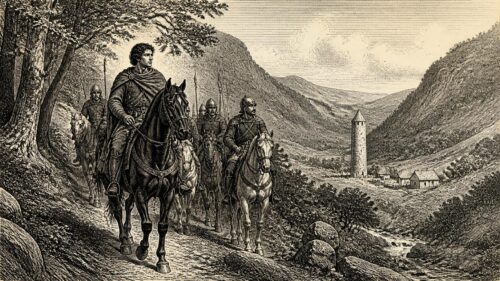
The central narrative is preserved independently, with close agreement, in Annála Connacht, the Annals of Loch Cé and the Annals of the Four Masters. Each says that a great court was held at Dublin by the Galls or ‘Foreigners’ of Ireland, a contemporary Irish term generally used in this setting for the Anglo-Norman and Anglo-Irish political community. Áed Ó Conchobair was summoned to attend. The annals say that deceit or treachery was practised against him there, but that William Marshal, described as Áed’s personal friend, arrived with followers and forcibly removed the Connacht king from the court, escorting him safely home.
The sources do not specify what charge, demand or plot lay behind the confrontation, so it would be unsafe to supply one. What can be said is that the incident belonged to a wider struggle over Connacht after the death in 1224 of Áed’s father, Cathal Crobderg, whose long reign had combined warfare, negotiation and accommodation with the lordship. Áed’s kingship was contested by the sons of Ruaidrí Ó Conchobair, while Geoffrey de Marisco had returned as justiciar in 1226. Dublin was therefore not merely a distant administrative centre: it was a place where the royal government and its Irish allies attempted to shape power in the west.
Marshal’s intervention is particularly revealing. It shows that political relationships crossed the usual modern divide between ‘Gaelic’ and ‘English’. A Connacht king could have a powerful magnate as a friend, while other men of the lordship were aligned with his domestic rivals. Such personal alliances could be decisive, but they were also fragile. Áed had escaped the Dublin court; he had not escaped the political pressure behind it.
The Meeting at Lathach Caich
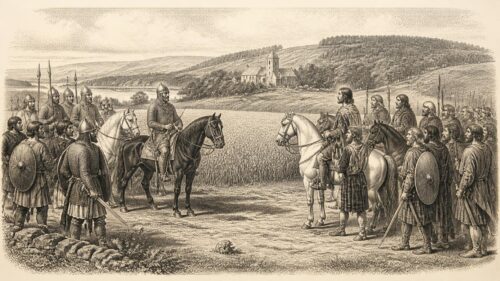
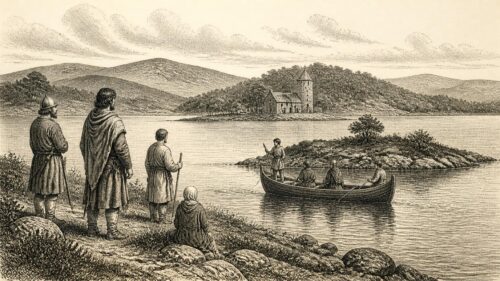
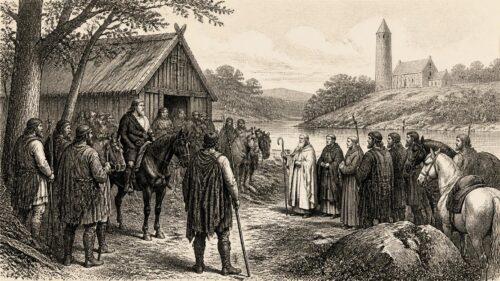
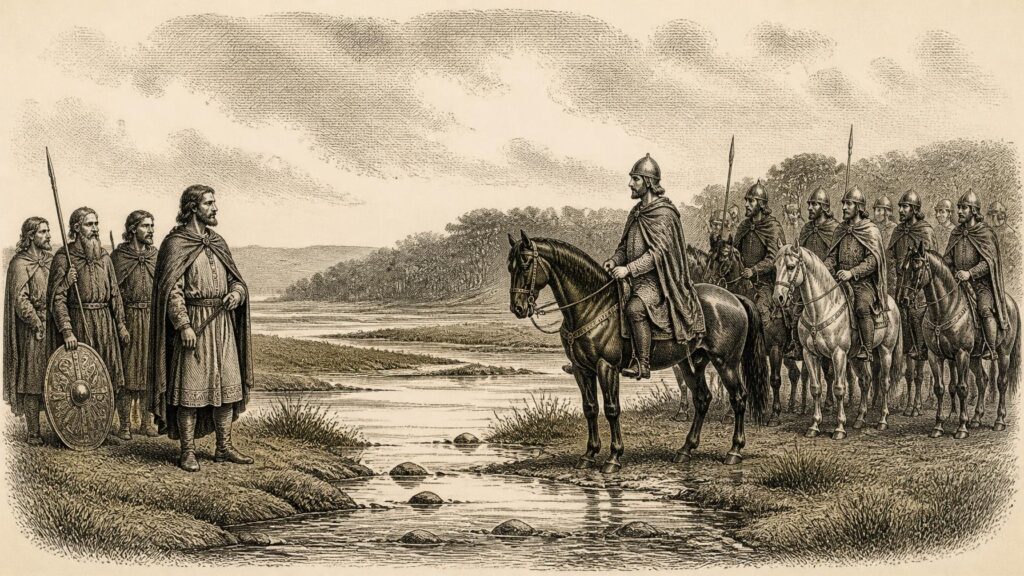
Soon afterwards, Áed arranged a meeting at Lathach Caich Tuaithbil with William de Marisco, Geoffrey’s son. The name includes lathach, ‘a muddy place’ or slough, and the annals’ wording suggests a difficult crossing rather than a formal urban setting. Áed crossed with only a small party: Cormac mac Tomaltaig Mac Diarmata of the Rock, Diarmait son of Magnus, Magnus son of Muirchertach Ó Conchobair, Tadc son of Mathgamain Ó Céirin, and Ruaidrí Ó Maelbhrenainn. William came with eight mounted men.
The chroniclers present Áed’s action as a response to the danger at Dublin. Before the opposing party had dismounted, he and his companions seized William de Marisco. Master Slevin and Hugo Arden were also captured, while the constable of Athlone was killed. The Annals of Ulster, in its much shorter notice, confirms the essential fact: William Mares, son of the justiciar, was taken prisoner by Cormac Mac Diarmata and Áed Ó Conchobair. That convergence matters. The fuller Connacht accounts are plainly partisan in their language of treachery and success, but the capture itself is firmly anchored across the record.
Áed’s force then moved against Athlone, plundering its market and burning the town, according to the Connacht annals. This was a blow at a key Shannon crossing and at the commercial infrastructure sustaining lordship power on Connacht’s eastern frontier. The burning should not be imagined as a precise archaeological description of every street or building. Medieval annalists often used such terms broadly in reporting military devastation. Nevertheless, the explicit mention of the market indicates that trade, provisioning and the movement of people as well as military prestige were at stake.
The prisoners became negotiating assets. The annals state that Áed recovered his son and daughter, together with the hostages of Connacht held by the lordship, and obtained peace for the province. Hostage-giving was not an incidental cruelty but a recognised mechanism of political security: elite children and dependants were held to guarantee submission or agreements. Their recovery was consequently a major gain for Áed. The agreement cannot safely be assigned a duration, and it did not settle Connacht permanently; in 1227, however, the chroniclers regarded the exchange as an achievement benefiting the whole province.
Fortresses on the Shannon Frontier
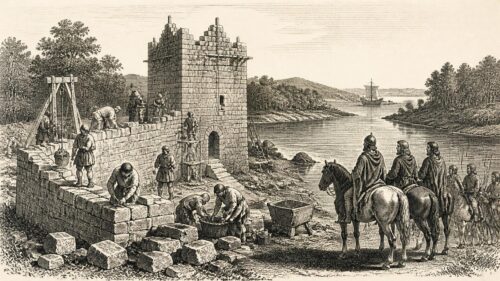
At the same time, Geoffrey de Marisco and Toirrdelbach, son of Ruaidrí Ó Conchobair, led a force into Mag nAí, the fertile plain around Roscommon. There they took hostages from the Síl Muiredaig and began a castle at Rindoon, on a peninsula projecting into Lough Ree. This is one of the year’s clearest material developments. Archaeological and historical work identifies 1227 as the beginning of the Anglo-Norman masonry castle at Rindoon, though its walls and associated settlement developed in stages rather than appearing complete at once.
Rindoon’s position was strategic. Its harbour and peninsula gave control over an important stretch of the Shannon–Lough Ree waterway, while its siting made it a forward base near the unsettled boundary between lordship influence and Connacht. A castle was not simply a military structure. It implied a garrison, supplies, craftsmen, transport by water and road, administrative oversight and a population expected to trade or live under its protection. Its foundation therefore represented an attempt to turn an expedition and hostage-taking into a more permanent regional order.
The annals also record that Geoffrey built a castle at Athleague, another Shannon crossing. Taken together, Rindoon and Athleague show a deliberate emphasis on river routes, crossings and border nodes. They also explain why Athlone’s market could be both a tempting target and a politically meaningful one. Control of Connacht was pursued through places: courts in Dublin, fords and wetlands, market towns, lake peninsulas and castles.
Raiding, Rivalry and Captivity
Áed’s success at Lathach Caich did not end the fighting. Mac William Burke, accompanied by Áed son of Ruaidrí Ó Conchobair, entered Connacht with a large force, burned Inis Meáin, plundered widely and took hostages. Toirrdelbach son of Ruaidrí, working with the men of Meath, raided west Connacht and then Carra, taking hostages and cattle. The annals’ reference to beasts taken from each surrounding cantred points to the economic grammar of warfare. Cattle were food, movable wealth, breeding stock and the basis of seigneurial authority; their seizure struck households directly while rewarding a victorious host.
Dynastic conflict also penetrated family life. Áed travelled north to meet Ó Domnaill of Tír Conaill and returned with his wife, only to be overtaken near the Curlew Mountains by the sons of Toirrdelbach. They seized his horses and wife, who was then delivered to the Galls. Elsewhere, the justiciar and Brian, son of Toirrdelbach, raided Sligo and took many women prisoner. These notices are stark reminders that warfare was experienced not only by kings and mounted retainers but by women, children, captives and communities stripped of livestock and protection.
Local political violence continued within Connacht. Donn Sléibhe Ó Gadhra, king of Sliabh Lugha, was killed at night by his nephew Gilla Ruad after the latter seized the house in which he was staying. The annals then credit Áed Ó Conchobair with arranging Gilla Ruad’s death. Such an entry shows both the vulnerability of regional kingship and Áed’s continuing capacity to intervene beyond his immediate household. Lordship rested on personal loyalty, kinship and retaliation as much as on formal titles.
Famine, Cold and Religious Horizons
Against this background, Annála Connacht records famine throughout Ireland in 1227, accompanied by much sickness and death from cold, hunger and disease. The Annals of Loch Cé similarly notes a great famine and deaths from assorted illnesses. These are grave contemporary-style notices, but they do not provide harvest figures, mortality totals, a named epidemic or a month-by-month account. It is therefore responsible to recognise a severe food crisis without claiming a single proven cause. Recent climate scholarship treats the annalistic report as evidence consistent with unusually cold conditions in the wider North Atlantic region, while also stressing the compounding effects of conflict and insecurity.
For ordinary people, the combination was devastating. Raids removed cattle and stores; hosts consumed provisions; movement became dangerous; and cold or poor growing conditions could turn scarcity into famine. The annual record does not allow us to reconstruct one family’s experience, yet its repeated notices of plunder, captives, livestock, famine and sickness reveal how closely politics and subsistence were joined.
Religion nevertheless remained embedded in public life. Cu Mara Ó Domnalláin was killed in captivity while, the annals note, he had ‘taken the Cross’; Dionysius Ó Mordha, bishop of Elphin, likewise took the cross. Neither entry proves that either man reached the eastern Mediterranean, but both attest to the reach of crusading devotion and obligation into Irish ecclesiastical and aristocratic circles. In a year of local war, Ireland was thus also connected, however unevenly, to wider Latin-Christian movements.
1227 was not a year in which Connacht’s future was decided once and for all. It was, rather, a year in which its stakes became exceptionally clear. Áed Ó Conchobair converted a perilous summons and a small-scale seizure at a wetland meeting into the recovery of hostages and a peace. His rivals and the justiciar answered with raids and new castles. Meanwhile famine and sickness made every loss of cattle, grain, shelter and security still more consequential. The hostage peace at Lathach Caich was real enough to be remembered, but it rested in a landscape where power remained contested and survival precarious.
Primary Sources
- Annála Connacht: Annal 1227
- Annals of Loch Cé: Annal 1227
- The Annals of Ulster: Year U1227
- Annals of the Four Masters: Annal M1227
- Annals of Inisfallen
- Annála Connacht, CELT Project Record
- Annála Connacht, Irish Text
- Annala Uladh: Annals of Ulster Otherwise Annala Senait
- The Annals in Cotton MS. Titus A. XXV
- Geoffrey de Marisco, Dictionary of Irish Biography
- Rindoon Castle, Co. Roscommon: A Border Castle on the Irish Frontier
- Rindoon County Roscommon Management Plan
- Irish Castles: 1180 to 1310
- Archaeology of a Medieval Irish Castle
- A Community in Competition: The Barons of Leinster in Thirteenth-Century Ireland
- Medieval Irish Chronicles Reveal Persistent Volcanic Forcing of Severe Winter Cold Events, 431–1649 CE
- Medieval Irish Chronicles Reveal Persistent Volcanic Forcing of Severe Winter Cold Events, 431–1649 CE (Trinity repository copy)
- Climate, Disease and Society in Late-Medieval Ireland
- Climate and Society in Ireland: From Prehistory to the Present
- Reconstructing 800 Years of Summer Temperatures in Scotland from Tree Rings
- Rathcline History
- The Irish Annals: Their Genesis, Evolution and History