Editorial — Áed — Death
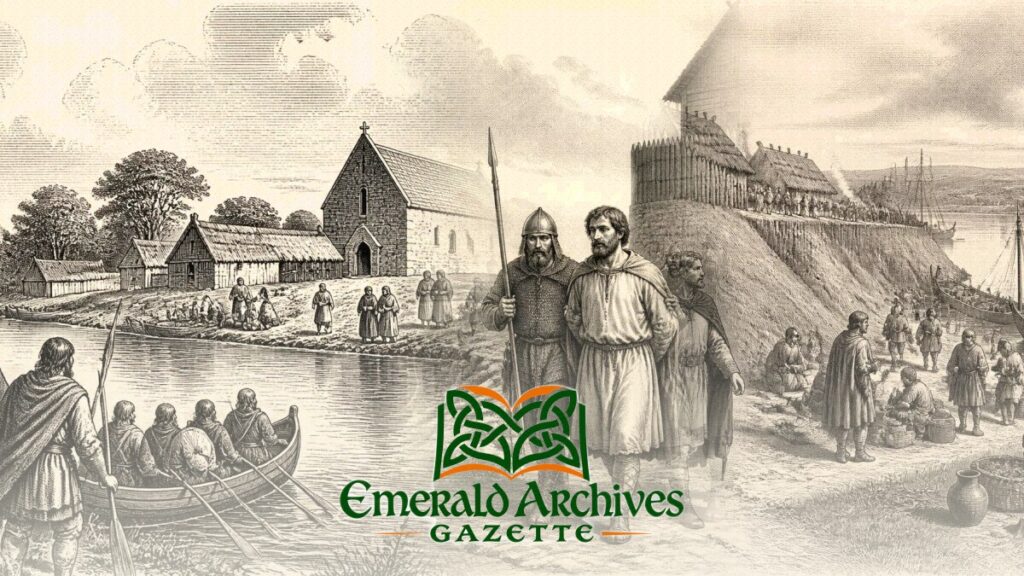
Welcome to the Emerald Archives Gazette. In today’s issue we look back at the latest additions to the archive. Fedlimid’s Captivity — In 1231, the most consequential Irish political event securely assigned to the year was the seizure of Fedlimid mac Cathail Chrobdeirg Ó Conchobair, claimant and recent ruler of Connacht. He was taken at Meelick by Richard de Burgh, known in Irish annals as Mac William Burke. The capture was more than a sudden reversal for one king: it exposed the precarious bargain by which a Gaelic ruler could gain power with Anglo-Norman backing, only to find that backing turned into custody.
Dateline
The Day in Irish History
Welcome to the Emerald Archives Gazette. In today’s issue we look back at the latest additions to the archive.
Fedlimid’s Captivity — In 1231, the most consequential Irish political event securely assigned to the year was the seizure of Fedlimid mac Cathail Chrobdeirg Ó Conchobair, claimant and recent ruler of Connacht. He was taken at Meelick by Richard de Burgh, known in Irish annals as Mac William Burke. The capture was more than a sudden reversal for one king: it exposed the precarious bargain by which a Gaelic ruler could gain power with Anglo-Norman backing, only to find that backing turned into custody. Around Lough Key and across Connacht, meanwhile, the year’s annals preserve a denser local world of monastic deaths, episcopal…
Fincharn Campaign — The best-documented Irish story of 1230 is a struggle for Connacht in which a disputed kingship, an Anglo-Norman lord’s military reach, and the safety of ordinary households became inseparable. The surviving annals do not provide a day-by-day chronicle, and no precise date can responsibly be assigned to the campaign. They do, however, place its principal events firmly within this calendar year: the rebellion of Áed son of Ruaidrí Ó Conchobair, the counter-campaign led by Richard de Burgh, the elevation of Fedlimid son of Cathal Crobderg, and the death of Áed Ó Néill of Tír Eógain.These events belonged to a longer…
Tibohine Burial — The most vivid Irish episode securely assigned to 1229 did not take place on a battlefield or in a royal hall. It concerned the body of Diarmait Mac Gilla Carthaig, erenach of Tibohine in Connacht, an archpriest whom the Annals of Connacht praises as the outstanding figure for charity and humane conduct in his region. On his death, monks of Boyle and canons of the Trinity disputed his burial. His corpse lay for two days and nights in the church at Drum because the monks would not permit interment; only at the end of the third day was it taken…
Carnfree Inauguration — In 1228, the struggle for Connacht became one of the clearest demonstrations of how precarious power could be in thirteenth-century Ireland. A king was killed while away from his province; rival branches of his dynasty fought over the succession; the newly appointed royal justiciar intervened; and an inauguration at Carnfree was followed by devastation serious enough for Irish annalists to describe famine, plunder and the dispersal of clergy and learned people. The year also saw changes in Dublin’s political church, a renewed fortification at Cúil Rathain on the Bann, and a fresh assertion of English royal law within the lordship.…
Hostage Exchange — In 1227, Connacht stood at the sharpest edge of the English lordship’s westward advance. The year’s annals do not offer a single, simple war between two peoples. Instead, they reveal a shifting and dangerous contest involving Áed mac Cathail Chrobdeirg Ó Conchobair, king of Connacht; rival branches of his own dynasty; the justiciar Geoffrey de Marisco; magnates and settlers of the lordship; and regional rulers whose allegiance was sought through force, hostages and cattle-raiding. The best-attested episode began in Dublin, continued at a meeting place called Lathach Caich Tuaithbil, and ended with prisoners exchanged for Connacht hostages and a reported…
Cill Mór — In 1226, Ireland’s most consequential developments lay in Connacht and its northern and eastern approaches. The annals record no single battle that transformed the island, but they do preserve a concentrated sequence of killings, seizures, captivity and the destruction of a castle. Together, these notices show how precarious authority had become after the death in 1224 of Cathal Crobderg Ua Conchobair, long-standing king of Connacht. His son Áed held the kingship, yet his position was threatened by rival branches of the Ua Conchobair family, ambitious neighbouring dynasties and a changing policy at the court of Henry III. A Province Without…
Carnfree Succession — In 1225 Connacht endured a succession struggle so destructive that its effects reached from the Shannon crossings to the western lake country, through the cattle districts of north Connacht and into the church lands of south Galway. The year’s central event was the short-lived inauguration at Carnfree of Toirrdelbach, son of Ruaidrí Ó Conchobair, followed by the restoration of his rival Áed mac Cathail Chrobdeirg. Yet to call this merely a dynastic quarrel would understate its scale. It became a war of shifting coalitions, in which an Ulster king, the Anglo-Norman administration, magnates from Munster and Leinster, local Connacht lords,…
Cathal Crobhderg — In 1224, Ireland’s political map was altered by two linked crises: the death of Cathal Crobhderg Ua Conchobair, the long-serving king of Connacht, and the Crown’s recovery from Hugh de Lacy’s revolt in the Anglo-Norman lordship. These were not separate worlds. Gaelic kings, Anglo-Norman magnates, churchmen and townsmen made alliances across cultural and regional boundaries, while castles, hostages, ecclesiastical patronage and the food supply all mattered to the exercise of power. Cathal Crobhderg’s Last Months Cathal Crobhderg Ua Conchobair died at the monastery of Knockmoy, near modern Tuam, on 28 May 1224. The date is securely supplied by the Irish…
Glenn Máma — A Year of Shifting Allegiance Ireland in 999 was not a single kingdom with a settled government. It was a landscape of provincial rulers, ambitious overkings, church communities and port towns, tied together by hostage-taking, tribute, marriage alliances, raids and negotiated submission. Two men stood above the crowded political field. Máel Sechnaill mac Domnaill of the southern Uí Néill was king of Tara and exercised a recognised, if contested, pre-eminence in the north and midlands. Brian mac Cennétig of the Dál Cais, king of Munster and associated in the annals with Cashel, had become the dominant force in the south.…
Shannon Submission — In 998, Ireland’s political map was being redrawn not by a single coronation or a decisive battle, but by the movement of rulers, armies and hostages across its great internal waterways. The most securely dated development is recorded by the Annals of Inisfallen: Brian son of Cennétig, king of Munster, came to Áth Luain—Athlone—and within a week took the hostages of Connacht before handing them to Máel Sechnaill son of Domnall, king of Tara. It is a compressed notice, but it reveals a great deal. Athlone was not merely a crossing on the Shannon: it was a place where power…
Royal Accord — In 997, two men who had spent much of the previous two decades testing each other’s strength met at a waterside place named in the Annals of Inisfallen as Port Dá Chaineóc. Brian Bóruma, king of Munster, came with the leading men of Mumu; Máel Sechnaill mac Domnaill, king of Tara, represented the dominant Clann Cholmáin branch of the southern Uí Néill. Their agreement did not create a united Irish kingdom. Rather, it publicly recognised that neither could presently impose his will on the other. Yet it was an extraordinary acknowledgement of Brian’s ascent: the king of Tara conceded an…
Brian’s Hostages — For Ireland in 996, the safest starting point is an unusually revealing but compact annal from the south. The Annals of Inisfallen record that Brian son of Cennétig took the hostages of Uí Cheinnselaig and of the lands west of the Liffey at Mag Ailbe. No day or season is supplied, and the terse notice does not narrate a battle. Yet it captures a substantial political development: Brian, king of Munster and head of the Dál Cais, was extending authority into Leinster while Máel Sechnaill mac Domnaill remained king of Tara and the foremost ruler of the midlands.The year must,…
Cashel Fortifications — For 995, the clearest firmly dated Irish notice comes from the Annals of Inisfallen, a Munster-centred chronicle. It records an act of building by Brian, son of Cennétig: the strengthening or fortifying of Caisel, Inis Locha Gair and Inis Locha Sainglenn, together with “many structures besides”. The entry is brief, but it is unusually revealing. In a decade when Brian’s power was expanding beyond his Dál Cais homeland, work at royal and lake-side strongholds expressed security, wealth and authority as surely as a military expedition did. A Year With Uneven Dates Irish annals are indispensable for 995, but they must…
Sitriuc Silkbeard — A Year Seen Through Fragments The surviving record for 994 is brief, regional and unusually revealing. No annal offers a continuous narrative of Ireland that year; instead, separate notices register killings, a church burning, clerical deaths and a sudden reversal in Dublin. Taken together, they show an island divided among many competing lordships, in which authority rested not upon a single state but upon the ability of kings, dynasties and church communities to defend people, land, prestige and wealth. The firmest contemporary-style framework comes from the Annals of Ulster, whose entry for 994 records the killing of regional rulers, the…
Mortality Crisis — The Irish annals preserve 993 as a year of unusually stark contrasts: a kingdom-making ecclesiastical progress in the north, killings among local dynasties across the midlands and west, manoeuvres by the island’s greatest rivals, and, above all, a reported mortality affecting people, cattle and bees. These notices do not form a continuous narrative, and medieval annalists did not date events with the precision expected of a modern calendar. The Annals of Ulster heading itself signals a chronological complication, giving its entry as “AD 992 alias 993”. The safest approach is therefore to treat the notices as events conventionally placed in…
Mide Expedition — For Ireland, 992 is a year best approached through careful reading of the annals rather than through the later, simplified story of a contest between Brian Boru and Máel Sechnaill. The surviving records do not offer a single continuous narrative. They preserve a Connacht expedition, deaths in several regional kingdoms and ecclesiastical centres, and an extraordinary report from the night of St Stephen’s Day. Their dating also needs care: the Annals of Ulster head this material as 991 “alias 992”, while the Annals of the Four Masters likewise correct their annal to 992; the Annals of Inisfallen place its southern…
Leinster Campaign — The surviving record for 991 is short, but it catches Ireland at a revealing moment: a Munster king was campaigning in Leinster; a politically prominent heir was killed in circumstances that later annalists described differently; and a senior church officer died at Cell Dá Lua, modern Killaloe. These notices do not amount to a continuous narrative. They are carefully selected memorials of armed action, elite death and ecclesiastical succession. Yet taken together, they show how far the reach of rulers, monasteries and rival dynasties extended across the island. A Hosting into Leinster The clearest event placed in 991 comes from…
Airbertach’s Ransom — The Irish evidence for 990 is unusually concentrated, yet it reaches from Derry to the south-western coast and from the midlands to Munster. Its notices preserve no single national story. Instead, the year appears as a set of connected pressures: a victory by Máel Sechnaill son of Domnall over forces from north Munster; attacks on major ecclesiastical places; a change of abbot at Emly; and the capture and ransom of a learned churchman from Ross Carbery. The annals are terse and were preserved in later manuscripts, so they do not permit a day-by-day reconstruction. Nevertheless, when read alongside one another,…
Glún Iairn — The annals for 989 preserve a year of abrupt reversals. Ireland was not a single kingdom, nor was its political life divided neatly between ‘Irish’ and ‘Viking’. Kingship was exercised through shifting local alliances, hostage-taking, tribute, raiding and control of major churches. The most striking entry is the death of Glún Iairn, king of the foreigners of Dublin, killed while drunk by his own slave. Yet 989 mattered just as much in the north: Dún Lethglaise, modern Downpatrick, was plundered and burned; a ruler of the Isles was killed in Dál Riata; and the successor of St Patrick at Armagh…
Brian’s Armada — The most consequential Irish notice for 988 is striking because it is measured not in spears, hostages or cattle, but in boats. The Annals of Inisfallen, a chronicle compiled in the south of Ireland, records that Brian son of Cennétig placed a fleet of 300 vessels on Loch Rí (Lough Ree). From there it harried Mide and went to Uisneach. Twenty-five boats then entered Connacht, where their crews suffered a heavy defeat, although they killed Muirgius son of Conchobar, described as a royal heir of Connacht. It is an unusually large and vivid notice, revealing both the reach of Brian’s…
Louth Oratory — The most vivid Irish notice assigned to 987 is not a battle or a royal accession, but a storm. The Annals of Tigernach records that a great wind brought down many buildings, including the dertech, or oratory, at Louth (Lugmad) in present-day County Louth. The same annal also reports a frightening sickness in eastern Ireland and the onset of a major cattle disease. Together, the entries make 987 a year in which ordinary security—of bodies, herds, houses and sacred places—could not be taken for granted.Yet the year must be handled with care. Medieval Irish annals did not use a modern,…
Patrick’s Shrine — In 986, an episode involving the shrine of St Patrick brought royal authority, local conflict and ecclesiastical privilege into unusually sharp focus. The surviving annals are brief, and their differing chronologies require care, but the central record is clear enough: Máel Sechnaill mac Domnaill, king of Tara and ruler of Mide, removed Patrick’s shrine from Áth Firdiad, modern Ardee, to Áth Sige during a war involving the sons of Cairellán. A settlement followed. The king then rendered what the annalist calls Patrick’s due: a visitation involving the men of Mide, clergy and laity alike, hospitality or a feast from every…
Déisi Reprisal — The surviving record for 985 is brief, but it shows Ireland under pressure in several regions at once. In the south, Brian son of Cennétig—later remembered as Brian Bóruma or Brian Boru—answered a cattle raid with a destructive counter-campaign through the Déisi. In the west, Máel Sechnaill son of Domnall, overking of Mide and claimant to the kingship of Ireland, raided Connacht, destroying defended artificial islands and killing local rulers. Leinster also lost a king, Diarmait son of Uathmarán. These notices do not amount to a national narrative: tenth-century Ireland had no single state with a single political agenda. Yet…
Mag Aí — The clearest event that can be assigned to calendar year 984 was a hard, westward assertion of power by Máel Sechnaill mac Domnaill, king of Mide and holder of the kingship of Tara. The Irish annals record that he led an army into Connacht, devastated Mag Aí and struck at its islands. The account is brief, but its vocabulary is unusually forceful: the plain was reduced to ashes, leading men were killed, and island settlements were attacked. Connacht answered with a retaliatory raid eastwards towards Loch Aininn, now Lough Ennell, where the men of Connacht burned territory and killed the…
Glendalough Plunder — A Year of Overlapping WarsIn the conventional calendar year 983, Ireland’s annals record a striking conjunction of warfare: a coalition led by Máel Sechnaill mac Domnaill defeated enemies from Leinster and Waterford; Dubliners plundered the great ecclesiastical settlement of Glendalough; and Brian mac Cennétig sent a fleet into Connacht while pressing hard upon Osraige and Leinster. These were not episodes in a single national war. They were campaigns within a politically divided island, where kings, church communities and the rulers of the coastal towns competed through alliance, raiding, hostage-taking and control of routes.The evidence needs handling with care. The Annals…
Mag Adair — In 982, a short annalistic notice recorded an act whose physical scale was small but whose political meaning was immense: the breaking of the Tree of Mag Adair in what is now County Clare. The tree stood at an inauguration landscape associated with the Dál Cais, the rising Munster dynasty of Brian son of Cennétig, later known as Brian Boru. Its destruction by Máel Sechnaill mac Domnaill, overking of Mide and king of Tara, made visible a widening contest between two ambitious rulers. The same year also brought a Munster raid into Osraige, the plundering of Kildare by Ímar of…
Bishop Anmchad — The surviving notices for 981 are brief, but they are unusually revealing when read together. They record the death of Anmchad, bishop of Kildare; a fatal encounter between two northern rulers; the passing of leading churchmen attached to the cults of Feichín, Brendan and Comgall; and an exceptional mast-crop. None is a grand national set-piece. Together, however, they show an Ireland whose political life remained intensely local, whose churches were major institutions of authority and memory, and whose rural economy was still exposed to the rhythms of woodland as well as field and pasture. A Carefully Dated Year Medieval Irish…
Domnall’s Captivity — For Ireland, 979 is a year best approached through a small but unusually revealing cluster of annalistic notices. No surviving source supplies a continuous narrative, and none explains every motive or consequence. Yet the recorded capture of Domnall Claen, king of Leinster, by the foreigners of Dublin exposes the political weight of the Hiberno-Norse town at the mouth of the Liffey. Deaths and killings among rulers in Offaly, Dál Araide and Cenél Conaill show, at the same time, that power remained fragmented across many regional kingdoms. Notices of a Kildare church leader, a Clonmacnoise scholar-cleric and a foremost man of…
Belach Lechta — The Irish annals place a striking cluster of violence in 978: a decisive contest in Munster, a Dublin victory over Leinster, a northern rout, and assaults on two important southern ecclesiastical centres. These notices are terse, but together they show that Ireland was not moving under a single authority. Power lay in overlapping regional kingships, church networks and maritime towns. The year is especially important because it marked the emergence of Brian son of Cennétig—later Brian Bórama or Brian Boru—as the dominant figure in Munster.Care is needed with the dating. The Annals of Ulster label their material “977 alias 978”,…
Amlaíb’s Killings — In 977, the most consequential Irish event securely assigned to the year was not a pitched battle or a change of king, but a killing that reached into the heart of royal succession. The Annals of Ulster record that Muirchertach, son of Domnall ua Néill, and Congalach son of Domnall were killed by Amlaíb son of Sitriuc, the ruler of Viking Dublin. The annalist calls both men rígdamna Érenn: royal heirs, men eligible for the kingship of Ireland. The wording was deliberate. Their deaths were not merely private murders among noble families, but a violent intervention in the uncertain politics…
Mathgamain’s Betrayal — A Year Recorded Through LossFor Ireland, 976 CE is most securely remembered as a year of violent political reversal in Munster and of important deaths elsewhere on the island. The evidence is unusually revealing but also demands care. Medieval Irish annals preserve events under year-headings that do not always align perfectly between manuscripts and later compilations. Nevertheless, the Annals of Ulster and Chronicon Scotorum both place the killing of Mathgamain son of Cennétig, king of Munster, in 976, while the Annals of Inisfallen preserves a fuller account of his capture and execution in a displaced entry. Taken together, they make…
Cináed Obituary — The Irish evidence for 975 CE is unusually revealing precisely because it is so uneven. No surviving source offers a continuous narrative of the year. Instead, separate annalistic records preserve terse notices from Munster, the north-east, Brega and the Irish Sea world: a killing by the army of Mathgamain mac Cennétig; the escape of an Ímar overseas and the recapture of an island site; the death of the celebrated poet Cináed ua hArtacáin; the killing of an ecclesiastical superior by “heathens”; and a year of notably poor weather. Taken together, they show an Ireland in which political authority, church communities,…
Inis Cathaig — The most vivid Irish notice assigned to 974 concerns an island at the mouth of the Shannon. The Annals of Inisfallen record that the son of Aralt travelled around Ireland with a great company, plundered Inis Cathaig—Scattery Island—and carried Ímar away captive. The same annal also records the death of Scandlán Ua hEirc, described as both a learned bishop and abbot of the island. These are firmly dated annalistic notices, though they are brief. Together they make 974 a year in which a powerful ecclesiastical settlement, a Scandinavian ruler connected with Limerick, and maritime forces from the wider Irish Sea…
Céis Chorainn — For Ireland, 973 was a year in which a provincial succession collapsed almost as soon as it began. The death of Conchobar son of Tadc, overking of Connacht, was followed by the brief elevation and near-immediate killing of Cathal son of Tadc. In the same conflict, Géibennach son of Áed, king of Uí Maine, and many others fell. The annals present these events starkly, but their consequences were substantial: Connacht lost both an established ruler and his short-lived replacement while an outside force harried the province.The year must, however, be handled with care. The Annals of Inisfallen explicitly place these…
Limerick Ordinances — The most consequential Irish development securely associated with 972 occurred in Munster, where Mathgamain son of Cennétig consolidated control of Limerick and its Scandinavian political community. The Annals of Inisfallen, a source especially close to Munster interests, places the episode in a leap year and describes an extraordinary programme agreed by a council of provincial nobles. Its terms were remembered as three ordinances: the expulsion of Norse officials from Munster, the expulsion of the foreigners from Limerick, and the burning of their fortress. The same entry records that Dubchrón Ua Longacháin’s house was burned, with seventy people killed. The annal…
Domnall’s Return — The Irish annals place a sharp crisis of kingship in the entry conventionally labelled 971. The Annals of Ulster, whose dating heading also notes an alternative reckoning, record that Domnall ua Néill, king of Tara, was driven from Mide by Clann Cholmáin, then led an army back against the men of Mide. Chronicon Scotorum tells the same essential story: Domnall was expelled, but was again in Mide and devastated churches and people who opposed him. These are firm annalistic notices for the year-entry, though neither source supplies months, battle sites or a continuous narrative. They nevertheless reveal an Ireland in…
Cell Móna — The surviving record for 970 is unusually concentrated in the northern and midland zones of Ireland, and it must be read with care. The Annals of Ulster introduces its cluster of notices with a dating formula that spans 969–970, while Chronicon Scotorum places closely corresponding events under 970. Modern historical convention therefore treats the sequence as belonging to 970, but the annals are terse retrospective records rather than a day-by-day chronicle. Even so, their convergence reveals an eventful year: Dublin’s ruler Amlaíb Cuarán and a Brega ally challenged the Uí Néill king of Tara; major churches and settlements were raided;…
Niall Mór — Niall Mór Ó Néill, who died in 1397, was among the most formidable Gaelic rulers of fourteenth-century Ireland. King of Tír Eógain, head of a leading branch of the Uí Néill, military adversary and occasional negotiating partner of the English administration, he presided over an expansion of O’Neill power at a moment when the old Anglo-Norman order in Ulster was under acute strain. His career is best understood not as the story of an isolated ‘Irish chieftain’, but as that of a ruler operating within a crowded political world: Gaelic dynasties, Scottish gallowglass captains, ecclesiastical institutions, colonial towns, the Mortimer…
Mathgamain’s Hostages — In 969, Ireland was not a kingdom with a single settled centre of government, but a patchwork of rival overkingships, lesser lordships, ecclesiastical communities and Scandinavian port towns. The year’s surviving notices are brief, yet they disclose a country in which authority had to be repeatedly demonstrated in the field. In Munster, Mathgamain son of Cennétig advanced his claim to supremacy through a hosting and the taking of hostages. In the north and midlands, kings and churchmen died amid contests involving Dublin’s Scandinavian forces. The evidence does not allow a continuous narrative of the year, but it permits a vivid…
Domnall’s Blockade — The surviving notices for 968 CE are brief, but they catch Ireland at a moment of sharp regional pressure. In the east, Domnall ua Néill, king of Tara and leader of the northern Uí Néill, carried war into Leinster and sustained a two-month blockade against the Leinstermen and the ‘foreigners’—the Scandinavian-led rulers of Dublin. In Munster, Mathgamain son of Cennétig continued the forceful advance of his Dál Cais kindred, while an important church at Imlech Ibuir, now Emly in County Tipperary, was plundered. Several senior churchmen died in the north and midlands.That is not a full portrait of a year.…
Sulchuait Victory — In 967, a short annalistic notice marks one of the most consequential reverses suffered by the Norse rulers of Limerick in the tenth century. The Annals of Inisfallen, a chronicle compiled in Munster, records that Mathgamain son of Cennétig defeated the “foreigners of Limerick” at Sulchuait and burned Limerick before noon on the following day. Behind its compressed wording lies a hard-fought contest for power in Munster: not a simple struggle between Irish and Scandinavian peoples, but a contest between ambitious dynasties, port-based rulers and regional client kingdoms. The evidence for this year is unusually clear in one respect and…
Boirenn Defeat — The surviving Irish annals make 966 a year of unusually clear political consequence in the west and north, but they also demand caution. Their entries preserve deaths, a battle and the fall of a Connacht king; yet the chroniclers did not all arrange events under the same year. The Annals of Ulster and Chronicon Scotorum, the closest guides for this article, place a defeat of the Uí Ruairc in 966 in Boirenn of Corcu Mruad, modern north Clare. A much later compilation, the Annals of the Four Masters, puts the same encounter two years earlier and gives a different casualty…
Great Famine — For Ireland, 965 is remembered above all for hunger. The Annals of Ulster, our most nearly contemporary surviving annalistic witness for the year, opens with an unusually stark notice: a “great and intolerable famine” afflicted Ireland, and desperation was said to have driven fathers to sell sons and daughters for food. The sentence is brief, but it brings the human stakes of the year into sharper view than the usual record of kings, raids and clerical deaths. It also places the politics of 965 in a landscape where food, dependants and cattle were inseparable from power.The year’s evidence is not…
Kildare Ransom — A Raid Clearly RecordedThe most securely attested Irish event of 964 was the plundering of Cell Dara, modern Kildare, by the foreigners of Áth Cliath, Dublin. The Annals of Inisfallen, whose entry is explicitly placed under 964, records both the attack and the death in the same year of Kildare’s female erenagh, or hereditary church officer. Chronicon Scotorum gives a fuller version: the attackers were the Dublin foreigners led by Amlaíb son of Sitric, usually known as Amlaíb Cuarán. Neither source supplies a month, the route taken, a battle narrative or a list of goods seized. Yet their agreement leaves…
Thomond Kingdom — Thomond was not merely an old name for County Clare, nor simply the hereditary possession of the O’Brien dynasty. It was a changing political world in north Munster: a Gaelic kingdom shaped by the River Shannon, religious institutions, kinship, warfare, lordly patronage, towns and castles, and repeated negotiation with external powers. For several centuries its rulers stood among the most consequential figures in Ireland, yet their authority was never absolute, their territory never entirely fixed, and their history survives through sources that require careful reading. Thomond Geography The name Thomond derives from Tuadmumu, meaning North Munster. It emerged as a…
Dublin Parades — Dublin’s parade culture is a history of people making meanings in public space. Processions have carried saints’ images, civic dignitaries, soldiers, trade emblems, political banners, festival floats and demands for equal rights through the same streets. They have been devotional acts, entertainments, assertions of authority and occasions of confrontation. The evidence shows no single, uninterrupted ‘Dublin parade tradition’; rather, successive groups repeatedly adapted the city’s streets, squares and bridges to demonstrate who belonged, what should be remembered and what kind of Ireland ought to be visible. Ritual Routes The word ‘parade’ can misleadingly suggest a uniform modern spectacle: a planned…
Sliabh Fuait — In the annalists’ record, 963 was not a year of one island-wide battle or a single change of ruler. It was instead a year in which the workings of power appear in sharp, local episodes: a remarkable movement of ships across a northern upland route; a murderous succession crisis in Airgialla; the death of a king at Cashel; violence on the Shannon; and changes within major ecclesiastical communities. Taken together, these notices show an Ireland of many competing lordships, connected by rivers, roads, churches and kinship, rather than a country ruled through a single uniform administration. Dating a Difficult Year…
Irish Diplomacy — Irish diplomacy was neither an ornamental extension of independence nor a simple story of a small nation finding its voice. It was a practical, contested effort to turn a claim to nationhood into recognised state authority: first amid revolution and civil war, then within the British Commonwealth, and later through multilateral institutions, European integration and painstaking negotiations over Northern Ireland. Its history is best understood as the search for room to act under severe constraints of geography, trade, partition and unequal power. Irish Diplomacy “Irish diplomacy” can be used loosely to describe contacts between Irish rulers, churchmen, emigrants and foreign…
Irish Sport — Irish sport has never been merely a diversion from community life. It has been one of the ways communities have been made: through the voluntary club, the parish field, the school team, the workplace side, the railway excursion, the fundraising dance, the county final and the shared recollection of a match. Yet this history is not a simple story of an ancient people expressing an unchanging national character. It is a history of organisations, arguments, exclusions, loyalties and reinventions. Gaelic games became exceptionally influential, but they developed beside rugby, cricket, association football, golf, athletics, rowing, boxing, horse racing and many…
Flaithbertach’s Expedition — For Ireland, 962 is a year best approached through a small cluster of annalistic notices rather than a single commanding narrative. Those notices are unusually revealing. They record a failed northern raid, the killing or death of several rulers across the island, and a parallel change in Alba. Together they show a political world made up not of a unitary state but of overlapping kingships, kin-groups, ecclesiastical interests and strategic routes. The clearest event was the death of Flaithbertach son of Conchobar, king of Ailech, after an expedition into Dál nAraide. It was a sharp reminder that even a ruler…
Brigid Imbolc — St Brigid and Imbolc stand at a crowded crossing-place in Irish history: early medieval Christianity, vernacular literature, monastic politics, seasonal farming, local custom and modern national commemoration all meet there. Their proximity on 1 February is real and historically important, but it does not permit a simple conclusion that a pagan goddess became a Christian saint. The surviving evidence is later than Brigid’s supposed lifetime, is shaped by religious institutions, and preserves folklore rather than direct testimony from pre-Christian ritual. The task is therefore not to dissolve one Brigid into the other, but to trace how several traditions acquired, exchanged…
Fiery Arrow — The year conventionally indexed as 961 in the Annals of Ulster is remembered above all for a startling, violent report: a saiget tenedh, literally a “fiery arrow” or bolt of fire, travelled across Leinster from the south-west towards Áth Cliath, later Dublin. The annalist says that it killed a thousand people and animals. It is among the most dramatic environmental notices in tenth-century Irish historical writing, yet it must be handled with care. The source supplies neither day nor season, no named locality beyond Leinster and Dublin, and no explanation of what was seen. It may preserve memory of an…
Dál Araide — For Ireland in 960, the surviving record is brief but unusually revealing. It does not offer a single decisive battle, a royal inauguration or a named treaty. Instead, the nearest contemporary annalistic sequence preserves a cluster of movements: a northern ruler took pledges in Dál Araide; a man of the Dublin dynasty suffered defeat at an otherwise uncertain place; a figure called Muiredach made a wide circuit of Connacht; and Cathmug, associated with the great church of Lismore, died. Read carefully, these notices illuminate the practical business of power in a country of many kings, river routes and ecclesiastical communities.…
Dublin Insurrection — The Easter Rising was a short, fractured and militarily defeated rebellion, yet it became one of the most consequential events in modern Irish history. Between Easter Monday, 24 April, and Saturday, 29 April 1916, Irish republicans, labour militants, nationalists and women auxiliaries challenged British rule in Dublin and at several smaller sites elsewhere. Its immediate outcome was destruction, death, surrender and severe repression. Its longer consequence was less direct but immense: it altered political language, created martyrs, discredited an established constitutional settlement for many people, and supplied a founding episode for the revolutionary years that followed. Historical Setting In 1916…
Shannon Plundering — For 959, the Irish annals preserve a small but unusually revealing cluster of notices. Their central event was the plundering of Clonmacnoise by men of Munster. In the same annalistic year, Dub dá Bairenn, king of Cashel, was killed by his own people; several leading churchmen died; and a northern ruler took hostages in Dál nAraidi. These brief records do not yield a continuous narrative, but together they show an island in which royal violence, ecclesiastical wealth and regional military power were closely intertwined. The dating deserves care. The Annals of Ulster head their entry “AD 958 alias 959”, while…
Thank you for reading today’s Gazette. Follow any of the links above to read the full article and explore its sources.