

Ballylahan’s Ashes and Edward’s Lordship1254 CE
Dateline
The records for 1254 preserve a revealing contrast. At the highest level, Henry III of England reassigned much of the royal lordship of Ireland to his teenage heir, Lord Edward. In Dublin, the rebuilt church of St Patrick was dedicated as a cathedral. Yet the Irish annals are equally attentive to a burned Dominican house in north Mayo, killings around Lough Ree and Cluain Conmaicne, an arrest and blinding ordered by the king of Connacht, and an exceptionally productive year of milk, acorns and other foodstuffs. Ireland was not one political unit moving in step with an English royal decision. It was a landscape of overlapping jurisdictions, local lordships, religious communities and agricultural households, tied together by travel, taxation, warfare and patronage.
Edward’s New Lordship
The most securely dated constitutional development occurred on 14 February, at Bazas in Gascony. Henry III granted his eldest son Edward an immense apanage: an endowment intended to support the prince’s status and future rule. It included, subject to important reservations, the royal lands and rights in Ireland, alongside territories in England, Wales and Gascony. Edward was only fourteen. Ireland was not detached from the English crown: the arrangement was expressly designed to preserve ultimate royal allegiance and the integrity of the crown’s dominions. But it made the prince the immediate lord to whom many of the profits, services and political claims of royal government in Ireland would now be directed.
This was an administrative and dynastic change of considerable potential, not a sudden conquest of the island. The king’s government possessed strongest authority in the ports, towns, shires, royal castles and settled lordships of the English colony. Beyond and between them stood powerful Irish kings and kindreds, as well as great Anglo-Irish magnates whose practical authority rested on land, alliances and armed followings. In Connacht, for example, Fedlimid Ó Conchobair remained king, while the de Burgh inheritance supplied a rival framework of lordship. Edward’s grant altered the Crown’s ownership and patronage; it did not erase these realities.
Its first effects were visible in official command. A royal letter of 4 August required that Edward receive the homages and fealties due from lands given to him in England, Ireland, Wales and Cheshire, while saving allegiance to Henry. A 1254 instruction issued in Edward’s name to Richard de la Rochelle, deputy justiciar in Ireland, called for the pacification of Ulster after resistance to the new lord had been reported. The surviving notice gives no adequate narrative of the rising, and it would be unsafe to enlarge it into a major campaign. It does, however, show that Edward’s lordship was being asserted through the existing machinery of government and that northern Ireland was not politically quiet.
Government and the Gascon Demand
Irish resources were also drawn into Henry III’s wider continental difficulties. The king was in Gascony, confronting threats connected with Alfonso X of Castile. Orders issued early in 1254 demanded that ships capable of carrying horses be assembled at Waterford, ready for a crossing; they also required provisions on a formidable scale, including wheat and hogs, to be sent to Gascony. Such orders demonstrate how the ports, livestock, grain supply and fiscal institutions of the lordship could be mobilised for war beyond Ireland. They do not prove that every demanded ship or cargo sailed, but they expose the Crown’s expectations.
The annals of Connacht and Loch Cé record tersely that ‘the Justiciary of Ireland went to Saxon-land’. John FitzGeoffrey remained formally justiciar at this point, although he had been summoned from Ireland for royal service and was frequently absent; his nephew Richard de la Rochelle acted on his behalf. The annalists’ brief notice is therefore best understood as evidence of government conducted across the Irish Sea, rather than proof of a single precisely dated departure or a full account of who accompanied him. For people in the royal areas, overseas war was not remote: it could mean requisitioned transport, demands upon estates, and decisions taken by deputies rather than a resident chief governor.
A Dublin Cathedral Dedicated
Against this setting of royal extraction and delegated rule came one of the year’s most enduring Irish events: the dedication of the church of St Patrick in Dublin. The Annals of Ulster place the dedication in 1254. Later cathedral scholarship identifies St Patrick’s Day as the occasion, but the annal itself supplies only the year; that distinction matters. The new building had been developed over preceding decades under the Dublin archbishops, especially Luke of Netterville, and represented the expanding institutional life of the colonial capital.
St Patrick’s was a secular cathedral, served by a chapter of clergy rather than by monks. Its elevation gave Dublin two cathedrals, alongside Christ Church. This was not merely architectural display. A cathedral was a place of liturgy, preaching, burial, administration, patronage and education, sustained by revenues and clergy connected to Irish, English and continental ecclesiastical worlds. Built in Gothic form with local limestone and imported stone, the church also made material demands upon quarrying, transport, craftsmen and donors. The dedication did not settle every question of precedence between Dublin’s two cathedral communities; those tensions persisted. But 1254 marks a clear public statement of St Patrick’s standing.
Fire at Athlethan
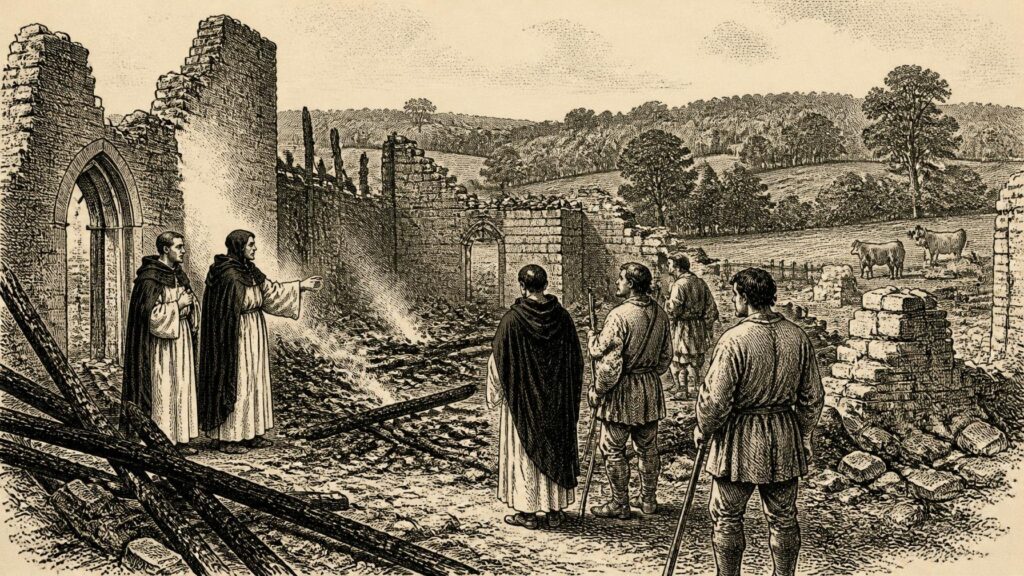
In the same year, the annals report the complete burning of the monastery of the Friars Preachers at Athlethan in Luighne, now associated with Ballylahan or Straide in County Mayo. The loss matters precisely because it was not an ancient and detached monastic survival. The house had only recently passed into Dominican hands, within a region where the de Exeter lordship, borough formation, castle-building and new religious foundations were reshaping local connections. Mendicant friars depended upon communities of lay patrons and neighbours for food, building materials, alms and protection. A destructive fire could therefore interrupt worship and residence while also testing those support networks.
The annals do not identify a cause, name casualties or describe rebuilding. It should not be represented as an attack without evidence. What can responsibly be said is that a newly established Dominican presence in north Mayo suffered a total conflagration in 1254. Its later restoration is a reminder that religious expansion in thirteenth-century Ireland was neither smooth nor secure. The year consequently offers two sharply different ecclesiastical images: formal dedication and growing prestige at Dublin, sudden material vulnerability at a small friary in the west.
Connacht’s Violent Politics
Most detailed Irish notices cluster around Connacht and its eastern approaches. Fedlimid Ó Conchobair, son of Cathal Crobderg, had regained and maintained a difficult kingship amid rivalry within his own dynasty, pressure from colonial lordships and the interests of neighbouring powers. In 1254 he seized Sitric Mac Shanly and ordered the blinding of Sen-Shuileach Mac Shanly after being told that they had plotted treachery against him. The account in the Annals of Loch Cé calls the blinding unnecessary, a moral judgement by the annalist which ought not to be silently converted into an established judicial finding. Nevertheless, the episode plainly reveals a ruler using imprisonment and bodily punishment to answer a perceived threat.
Other killings underline the precariousness of lordship. Murchad Ó Máel Sechlainn was slain by Domnall, son of the Sinnach Ó Catharnaigh. Yet Murchad himself killed Piers Ristubard, lord of Síl Máelruain and described as a noble baron, on Lough Ree. Donnchad, grandson of Tomaltach Mac Diarmata, and Amlaíb Ó Bíobhsach were killed by Connacht men at Cluain Conmaicne. Maghnus Ó Gadhra was, according to the Connacht annals, killed ‘without cause’ by Fedlimid’s people. Such compressed reports rarely permit reconstruction of motives, numbers or wider strategy. Their cumulative force lies elsewhere: political power was enacted through personal followings, lake and river corridors, hostage-taking, punitive violence and sudden changes in the fortunes of local elites.
The death of Piers Pramister, lord of Conmaicne of Dún Mór, belongs to the same regional pattern. So does the death of Máel Finnén Ó Beolláin, comarba, or hereditary successor, of Drumcliff. In the north, the death of Aindiles Ua Inneirghi was commemorated by the Annals of Ulster in the elevated language reserved for a notable warrior, ‘a tower of valour of the north of Ireland’. These notices should not be mistaken for a complete political map, but they show that status in Gaelic society was expressed through inherited offices, territorial lordship, ecclesiastical succession and martial reputation alike.
Food, Woodland and Livestock
Alongside violence, the Connacht annals offer an unusually favourable assessment of the year. They call it excellent, marked by abundance of oak-fruit, milk and other good things. This is not a statistical harvest report, and it cannot tell us equally about every district or household. It does, however, preserve an important contemporary measure of well-being. Oak mast had value in woodland economies, especially where pigs fed in forests; plentiful milk points to the centrality of cattle and dairying; and the phrase ‘all other good things’ suggests a broader sense of agricultural sufficiency.
For ordinary people, abundance did not cancel insecurity. Cattle, grain, woodland produce and movable goods were exactly the resources vulnerable to raids, military provisioning and local exactions. The same year could therefore bring good grazing and food supplies to many households while exposing others to loss through conflict or fire. That tension is central to 1254. Royal claims reached Ireland across sea routes and through officials; cathedral and friary life depended on accumulated resources; and regional rulers fought for authority over people and property. The annals preserve both the prosperity of the land and the fragility of those who lived upon it.
Primary Sources
- The Annals of Ulster: Year U1254
- Annála Connacht: Annal 1254
- Annals of Loch Cé: Annal LC1254
- Annals of the Four Masters: Annal M1254
- Annals of Inisfallen: Annal AI1254
- Annals of Loch Cé A.D. 1014–1590: Bibliographical and Editorial Information
- FitzGeoffrey, John
- O'Connor (Ó Conchobair), Fedlimid
- Burgh, Walter de
- Fulbourn, Stephen de
- The Lord Edward and the Administration of Justice across his Apanage, 1254–72
- A Letter from Henry III, 4 August 1254
- Calendar of Documents Relating to Ireland, Volume 2, Item 411 (1254)
- St Patrick’s Cathedral: The History of the Building
- St Patrick's Cathedral in Dublin: A History
- St Patrick’s Cathedral — Dublin City Urban Archaeology Survey
- A History of the Irish Dominicans, Volume 1
- The History of the County of Mayo to the Close of the Sixteenth Century
- Calendar of Ormond Deeds, Volume I, 1172–1350
- ‘Divide and Rule’: Factionalism as Royal Policy
- Calendar of Documents Relating to Ireland, 1252–1284
- CIRCLE: A Calendar of Irish Chancery Letters, c.1244–1509
- Material Used in the ‘Calendar of Documents Relating to Ireland’
- A Catalogue of the Acts of the Lord Edward, 1254–1272


