Sligo’s Dominican Foundation1253 CE
In 1253, Sligo gained a Dominican friary and consecrated cemetery, establishing a centre for preaching, learning, burial and patronage in a strategic Geraldine settlement. The foundation reflected mendicant expansion supported by both Anglo-Irish and Gaelic rulers, also evident at Roscommon. Politically, Maurice FitzGerald’s Anglo-Irish expedition into Tír Eógain failed to secure hostages from Brian Ó Néill, demonstrating limits to colonial power and strengthening Ó Néill’s position. Church notices recorded deaths of leading bishops and construction of an episcopal residence at Elphin. Annals described a notably productive summer, while December royal orders sought Irish military and logistical aid for threatened Gascony.

Dateline
In 1253, the clearest new landmark in Ireland was not a battlefield or a royal charter but a religious house at Sligo. The Annals of Connacht record that a monastery was built and a cemetery consecrated there for the Friars Preachers, the Dominican order. In a country divided among Gaelic kings, Anglo-Irish magnates and the king of England’s administration, that foundation was a local event with wider meaning. It placed a new institution of preaching, learning and burial in a strategic north-western settlement, while war and political resistance continued beyond its walls.
The year is unusually revealing because its surviving records do not tell a single national story. Different annals preserve short notices from Connacht, Ulster and Munster; administrative material connects Ireland to Henry III’s overseas concerns. Taken together, they show an island of overlapping jurisdictions. English royal authority was strongest in its towns, castles and lordships, but could not simply compel obedience from major Gaelic rulers. The Church, meanwhile, was being reshaped by friars, bishops and patrons who operated across those political boundaries.
Reading a Difficult Year
Medieval Irish annals are invaluable but are not modern calendars. They were compiled in different places, sometimes copied or revised long after the events they describe, and their year-headings can occasionally fall out of step. For 1253, the strongest basis is provided by notices independently associated with that year in the Connacht and Loch Cé traditions, alongside records whose dating can be checked against other evidence. This matters particularly for episcopal successions: some later compilations group events under 1253 that documentary evidence suggests had begun in late 1252. Rather than turn every annalistic notice into a precise date, the safer picture is of developments securely reported for 1253 and of institutions already in motion.
That caution does not make the year colourless. It helps distinguish firm events from broad context. The Dominican cemetery at Sligo, the unsuccessful expedition into Tír Eógain, the deaths of prominent churchmen and rulers, the favourable harvest notices, and a late-year royal warning concerning Gascony all belong to a particular calendar year. They also illuminate larger changes without pretending that Ireland was governed from one centre or experienced one uniform set of conditions.
Brian Ó Néill’s Northern Success
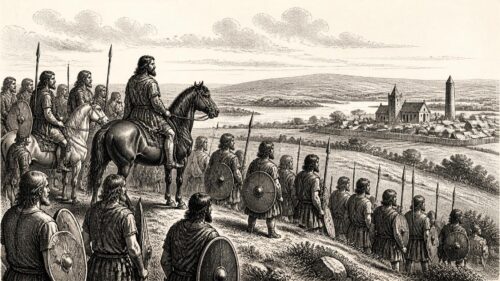
The sharpest political event was in the north. The Annals of Connacht state that the ‘Galls of Ireland’—the Anglo-Irish—under Mac Muiris, Maurice FitzGerald, made a great hosting into Cenél nÉogain against Ó Néill. They suffered heavy losses and, crucially, gained neither hostages nor sureties. Hostages and pledges were not incidental trophies: they were practical instruments of overlordship, meant to guarantee submission and future obedience. Their absence signalled that the expedition had failed in its immediate political purpose.
The opponent was Brian Ó Néill, king of Tír Eógain. Maurice FitzGerald had long sought a durable foothold in north-western Ireland from his base around Sligo, and his ventures in Cenél nÉogain and neighbouring regions formed part of a wider Anglo-Irish drive to turn claims, castles and military superiority into lasting control. Yet the 1253 campaign showed the limits of that project. Brian had survived previous pressures and submissions; now he repelled a major force. A later annalistic account associates the year with a devastating Ó Néill counter-offensive against English settlements and castles in Ulster. The exact sequence and scale require care, but the larger point is firm: 1253 was a year in which Brian’s position strengthened rather than collapsed.
This was not an isolated frontier skirmish. The contest for Tír Eógain involved access between Connacht, Donegal and eastern Ulster, the safety of newly established lordships, and the standing of an Irish king who would soon make a more ambitious claim to leadership. The defeat did not end FitzGerald power in the west, but it exposed the difference between raiding successfully and ruling securely. In Ireland, as elsewhere in the thirteenth century, castles, mounted troops and royal backing could be formidable without being decisive.
A Priory and Cemetery at Sligo
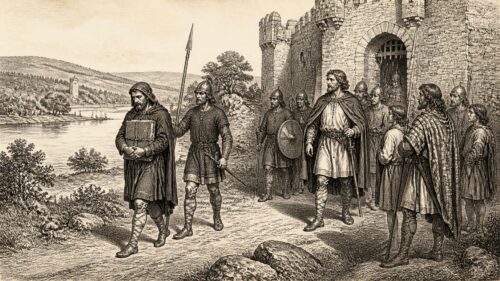
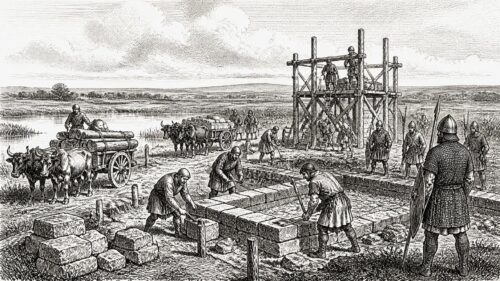
Against that unsettled political background, the Dominican foundation at Sligo was especially significant. The annal’s paired wording—monastery built, cemetery consecrated—captures two sides of the new community. A friary required buildings in which brethren could pray, sleep, study, eat and organise their work. A consecrated burial ground made the site a spiritual destination for the surrounding population and its patrons. It connected the living to the dead through burial, commemoration, almsgiving and intercessory prayer.
The Friars Preachers were a relatively new order in Ireland. Unlike older monastic communities tied primarily to landed estates, Dominican friars were mendicants: they relied on benefaction and were intended to preach, hear confession and teach among laypeople. Their houses were therefore commonly placed beside towns or developing settlements, where congregations, markets, travel routes and potential patrons were close at hand. Sligo, beside the Garavogue and near its estuary, was well suited to such a role. Its castle and settlement had become an important Geraldine base in north Connacht, positioned close to the contested approaches towards Ulster.
Modern heritage and archaeological accounts usually associate the foundation with Maurice FitzGerald and date the building phase to about 1252–53. The contemporary annalistic wording is more securely tied to 1253 because it records the completed religious and burial function. This distinction is useful: a patron could grant land or begin construction in one year, while a community’s churchyard was consecrated and its public presence recorded in another. What can safely be said is that by 1253 the Dominican house at Sligo had become an established religious site.
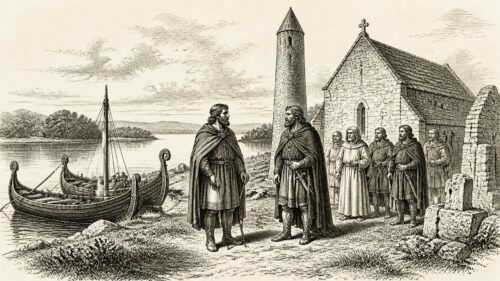
Another Dominican development in Connacht is conventionally dated to the same year. St Mary’s Priory at Roscommon is associated with the patronage of Feidlimid Ó Conchobair, king of Connacht. Whether viewed through Sligo or Roscommon, the pattern is striking. Mendicant institutions could receive support from both Anglo-Irish and Gaelic rulers. Their expansion was therefore not simply a cultural import imposed by conquest. Friaries became places where political patrons sought prayers, burial, prestige and access to educated clergy, even while those patrons competed fiercely for land and authority.
Bishops, Residences and Local Authority
The ecclesiastical notices of 1253 show a Church rooted in local lordships but connected to wider religious networks. David son of Cellach Ó Gilla Pátraic, archbishop of Cashel, died, according to the Annals of Connacht. Gilla Cellaig Ó Ruadáin, bishop of the Uí Fiachrach Muaide, whose diocese was centred on Killala, also died. The Annals of Loch Cé record the death of Ailín Ó Súilleabháin, bishop of Lismore. Such obituaries are brief, but they marked real transfers of authority over clergy, revenues, churches and pastoral responsibilities across Munster and Connacht.
At Elphin, Tomaltach Ó Conchobair built a residence at Cill tSeisin, recorded in the Loch Cé annals as a mansion or palace. The word should not conjure a later aristocratic palace. It indicates a substantial episcopal residence: a place from which a bishop could receive visitors, manage resources, maintain a household and display the standing expected of a diocesan lord. The building demonstrates that ecclesiastical power involved material infrastructure as well as liturgy. Bishops were religious leaders, but they also worked within the political and economic fabric of their regions.
These entries also show why religious change cannot be reduced to a contest between ‘native’ and ‘foreign’ institutions. Ó Conchobair was a Gaelic bishop building locally; Dominican friars were part of an international order but relied on Irish patrons; archbishops and bishops moved within a reformed diocesan structure that linked Ireland to Rome. The Church was one of the principal means by which local society encountered wider European practices of administration, religious discipline and learning.
Summer Plenty, Winter Demands
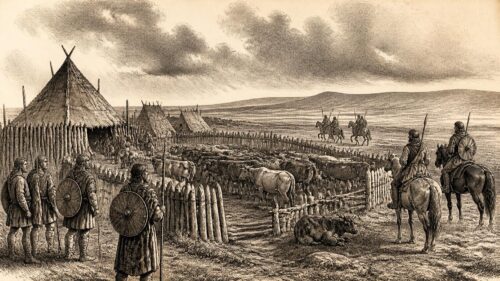
For ordinary households, weather and livestock could matter more immediately than high politics. The Annals of Inisfallen describe 1253 as a hot summer. In Connacht, the Annals of Loch Cé called it the best year remembered for nuts and for the produce of earth, cattle, trees and herbs. These are regional testimonies, not a statistical survey of the entire island, and they should not be converted into a claim that every district prospered equally. Nonetheless, the notices suggest that contemporaries perceived an unusually favourable season across parts of Ireland.
Abundance had practical consequences. Good grazing improved milk and cattle condition; crops, woodland produce and herbs enlarged the stores on which households depended through winter; surplus could support hospitality, rent and exchange. It also mattered to armies and religious communities, both of which required food, animals and transport. In a society where cattle remained a central measure of wealth, an excellent year for livestock and produce strengthened the resources available to lords and tenants alike, though distribution remained unequal.
Yet Ireland’s prosperity was tied to affairs beyond its shores. On 27 December 1253, royal government warned the justiciar in Ireland of the expected threat to Gascony from Alfonso X of Castile and appealed for military aid. The projected campaign would soon bring demands for ships, horses, provisions and men through Irish ports, especially Waterford. Nothing in this late-December communication meant that Ireland was about to be invaded; rather, it shows the Angevin and English monarchy treating its Irish lordship as a source of maritime logistics and military support in a continental crisis.
Thus 1253 closed with two contrasting realities. At Sligo, a new Dominican community and cemetery gave permanent religious shape to a growing settlement. In Tír Eógain, Brian Ó Néill had demonstrated that a major Anglo-Irish hosting could be repelled without yielding hostages. And beyond Ireland, royal planners were already looking to its ships and supplies. The year’s surviving evidence is fragmentary, but its message is clear: political power was contested, religious institutions were expanding, and local lives remained closely bound to the harvest, the herd and the changing demands of war.
Primary Sources
- Annála Connacht: Annal 1253
- Annals of Loch Cé: Annal 1253
- Annals of the Four Masters
- Annals of Inisfallen: Annal AI1253
- The Annals of Ulster
- Annales Dominicani de Roscoman
- Annales Hiberniae
- Annales Breves Hiberniae
- Published Texts at CELT
- Sligo Abbey
- Ancient Dominican Priories
- FitzGerald, Maurice fitz Gerald
- O'Neill (Ó Néill), Brian
- MacCarthy (Mac Carthaig), Fingen
- Materials for the History of the Franciscan Province of Ireland, A.D. 1230–1450
- Calendar of Documents Relating to Ireland, 1171–1307: Parchment Conquest
- Calendar of Documents, Relating to Ireland: National Library of Ireland Catalogue
- Journal of the Royal Society of Antiquaries of Ireland
- Sligo Abbey, Abbey Street, Sligo
- Sligo City Centre Public Realm, Co. Sligo: Archaeological Assessment
- Sligo: 6–7 Abbey Street, Sligo
- County Waterford City Urban Archaeology Survey