

The Curragh’s Fallen Earl1234 CE
In 1234, Richard Marshal, earl of Pembroke and lord of Leinster, brought his rebellion against Henry III’s Poitevin advisers to Ireland. Supported by Leinster allies, he recovered positions and captured Limerick, but royalist magnates Maurice FitzGerald, Hugh de Lacy and Walter de Lacy defeated him on the Curragh of Kildare on 1 April. Wounded and detained, Marshal died at Kilkenny on 16 April and was buried there. His defeat strengthened royal authority, restored Richard de Burgh’s Connacht interests under restrictive terms, and prepared subsequent expansion. Meanwhile, fighting at Tralee demonstrated continuing conflict between settler powers and Gaelic dynasties across Ireland.
Dateline
In 1234, Ireland became the decisive theatre in a conflict that had begun at the court of Henry III of England. Richard Marshal, earl of Pembroke and lord of Leinster, crossed the Irish Sea while in rebellion against the king’s Poitevin advisers. His defeat on the Curragh of Kildare and death later that month transformed the balance of power within the lordship of Ireland. It also helped restore Richard de Burgh to royal favour and prepared the political ground for a renewed drive into Connacht. The year’s evidence is unusually vivid but not wholly consistent: annals agree that Marshal fell in the Kildare fighting, while later narratives differ over dates, circumstances and responsibility.
A Rebellion Reaches Leinster
Richard Marshal inherited the vast Marshal lordship in 1231: estates in England and Wales, the earldom of Pembroke, and the great liberty of Leinster in Ireland. His position made him one of the most powerful subjects of Henry III. By 1233, however, he had entered opposition to the royal regime dominated by Peter des Roches, bishop of Winchester, and Peter de Rivaux. Marshal’s rebellion was rooted in English and Welsh politics, but Ireland was never peripheral to it. His Irish inheritance was both a source of income and a field of power, containing castles, towns, tenants and allies whose loyalty mattered in a wider struggle.
During the crisis, Marshal’s enemies in Ireland acted against his lands. Maurice FitzGerald, lord of Offaly and justiciar of Ireland since September 1232, stood with the crown. So did Hugh de Lacy, earl of Ulster, and Walter de Lacy, lord of Meath. Richard de Burgh, former justiciar and claimant to Connacht, was another important royalist. Their co-operation shows that the lordship was not governed as a single, settled realm. It was a political mosaic: royal officials in Dublin, powerful Anglo-Norman liberties, episcopal lands, chartered towns and Irish kingdoms overlapped, competed and occasionally combined.
Marshal came to Ireland in February 1234 with a relatively small following. The precise sequence of his movements cannot be reconstructed in full, but contemporary and near-contemporary accounts agree that he gathered support in Leinster, recovered positions held against him and took Limerick. That advance was consequential. Limerick was a major river-port and a centre of royal and seigneurial authority in the west; control of it gave Marshal a striking, if temporary, demonstration that his cause had support beyond his immediate estates.
Battle on the Open Plain
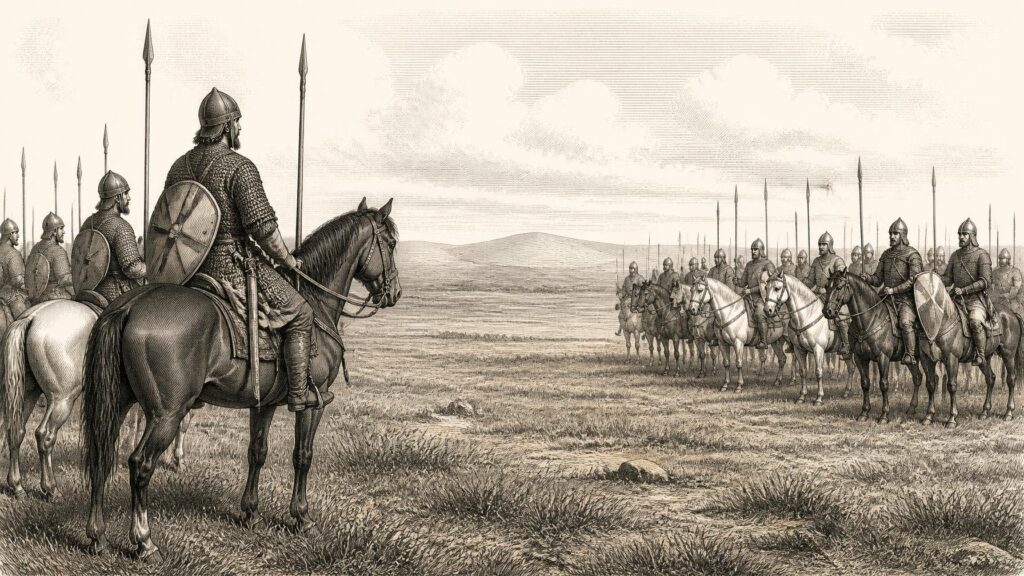
The decisive encounter took place on the Curragh, the broad limestone grassland beside Kildare. The battle is securely associated with 1 April 1234 by modern scholarship drawing on the chronicle tradition. The Annals of Connacht name the opposing royalist leaders—Maurice FitzGerald, Hugh de Lacy and Walter de Lacy—and say that the English of Leinster and of Ireland assembled on the king’s behalf. The annal describes a fierce battle in which Marshal was killed and Geoffrey de Marisco was captured. Geoffrey was a major landholder and former royal official whose relationship with Marshal had become deeply hostile.
The setting mattered. The Curragh was open country, suitable for the mounted warfare favoured by Anglo-Norman knights and their retinues, rather than a wooded or boggy landscape in which a smaller force might find cover. Yet the sources do not permit a reliable reconstruction of formations, numbers or individual manoeuvres. Later accounts turned the battle into a story of deliberate betrayal: Marshal was supposedly invited to negotiate, abandoned by men he trusted, and then mortally wounded. Such claims were politically powerful, but they must be treated carefully. They depend heavily on hostile or retrospective chroniclers, and historians cannot establish murder or a pre-arranged ambush as fact.
What can responsibly be said is stark enough. Marshal was defeated, wounded and taken into custody. The Irish annalists’ wording is compressed, calling him dead on the field; Latin annals and English narrative sources instead place his death shortly afterwards. One Irish compilation dates the wounding to 12 April, while a later account records death on 16 April. The stronger modern reconstruction places the battle on 1 April, followed by death at Kilkenny on 16 April. The variation is a reminder that medieval annals often preserve the importance of an event more securely than its exact chronology.
Death and Burial at Kilkenny
Marshal died at Kilkenny, where he was buried at the Franciscan church on 17 April according to the biographical evidence assembled from the chronicles. This was no insignificant resting place. Kilkenny was one of the chief urban and administrative centres of the Marshal lordship, and the Franciscan presence connected aristocratic commemoration with one of the rapidly expanding religious orders of the thirteenth century. The burial made the town a place of dynastic memory as well as government, exchange and craft production.
For ordinary inhabitants of Kildare and the wider Leinster lordship, the campaign would have had consequences beyond the famous names. Armies required horses, food, forage, guides and carriage. Castles and towns became points of refuge, supply and coercion; tenants could face demands from rival lords whose claims were backed by armed men. The surviving record does not provide a day-by-day account of civilian experience in April 1234, and it would be wrong to invent one. Still, the concentration of forces around Kildare, followed by the detention and death of an earl at Kilkenny, makes clear that high politics had entered the daily geography of roads, fields, religious houses and markets.
Marshal’s death also revealed the fragile character of lordly allegiance. Some of his Leinster tenants fought for him; others sided with the king or pursued their own advantage. Recent research emphasises that lesser barons and knights were not passive followers. Their cross-channel landholding, marriages, offices and local interests shaped where they stood. The result was not a simple opposition between ‘English’ and ‘Irish’, but a contest among interconnected lordships in which Irish, Welsh, English and continental ties all mattered.
Royal Favour and Connacht
The immediate political beneficiary was Richard de Burgh. He had fallen from favour after the collapse of his uncle Hubert de Burgh’s power in England, losing the justiciarship and facing scrutiny of his Irish administration. Service against Marshal changed this. A new settlement of his Connacht interests was made in 1234, and the patent enrolment of 7 October recorded restitution of his lands there for a fine of 3,000 marks. In return, de Burgh was to render 500 marks yearly at Dublin and the service of twenty knights’ fees.
The terms are revealing. The crown reserved the five best cantreds near Athlone, along with royal dignities, justice and ecclesiastical payments described in the record as the ‘gifts of croziers’. Connacht was therefore not handed over as an independent palatine liberty comparable to Leinster or Meath. It was arranged as a royal county in which de Burgh held extensive interests but the king retained important rights. Hostages and a renewed undertaking of faithful service were also required. The agreement was a reward, but it was designed to bind a great magnate more tightly to royal authority.
This did not mean that Connacht had simply been conquered in 1234. Feidhlimidh Ó Conchobhair remained a central Gaelic ruler in the province, and the decisive expansion of de Burgh and FitzGerald power belongs chiefly to the campaigns from 1235 onwards. The significance of 1234 lies in preparation rather than completion: Marshal’s defeat removed a major rival, de Burgh’s position was restored, and the crown and leading colonial magnates again had reason to work together. The charter’s language of rents, knight service, reserved districts and royal justice shows conquest being imagined administratively before it was secured militarily.
Conflict at Tralee
Southern Ireland also saw violence. Mac Carthaigh’s Book records that ‘the defeat of Tralee’ was inflicted by the Galls on the Gaels. Among the dead were Diarmaid, son of Cormac Liathánach Mac Carthaigh, together with An Gasgúineach Ó hEidirsgeóil and his brother Muircheartach. The entry gives no date within the year, no full account of the opposing force, and no trustworthy casualty total. Its value lies in showing that 1234 was not defined only by the Curragh. Conflict continued in Kerry between Gaelic dynastic interests and the settler power described by the annalist as the Galls.
The notice is also an early sign of Tralee’s strategic emergence. Archaeological assessment cautiously concludes that some form of settlement probably existed there by this date, though the later medieval borough and its Dominican friary should not be projected backwards as if they were already fully formed. In 1234, Tralee was a contested locality in north Kerry, not yet the documented walled and commercial town of later records.
By the end of the year, then, two related developments stood out. In Leinster, the death of Richard Marshal ended a dramatic challenge to Henry III’s authority and weakened one of the greatest inherited lordships in Ireland. In Connacht, the crown’s settlement with Richard de Burgh supplied a legal and financial framework for renewed expansion. Neither development settled Ireland. Instead, 1234 sharpened the connections between warfare, lordship, administration and land: connections that would drive the next phase of thirteenth-century change.
Primary Sources
- Annála Connacht
- Mac Carthaigh’s Book, Part 11
- Annales Hiberniae
- Annales Breves Hiberniae
- Annals of the Four Masters, Volume 3
- Annals of Ulster Otherwise Annala Senait
- Richard Marshal and the Marshal Family, Dictionary of Irish Biography
- Burgh, Richard de, Dictionary of Irish Biography
- FitzGerald, Maurice fitz Gerald, Dictionary of Irish Biography
- Patent Rolls: 7 October 1234
- “Divide and Rule”: Factionalism as Royal Policy in the Lordship of Ireland, c.1171–1265
- “Divide and Rule”: Factionalism as Royal Policy in the Lordship of Ireland, c.1171–1265, Irish History Online record
- A Community in Competition: The Barons of Leinster in Thirteenth-Century Ireland
- Earl Gilbert Marshal and His Mortal Enemies
- County Kerry Urban Archaeological Survey
- Irish Texts at CELT
- List of Published Texts at CELT
- MS C iii 3: The Annals of the Four Masters
- The Annals of the Four Masters: Irish History, Kingship and Society in the Early Seventeenth Century
- CELT Frequently Asked Questions


