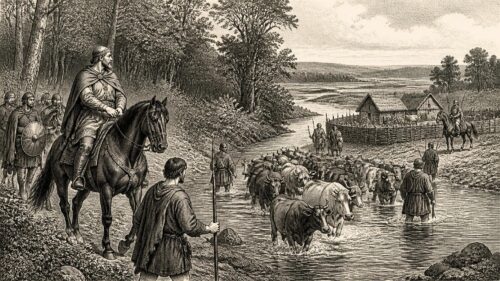
Rindoon’s Cattle Raid1236 CE
In 1236, Connacht remained unstable after Anglo-Norman conquest, as Maurice FitzGerald displaced Fedlimid Ó Conchobair, who escaped northwards. FitzGerald’s forces pillaged lands, captured women and built a stronghold, while Brian Ó Conchobair ruled with foreign support. Fedlimid returned with allies and raided Rindoon’s defended settlement for cattle, but his dispersed forces were defeated. Richard de Burgh later backed him, yet warfare devastated Tuam, Mayo and surrounding districts, including churches and their food stores. Burned sanctuaries, captivity, hunger and scarcity marked the year. Ecclesiastical authority proved ineffective against violence, although Tuam’s archbishop-elect gained English and papal confirmation. No durable settlement emerged.

Dateline
A Connacht Crisis
The events recorded for 1236 are concentrated overwhelmingly in Connacht, where the previous year’s Anglo-Norman conquest had not produced a settled order. Instead, it opened a fierce contest over who could govern the province, hold its cattle and command its churches. The principal figures were Fedlimid mac Cathail Chrobdeirg Ó Conchobair, claimant to the kingship of Connacht; Maurice fitz Gerald, the king of England’s justiciar in Ireland, known to Irish annalists as Mac Muiris; and Richard de Burgh, called Mac William. Their actions show that Connacht was neither simply conquered nor securely independent. It was a frontier of competing jurisdictions, alliances and armed households.
This was the immediate aftermath of the great campaign of 1235, in which de Burgh and FitzGerald had brought Fedlimid to terms and restricted him to a reduced lordship in Roscommon. That settlement belongs to the preceding year, but it explains why 1236 began with so little trust. In the year’s annalistic record, royal officers, Anglo-Norman lords and several branches of the Ó Conchobair dynasty all sought to exploit a political order that remained unsettled. The hardship borne by ordinary people was not incidental to that struggle: seizure of food, livestock and captives was one of its chief methods.
Fedlimid’s Escape
The most dramatic episode was Fedlimid’s removal from power by the justiciar. Annála Connacht and the Annals of Loch Cé report that Maurice FitzGerald summoned an assembly at Afeoran or Bél Átha Feorainne. Fedlimid attended, despite the evident danger. The Connacht annalist calls Maurice his gossip, a relationship of spiritual kinship which makes the alleged plot especially striking, but should not be mistaken for a guarantee of political loyalty. Warned in advance, Fedlimid escaped with only a few horsemen. The annals state plainly that he fled north to seek the protection of Ó Domnaill of Tír Chonaill.
His pursuers ranged from the meeting-place through Roscommon and as far as the bridge at Sligo. Unable to catch him, they attacked the lands of Tadc Ó Conchobair and carried off many high-status women as captives. The Annals of Ulster independently preserves the core fact of the pillaging of Sligo by the justiciar and Brian, son of Toirdelbach Ó Conchobair, including the taking of women captive. This agreement between annalistic traditions makes clear that the pursuit was not merely a failed arrest of one ruler. It became a destructive expedition against the people connected with him.
The Connacht account also places the building of a castle at Muille Uanach, rendered as Onagh in translation, in this crisis and describes it as a stronghold against the men of Connacht. Its exact modern location is uncertain, so it is safer not to attach it to a particular surviving site. What matters is the recorded purpose: fortification was being used to transform a temporary military intervention into a durable claim over territory. Castles, garrisons and local allies offered the administration of the English lordship a means of holding ground beyond the Shannon; they also presented Connacht rulers with fixed targets and reminders of outside domination.
A Substitute Ruler
After the justiciar and his forces withdrew, Brian, son of Toirdelbach and grandson of the former high king Ruaidrí Ó Conchobair, was left to “guard and rule” the country. That wording is important. Brian was not an impersonal official but a rival member of the Connacht royal kindred, supported by the justiciar’s soldiers. He and those troops raided the sons of Áed mac Cathail Chrobdeirg and other adherents of Fedlimid; Áed’s sons retaliated against both the newcomers and their Gaelic enemies. The annalist’s conclusion is stark: the countryside was ruined by the alternating attacks.
Connacht’s political vocabulary still centred on kingship, descent and the obligations between a lord and his following. Yet the year shows how readily that language could be joined to the military resources of the English crown’s Irish administration. Brian could be presented as ruler while dependent upon foreign-backed force; Fedlimid could seek refuge with Ó Domnaill while retaining supporters within Connacht; local lineages could change alignment in order to protect people and herds. Rule was therefore not a settled possession but something that had to be continually demonstrated through protection, tribute, hospitality and military success.
Rindoon and Dispersal
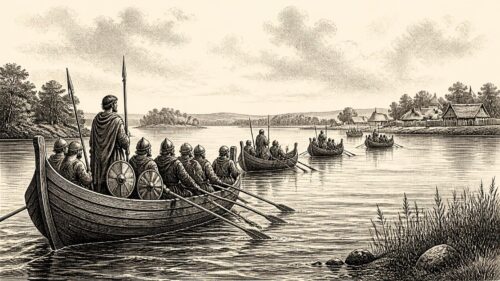
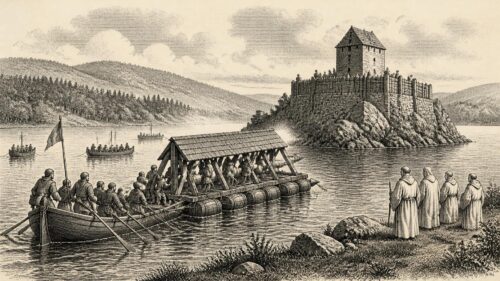
Fedlimid soon returned at the invitation of Connacht allies. The annals name Ó Cellaig, Ó Flainn, the sons of Áed mac Cathail Chrobdeirg and the son of Art Ó Máelsechlainn, and say that their combined host formed four large battalions. They advanced on Rindoon, the royal Anglo-Norman castle and developing settlement on a peninsula projecting into Lough Ree. The account says that Fedlimid’s force crossed the bádún, or enclosed outer defence, and the ditch, reaching the area where the cattle of the territory were held.
That distinction matters. Archaeological and documentary study of Rindoon supports the view that the raiders broke into the defended settlement or outer enclosure but did not capture the masonry castle itself. It is a useful corrective to any image of a simple storming and conquest. The raid exposed the vulnerability of the new settlement, while the castle’s survival showed the continuing strength of the royal foothold. Rindoon’s position on Lough Ree and the Shannon route made it strategically valuable: it was a fortified point in the communications linking the midlands and Connacht.
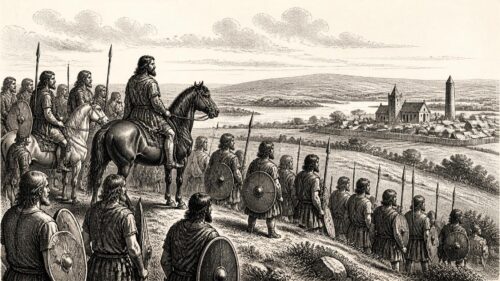
Fedlimid’s success immediately turned into failure. The annals condemn his men for abandoning their lord in pursuit of cattle. Each leader seized livestock wherever he encountered it, scattering the four battalions until only four horsemen remained with Fedlimid. Brian, Eoghan Ó hEidhin, Mac Goisdelb and Conchobair Buidhe then attacked with a small mounted force and many foot soldiers. Conchobair Buidhe was himself killed by Ruaidrí, son of Áed, but a large number of Fedlimid’s host were slain inside and outside the enclosure. The cattle raid reveals more than battlefield indiscipline. Cattle were mobile wealth, food, breeding stock, compensation and the visible substance of lordship. In a time of scarcity, the chance to drive them away could prove stronger than cohesion in battle.
Churches Under Pressure
Richard de Burgh returned from England during the year. The annalist remarks that no one knew whether he brought peace or war, an unusually revealing acknowledgement of uncertainty. On hearing of the defeat at Rindoon, Mac William supported Fedlimid against those who had turned against him. This was not a principled reconciliation so much as another rearrangement of power. His expedition reached Tuam and then Mayo, where the annals report that no heap of seed-corn was left in the great church of Mayo or in the church of St Michael. Between sixty and eighty baskets were taken from those churches, followed by further raiding at Turlough.
These details bring everyday survival into view. Churches were places of worship and sanctuary, but also held grain, cattle and other resources. They could shelter people in flight and serve as stores in a region disrupted by war. In 1236 those functions made them vulnerable. Some cattle were later restored to Conchobair Ruad and to church people when Mac William made peace with them; the wording suggests restitution of what was found alive, not a general repair of losses. Such settlements were practical bargains, negotiated under pressure and closely tied to possession of herds.
The violence reached an appalling extreme when Brian’s followers burned the church of Emlagh against the people of Ó Flainn. The Annals of Loch Cé says it contained women, children, black nuns and three priests. The justiciar also burned Termon Caelainn. These were not vague claims of collateral damage. They are specific annalistic accusations of breaches of sanctuary, and they explain the chronicler’s severe moral language about armed men who disregarded church privilege.
Rain, Hunger and Ecclesiastical Authority
The same source characterises 1236 as a year of heavy rain, bad weather, war, hunger and scarcity of both food and clothing. This should be read as contemporary chroniclers’ judgement on conditions in Connacht, rather than as a precise island-wide measurement of harvest. Even so, it is powerful evidence that weather and warfare were experienced together. Raiding removed stored grain and cattle; people repeatedly fled to churches; ecclesiastical buildings became overnight lodgings for refugees. The annalist portrays clerics as living in constant fear and bishops as excommunicating violent bands, yet spiritual penalties did not stop the destruction.
Religion also connected Connacht to wider powers. Máel Muire Ó Lachtáin, archbishop-elect of Tuam, travelled to England and was consecrated with papal letters and the consent of the king of England. The firmly dated year therefore records an ecclesiastical appointment whose confirmation crossed Irish Sea political and religious networks. It did not mean that Tuam was insulated from conflict: Mac William’s troops reached the town in the same year. Rather, the elevation of its archbishop demonstrates how local church government operated through both papal authority and royal approval.
Other deaths and acts of violence underline the breadth of instability around Connacht. Máel Sechlainn Ó Máille was killed on Oileán Dacruindi; Conchobar, son of Áed Muimhnech Ó Conchobair, was killed by Magnus, son of Muirchertach Muimhnech; and Diarmait, son of Niall Ó Ruairc, was blinded by Cú Chonnacht Ó Ráigillig. Áed Ó Flaithbheartaig, king of West Connacht, also died, praised by the annalist as an exceptionally generous and independent protector. Clerical losses included Mac Raith Mac Mailin of Kilmactranny and Áed Ó Gibelláin, a priest of Kilrodan and later canon of Holy Trinity Island on Lough Key.
An Unfinished Settlement
By year’s end, Fedlimid had defeated the descendants of Ruaidrí Ó Conchobair and Conchobar mac Cormaic Mac Diarmata at Cluain Catha, but no lasting peace had emerged. The year’s record is not of a single conquest or a single civil war. It is of overlapping contests in which Anglo-Norman officers, de Burgh power, Gaelic dynasties, church communities and local armed followings all acted upon one another. Rindoon remained standing, Fedlimid remained politically active, and the costs of manoeuvre had been paid in hunger, displacement, captives and burned sanctuaries. In 1236, Connacht’s future was still being fought over village by village, herd by herd and refuge by refuge.
Primary Sources
- Annála Connacht: Annal 1236
- Annála Connacht: CELT Project Record
- The Annals of Loch Cé: Annal LC1236
- The Annals of Loch Cé: CELT Edition
- The Annals of Ulster: Year U1236
- Annals of the Four Masters: 1236 Entries
- FitzGerald, Maurice fitz Gerald
- O'Connor (Ó Conchobair), Fedlimid
- Rindoon Castle, Co. Roscommon: A Border Castle on the Irish Frontier
- Archaeology of a Medieval Irish Castle
- Rindoon
- The Waterways Under the Normans
- Rindoon, Co. Roscommon – Archaeology
- Calendar of Documents Relating to Ireland, Volume 1, Item 2244
- Henry III Fine Rolls
- Fine Rolls, Henry III (1216 to 1236)
- Annals of Connacht (AD 1224–1544)
- Features: Inside a Medieval Gaelic Castle
- Three Medieval Settlements
- Notes on the Early History of Tuam, Killala and Achonry