Cluain Moccu Nóis Burns755 CE
In the annal-year 755, Cluain Moccu Nóis (Clonmacnoise), a major monastery beside the Shannon, was burned on 21 March, though modern calendar alignment remains uncertain. The annals do not state the cause, scale or casualties, but the fire exposed the vulnerability of a wealthy religious and transport centre dependent on regional labour and patronage. They also record deaths of kings of Uí Méith, Uí Maine and Uí Fhailgi, alongside churchmen and abbots from several communities. These notices reveal politically fragmented, interconnected Ireland, where monasteries held economic, scholarly and social importance. No evidence supports nationwide crisis, war, famine or rebuilding details.
Dateline
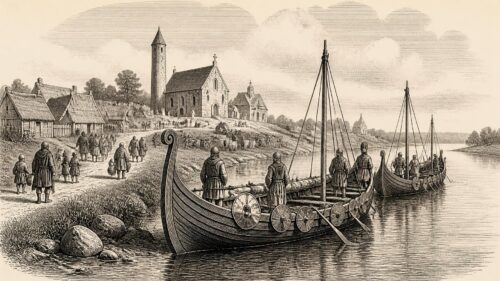
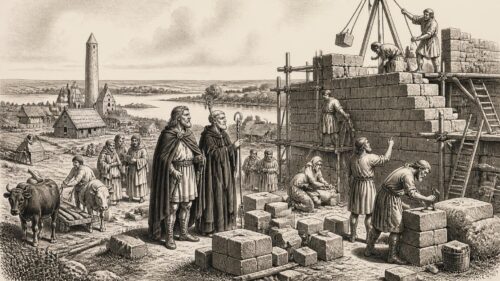
The most vivid Irish notice conventionally placed under 755 is also the most precise: Cluain Moccu Nóis, now Clonmacnoise, was burned on 21 March. The entry is brief, but its subject was not. Set beside the Shannon at a crucial crossing between Connacht and the midlands, the monastery was already a major religious community and a place where routes, patrons, learning and political influence met. A fire there was therefore more than a local accident. It interrupted worship, damaged buildings and possessions, and demanded labour, food, timber and protection from a broad network of dependants and benefactors.
The year’s evidence must nevertheless be handled with care. The Irish annals preserve a 755 entry for the burning, and give the day of the month, but their chronological systems do not always align neatly with modern calendar numbering. The Annals of Ulster, for example, preserves the same notice under U755 while printing an AD 754 alignment in its heading. The Annals of Tigernach places it under T755. It is responsible, then, to treat 21 March as an unusually well-preserved annalistic date and the fire as firmly connected with the annal-year 755, while avoiding a false claim that the surviving texts settle every question about modern calendar conversion.
A Fire on the Shannon
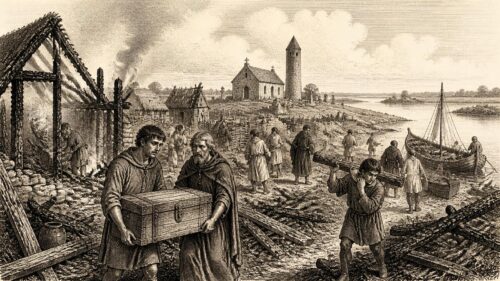
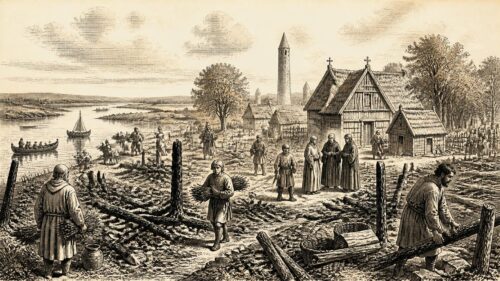
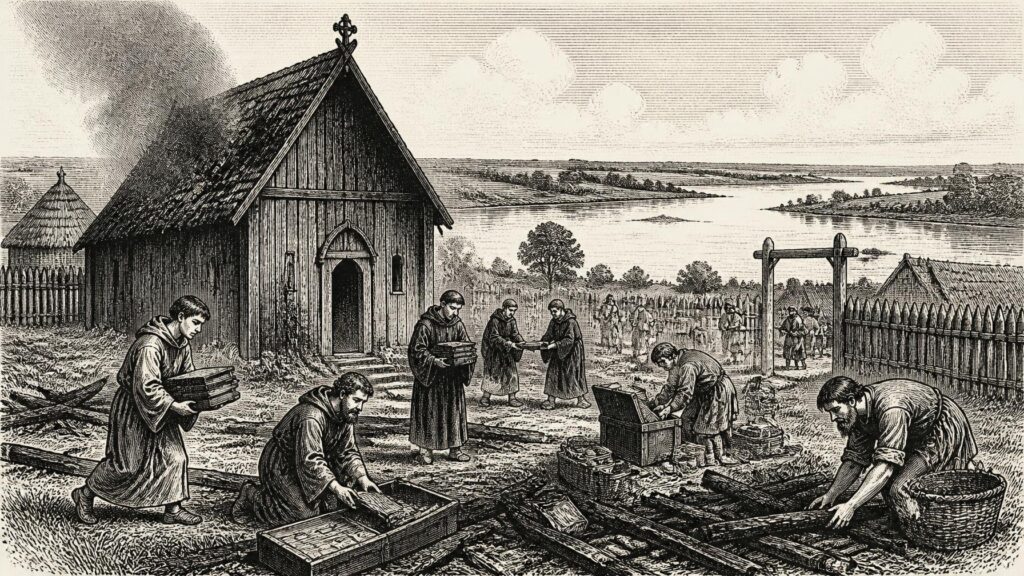
The annalists say only that Cluain Moccu Nóis was burned. They do not identify an arsonist, invading force, lightning strike or domestic mishap; nor do they specify which structures were lost or how many people died. A fire should not automatically be converted into a raid. Early medieval Irish monasteries contained many combustible elements: timber churches and dwellings, roof thatch or shingles, workshops, storehouses, fencing, fuel supplies and the books, clothing, food and liturgical furnishings kept within them. Even a blaze confined to part of the settlement could have been a grave institutional crisis.
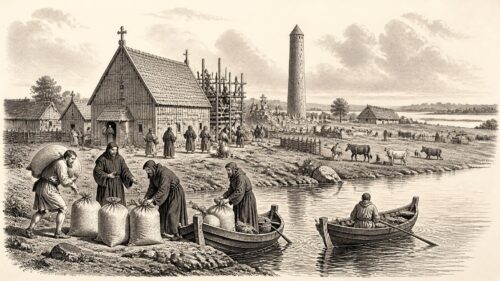
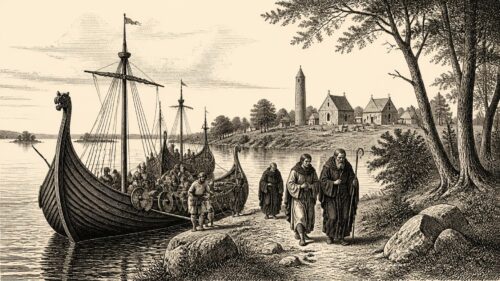
Clonmacnoise’s setting explains its importance. Its name, Cluain Moccu Nóis, means the meadow of the sons of Nós. Founded in the sixth century in the tradition associated with Ciarán, it stood on the Shannon at a place where river travel and an important east–west land route converged. The river was a principal artery through the island: it linked communities around Lough Ree and the midlands with Connacht, while nearby routes opened towards Mide and Leinster. The monastery was not an isolated retreat. It was a riverside ecclesiastical settlement, served by agricultural land and bound into the movements of clerics, travellers, clients, craftsmen and rulers.
Rebuilding after a monastic fire would have required collective resources. Wood had to be felled and transported, roofs remade, boundaries repaired and the sacred routine re-established. If manuscripts, altar vessels or food stores had been damaged, their replacement would have mattered as much as the repair of walls. Yet the annals do not describe a rebuilding campaign, and it would be unsafe to attach surviving stone churches, crosses or towers to this event. Most visible monuments at Clonmacnoise belong to later centuries. What the 755 notice securely reveals is vulnerability within an important centre, not the appearance of the ruins seen today.
Deaths and Political Turnover
The same annal-year records a striking sequence of deaths among rulers and churchmen. Flaithnia son of Tnúthach, king of the Uí Méith, died. The Uí Méith were a people of the north-east, in the borderlands later associated with Monaghan and Louth. Indrechtach son of Dlúthach, king of Uí Maine, also died. Uí Maine was a substantial Connacht kingdom, centred broadly in territory later forming parts of south Roscommon and east Galway. In the midlands, Flaithnia son of Flann, king of Uí Fhailgi, died; his people gave their name to the later Irish designation of Offaly.
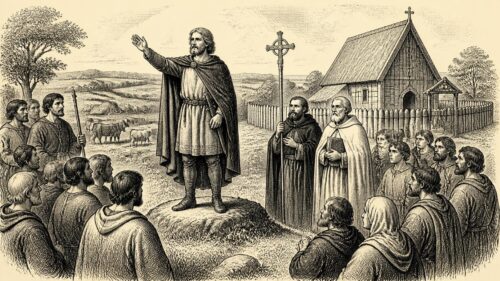
These notices should not be mistaken for proof of a single island-wide succession crisis. Ireland was divided among many dynasties and kingdoms, from local túatha to larger over-kingdoms. Kingship was personal, competitive and sustained by kinship, clientage, military following and the ability to reward supporters. The death of a king could open a contest within a ruling lineage, but the annals do not record the successors in these particular cases. We cannot responsibly reconstruct unrecorded battles, settlements or hostages from the bare fact of death.
Even so, the geographical spread is revealing. In one cluster of entries the annals noticed a northern ruler, a Connacht ruler and a midland ruler. They did so because the political life of Ireland did not flow solely from a single royal centre. Powerful families around Tara and among the Uí Néill exerted influence across the midlands, but the map was made of overlapping loyalties rather than fixed national administration. Uí Fhailgi stood in a strategically sensitive zone between Leinster and the expanding powers of Mide; Uí Maine mattered within Connacht; Uí Méith lay amid the shifting politics of the north-east. The deaths recorded in 755 remind us how often power changed hands below the level of the most famous kings.
Churches, Scholars and Routes
The year’s obituary also traces a network of religious houses across Ireland. It names Fiachra of Martharthech; Felcmaire son of Comgall; Cathal son of Diarmait, explicitly called a learned man; Daelgus, abbot of Cell Scíre; Fiangalach, abbot of Inis Bó Finne in Lough Ree; and Snéidcheist, abbot of Nendrum. The Annals of Inisfallen, which has a different and much shorter entry for its own 755, records the death of Máel Turaig, abbot of Inis Bó Finne. Differences of this kind are a warning against treating any single annal as a complete annual register, but they also show that monastic personnel were worth remembering in more than one historical tradition.
These were not merely devotional communities. Monasteries educated clerics, preserved texts, administered lands, received gifts, offered hospitality and served as burial and commemorative places for elites. A man described as sapiens, or learned, belonged to a culture in which mastery of scripture, Latin, ecclesiastical computation, vernacular learning and legal tradition could carry public authority. Abbots, often drawn from politically important families, managed institutions whose wealth and prestige made them partners and rivals of secular rulers.
Inis Bó Finne, on Lough Ree, and Nendrum, on Mahee Island in Strangford Lough, point to the practical importance of water. Loughs, rivers and coastal inlets supplied fish and transport, connected dispersed settlements and allowed bulky goods to move more readily than by land. Nendrum’s early medieval tidal mills, known from archaeology, illustrate the technical and economic capacity that could accompany monastic life. Such evidence does not tell us what happened at Nendrum in 755 beyond the recorded death of its abbot, but it gives substance to the sort of resourceful ecclesiastical world in which that succession occurred.
Work Beyond the Annals
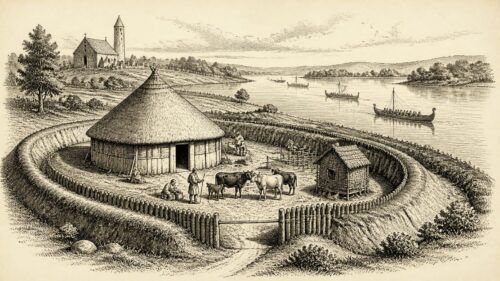
For most people, 755 would have been measured less by named deaths than by seasonal work. Ireland remained overwhelmingly rural. Cattle were fundamental markers of wealth, status and exchange, while pigs, sheep, dairying and arable crops sustained households. Archaeological and legal evidence indicates that cereal production became increasingly important during the eighth century, alongside more intensive processing through mills and grain-drying installations. Ringforts and enclosed farmsteads structured much of the inhabited countryside, while larger monasteries drew in produce, labour and skilled work.
It would be wrong to claim a documented harvest, famine, epidemic or weather disaster for this particular year: the annals give none. Nor can the fire at Clonmacnoise be used to measure island-wide prosperity or hardship. But the event makes the dependence of a great monastery on its hinterland unusually visible. Repairing a burned community required the output of farms, woods and workshops, and the obligations owed by tenants, clients and patrons. In that sense, a short annalistic sentence opens onto the work of many unnamed people.
An Uneven Record
Nothing in the surviving notices permits a grand narrative of 755 as a year of national war or transformation. There is no securely recorded campaign, treaty or assembly to place beside the Clonmacnoise fire. Its significance lies elsewhere: a major Shannon monastery suffered a dated calamity, while deaths registered political turnover in several regional kingdoms and vacancies in religious communities from Lough Ree to Strangford Lough. The evidence is fragmentary, but not trivial. It shows an Ireland of interconnected yet locally governed societies, in which a burned monastery and the passing of rulers were events worthy of preservation in historical memory.
Primary Sources
- The Annals of Tigernach, Part 14
- The Annals of Ulster, Part 325
- Annals of the Four Masters, Part 58
- Annals of Inisfallen, Part 31
- CELT Project: The Annals of Ulster
- TEI Header for The Annals of Ulster
- CELT Project: Annals of Inisfallen
- Irish Texts at CELT
- Exploring the Irish Annals
- Clonmacnoise, County Offaly
- Clonmacnoise Monastic Site
- The Economy of Early Medieval Ireland
- Agriculture, Settlement and Society in Early Medieval Ireland
- The Chronology and Sources of the Early Irish Annals
- On Reconstructing Medieval Irish Chronicles
- Reassessing the Irish ‘Monastic Town’
- Residence, Ritual and Rulership: A State-of-the-Art for Royal Places in Early Medieval Ireland
- Nendrum: Historic Environment Technical Supplement 10
- The Sequence of Early Christian Period Horizontal Tide Mills at Nendrum Monastery: An Interim Statement
- Húi Failgi Relations with the Húi Néill in the Century after the Loss of the Plain of Mide
- Irish Sagas: Cath Maige Mucrama Names
- Críchad an Chaoilli: A Medieval Territory Revealed