Fedlim’s Drumrat Charge1237 CE
In 1237 Fedlim mac Cathail Chrobdeirg Ua Conchobair led a Connacht coalition against rival Ua Conchobair claimants, defeating troops linked to the Justiciar at Drumrat and devastating opponents’ lands. His forces briefly controlled Magh Luirg and Lough Key, where land was granted to a Holy Trinity community, while Fedlim later executed hostages. He subsequently made peace with the Justiciar, receiving the Five King’s Cantreds free of tribute, as Irish barons began castle-building in Connacht. Church reform advanced through Archbishop Máel Muire Ó Lachtáin’s Athlone synod. Clarus Mac Máelín founded a canons’ monastery on Trinity Island, while several prominent clerics died.
Dateline
The surviving Irish annals place an unusually concentrated sequence of events in Connacht during 1237. Their entries do not provide a day-by-day narrative, and some were written or compiled later than the year they describe; nevertheless, they firmly assign a campaign, a settlement with the royal government, new castle-building, a provincial synod, ecclesiastical foundations and several deaths to this calendar year. Together they show a region in which Gaelic dynastic power, the expanding English lordship and reforming church institutions were not separate worlds. They met in the same roads, lakes, churches and contested lordships.
A Connacht Campaign
The chief political and military event was a hosting led by Fedlim mac Cathail Chrobdeirg Ua Conchobair, king of Connacht. Fedlim’s force was not simply his household. It included Cú Chonnacht Ó Raigillig and the Uí Briúin, Cathal Mac Ragnaill and the Conmaicne, as well as the three sons of Áed mac Cathail Chrobdeirg. The roster matters: it presents warfare as a coalition of kin-groups and regional communities, assembled behind a claimant whose authority still depended upon allies with their own interests.
The target was a rival branch of the Ua Conchobair dynasty, described as the descendants of Ruaidrí: Brian son of Toirdelbach, Muirchertach and Domnall, sons of Diarmait, and Conchobar son of Cormac Mac Diarmata, who was associated with them. Such genealogical precision was political language. The dispute was not an abstract struggle between ‘Irish’ and ‘English’, but a contest over the succession, lands and client networks of Connacht’s ruling family, into which the government of the English lordship had become involved.
Fedlim’s host pursued its opponents north through the Curlieu Hills to Drumrat. The annals state that the rival party then sent against him the soldiers or mercenaries of the Justiciar of Ireland. This is a particularly revealing detail. The Justiciar was the king of England’s chief governor in Ireland, yet his troops appear here fighting beside one Connacht faction rather than conducting an independent conquest. Military service, paid soldiers and local dynastic rivalry could be combined in ways that made political allegiance highly practical and changeable.
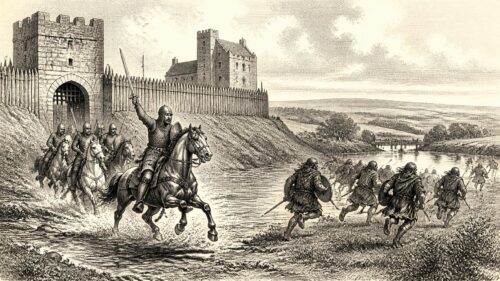
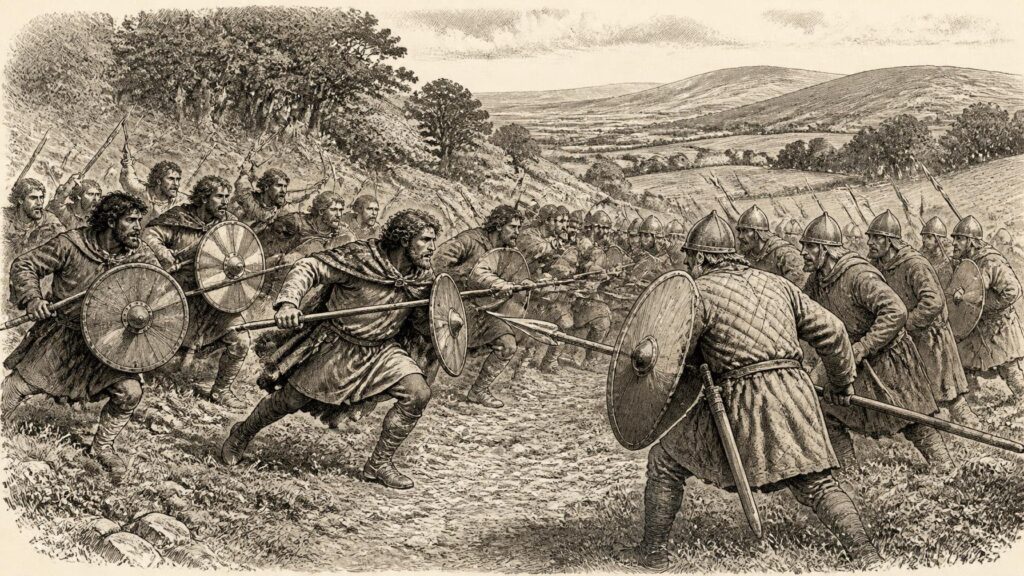
The encounter at Drumrat was remembered for Fedlim’s tactical order. He told his men not to shoot, but to lower their heads and charge fiercely at close quarters. The annals say that the Justiciar’s soldiers could not withstand the onset and were routed back upon their allies; many were killed, among them a man called Mac Mibric. The named casualty should not be inflated into evidence for the size of the action, which the sources do not give. But the result was clear enough: Fedlim’s coalition broke the immediate resistance facing it.
The rival descendants of Ruaidrí then withdrew, and the annalists say that they were dispersed so thoroughly that they no longer had a residence in Síl Muiredaig, the central Connacht territory associated with the Ua Conchobair kings. Fedlim’s men plundered their people and made major raids upon Conchobar son of Cormac in Tír Oilella. Warfare in 1237 was therefore not confined to a single clash. Its intended consequences included displacement, the seizure of movable wealth, and the destruction of a rival’s ability to maintain followers.
Waterways and Hostages
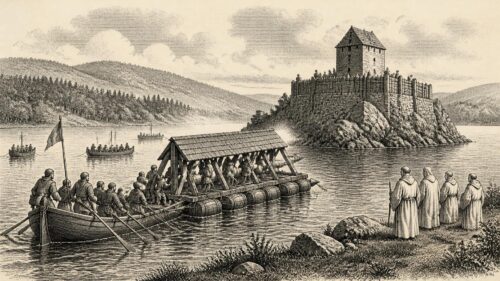
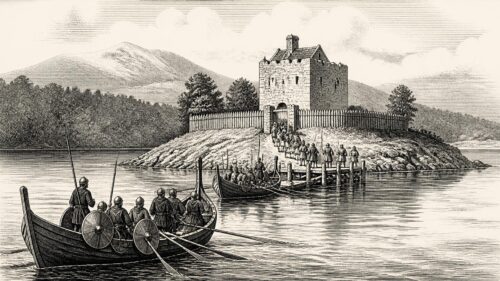
The campaign extended onto Lough Key. Fedlim’s party brought a fleet onto the lake, expelled Conchobar son of Cormac from Magh Luirg, and installed Donnchad son of Muirchertach Luathshúilech in authority over the district and lake. Lough Key was more than scenery: boats could move armed men, supplies and communications around a landscape otherwise divided by woods, bogs and lordship boundaries. Control of its shores and islands was a strategic asset.
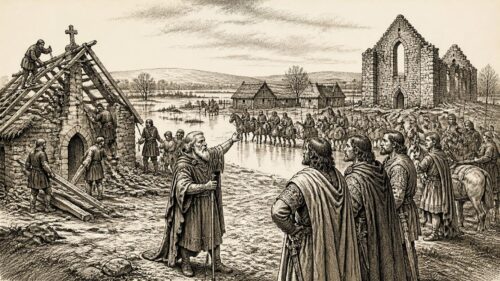
Yet the settlement proved fragile. Donnchad’s reign lasted only a month before Conchobar recovered the lordship. During that brief interval Donnchad granted Drommann Iarthair and land extending from Lathach Cille Bráin to the lake—specified as wood, plain and bog—to the community of Holy Trinity on Lough Key and to Clarus Mac Máelín. The unusually detailed description preserves a glimpse of resources valued in a lordship: timber, grazing or arable ground, wetlands and access to water. A religious gift was at once an act of devotion, a statement of legitimate rule and a practical transfer of productive landscape.
The harder edge of political control appears in another entry. Fedlim had the hostages of Conchobar son of Cormac killed. Hostages were not incidental prisoners. They were persons delivered as security for agreements, submission or good conduct, often drawn from elite families. Their deaths demonstrate both the coercive foundations of medieval diplomacy and the danger faced by kin when a political compact collapsed. Other killings within the extended Ua Conchobair kindred in the same year underline that victory at Drumrat did not end the family’s internal violence.
Peace and New Fortifications
Despite his victory over troops attached to the Justiciar, Fedlim made peace with the Justiciar during 1237. The annals say that the five King’s Cantreds were given to him free of cattle-tribute or rent. The wording is important and should be left close to the source: it records a fiscal and territorial arrangement, not the restoration of an uncomplicated independent kingship. Fedlim could be a powerful Gaelic ruler and, simultaneously, negotiate with the structures of the English lordship over dues, land and recognition.
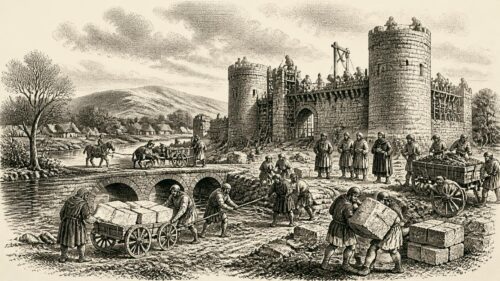
The same year, the ‘Irish barons’ entered Connacht and began building castles there. The annals do not name the individual sites begun in 1237, so it would be unsafe to attach this statement to a particular surviving ruin. Nor do they specify materials. A castle could begin as an earth-and-timber enclosure before acquiring more durable structures. What the notice securely conveys is a change in the province’s political landscape. Castles provided defensible bases for garrisons, administration, settlement and the collection of revenues; their construction made claims to territory visible and enduring.
This development belongs to the immediate aftermath of the English advance into Connacht in the 1230s, but it should not be treated as an event with a single, finished outcome in 1237. Fedlim’s peace and the barons’ building programme point in opposite directions only at first sight. Both were methods of ordering a contested province: negotiated recognition for a king, and fortified footholds for incoming lords. Neither removed the need for local alliances, as the Drumrat campaign had just shown.
Church Authority at Athlone
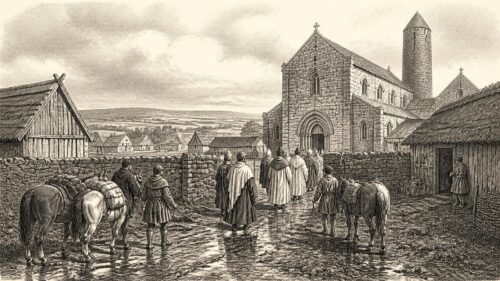
At Athlone, Máel Muire Ó Lachtáin held his first synod after receiving his pallium from Rome. The pallium, a woollen vestment sent by the papacy to metropolitan archbishops, marked his recognised authority as archbishop of Tuam. The choice of Athlone was significant. Standing at a principal Shannon crossing, the town connected Connacht with the midlands and the English-held east; it was an apt place for a provincial church gathering in a politically divided landscape.
A synod did not merely offer ceremony. It was an assembly through which bishops and leading clergy could address discipline, jurisdiction and the practical rights of churches. The annal’s notice is brief, so its specific decisions are unknown. Still, the event firmly demonstrates that the ecclesiastical reform associated with dioceses, archbishops and papal links was being enacted in Connacht in 1237, rather than existing only in distant canon law or in Latin correspondence.
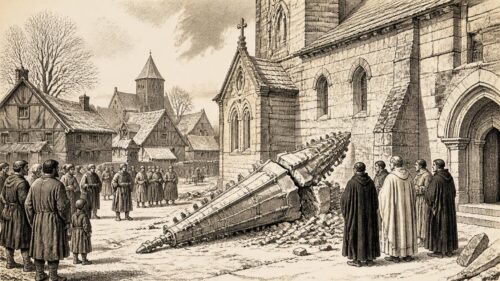
Religious leadership also changed elsewhere. Donait Ó Fidhabra, successor of Patrick—that is, head of the principal Patrician ecclesiastical office at Armagh—died. Thomas Ó Ruadáin, bishop of Luighne, and Gilla Ísa Ó Tormaig, bishop of Conmaicne, also died, while Gilla na nÉcc Ó Mannacháin died at Boyle monastery. These entries are reminders that monasteries and episcopal churches were centres of community as well as prayer: they housed clerics, preserved memory, received gifts of land and could be caught up in political change.
A New House on Lough Oughter
One of the year’s constructive developments lay in Bréifne. Clarus Mac Máelín began building a monastery for canons on Trinity Island in Lough Oughter, aided by a gift from Cathal Ó Raigillig. The annals give no architectural description and do not license an imagined grand stone abbey in 1237. They do, however, record the beginning of an institutional project: an island site, a patron from the ruling dynasty of the region, and a community of canons linked by its dedication to Holy Trinity with the community on Lough Key.
This foundation and Donnchad’s land grant on Lough Key show how religious patronage worked amid instability. Lords could seek spiritual benefit and commemoration, but they also strengthened relationships with communities able to manage land, prayer and prestige. Islands offered seclusion and defensibility, while lakes connected them to surrounding territories. In a year marked by raids, hostages and castles, the deliberate creation and endowment of religious houses was another way in which power was placed upon the landscape.
No surviving annal for 1237 records a harvest, epidemic or exceptional weather for Ireland. It is better not to manufacture an ordinary year’s conditions from the much harsher reports attached to nearby years. What can responsibly be said is that people in Connacht and Bréifne lived through a year in which armed coalitions crossed difficult country, fleets used inland waters, rival lords redistributed land, church leaders convened at a major crossing, and new fortifications and religious communities began to reshape local life. Drumrat was a sharp military success for Fedlim, but the month-long rule at Magh Luirg, the killing of hostages and the arrival of castle-builders reveal how provisional that success remained.
Primary Sources
- Annála Connacht, Annal 1237 (translation)
- Annála Connacht, Annal 1237 (Irish text)
- Annals of Loch Cé, Annal LC1237
- Annals of the Four Masters, Annal M1237
- The Annals of Ulster AD 1202–1378
- Chronicon Scotorum
- Annals of Inisfallen
- Mac Carthaigh’s Book
- Annales Dominicani de Roscoman
- Calendar of Documents, Relating to Ireland: 1171–1251
- Calendar of Documents Relating to Ireland, Volume 1 (1177)
- Anglo-Norman Relations with Connacht, 1169–1224
- King and Magnate in Medieval Ireland: Walter de Lacy, King Richard and King John
- Anglo-Irish Shire Government in the Thirteenth Century
- Pope Innocent III and the Irish Kings
- Normans & Natives in Medieval Connacht
- Notes on the Early History of Tuam, Killala and Achonry
- The Church of St Ciarán: An Irish Royal Church in a Changing World
- The Abbey at Trinity Island, Lough Oughter
- Inside a Medieval Gaelic Castle
- CELT Project: Annála Connacht
- Exploring the Irish Annals