Fincharn and the Connacht Crown1230 CE
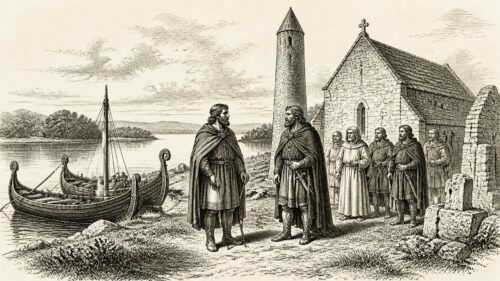
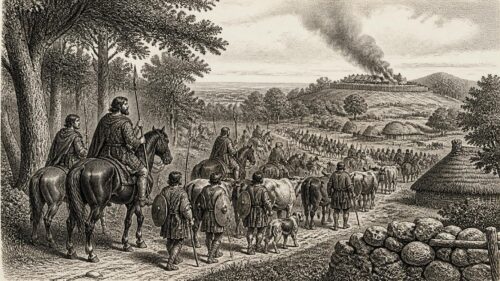
In 1230, Áed mac Ruaidrí Ó Conchobair’s revolt against Richard de Burgh, Mac William, intensified Connacht’s succession crisis. De Burgh assembled Anglo-Norman and Gaelic allies, advanced through Galway and Mayo, secured submissions and hostages, and defeated Donn Óc Mac Airechtaig’s forces at Fincharn. His troops devastated communities sheltering with cattle in remote terrain, causing hunger, deaths and dispossession. At Lough Key, de Burgh installed Fedlimid mac Cathail Chrobdeirg as king and expelled Áed, who sought Ó Néill’s protection in Tír Eógain. The year also recorded Áed Ó Néill’s death and obituaries illuminating ecclesiastical leadership, monastic craftsmanship and scholarship across Ireland.
Dateline
The best-documented Irish story of 1230 is a struggle for Connacht in which a disputed kingship, an Anglo-Norman lord’s military reach, and the safety of ordinary households became inseparable. The surviving annals do not provide a day-by-day chronicle, and no precise date can responsibly be assigned to the campaign. They do, however, place its principal events firmly within this calendar year: the rebellion of Áed son of Ruaidrí Ó Conchobair, the counter-campaign led by Richard de Burgh, the elevation of Fedlimid son of Cathal Crobderg, and the death of Áed Ó Néill of Tír Eógain.
These events belonged to a longer Connacht succession crisis, but 1230 was not merely another episode in a familiar feud. It demonstrated how claims to lordship could be pressed by mobile forces drawn from several communities, how hostages and cattle were central instruments of power, and how violence reached people seeking shelter in woods, hills, islands and monastic precincts. It also brought a decisive, if temporary, rearrangement of Connacht’s political leadership.
A Revolt Against Mac William
Áed mac Ruaidrí Ó Conchobair had emerged as king of Connacht after the killing of Áed, son of Cathal Crobderg, in 1228. His position remained vulnerable. Richard de Burgh, normally called Mac William or “the son of William” in the Irish annals, was the son of William de Burgh and possessed a royal-backed claim to extensive rights in Connacht. The province was therefore contested not simply between two Irish royal branches but within a political world in which English royal grants, Anglo-Norman magnates, Irish rulers and local kindreds all had interests.
In 1230 Áed mac Ruaidrí and his Connacht followers turned openly against de Burgh and the annals’ Galla, or Foreigners. The Annals of Connacht attribute the decision especially to Donn Óc Mac Airechtaig and Cormac Mac Diarmata, together with their followers. Their reported pledge was stark: they would not accept a lord who would bring them into submission to the Foreigners. That phrase records a political programme rather than a simple ethnic divide. The campaigning that followed involved Irish allies on both sides, while the annals also show individual Irish dynasties calculating which claimant offered the safer or more profitable settlement.
The rebels immediately raided de Burgh’s interests. Áed and men of western Connacht plundered the young son of William and Adam Dubh, while Donn Óc, the sons of Magnus and new levies of Síl Muiredaig struck lands associated with Mac Goisdelb and Tír Maine as far as Athlone. Raiding was not peripheral to medieval warfare. The seizure of livestock damaged wealth, food supply and status; it also challenged an opponent’s ability to protect dependants and clients. The route towards Athlone shows that the contest touched the approaches to the Shannon as well as Connacht’s western seaboard.
Galway’s River Frontier
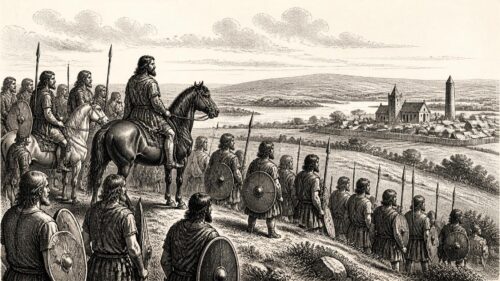
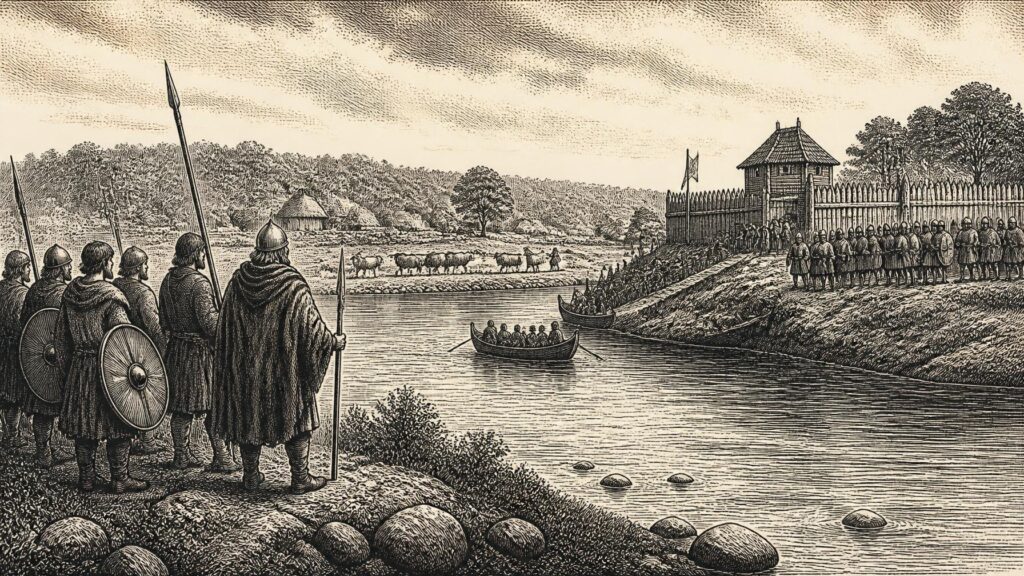
De Burgh responded by assembling what the Annals of Connacht describes as the Foreigners of Ireland and his Gaelic forces. He entered Connacht with Fedlimid mac Cathail Chrobdeirg, whom he intended to establish as king while driving out Áed mac Ruaidrí and the other rebels. The campaign’s first recorded objective was Bun Gaillimhe, at the mouth of the River Galway, where Áed Ó Flaithbheartaig held out. The place was already a strategically important river crossing and coastal strongpoint; it was not yet the later walled town of Galway.
Áed mac Ruaidrí came to assist Ó Flaithbheartaig, accompanied by Connachtmen and the sons of Muirchertach Ó Conchobair. The opposing forces faced one another across the river: Connacht’s men on the west bank, de Burgh’s army on the east. The annal reports fighting every day but no agreement, hostages or submission. This was a meaningful check on de Burgh’s advance, even if it did not halt the expedition. A brief southern notice in the Annals of Inisfallen also records that a major force, including Mac William, Irish magnates and Munster allies, reached Ó Flaithbheartaig’s territory, underlining the breadth of the coalition involved.
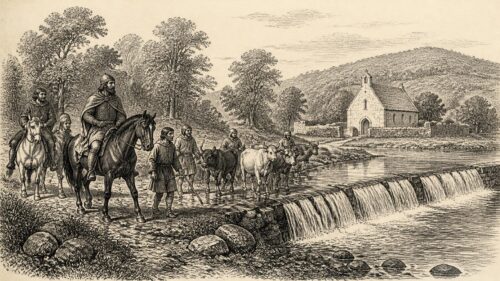
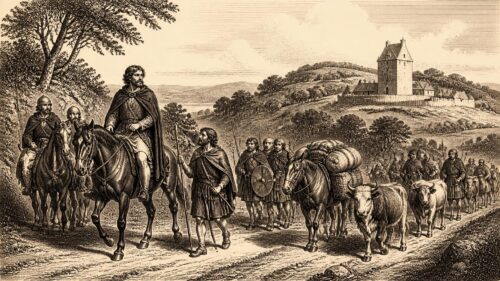
Unable to compel the defenders immediately, de Burgh’s force turned towards those who had withdrawn with their cattle and households to mountain fastnesses, islands and other difficult ground. The target was therefore the social base of resistance. At Droichet Ingine Goilin, and then around Cong and Inishmaine, de Burgh’s men caught a party of Connachtmen who had been ferried across the water during the night in small groups. Several officers of Magnus mac Muirchertach Ó Conchobair were killed. The episode reveals the practical constraints of flight: lakes and inlets could shelter families and herds, but boats, fords and narrow crossings also created dangerous bottlenecks.
Submission, Hostages and Fincharn
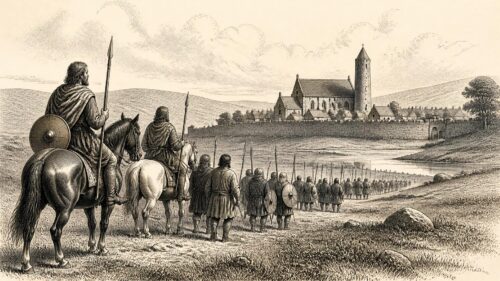
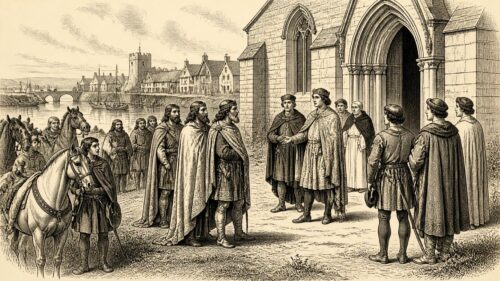
The host moved through Mayo and north Connacht. At Ballintober, canons and religious people asked de Burgh not to encamp beside them overnight; he granted the request and marched on. The detail should not be romanticised as immunity for the Church, but it shows that religious communities could approach a commander and negotiate for immediate protection. Elsewhere, pressure was harsher. Magnus mac Muirchertach made submission at Aghagower, surrendering pledges and hostages. Such hostages were political guarantees: their delivery bound a ruler or kindred to the terms imposed by a stronger force, while exposing families to grave personal risk if those terms were broken.
De Burgh then travelled through Luighne and the Curlew Mountains. Áed mac Ruaidrí, Cormac Mac Diarmata, Donn Óc and men of Síl Muiredaig had withdrawn into woodland, while people and cattle had been sent towards Slieve Anierin and remote places. They initially chose not to challenge the advancing host. Donn Óc rejected that restraint. At Fincharn he took a position on the western flank with kinsmen, young warriors of Síl Muiredaig, his own Foreigners, troops belonging to the son of Domnall Bregach Ó Máel Sechlainn, and Brian son of Toirrdelbach Ó Conchobair.
The resulting encounter was a disaster for the rebels. Donn Óc sent men to harry the passing army, but de Burgh’s soldiers and horsemen worked around the hill or cairn and surrounded his position from the west. The annalist’s account of Donn Óc’s death is plainly commemorative: wounded by five arrows and armed only with an axe, he is said to have kept a mounted attacker at bay before being overwhelmed. Its precise martial detail cannot be independently tested, yet the outcome is secure. Donn Óc was killed, as was Echtigern Ó Minacháin, son of the brehon or jurist.
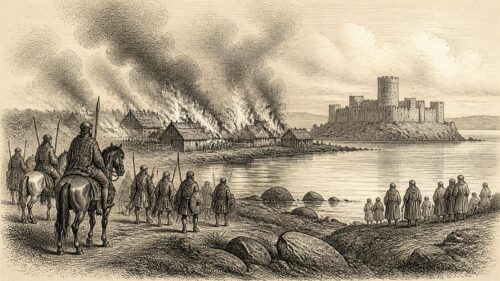
Victory at Fincharn opened the way for a punitive sweep. The Annals of Connacht reports that de Burgh’s forces took great prey from Slieve Anierin, leaving people reduced to cold and hunger; women and children were killed, and survivors were stripped of possessions. Such testimony is unusually direct about the human cost of a campaign otherwise described through rulers, routes and submissions. It also explains why cattle, provisions, shelter and access to difficult terrain mattered so much in the politics of 1230.
A New King, Then an Uncertain Refuge
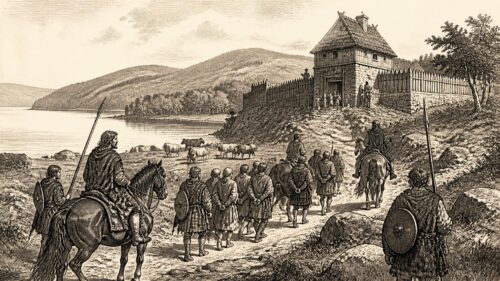
After the raid, the victorious army spent nine nights on the shore opposite the Rock of Lough Key. There it gave the kingship of Connacht to Fedlimid mac Cathail Chrobdeirg and banished Áed mac Ruaidrí. The annals state that the latter sought refuge with Áed Ó Néill, king of Tír Eógain. Fedlimid’s installation was a real political achievement for de Burgh, but it should not be mistaken for the uncontested absorption of Connacht. Kingship still depended on local followings, rival branches of the Ó Conchobair dynasty remained active, and de Burgh’s authority required repeated military enforcement.
The same year saw the death of Áed Ó Néill, a ruler whom the Annals of Ulster and Annals of Connacht praise in exceptionally elevated language. They portray him as king of the North, defender of Leth Cuinn, formidable opponent of the Foreigners, destroyer of castles and protector of dispossessed Gaels. Such language is not neutral biography: it expresses a learned Gaelic political ideal. Yet it confirms his considerable stature and helps explain why an exiled Connacht claimant would look north to his court. The annals do not allow the exact sequence of Áed mac Ruaidrí’s arrival and Áed Ó Néill’s death to be fixed, but the coincidence made the exile’s position still more precarious.
Churches, Craft and Learning
1230’s obituary notices reveal a religious and intellectual landscape extending well beyond the battlefield. Gilla Ísu Ó Cléirigh, bishop of Luighne-Achonry, died, as did Joseph Mac Teithedan, bishop of Conmaicne, Mac Raith Mac Gerraig of Conmaicne Ardagh, Florence Ó Cerballáin of Tír Eógain and Rolf Petit, bishop of Meath. Máel Muire Ó Máel Eoin, coarb of St Ciarán at Clonmacnoise, also died. Their obits mark the importance of episcopal, monastic and hereditary ecclesiastical offices across Gaelic and Anglo-Norman spheres.
Two deaths at Boyle are especially revealing. Donnsléibhe Ó hInmainén was remembered as a holy monk and chief master-carpenter, while Máel Sechlainn Mac Fhirédin was called a distinguished priest and master of learning, though he died as a novice there. Boyle Abbey was a major Cistercian house, and these notices show that its community valued both skilled construction and scholarship. They do not prove the details of any building project in 1230, but they offer a rare glimpse of the specialised people whose labour and learning sustained religious institutions.
Thus 1230 was a year in which Connacht’s crown changed hands through war, while religious houses continued to offer negotiation, refuge, training and commemoration. The annals’ strongest memory is of de Burgh’s destructive victory and Fedlimid’s installation. Equally important is what that memory preserves around the margins: families moving cattle towards safety, ferries crossing at night, clerics seeking to protect a precinct, craftsmen serving a monastery, and a northern king whose death altered the map of refuge and alliance.
Primary Sources
- Annála Connacht: Annal 1230
- Annals of Loch Cé: Annal LC1230
- The Annals of Ulster: Year U1230
- Annals of the Four Masters: Annal M1230
- Annals of Inisfallen: Annal I1230
- Annales Dominicani de Roscoman
- Annales Hiberniae, edited by Richard Butler
- CELT: Annála Connacht project and annal index
- Burgh, Richard de
- O'Connor (Ó Conchobair), Áed
- O'Connor (Ó Conchobair), Fedlimid
- O'Neill (Ó Néill), Áed
- Burgh, William de
- Ua Conchobair, Ruaidrí
- O'Neill (Ó Néill), Brian
- Medieval and Post Medieval, Galway City Museum
- Galway/Gaillimh: Irish Historic Towns Atlas
- Gaillimh/Galway, logainm.ie
- Boyle Abbey, Boyle, Corpus of Romanesque Sculpture in Britain and Ireland
- The Crusades to 1291 in the Annals of Medieval Ireland