Amlaíb’s Two Royal Killings977 CE
In 977, Amlaíb Cuarán, Scandinavian-Gaelic ruler of Dublin, killed Muirchertach son of Domnall ua Néill and Congalach son of Domnall, both designated royal heirs of Ireland. Their deaths weakened Domnall, king of Tara, amid contested Uí Néill succession, illustrating Dublin’s influence within intertwined Irish and Viking dynasties. Domnall also killed Gilla Coluim ua Canannáin, lord of Cenél Conaill. Annals record Conaing, successor of Moedóc, dying, while Chronicon Scotorum chronologically associates Domnall’s plundering of Adomnán’s shrine with 977. Irish sources also noted a Scottish royal killing, reflecting Irish Sea connections. Misdated records exclude Leinster and Kildare events from this calendar year.
Dateline
In 977, the most consequential Irish event securely assigned to the year was not a pitched battle or a change of king, but a killing that reached into the heart of royal succession. The Annals of Ulster record that Muirchertach, son of Domnall ua Néill, and Congalach son of Domnall were killed by Amlaíb son of Sitriuc, the ruler of Viking Dublin. The annalist calls both men rígdamna Érenn: royal heirs, men eligible for the kingship of Ireland. The wording was deliberate. Their deaths were not merely private murders among noble families, but a violent intervention in the uncertain politics of supremacy.
Two Heirs Removed
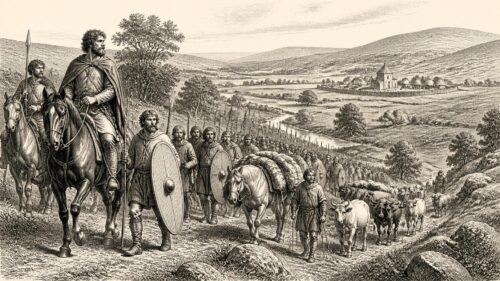
Domnall ua Néill, king of Tara and leading ruler among the northern Uí Néill, was still alive in 977. He had held pre-eminence since the mid-950s, but that authority was neither a modern monarchy nor an uncontested national office. Ireland was governed through overlapping provincial kingships, kin-groups, clientships and ecclesiastical alliances. A ruler described as king of Tara could claim a paramount position, receive hostages and lead armies across provincial boundaries; he could not automatically command every region. His authority had to be made real through negotiation, tribute, military display and the placement of trusted relatives in strategically important territories.
Muirchertach was Domnall’s son and, as later evidence shows, father of Flaithbertach Ua Néill, who would become king of Ailech. Congalach was another claimant of royal standing, identified in the Annals of the Four Masters as son of Domnall son of Congalach. The two men may not have represented one simple line of succession, but the annal’s collective designation shows that each mattered to the future of the Irish overkingship. Their deaths narrowed the field at a moment when Domnall’s long reign was approaching its end.
The source does not say where the killings occurred, whether they followed a battle, an ambush or an act of treachery, or which supporters stood beside the victims. Those silences matter. It would be tempting to turn the terse entry into a dramatic raid from Dublin, yet the evidence does not permit it. What can safely be said is that Amlaíb Cuarán—Amlaíb son of Sitriuc—was held responsible, and that the victims’ rank made the act politically explosive.
Dublin’s Calculated Reach
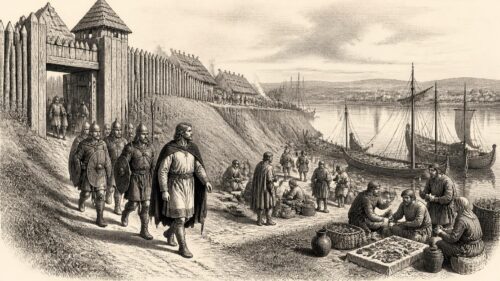
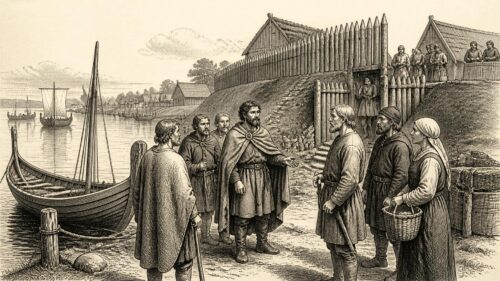
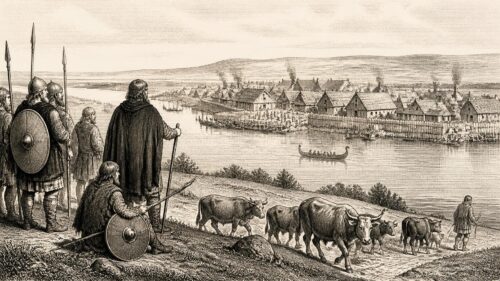
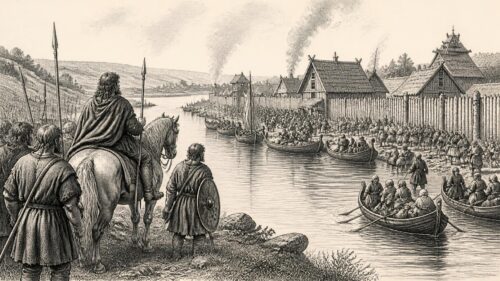
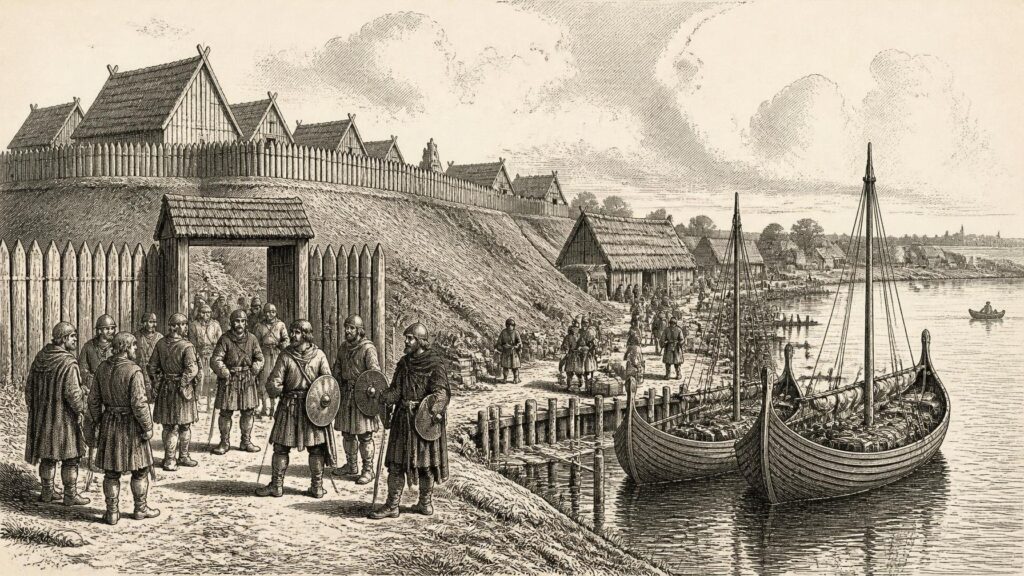
Amlaíb was no passing raider. He was the Scandinavian-Gaelic king of Dublin, a ruler whose life and family linked Ireland to Northumbria, the Isles and western Scotland. Dublin in the tenth century was a defended settlement beside the Liffey, enclosed by substantial earthen banks and connected by sea-routes to Britain and the wider Irish Sea. Its ships, merchants, craftsmen, warriors and accumulated wealth gave its king resources unlike those of a purely rural lordship. The city was Irish in its setting and increasingly mixed in population, yet it remained capable of acting as an armed political power in its own right.
The killing of the two rígdamna demonstrates that Dublin’s power extended beyond its walls and coastal hinterland. Amlaíb was also tied by marriage to the political world of the Uí Néill: Domnall ua Néill’s sister Dúnlaith had been Amlaíb’s wife. Such marriages did not prevent conflict. On the contrary, kinship created channels for alliance, fosterage, rivalry and revenge. The relationship makes 977 a reminder that the familiar contrast between “Irish” and “Viking” is too blunt. The contestants were entangled dynasties, not sealed ethnic blocs.
For Domnall ua Néill, the loss was both personal and strategic. His northern Cenél nEógain kindred had built their position through generations of warfare and alliance-making, while rivals in Mide, Brega, Leinster, Connacht and Dublin all possessed their own claims and ambitions. Removing a prominent son and another royal claimant did not automatically overthrow Domnall, but it weakened the human network through which an ageing overking projected influence. It also improved the relative prospects of Máel Sechnaill mac Domnaill of Clann Cholmáin, Domnall’s nephew and eventual successor, although no source says that Máel Sechnaill arranged or approved the killings.
A Northern Counterstroke
The same year’s annal contains another killing, this time attributed directly to Domnall ua Néill himself: Gilla Coluim ua Canannáin was slain by the king. The Annals of the Four Masters, in an entry whose corrected chronology corresponds to 977, calls Gilla Coluim lord of Cenél Conaill. Cenél Conaill, based principally in the north-west, was a fellow branch of the northern Uí Néill world but also a long-standing competitor of Cenél nEógain.
Again, the record refuses to supply a narrative. There is no named battlefield and no explanation of motive. Yet the juxtaposition is telling. In a year when Dublin’s ruler killed men described as heirs to Ireland, Domnall killed a northern rival lord. The two notices should not be treated as proven parts of one campaign, but together they reveal a political order in which succession, territory and personal security were inseparable. Kingship was sustained by armed followings and vulnerable to sudden elimination.
This was not conflict between a central state and rebellious peripheries. Cenél Conaill and Cenél nEógain were major dynastic interests whose relationship combined common ancestry with rivalry. A king of Tara could seek to discipline a northern competitor, but he did so in a landscape of local lordships, church federations and shifting military coalitions. The annals’ compression is itself revealing: for their compilers, the identity and rank of those killed mattered more than a descriptive account of manoeuvres.
Church Offices and Sacred Property
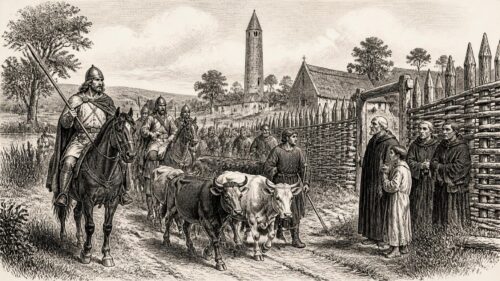
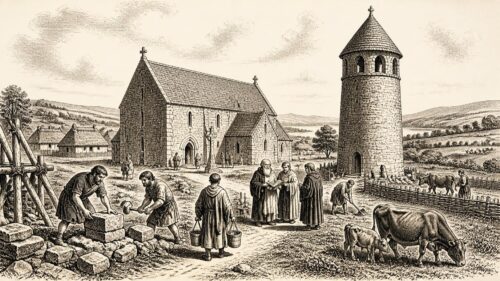
Political violence did not make ecclesiastical life peripheral. The Annals of Ulster also record the death of Conaing son of Cadán, “successor of Moedóc”. Such a title denoted more than personal piety. A successor, or comarba, inherited the standing associated with a saint and exercised authority over a church community, its lands, tenants, revenues, relics and learning. The notice is brief, but it points to the institutional texture of tenth-century Ireland: churches were centres of worship and scholarship, but also durable landed powers whose leaders belonged to the political world around them.
A further report must be handled with care because it exposes the difficulties of annalistic dating. Chronicon Scotorum places the plundering of the shrine of Adomnán by Domnall ua Néill under its annal 978. In this section of that chronicle, however, its year-numbering is one year ahead of reconstructed AD chronology, so the episode is conventionally placed in 977. It is therefore responsibly connected with this year, though the internal heading should not be silently treated as a modern calendar date.
The shrine was associated with Adomnán, the seventh-century abbot of Iona and biographer of Columba. To plunder such an object was to take valuable metalwork and movable wealth, but also to violate a focus of communal memory and saintly protection. Domnall’s responsibility is striking: secular rulers could be patrons, protectors and donors to churches, yet political pressure could also bring them into conflict with ecclesiastical property. The entry offers no explanation, no location and no account of restitution. It should not be enlarged beyond that. Still, it warns against imagining church and kingship as separate spheres.
Across the Narrow Sea
The Ulster annalist also notes that another Amlaíb, son of Amlaíb and described as king of Scotland, was killed by Cinaed son of Domnall, king of Alba. This was an event in Scotland, not Ireland; its inclusion here is justified because it was recorded in an Irish chronicle and belongs to the closely connected political world of the Irish Sea. The entry does not establish a direct link with Amlaíb Cuarán’s killings in Ireland, and none should be invented. Its value is contextual: Irish chroniclers watched events across the water because rulers, fleets, ecclesiastical communities and dynasties moved through a shared maritime zone.
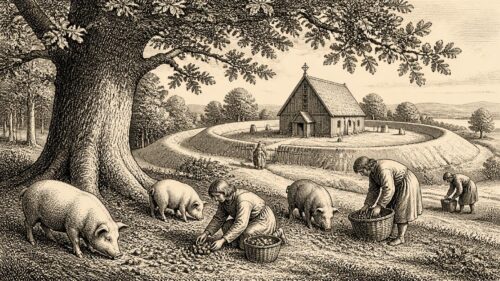
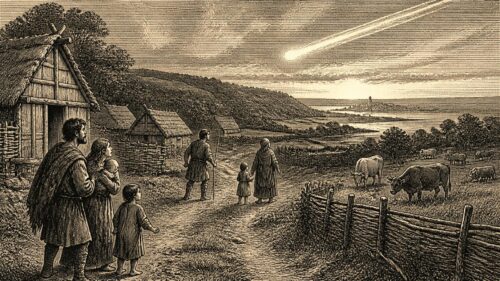
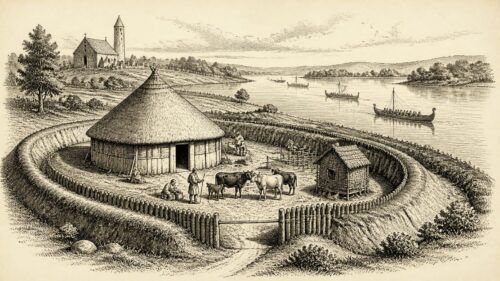
For ordinary people, 977 cannot be reconstructed in comparable detail. The annals preserve kings, clerics and violent acts, not the routines of farmers, fishers, household workers, traders or craftworkers. Archaeology nevertheless suggests the broad setting. Most people lived in rural communities where cattle, grain, dairying and obligations to lords and churches structured life. At Dublin, timber-built houses, workshops, waterfront activity and imported goods attest to an urban economy tied to seaborne exchange. These are conditions of the later tenth century, not events demonstrably occurring in this single year.
Reading a Difficult Year
Careful chronology is essential. The Annals of the Four Masters place the capture of Domnall Claen of Leinster and the plundering of Kildare under their annal labelled 977, but that annal is explicitly marked rectè 979. Those events therefore do not belong in a calendar-year account of 977. By contrast, the killings of Muirchertach and Congalach appear in the Four Masters under the entry labelled 975, itself marked rectè 977, and agree with the securely dated Ulster record.
That distinction leaves 977 neither empty nor simple. It was a year in which Amlaíb of Dublin removed two men who stood near the summit of Irish politics; Domnall ua Néill killed a northern rival; an ecclesiastical successor died; and a royal attack on Adomnán’s shrine is chronologically connected to the year. The immediate future remained open. Yet the deaths of the two heirs showed how precarious the old order had become, and how decisively Dublin could still shape the contest for power in Ireland.
Primary Sources
- The Annals of Ulster: Year U977
- The Annals of Ulster: CELT edition and bibliographical header
- The Annals of Ulster
- Annals of the Four Masters, Volume 2: Annals M975–M978
- Annals of the Four Masters: CELT edition
- Chronicon Scotorum
- Chronicon Scotorum: CELT edition index
- The Annals of Inisfallen
- The Annals of Tigernach
- Chronological Synchronisation of the Irish Annals
- Ua Néill, Domnall | Dictionary of Irish Biography
- Ua Néill, Flaithbertach | Dictionary of Irish Biography
- Vikings in Ireland and Scotland
- General Vikings in Ireland
- The Vikings in Ninth-Century Ireland: Sources and Settlements
- Getting to Know Dublin
- Unpublished Excavations in the Republic of Ireland 1930–1997, Volume 2
- History of the Irish State to 1014
- 21. Clann Cholmáin, Caille Follamain
- The Ninety-Ninth Year
- Exploring the Irish Annals
- Irish Texts at CELT