Mathgamain’s Broken Guarantee976 CE
In 976, Ireland experienced political upheaval marked by Mathgamain son of Cennétig’s treacherous killing after Donnubán of Uí Fidgente surrendered him to Máel Muad despite guarantees. His death disrupted Dál Cais ascendancy in Munster, leaving Brian’s future leadership uncertain. Donnchad of Osraige and Domnall of Brega also died, while Tadc of Cianachta and Máel Sechnaill of Gabair were killed. Ecclesiastical authority remained influential yet vulnerable: Conaing died, Colum Cille’s shrine was plundered, and Nendrum’s superior was burned. Annals depict fragmented, negotiated power, linking kingship, churches, warfare and Norse-Gaelic involvement across Ireland while stressing continuity in ordinary life beyond recorded events.
Dateline
A Year Recorded Through Loss
For Ireland, 976 CE is most securely remembered as a year of violent political reversal in Munster and of important deaths elsewhere on the island. The evidence is unusually revealing but also demands care. Medieval Irish annals preserve events under year-headings that do not always align perfectly between manuscripts and later compilations. Nevertheless, the Annals of Ulster and Chronicon Scotorum both place the killing of Mathgamain son of Cennétig, king of Munster, in 976, while the Annals of Inisfallen preserves a fuller account of his capture and execution in a displaced entry. Taken together, they make the broad historical sequence clear even where the mechanics of annalistic dating are difficult.
The year therefore cannot be understood as a simple list of unrelated deaths. Mathgamain’s fall ended a remarkable phase in the rise of Dál Cais power. At the same time, the deaths of Donnchad son of Cellach, king of Osraige, and Domnall son of Congalach, king of Brega, showed how much political authority still rested upon individual rulers and their dynastic households. Further entries concerning monasteries, pilgrimage, plunder and local killing offer a glimpse of a country in which royal, ecclesiastical and maritime power were deeply intertwined.
Mathgamain’s Killing in Munster
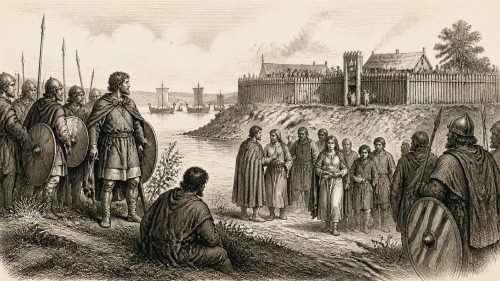
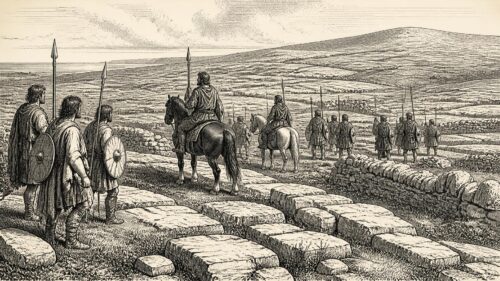
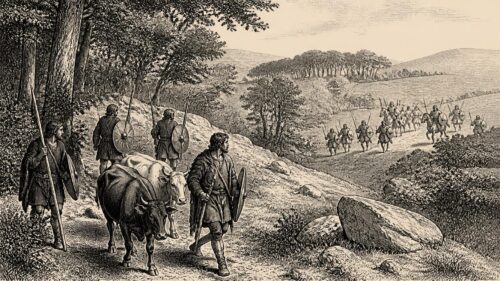
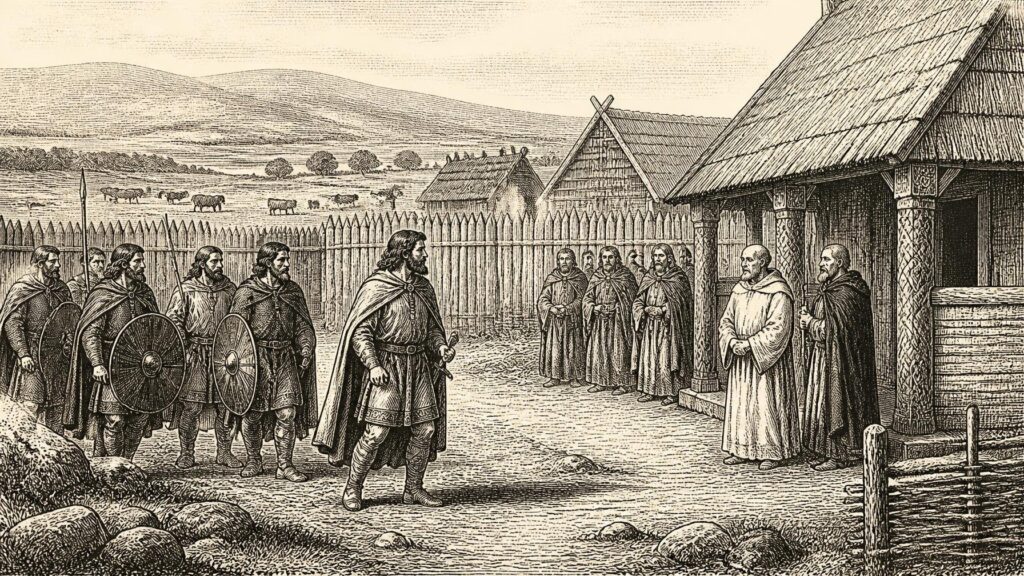
The central event was the killing of Mathgamain son of Cennétig. The Annals of Ulster call him king of Caisel and state that Máel Muad son of Bran killed him. Chronicon Scotorum adds the decisive political detail: Mathgamain was handed over “in treachery” by Donnubán son of Cathal, king of Uí Fidgente, to Máel Muad, king of Uí Echach. The fuller Inisfallen version says that Donnubán seized Mathgamain and delivered him to the son of Bran despite a guarantee and despite the opposition of the “elders of Mumu”. It is an unusually explicit record of a killing that contemporaries or near-contemporaries regarded as a breach of protected conduct rather than an ordinary battlefield death.
Guarantees mattered in the political culture of early medieval Ireland. Kings and nobles could negotiate, submit, exchange hostages, travel under protection, or accept clerical mediation. Such arrangements were not evidence of a peaceful state; rather, they were practical devices for managing recurrent rivalry between kindreds and kingdoms. To kill a protected man was to injure not only him and his immediate followers but also the status of those who had guaranteed his safety. The annalists’ language preserves that moral and political charge. It warns against treating the event merely as one more dynastic assassination.
Mathgamain’s position had been hard won. He belonged to Dál Cais, a rising north Munster lineage based around the Shannon region, rather than to the long-established Eóganacht dynasties traditionally associated with the kingship of Cashel. Earlier in the 960s and 970s he and his brother Brian had led the Dál Cais into conflict with rivals in Munster and with the Norse-Gaelic community of Limerick. Mathgamain had demonstrated real authority in 973 when, according to the Annals of Inisfallen, he intervened in a dispute over ecclesiastical dues between the coarbs, or hereditary successors, of Patrick and Ailbe during an Armagh visitation in Munster.
That earlier arbitration helps explain the significance of 976. Mathgamain was not simply a local war-leader. He had become a figure whose authority could affect the claims of major churches and the balance between regional rulers. His death opened the way for Máel Muad’s restoration in the Munster kingship, but it did not erase the Dál Cais. Brian, Mathgamain’s younger brother, remained an important leader in north Munster. The better-known later campaigns associated with Brian should not be projected back into the year itself: in 976, the immediate fact was the abrupt removal of his brother and the uncertainty that followed.
Osraige Loses a Long-Standing King
The death of Donnchad son of Cellach, king of Osraige, is recorded independently by the Annals of Ulster, Chronicon Scotorum and the Annals of Inisfallen. His passing mattered because Osraige occupied the borderland between Munster and Leinster, covering much of modern County Kilkenny and adjoining districts. Its rulers had to navigate the ambitions of larger neighbours while preserving a kingdom with strong ecclesiastical centres and productive river valleys.
Donnchad had ruled for several decades, following a period in which his family had strengthened Osraige’s standing. A long reign did not guarantee a settled succession. The surviving genealogical material identifies Gilla Pátraic, Donnchad’s son, as his successor, and the next generation would give the dynasty its enduring Mac Giolla Phádraig name. Yet the annals’ stark notice of Donnchad’s death should caution against imagining an orderly modern-style transfer of office. Kingship depended on the support of close kin, client rulers, churchmen and fighting men; an heir still had to secure acceptance.
The event also underlines a broader feature of 976: Irish political geography was not organised as a single united kingdom. A claimant to the high-kingship might command enormous prestige, but power was enacted through provincial and local kingships such as Munster, Osraige, Brega, Ulaid and Cianachta. The death of a ruler in any one of them could unsettle alliances far beyond his own territory.
Deaths and Disorder Beyond Munster
In Brega, the fertile region north of the River Liffey and around the Boyne, the Annals of Ulster record the death of Domnall son of Congalach, king of Brega. Chronicon Scotorum calls him heir designate of Ireland. The language reveals both his high standing and the distance between being marked out as a potential overking and actually attaining that position. The southern Uí Néill ruler Domnall ua Néill still held the high-kingship in 976, but Brega remained central to wider contests for influence around Tara and the midlands.
The same annal records the killing of Tadc son of Ruaidrí, king of Cianachta, in Ulaid. This brief notice is valuable precisely because it is brief: it shows that warfare crossed regional boundaries and that even lesser kingships were named in the national chronicle. The killing need not imply a large campaign; it may have arisen from a raid, a local conflict or a political encounter. The source does not say. What it securely demonstrates is that political violence in 976 was not confined to the contest for Munster.
One further Inisfallen notice records the killing by “foreigners” of Máel Sechnaill son of Flannabra, king of Gabair. The exact location and political scale of Gabair are less certain than those of Munster or Osraige, so the episode should not bear more weight than the source allows. Yet it is a reminder that “foreigners” in the annals were active participants in Irish political life, not a separate force operating beyond it. In the late tenth century Norse-Gaelic rulers, fleets and armed groups were embedded in the shifting alliances of Irish Sea politics.
Churches, Relics and Authority
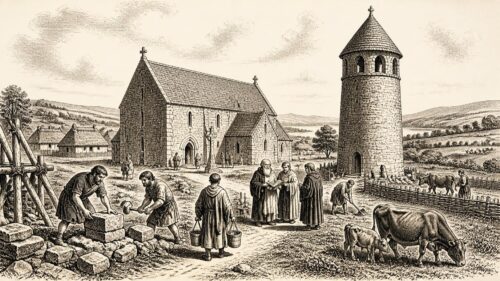
The annals for 976 also register ecclesiastical events that belong to the same landscape of power. Conaing ua Fínáin, successor of Mac Nise and Colmán of Lann Ela, died. Such a title linked him with important saints and churches, and indicates the continuing weight of hereditary ecclesiastical office. Monastic settlements were centres of worship and learning, but they were also landholders, employers, hosts for travellers and custodians of valuable objects.
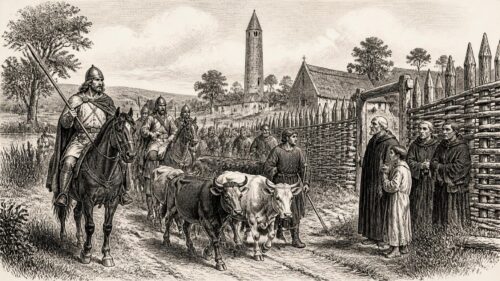
That vulnerability is visible in the Chronicon Scotorum entry that the shrine of Colum Cille was plundered by the son of Domnall son of Muirchertach. A shrine was not merely a container for relics. It embodied the authority of a saint and his religious community, while precious metalwork and offerings made it an attractive target. The notice demonstrates that attacks on ecclesiastical wealth could be undertaken by Irish dynastic actors as well as by Scandinavian raiders. Devotion, prestige and material value were inseparable.
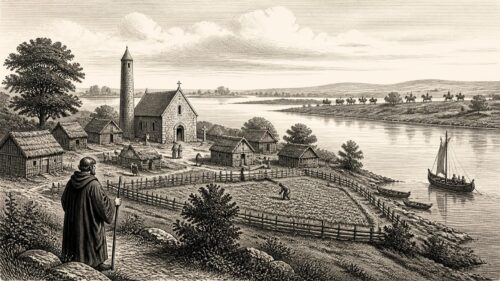
Another entry says that Sétna ua Demáin, superior of Nendrum, was burned to death in his own house. Nendrum, on Mahee Island in Strangford Lough, was a long-established monastic community with a sheltered maritime setting. The annal gives no motive, and it would be unsafe to supply one. But the violent death of its superior makes clear that religious office did not insulate a man from feud, attack or accident in an age when timber buildings and open flames were commonplace.
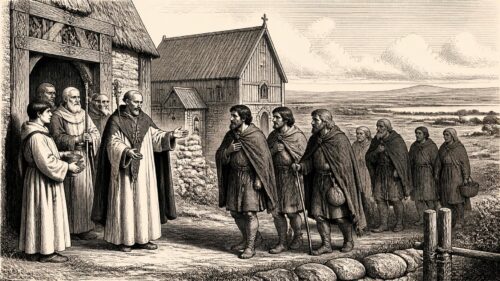
In a more peaceful register, Chronicon Scotorum records Dúnchad ua Braein, successor of Ciarán of Clonmacnoise, travelling on pilgrimage to Armagh and spending thirteen years there in piety. The chronology of this notice, like several tenth-century annal entries, requires caution; it illustrates an ecclesiastical relationship rather than supplying a precise itinerary for 976. Even so, it points to enduring connections between great churches. Armagh’s Patrician authority and Clonmacnoise’s Shannon-centred intellectual and political importance were sustained through people, privileges, relics and travel.
What the Year Allows Us to See
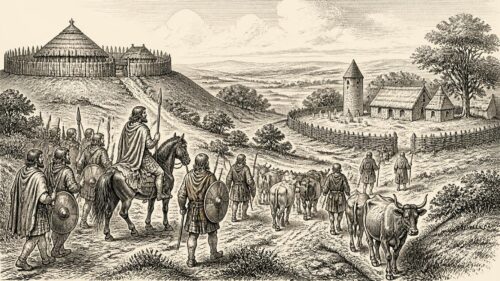
For ordinary households, 976 left no narrative of harvests, marriages or routines. Archaeology and legal material provide the wider setting: most people lived in dispersed farmsteads, often within ringfort enclosures, and depended on mixed agriculture in which cattle, dairying, grain, woodland resources and seasonal labour mattered greatly. But no surviving evidence permits those conditions to be turned into a claimed crisis or prosperity for this specific calendar year. The responsible picture is one of continuity beneath the annals’ political surface, not of a fully documented national experience.
What 976 does reveal with unusual sharpness is the fragility of personal power. Mathgamain’s protected status did not save him. Donnchad’s long Osraige reign ended. A prospective overking in Brega died before realising his claim. Churches retained prestige but could be robbed or attacked. Across Ireland, authority remained local, negotiated and often violently contested. The year’s entries are short, but their combined force is considerable: kingship, religion and warfare were not separate spheres, and a broken guarantee in Munster could reshape the political future of the island.
Primary Sources
- The Annals of Ulster, Year U976
- The Annals of Ulster: Bibliographic and Manuscript Information
- Chronicon Scotorum, Annal CS976
- Chronicon Scotorum: Bibliographic Information
- Annals of Inisfallen, Annals AI972–AI981
- Annals of Inisfallen: Bibliographic Information
- Annals of the Four Masters, Volume 2, Annals M973–M982
- Annals of the Four Masters, Volume 2
- Annals of Tigernach: Bibliographic Information
- The Making of Ireland
- Brian Boru and the Rise to Provincial Kingship
- Kingship of Limerick
- Kingship and Political Practice in Colonial Ireland, 1169–1366
- Genealogical Tables of the Irish Royal Dynasties
- Archaeological Excavations: The Robing Room, Bishop’s Palace, Kilkenny
- Conquest and Foundation: Kilkenny and Osraige
- The Iron Age and the ‘Dawn’ of Idough
- Ringforts / Ráthanna
- Brú na Bóinne Research Framework: Full Report
- Iona and the Shrine of Columba, c. 800–1200
- Cogadh Gaedhel re Gallaibh: The War of the Gaedhil with the Gaill