Domnall Beyond Sliabh Fuaid971 CE
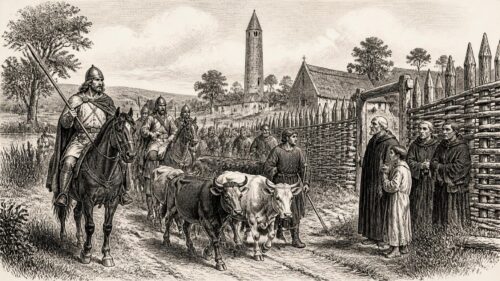
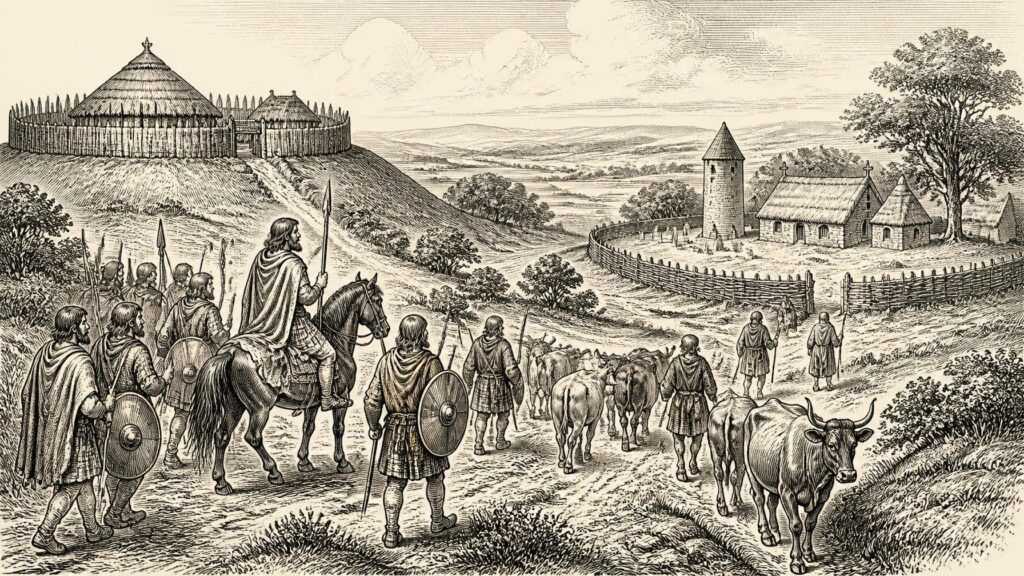
In 971, Domnall ua Néill, Northern Uí Néill king of Tara, was expelled from Mide by Clann Cholmáin, exposing the fragility of his claimed supremacy. He swiftly returned with an army, plundering churches, forts and communities in Mide and raiding Uí Fhailgi and Fotharta to punish resistance and display power. The year also saw the death of Niall son of Áed, king of Ulaid, amid eastern Ulster instability; ecclesiastical succession changes at Ciarán’s and Cainnech’s communities; and Cellach ua Nuadat’s killing by foreigners at a refectory. These entries reveal conflict affecting rural society, churches, dynastic politics and Irish Sea connections.
Dateline
The Irish annals place a sharp crisis of kingship in the entry conventionally labelled 971. The Annals of Ulster, whose dating heading also notes an alternative reckoning, record that Domnall ua Néill, king of Tara, was driven from Mide by Clann Cholmáin, then led an army back against the men of Mide. Chronicon Scotorum tells the same essential story: Domnall was expelled, but was again in Mide and devastated churches and people who opposed him. These are firm annalistic notices for the year-entry, though neither source supplies months, battle sites or a continuous narrative. They nevertheless reveal an Ireland in which a king’s claim to supremacy depended on movement, military following, tribute, ecclesiastical alliances and the ability to make rivals feel the costs of resistance.
An Expelled King
Domnall was a ruler of Cenél nÉogain, the dominant branch of the Northern Uí Néill, and had held the kingship of Tara since the mid-950s. ‘King of Tara’ was a title of immense prestige, but it did not signify command over a unified state with fixed institutions and unquestioned borders. It expressed a claim to precedence among powerful dynasties, especially within the wider Uí Néill world. Mide, the central region associated with Tara, was the homeland of Clann Cholmáin, Domnall’s Southern Uí Néill rivals. Control there was therefore both strategically useful and symbolically indispensable.
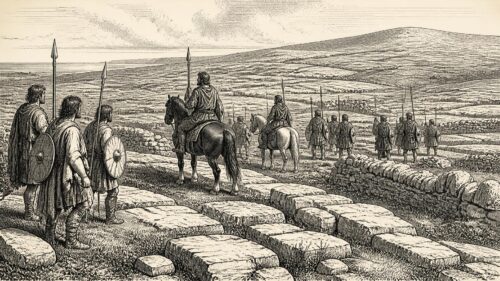
The expulsion recorded for 971 was not a minor local reverse. It showed that Clann Cholmáin could deny Domnall secure authority in the very landscape that underpinned his royal style. The annals do not name the commander who expelled him in their brief entries. A later and much fuller account in the Annals of the Four Masters, entered under 969 in that compilation’s chronology, says that Domnall was driven north across Sliabh Fuaid, the upland region around the modern Armagh–Monaghan border. It adds a verse lamenting that the removal of Tara’s prince would bring scarcity of corn and grass. That detail cannot safely be treated as a precisely dated report for 971, but it preserves how later annalistic tradition understood the political shock: the displacement of a paramount ruler was imagined as a danger to the proper order of land, pasture and food supply.
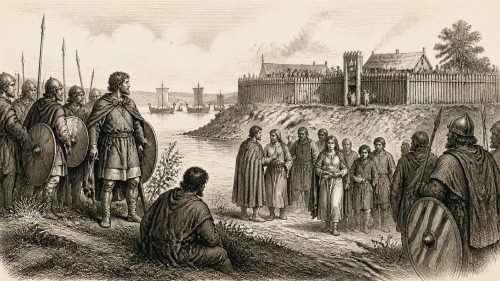
Domnall’s response was immediate enough to appear in the same annal-year. The Annals of Ulster state that he led a hosting against the men of Mide, plundered their churches and forts, and raided Uí Fhailgi and Fotharta. Chronicon Scotorum is still blunter: he devastated both churches and people who stood against him. The wording does not prove that every church or fort in Mide was attacked literally, nor does it identify every target. It does establish a punitive campaign directed at the infrastructure of rival power: settlements, strongholds, ecclesiastical communities and the dependants who sustained them.
War Across the Midlands
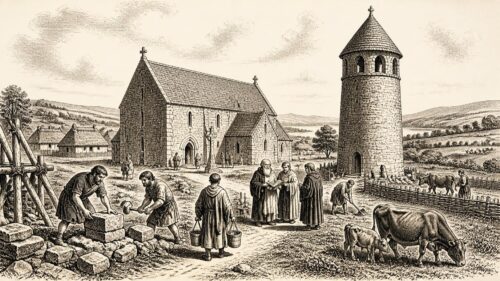
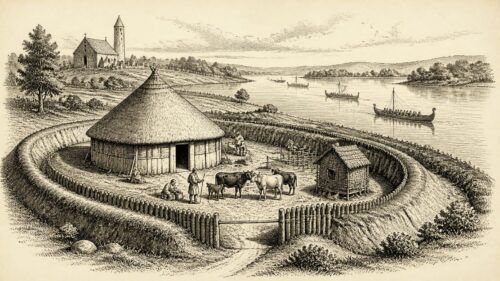
For people in the path of such a hosting, warfare was not confined to a clash between aristocratic war-bands. Early medieval Ireland was overwhelmingly rural. Most households lived and worked in farmsteads, cultivated grain, kept cattle, pigs and sheep, and processed dairy produce and textiles. Cattle were both productive animals and a central measure of wealth; grain, grazing and stored food underpinned the obligations that bound clients to lords. A raid could therefore strike at subsistence as well as status, through seizure, destruction, intimidation and the disruption of seasonal work.
The ‘forts’ in the annal should not be pictured automatically as later stone castles. The Irish word dún could cover a range of defended or high-status places. Across the countryside, ringforts and other enclosed farmsteads housed families, animals, stores and workshops. Their banks, ditches, palisades and gates offered some protection, but they were also visible statements of household standing. To plunder such places was to carry war into the everyday landscape of lordship. The attack on churches was equally practical. Monasteries and churches were religious communities, but also landholders, employers, centres of hospitality, writing, craft and exchange, connected to surrounding client populations.
The reference to Uí Fhailgi and Fotharta extends the consequences beyond Mide’s core. Uí Fhailgi lay in the central Leinster zone, while Fotharta was a name borne by several Leinster-associated populations. The annalist does not provide a route, distinguish separate operations or explain whether these groups had directly supported Clann Cholmáin. It is safest to see the notice as evidence that Domnall’s retaliation reached into politically connected neighbouring territories, rather than as proof of a neatly planned conquest. His purpose was more likely coercion: to punish opposition, obtain movable wealth and demonstrate that exclusion from Mide had not ended his capacity to act.
Ulaid Loses a King
Another firmly recorded death gave 971 a northern importance. Niall son of Áed, king of Ulaid, died. The entry offers no cause of death and no account of succession, so neither battle nor assassination should be inferred. Yet the office mattered greatly. Ulaid was not a modern county but an eastern Ulster kingship, where competing dynasties, neighbouring Airgíalla rulers and Irish Sea interests could all affect political alignments.
The timing was unsettling. In the preceding annal-year, Ardgar son of Matudán, king of Ulaid, had fallen at Cell Móna while fighting alongside Dublin’s foreigners against Domnall ua Néill. In the following year-entry, the annals report conflict between Ulaid and Dál Araide in which Áed son of Loingsech, described as king of the province, was killed. Those surrounding events do not tell us how Niall died in 971, but they place his death within a short period of conspicuous instability in eastern Ulster. Kingship there, as in Mide, was vulnerable to rapid changes in military fortune and dynastic competition.
Churches, Offices and Memory
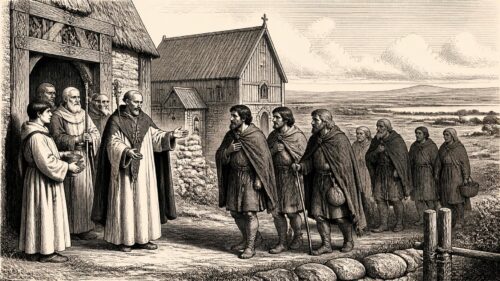
The annals also mark the deaths of Tuathal, successor of Ciarán, and Máel Samna, successor of Cainnech. ‘Successor’ or comarba did not simply mean a spiritual heir in the modern sense. It denoted the holder of an institutional office attached to a saint’s community, its lands, prestige, dependants and inherited rights. Tuathal’s office belonged to the community of Ciarán, associated with Clonmacnoise on the Shannon; Chronicon Scotorum calls him a bishop and says that he died suddenly after a three-day fast. Máel Samna held the succession of Cainnech, one of the major saintly foundations of the Irish midlands and south-east.
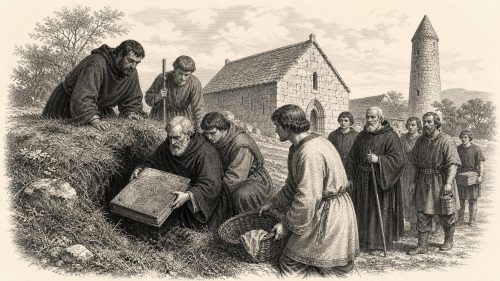
These notices illustrate the Church’s place in tenth-century politics without reducing it to a passive victim of royal violence. Great ecclesiastical centres were repositories of learning and liturgy, but they were also enduring corporate communities with property, tenants and networks of patronage. Clonmacnoise, situated beside the Shannon, was particularly well placed within routes linking the midlands, Connacht and Munster. The death of an office-holder could therefore matter to secular rulers as well as clerics, because a succession might alter local alliances and control over resources.
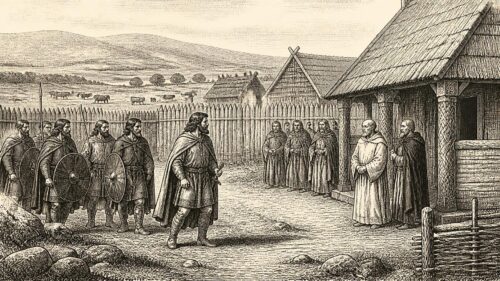
One of the year’s starkest entries concerns Cellach ua Nuadat, killed by ‘foreigners’ before the doorway of the refectory. The notice does not name the place, identify Cellach’s rank, or say which group of foreigners was responsible. ‘Foreigners’ in this period often referred to Scandinavian or Hiberno-Scandinavian people, but it should not be assumed that they came from a particular town or that the killing occurred during a large raid. What can be said is that violence reached a monastic dining space, an area at the heart of communal life and hospitality. The terse phrasing is precisely why it is memorable: an individual death at a threshold is preserved while its wider circumstances have vanished.
An Irish Sea Context
Events in 971 should not be framed as a simple opposition between Irish rulers and outsiders. The previous year’s fighting had involved Dublin forces in an alliance against Domnall, while the later expansion in the Annals of the Four Masters refers to fighting against the men of Mide and foreigners. Dublin was by this period an important Hiberno-Scandinavian port, tied into Irish Sea travel, exchange and politics. Its rulers and armed followers could become allies, enemies, employers or rivals of Irish dynasties. The killing of Cellach and the wars of the midlands belong to that entangled political world, even though the surviving evidence does not allow every connection to be reconstructed.
What the Year Shows
There is no securely dated harvest report, epidemic, building project, treaty or artistic commission for Ireland in this annal-year. It would be misleading to manufacture a calmer social history around the silence. What survives instead is a concentrated record of contested power: Domnall’s removal from Mide, his destructive return, the death of Ulaid’s king, changes in major ecclesiastical successions, and a killing at a refectory door. Together they show that political conflict touched fields, forts and churches alike.
Domnall was not finished in 971. His longer struggle with Clann Cholmáin continued, and the rivalry would shape the closing decades of the tenth century. But this year-entry catches an important truth about kingship in Ireland before the millennium: authority was not secured merely by possessing a prestigious title. It had to be continually enacted across roads, rivers, church lands and client territories—and, when challenged, defended at a heavy cost to the communities caught between rival powers.
Primary Sources
- The Annals of Ulster: Year U971
- The Annals of Ulster: Year U971 (Irish text)
- Chronicon Scotorum: Annal CS971
- Chronicon Scotorum
- Annals of the Four Masters
- Annals of the Kingdom of Ireland, by the Four Masters, Volume II
- Annals of Inisfallen: Annals AI972–AI977
- The Annals of Tigernach
- Ua Néill, Domnall
- The Organisation and Operation of Uí Néill Kingship in the Irish Midlands: Clann Cholmáin c.550–916
- Early Medieval Ireland: Archaeological Excavations, 1930–2009
- The Economy of Early Medieval Ireland
- Early Medieval Dwellings and Settlements in Ireland, AD400–1100, Volume 1
- Ringforts / Ráthanna
- Early Christian Monasteries
- Clonmacnoise Monastic Site
- Clonmacnoise Monastic Site: Highlights
- Vikings in Early Medieval Ireland
- Church-Raiding and Subjugated Vikings, 980–1014
- The Annals attributed to Tigernach
- The Annals of Ulster