Airther Seóla653 CE
In 653, the battle of Airther Seóla in Connacht saw Marcán, king of the Uí Maine, killed by forces led by Cenn Fáelad and Máenach, king of the Uí Briúin. The conflict illustrates rivalry among regional dynasties rather than a unified Connacht. The death of Máel Dóid, king of Mide, marked another potential shift in Irish politics. Irish annals also noted Pictish deaths and ecclesiastical figures, reflecting networks linking kings, churches and neighbouring regions. Dating remains uncertain: some annals place the Connacht battle in 652. Most people lived in dispersed agricultural communities supporting these competing centres of authority.
Dateline
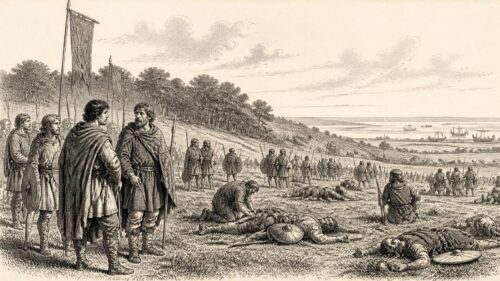
In 653 CE, the clearest Irish political event preserved by the annalistic tradition was a battle in Connacht: the battle of Airther Seóla. The Annals of Tigernach and Chronicon Scotorum record that Marcán son of Tommán, king of the Uí Maine, was killed, while Cenn Fáelad son of Colgu and Máenach son of Báithín, king of the Uí Briúin, were victorious. This is a small entry, but a consequential one. It reveals competition between powerful Connacht dynasties, the lethal stakes of regional kingship, and the way an encounter in one locality could reshape authority far beyond a battlefield. The evidence does not permit a detailed reconstruction of tactics, numbers or motives. It does, however, allow 653 to be seen as a year in which the balance between neighbouring ruling kindreds was violently renegotiated.
A Connacht Victory
The sources vary slightly in their naming of the place. Tigernach calls it Airther Seóla, while Chronicon Scotorum has Iartair Seóla; both place the conflict among the Connachta. Medieval place-name scholarship has associated Airther Seóla with the eastern part of Mag Seóla, in the wider Galway region, but the precise battlefield cannot be identified with confidence. That uncertainty matters. The annals preserve the political outcome, not a map, and modern county boundaries should not be projected back onto seventh-century lordships. Even so, the name situates the struggle in the western Connacht world, where control of land, cattle, dependants and routes between territories underpinned a ruler’s standing.
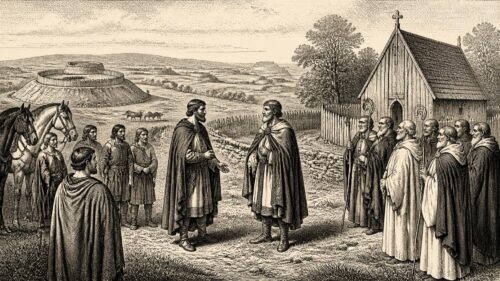
Marcán is identified as king of the Uí Maine, a major people whose later historical territory straddled parts of eastern Galway and south Roscommon. His death was therefore more than the loss of an individual warrior. Kingship in early medieval Ireland depended on a ruler’s capacity to lead allies, distribute resources, protect dependants and maintain the honour of his kin-group. A defeated king could leave a succession unsettled and expose his people to demands from rivals. The victors were named with equal care: Cenn Fáelad son of Colgu and Máenach son of Báithín. Máenach is explicitly styled king of the Uí Briúin in the annalistic tradition. The notice consequently points to a coalition, or at least an alignment, in which Uí Briúin power helped overcome the Uí Maine ruler.
Nothing in the surviving entries says that the battle created a united Connacht, nor that either victor became undisputed provincial king. Such claims would go beyond the evidence. “Connacht” in the annals could describe a broad political sphere containing numerous competing peoples and dynasties rather than a single centrally governed kingdom. The importance of Airther Seóla lies precisely in that fragmented landscape: regional authority was made through kinship, alliance, raiding, assemblies and, at times, open battle. The death of Marcán provides a rare fixed point within that shifting political geography.
The Death of a Mide King
The same year’s entries record the death of Máel Dóid son of Suibne, king of Mide. The notice is stark and supplies neither cause nor successor. Yet its inclusion demonstrates the importance of Mide, the central region whose ruling families held influence across the Irish midlands and near the ceremonial landscape of Tara. A king’s death was a moment of danger as well as commemoration: rival branches of a dynasty might press claims, allies might reassess obligations, and neighbouring rulers might test a new regime. We cannot state that warfare followed Máel Dóid’s death in 653, because the annals do not say so. We can say that his passing removed an established political actor at a time when Irish kingship remained personal, kin-based and intensely local even where a ruler commanded wider prestige.
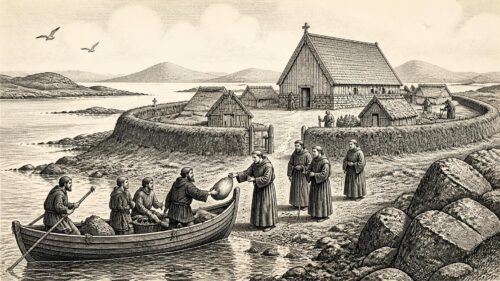
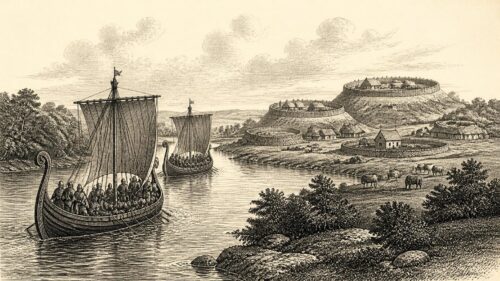
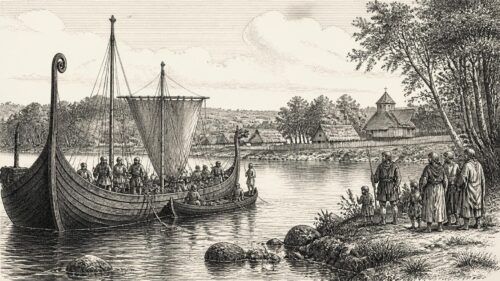
Other notices assigned to 653 reach beyond Ireland. The death of Talorc son of Foth, king of the Picts, appears in the Irish annals alongside the death of Ferech son of Totholán. Their presence should not be treated as proof of a specific Irish intervention in Pictish affairs. Rather, it shows that Irish chroniclers worked within a sea-connected northern world. Ecclesiastical ties, travellers, dynastic contacts and the circulation of news linked Ireland with western Scotland and northern Britain. The Irish Sea was not an empty frontier: it was a route through which information, people and religious influence could travel, even if the record for this particular year does not disclose the messengers or vessels involved.
What the Annals Can—and Cannot—Date
653 requires particular chronological care. The battle of Airther Seóla and Máel Dóid’s death occur under 653 in the Annals of Tigernach and Chronicon Scotorum. The surviving Annals of Ulster, however, place a shorter notice of the Connacht battle beneath a heading whose internal dating corresponds to AD 652. This discrepancy reflects problems in the transmission and chronological apparatus of the early annals, not necessarily disagreement that a battle occurred. Modern scholarship has shown why their kalends, year-headings and later copying must be scrutinised rather than accepted mechanically. Accordingly, the events discussed here are responsibly connected with 653 through the concordant Tigernach and Chronicon Scotorum tradition, while the exact calendar placement remains less secure than the deceptively precise modern year-label suggests.
The same caution applies to religious obituaries. Tigernach places the repose of Ultán moccu Chonchobair and Findchú of Brí Gobann, and the death of Dá Chua of Luachair, abbot of Ferns, under 653. Yet Chronicon Scotorum records Ultán’s repose in 657, and other annalistic compilations rearrange several seventh-century notices. It would therefore be misleading to announce these deaths as securely dated events of 653. They nevertheless illuminate the world around the year. Ferns was an early seventh-century ecclesiastical foundation in the territory of Uí Chennselaig, while Ultán was associated with Ardbraccan in Mide and later remembered as a learned churchman. Their appearance in the record shows how abbots, bishops and saints were embedded in the same regional networks as kings.
Churches, Learning and Authority
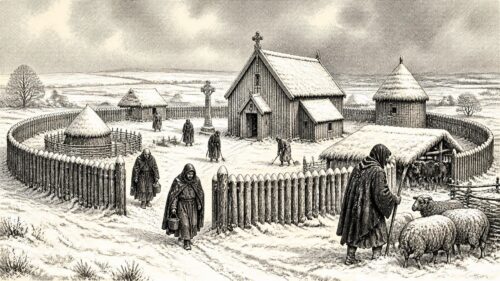
Church institutions were not isolated refuges from politics. In seventh-century Ireland, an important church could be a centre of worship, literacy, hospitality, landholding and learned authority, often connected to elite families. The title “abbot” did not imply a uniform institution of the later medieval kind, and ecclesiastical leadership could overlap with secular kinship and patronage. The several obituaries clustered around the annals’ mid-seventh-century entries therefore help explain why the deaths of churchmen were judged worthy of preservation alongside those of kings. They marked changes in communities that possessed property, followers, traditions and influence.
This was also an age of notable intellectual activity. Ireland’s seventh-century clerics and scholars were producing work in Latin and Irish, engaging with biblical learning, grammar, computus—the calculation of Easter—and the preservation of historical memory. It would be unjustified to attach a particular manuscript, school or composition to 653 merely because it belongs broadly to this period. Still, the annals themselves are evidence of a culture in which names, genealogies and memorable events were gathered and transmitted. Their terse form is not a sign that life was simple; rather, it reflects a highly selective record shaped by the concerns of learned communities.
Life Beyond the Entries
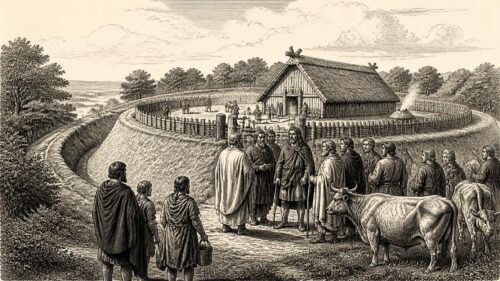
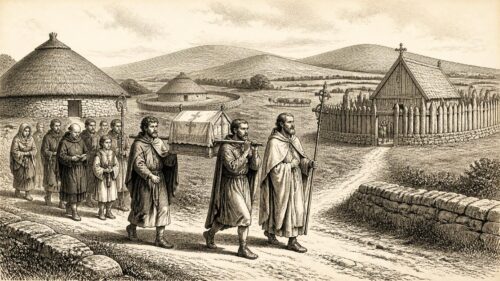
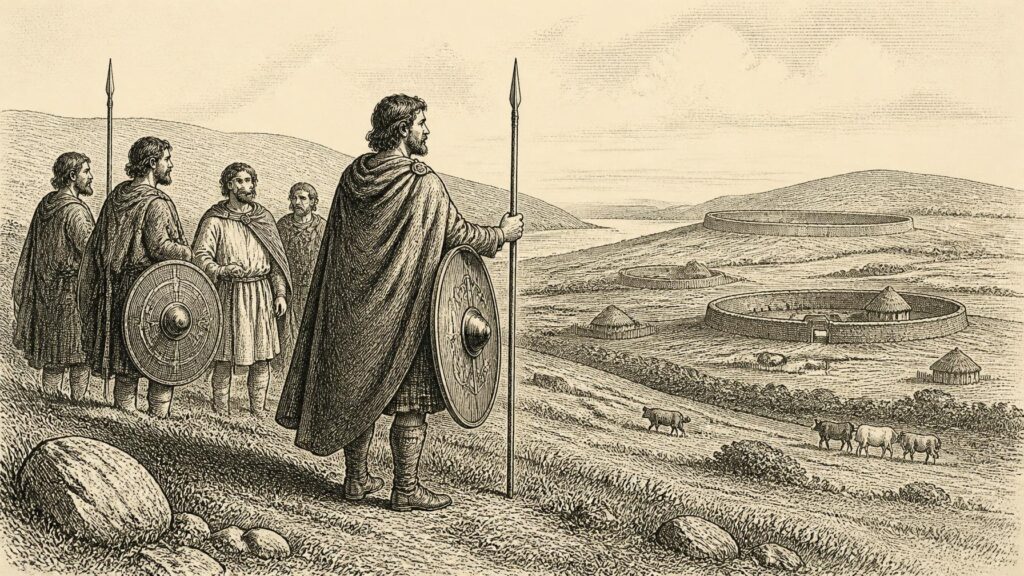
For most people, the year was not lived through annal entries or royal titles. Archaeology indicates that much of early medieval rural Ireland was organised around dispersed enclosed farmsteads, now commonly called ringforts, raths or cashels. These typically contained dwellings, work spaces, storage and places for livestock. Families raised animals, cultivated grain, ground corn, worked leather and iron, wove textiles and managed the seasonal demands of a predominantly agricultural economy. Such evidence describes the wider early medieval period, not a particular excavated farm in 653; it nevertheless gives necessary human scale to the political record. The struggle at Airther Seóla mattered because kings drew sustenance, military service and status from communities like these.
No surviving entry for 653 reports a national famine, epidemic, major church foundation, market development or environmental disaster in Ireland. Absence from the record is not proof that harvests were easy or that local hardship was unknown. It does mean that a responsible account should not invent a crisis to fill the silence. The year is best understood through what is actually preserved: a Connacht battle that killed a king of the Uí Maine; the death of Máel Dóid of Mide; notices connecting Irish chroniclers to Pictish affairs; and a cluster of ecclesiastical memories whose precise dating must remain qualified. In that narrow but revealing frame, 653 shows an island of many centres—farmsteads, churches and royal kindreds—bound together by movement, learning and contest rather than by a single state.
Primary Sources
- The Annals of Tigernach
- Part 9 of The Annals of Tigernach
- The Annals of Ulster
- Part 223 of The Annals of Ulster
- Chronicon Scotorum
- TEI Header for Chronicon Scotorum
- Chronicon Scotorum
- Annals of the Four Masters, Part 48
- The Chronology and Sources of the Early Irish Annals
- The Annals Attributed to Tigernach
- Exploring the Irish Annals
- Irish Field Monuments
- Early Medieval Farmsteads
- Ferns, the Ancient Capital of the Uí Chennselaig Lands of Wexford
- What Do We Really Know About the Early Irish Church?
- Sanctity and Secularity in the Early Irish Church
- Monasticism and its Limits: Rematerialising Monastic Space in Early Medieval Ireland
- Saints in Scottish Place-Names: Ultán m. Crónáin of Ard Breccáin
- Archaeology of Early Christianity in the North of Ireland, Volume 1
- Ringforts / Ráthanna
- Christian Ireland, 5th–8th Centuries
- The Scholar's Primer