Ailech’s Ransom939 CE
In 939, Irish annals record intense conflict linking kings, churches and Scandinavian seaborne power. Foreigners plundered Ailech, captured its ruler Muirchertach son of Niall, and released him for ransom. Dublin raided Cell Chuilinn in Leinster, while Munster forces with Scandinavian allies attacked Mide’s ecclesiastical sites, challenging Donnchad Donn. Donnchad campaigned in Brega, where a priest died during church violence, and Congalach defeated the Gailenga. Obits marked political and ecclesiastical succession. Donnchad commissioned a cover for Patrick’s Canon, probably the Book of Armagh. Annalists noted a blood-coloured sun, plausibly volcanic haze, and Æthelstan’s death in England on 27 October that year.
Dateline
The evidence for 939 is unusually vivid, but it must be handled with care. Irish annals do not provide a modern diary of the year: entries are brief, their chronological headings can drift, and later compilations sometimes place the same episode under a different year. The Annals of Ulster, whose heading explicitly acknowledges an overlap between 938 and 939, supplies the firmest framework. Chronicon Scotorum preserves closely related notices, alongside material absent from Ulster. Taken together, they show an Ireland in which kingship, church wealth, captive-taking and seaborne power were tightly entangled. The year’s defining event was the attack on Ailech and the seizure of its ruler, Muirchertach son of Niall.
A King Carried to the Fleet
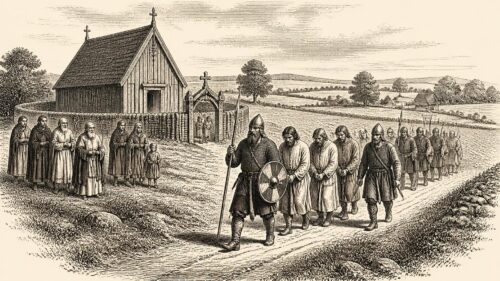
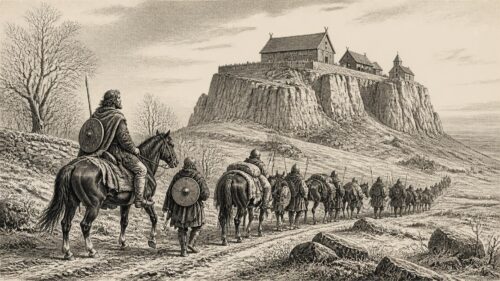
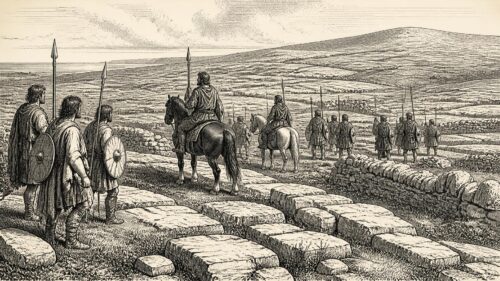
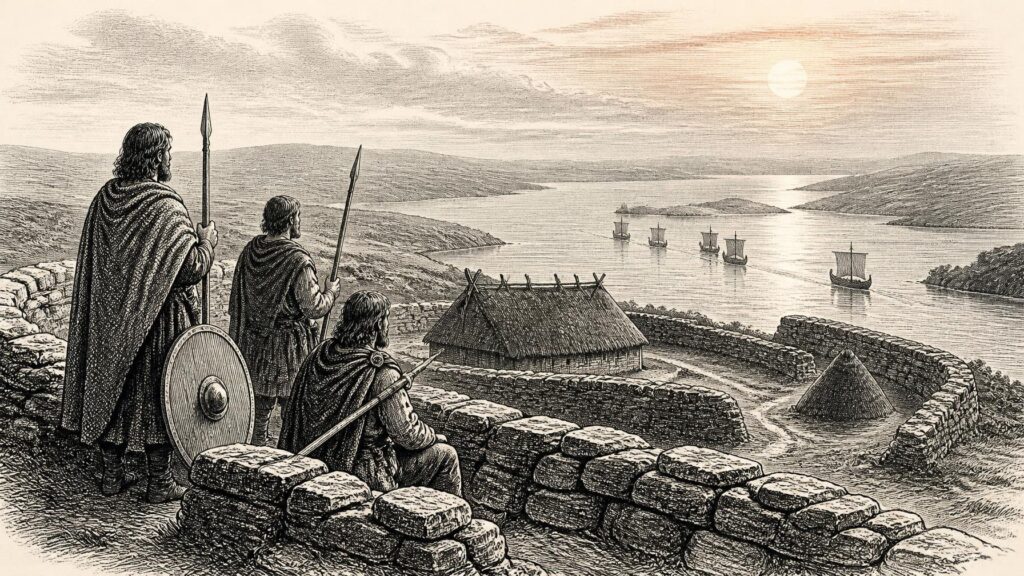
The annalists record that Ailech was plundered by “foreigners” hostile to Muirchertach, that he himself was carried off to their fleet, and that he later redeemed himself. The sources do not name a price, identify every participant, or describe the negotiations. Nor can it be demonstrated from this wording alone whether the attackers destroyed the hilltop royal enclosure itself, raided the wider kingdom of Ailech, or did both. What is certain is more than dramatic enough: a king of the northern Cenél nÉogain was taken alive in a maritime raid and recovered only through ransom.
Muirchertach had recently emerged as king of Ailech after a difficult period of rivalry within the northern Uí Néill. His father, Niall Glúndub, had been killed fighting the Dublin Norse in 919; by 939 Muirchertach was a major claimant to wider authority in Ireland. Ailech, centred in the north-west and symbolised by the great fort above the Foyle and Swilly region, was a political heartland rather than an isolated fortress. Its ruler’s capture advertised both the reach of seaborne enemies and the vulnerability of even the best-connected dynasties. The later career of Muirchertach makes the episode especially striking: he was not a marginal lord but a ruler whom the annals soon treated as eligible for the high-kingship.
The word “foreigners” normally denotes Scandinavian or Hiberno-Scandinavian forces in this annalistic setting, but it should not flatten the political landscape into a simple Irish-versus-Viking struggle. Dublin, Waterford and Limerick were ports whose rulers, crews and trading networks could be drawn into Irish dynastic politics; Irish rulers themselves could make use of Scandinavian allies. Ransom was a political act as well as an economic transaction. It returned Muirchertach to power, but it also demonstrated that ships, crews and coastal bases could impose terms on inland kings.
Dublin’s Reach into Leinster
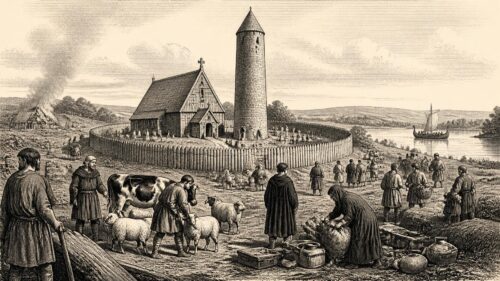
Another firmly dated notice concerns Cell Chuilinn, generally identified with the ecclesiastical site at Old Kilcullen in modern County Kildare. The Annals of Ulster say that the “foreigners of Áth Cliath”, Dublin, plundered it—an occurrence the annalist considered uncommon. That comment is revealing. Monasteries and churches had long been targets because they concentrated food, livestock, precious objects, manuscripts and people who could be held or sold. Yet the wording implies that this particular community was not habitually struck. Its plundering was therefore memorable enough to enter the record without any named leader, casualty list or claimed battle.
The raid illustrates Dublin’s continuing ability to project force into its Leinster hinterland. Cell Chuilinn stood well beyond the settlement’s walls and quays, in country crossed by routes linking Dublin, Kildare and the midlands. A raiding party did not need to conquer territory to profit: speed, local knowledge, captives and portable wealth mattered more. For nearby farming households, whose labour supported both secular lords and religious communities, the consequences of such violence could include lost cattle, disrupted cultivation and the removal of kin. Those effects are reasonable inferences from the nature of raiding, not details stated for Cell Chuilinn itself.
Munster Men in Mide
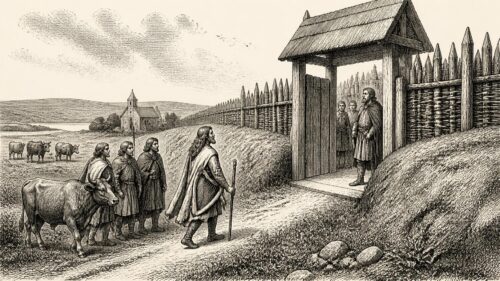
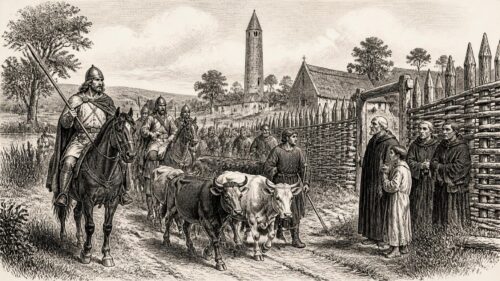
Chronicon Scotorum records a more ambitious incursion: men of Munster, associated with Cellachán of Cashel and accompanied by foreigners, raided Mide and struck a line of ecclesiastical places reaching from Cluain Eidnech and Cell Achaid towards Clonard. The later Annals of the Four Masters expands the account, naming foreign allies connected with Port Láirge, Waterford, and saying that two abbots were seized. Its fuller detail is valuable but should not be treated as equally secure in every respect, since the compilation was made centuries later and places the sequence under a shifted year. The shared core is nonetheless clear: forces from the south, joined by Scandinavian allies, penetrated the central plain and attacked churches as well as lordly territory.
This was not a random outbreak of lawlessness. Mide was the power-base of Donnchad Donn, king of Tara and leading member of Clann Cholmáin. To raid there was to challenge a ruler with claims extending far beyond his own lands. The participation of men “around” Cellachán does not prove that the Cashel king personally led every detachment, but it associates Munster’s royal politics with the expedition. Nor should “foreigners” be imagined as mere hired muscle. Their ships, weaponry, commercial connections and access to ports gave them a distinctive value as allies. The year therefore exposes a practical, sometimes ruthless diplomacy in which regional kings could work across cultural and religious lines when advantage required it.
Fighting in Brega
Donnchad responded in his own political neighbourhood. The Annals of Ulster state that he led an army into Brega, where Finnubair Abae was plundered and a priest was killed within a church, along with another person. The entry is a sobering corrective to any assumption that ecclesiastical immunity protected communities from Irish royal warfare. Churches could serve as sanctuaries, centres of learning and repositories of authority, but their buildings, produce and personnel also lay within contested landscapes. The killing of a priest in the church was important precisely because it violated expectations of sacred protection.
Nearby, Congalach son of Máel Mithig defeated the Gailenga Móra and Gailenga Beca at Áth dá Loarc; the annal gives no reliable total beyond saying that many fell. Congalach was a Brega ruler of Síl nÁedo Sláine, related by blood to Donnchad’s wider southern Uí Néill world but also capable of pursuing his own power. His victory over the two Gailenga groups shows that authority in the midlands was not exercised simply from Tara downwards. It was negotiated and fought among local dynasties, each with followers, land and routes to defend. The proximity in the annals of Donnchad’s expedition and Congalach’s victory captures the density of conflict in and around Brega during 939.
Deaths and Ecclesiastical Continuity
The year also brought changes in regional leadership. Críchán son of Máel Muire, king of Uí Fhiachrach, died, while Chronicon Scotorum records the death at Clonmacnoise of Domnall son of Lorcán, king of Aidne in south Connacht. Such notices are terse, but they mark moments when succession, alliance and local control had to be reworked. Clonmacnoise’s appearance as Domnall’s place of death also underlines its continuing standing as a religious and political centre on the Shannon corridor.
Fínnechta son of Cellach, comarba or successor of Daire—Derry—also died. The title mattered: succession to a saint’s foundation carried spiritual prestige, institutional authority and often control of lands, revenues and learned personnel. The obit reminds us that political life was not confined to kings. A major northern church could be headed by a figure whose death was worth recording beside battles and royal captures.
The Covering of Patrick’s Canon
One of the year’s most resonant cultural notices concerns the Canóin Phátraic, generally identified with the Book of Armagh. Chronicon Scotorum says that it was “covered” by Donnchad; the Annals of the Four Masters identifies him as Donnchad son of Flann, king of Ireland. This is understood as the commissioning of a protective cover or shrine for the revered manuscript, rather than the copying of a new book. The surviving Book of Armagh had been written in the early ninth century and contained biblical, Patrician and other authoritative texts. Its later name connected it to Patrick himself and to Armagh’s claims of ecclesiastical pre-eminence.
That a ruler’s patronage of such an object was recorded amid raids and warfare is significant. A manuscript was not merely a container of words. It could embody a saint’s authority, validate privileges, carry oaths and proclaim a church’s standing. A costly covering made its sanctity visible and helped preserve an object of institutional power. The notice does not allow us to reconstruct the lost cover’s materials or appearance. It does, however, offer rare direct evidence for royal investment in learned and devotional culture in 939.
A Blood-Coloured Sun
Chronicon Scotorum also reports that the sun had the colour of blood from the beginning of one day until the middle of the next. It is an extraordinary observation, but it should not be converted into a detailed Irish weather report. The annal gives no month, no description of crop damage and no claim of famine in Ireland. Modern ice-core and volcanic research has linked the report plausibly to atmospheric haze associated with the great Eldgjá eruption in Iceland, now dated broadly to 939–40. Recent work also stresses that several Icelandic eruptions occurred within this cluster and that the precise contribution of each to later climatic effects remains difficult to disentangle.
For people in Ireland, the immediate experience was visual and unsettling: an altered sun observed long enough to deserve commemoration. It belongs in the history of 939 because the observation itself is contemporary evidence, not because every subsequent hardship can be assigned to it. The annals record severe frost in a later year, but that should not be pulled backwards into this one. The blood-coloured sun is best understood as a carefully bounded glimpse of an Irish sky connected to an environmental event of North Atlantic scale.
Finally, the annalist noted the peaceful death of Æthelstan, king of the English, on 27 October 939. His death was not an Irish event, yet its inclusion confirms how closely Irish writers followed affairs across the Irish Sea. In 939, Ireland’s rulers faced immediate dangers from fleets, raids and regional rivals, while remaining attentive to changes among neighbouring kings. Ailech’s ransom, Dublin’s raid into Leinster, violence around Mide, the protection of Patrick’s book and an uncanny sun together make this a year in which military insecurity and cultural confidence existed side by side.
Primary Sources
- The Annals of Ulster — Year U939
- CELT Project: The Annals of Ulster
- Chronicon Scotorum — Annal CS939
- Chronicon Scotorum — English Translation
- Annals of the Four Masters, Part 4 — English Translation
- Annals of the Four Masters, Part 4 — Irish Text
- CELT Project: Annals of the Four Masters
- Muirchertach na Cochall Craicinin
- Donnchad Donn
- Congalach Cnogba
- Grianán of Aileach
- Excavations at Elagh Castle: Data Structure Report
- Irish Sagas: Bóroma Names
- The Book of Armagh
- The Book of Armagh: Facsimile Introduction
- Patrick (Patricius, Pátraic, Pádraig)
- The Eldgjá Eruption: Timing, Long-Range Impacts and Influence on the Christianisation of Iceland
- High-Resolution Ice-Core Analyses Identify the Eldgjá Eruption and a Cluster of Icelandic and Trans-Continental Tephras Between 936 and 943 CE
- Disparate Impacts of the Eldgjá and Laki Flood-Lava Eruptions
- An Evaluation of Astronomical Observations in the Irish Annals