Aralt’s Connacht Death940 CE
In 940, annalistic records depict Ireland as a politically fragmented but connected island. Donnchad mac Flainn, king of Ireland, and Muirchertach mac Néill led forces through Leinster and Munster, taking hostages to enforce overlordship, while Donnchad also raided Brega and Lann Léire. Connacht forces killed Aralt, grandson of Ímar and a Limerick Scandinavian leader, demonstrating resistance to maritime power. Muirchertach was implicated in the death of Niall, heir of Ailech, amid dynastic rivalry. Deaths included Ailech’s queen and senior churchmen. Rural farming, monasteries, coastal travel and growing Scandinavian towns underpinned society beyond the annals’ focus on rulers and warfare alone.
Dateline
The record for 940 is brief, but it catches Ireland at a moment when authority had to be made visible by movement: armies crossing provincial boundaries, rulers taking hostages, a Scandinavian leader dying in Connacht, and churches remaining important enough to be named among the year’s losses. The evidence is chiefly annalistic, and it requires care. The Annals of Ulster label their section ‘AD 939 alias 940’, reflecting a known difficulty in the annals’ chronology; Chronicon Scotorum and the Annals of Inisfallen place closely related notices under 940. It is therefore responsible to connect these events to 940 while avoiding invented months, battle-sites or motives.
A Progress of Submission
The year’s largest reported undertaking was a joint expedition by Donnchad mac Flainn, the king recognised in the annals as ruler of Ireland, and Muirchertach mac Néill of Ailech, the leading northern Uí Néill prince. They led an army into Leinster and Munster and took hostages from both. The phrase is compact, but its political meaning was substantial. A hostage was normally a high-status person entrusted—or compelled—to remain in another ruler’s custody as security for obedience, alliance, tribute or a settlement. Hostage-taking was thus not a decorative ritual at the end of a campaign: it was a practical instrument through which a superior king could claim leverage over subordinate peoples.
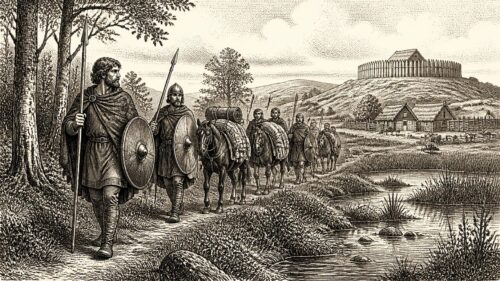
The entry does not say that Leinster and Munster had been conquered, and it should not be read that way. Tenth-century Ireland was not governed from a single capital by a permanent state apparatus. It was a landscape of overkingships, provincial dynasties, local lordships and ecclesiastical interests, in which a ruler’s reach depended on personal alliances, military followings and repeated demonstrations of power. Donnchad and Muirchertach’s progress southward was a forceful assertion that the northern and midlands political order could demand recognition beyond its home territories. That both men are named also matters: the campaign displayed cooperation between the reigning king and an exceptionally capable heir of the northern Uí Néill.
Muirchertach’s position was especially prominent. His father, Niall Glúndub, had been killed fighting the Dublin Scandinavians in 919. In the two decades that followed, Muirchertach built a reputation as a mobile and formidable war leader. Yet in 940 he was not king of Ireland. The joint hosting shows both the opportunities and the limits of political rank: he could project authority across the island, but did so alongside Donnchad rather than in his own right. The hostages taken in Leinster and Munster were therefore evidence of a negotiated hierarchy, backed by armed force, not proof of a settled united kingdom.
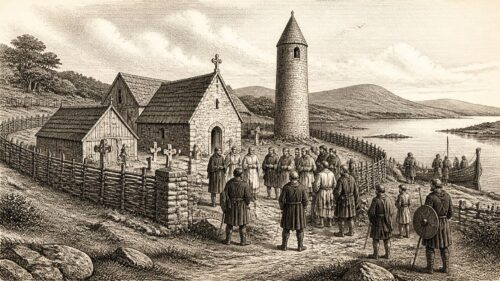
The Annals of Ulster also reports a separate raid by Donnchad into Brega, the rich central region north of the Liffey, and the plundering of Lann Léire, the important ecclesiastical site at modern Dunleer in County Louth. This is a useful corrective to any image of the high king’s authority as calm or automatic. Brega was close to the centres of Uí Néill power, yet it too could be raided. An attack on Lann Léire was an assault on a religious community with land, livestock, dependants and stores as well as a church. Political power and ecclesiastical wealth were deeply interwoven; a raid could punish rivals, provision a following and proclaim dominance at once.
Aralt and Connacht
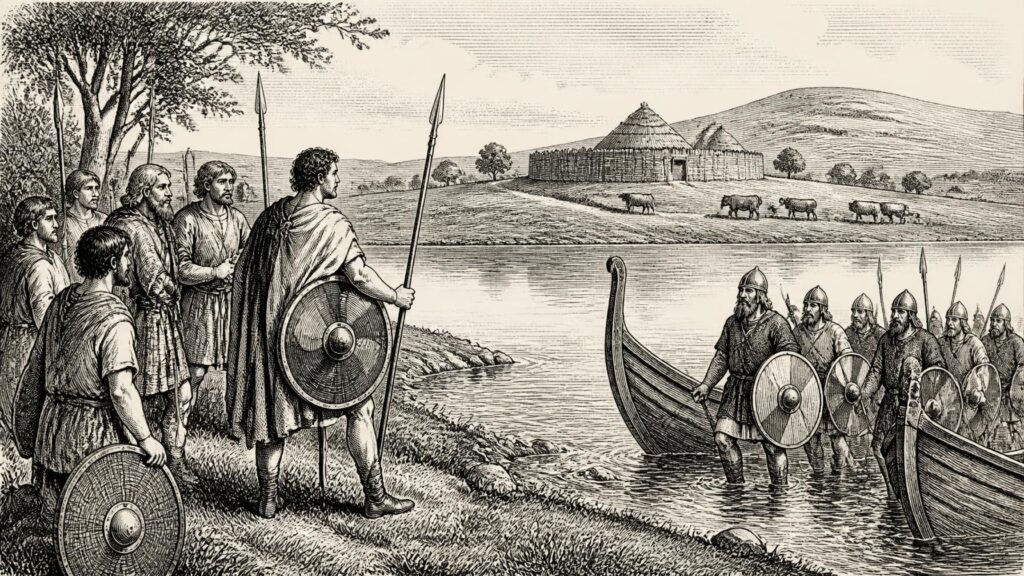
The sharpest event attached to 940 is the death of Aralt at the hands of the Connachta. The Annals of Inisfallen records simply the death of ‘Aralt, grandson of Ímar’, while Chronicon Scotorum connects him with Sitric and the foreigners of Luimnech, or Limerick. Later annalistic tradition describes him more explicitly as lord of Limerick’s foreigners. The sources do not preserve a full narrative, and they do not securely provide the precise place of his death. What can be said is that a leader of the Scandinavian political world centred on Limerick died in Connacht at the hands of Connacht forces.
Aralt belonged to the broad dynasty remembered as Uí Ímair, descendants or claimed descendants of Ímar. Its members were active across the Irish Sea world, including Dublin, York, the western seaways and Irish coastal settlements. Their identity cannot be reduced to a simple opposition between ‘Viking’ and ‘Irish’. The annals’ word gall, conventionally rendered ‘foreigner’, was a political and cultural label, while Scandinavian settlers and their descendants formed alliances, fought one another and interacted closely with Irish rulers. Still, Aralt’s death was a serious reverse for the Limerick-based Scandinavian leadership. It demonstrates that Connacht was not a passive margin exposed only to maritime raiders: its forces could defeat a figure connected to one of Ireland’s emerging port towns.
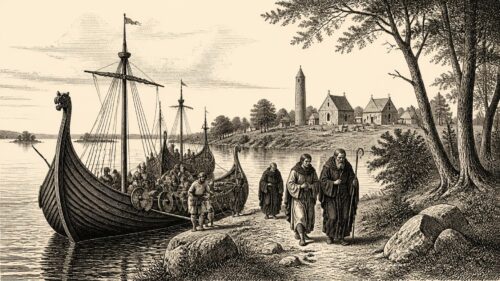
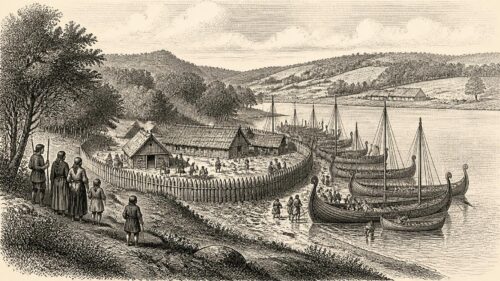
Limerick’s importance lay in its riverine setting and access to Atlantic and Irish Sea routes. Like Dublin, Waterford, Wexford and Cork, it belonged to the tenth-century development of defended Scandinavian bases into Ireland’s first towns. Such places linked warfare with commerce. Ships carried warriors, captives and plunder, but also silver, textiles, wine, tools, slaves and ideas. Aralt’s fate in Connacht reveals the vulnerability of that maritime power when it entered the territories of determined inland opponents. It should not, however, be made into a nationalist set-piece or a final expulsion of Scandinavian influence: Limerick remained politically significant, and Scandinavian groups continued to shape Irish affairs.
Violence Within Ailech
940 also contains a grim notice of conflict inside the northern political world. Niall son of Fergal, described in Chronicon Scotorum as heir-designate of Ailech, was killed by Muirchertach son of Niall. The Annals of Ulster gives a slightly different formulation: Niall was wounded and drowned, again through Muirchertach. The agreement on Muirchertach’s responsibility is more important than the difference in description. No surviving entry explains the immediate circumstances, so it would be unsafe to invent a succession plot, a battlefield or an act of revenge. But the killing shows that Muirchertach’s rise was accompanied by lethal rivalry among those nearest to northern kingship.
The same annalistic cluster records the death of the queen of Ailech, a daughter of Donnchad mac Flainn. The surviving versions differ in the rendering of her personal name, but agree on her status and parentage. Her position joined the king of Ireland’s household to the dynasty of Ailech. Royal marriages were political relationships, binding kin groups and strengthening claims; the death of a queen could consequently matter well beyond the household. Taken together with the campaign of hostages, her death and Niall son of Fergal’s killing underline the personal character of tenth-century politics. Rule rested not only on territories but on fragile networks of kinship, marriage and fosterage.
Churches, Coasts and Memory
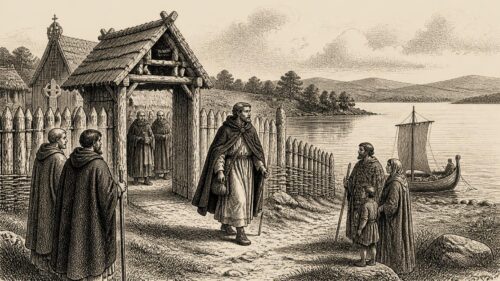
Two quieter notices illuminate institutions that warlike entries can obscure. Muiredach, ‘successor of Comgall’, died in 940. The title identifies him with the ecclesiastical inheritance of Comgall of Bangor, one of the great monastic founders of Ireland. A successor was not merely a cleric in a spiritual lineage: he could exercise authority over a church community, its estates, revenues, learning and dependant population. The death of such a figure marked a change in the leadership of a powerful institution.
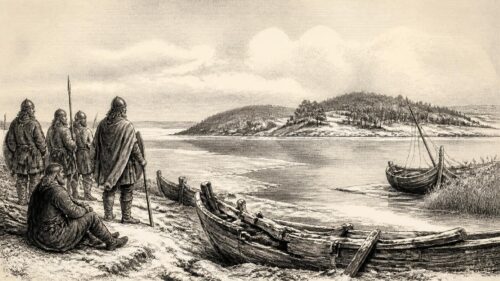
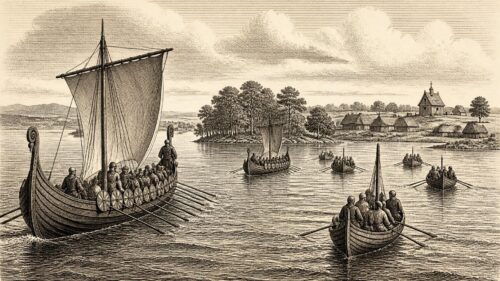
Chronicon Scotorum additionally records that Coibdenach, abbot of Cell Achaid, drowned at sea at Deilginis. The entry gives no cause—storm, accident or travel cannot be supplied—and Deilginis should not be forced into a precise modern identification. Yet it is a reminder that the sea was a working route rather than an outer boundary. Clerics, traders, political messengers and raiding parties moved along coasts and through estuaries. An abbot’s death at sea belongs to the same connected island world as Aralt’s movements and the larger military hostings.
Life Beyond the Annals
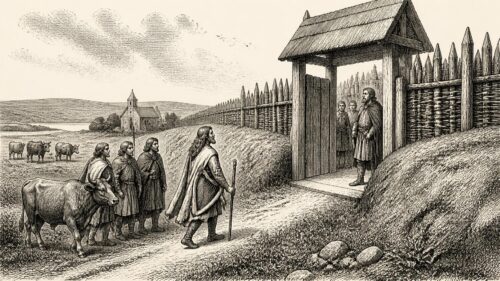
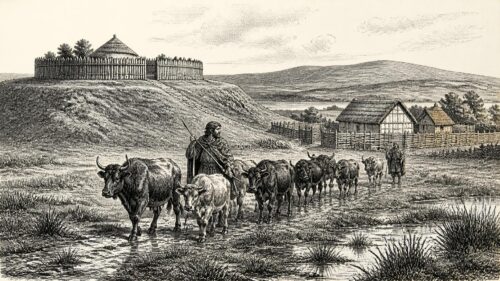
The annals concentrate on rulers, churchmen and violent deaths, not on ordinary households. Archaeology supplies the wider setting, although it cannot be assigned to a single calendar year. Most people in 940 lived in an overwhelmingly rural Ireland. Ringforts and stone cashels commonly enclosed farmsteads; farming combined cattle-keeping with cultivation, while mills, quern-stones, fences and crop-drying evidence point to labour-intensive food production. Cattle remained central to wealth and social obligation, which helps explain why armies, tribute and church resources were so closely bound to the countryside.
At the same time, the tenth century was changing the texture of Irish life. Excavated rural sites such as Ballinderry crannog in County Westmeath preserve wooden and metal tools, leather goods, spinning and weaving equipment, weapons and gaming pieces. They show communities neither isolated nor untouched by wider exchange. In the towns, post-and-wattle houses, craftworking and imported materials testify to dense settlements with connections across Britain, the Continent and beyond. Silver did circulate in this world, though Ireland had not yet begun its own coinage; cattle, food-renders and valuable objects remained crucial means of payment and display.
For church communities, learning, worship, craft production and estate management overlapped. Monasteries and churches were centres of literacy and record-keeping, but also landholders with livestock, labourers and stores worth defending or plundering. The year’s notices of Muiredach, Coibdenach and Lann Léire consequently belong beside the record of kings and armies, not apart from it.
A Year of Reach and Risk
940 was not defined by one decisive battle. Its surviving record instead shows authority being exercised in several ways: Donnchad and Muirchertach compelled hostages from Leinster and Munster; Donnchad raided Brega and Lann Léire; Connacht forces killed Aralt of the Limerick Scandinavian sphere; and violence touched the succession politics of Ailech. Deaths in royal and ecclesiastical circles, including one at sea, complete the picture. Ireland was connected by roads, rivers and sea-lanes, yet power remained local, personal and precarious. The year’s sparse annals preserve that tension with unusual clarity.
Primary Sources
- The Annals of Ulster: Year U940
- Chronicon Scotorum: Annal CS940
- Annals of Inisfallen: Annal AI940
- Annals of the Four Masters, Volume 2 English Translation
- The Annals of Ulster
- The Annals of Inisfallen MS. Rawlinson B. 503
- The Viking Age in Ireland
- Guide to the National Museum of Ireland
- The Rural Settlement Pattern
- Farming and Archaeology
- Early Medieval Farmsteads
- Dunleer: County Louth Urban Archaeological Survey
- 950–1450: Vikings, Normans and Medieval Mints
- Early Christian Monasteries
- Churches and Ecclesiastical Enclosures
- Annals of Inisfallen to Go on Public Display in University College Cork
- The Annals of Inisfallen: Reproduced in Facsimile from the Original Manuscript
- The Killing of the ‘Lord of the Foreigners of Luimneach’ in Ardrahan in AD 940
- Kings of Aileach and the Vikings, AD 800–1060, by Darren McGettigan
- List of Published Texts at CELT
- Translated Texts at CELT