Fethgna and Killashee874 CE
In 874, Féthgna, successor of Patrick and head of religion in Ireland, died after a long leadership of Armagh, highlighting that church’s political and spiritual authority. Áed Findliath, king of Tara, campaigned in Leinster, profaning Cell Ausili, probably Killashee, and burning other churches, demonstrating the vulnerability of sacred sites during royal coercion. Clerical deaths at Roscommon and Tamlacht emphasised the importance of bishops and scribes in administering wealthy, learned ecclesiastical communities. Foreign raiders plundered Cell Mór of Mag Enir. Against a changing Viking background following Ímar’s death, the year revealed Ireland’s interwoven military, religious, economic and intellectual pressures across society.
Dateline
On 6 October 874, Féthgna, bishop, successor of Patrick and head of religion in all Ireland, died. The date is unusually secure by the standards of ninth-century Irish history: the Annals of Ulster give the day, while the Annals of Inisfallen and Chronicon Scotorum independently preserve his death in their notices for the year. Yet 874 is not remembered because of a single battle or royal succession. Its surviving record instead exposes the pressure points of Irish life: an overking’s destructive intervention in Leinster, a separate foreign raid on a church, and losses among the learned clergy who sustained major religious communities.
A Death at Armagh
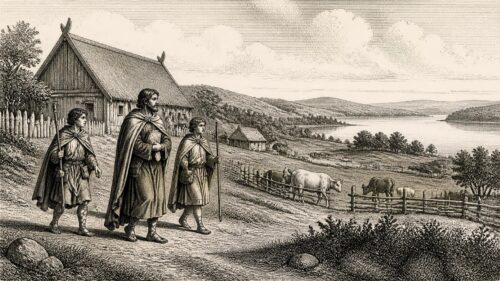
Féthgna’s death was the year’s clearest national event. His titles mattered. To be successor, or comarba, of Patrick was to head the Patrician church centred on Armagh; to be called the head of religion in all Ireland expressed an Armagh claim to island-wide spiritual precedence. This was not the title of a modern archbishop ruling a uniform diocesan institution. Ireland’s churches were dispersed among powerful local communities, and their leading offices were closely entwined with aristocratic families, landholding, learning and political alliance. But the annalists’ language shows the exceptional standing that Féthgna had attained.
He had been in office since the early 850s, a long tenure in an era when churches could be burned, plundered or drawn into dynastic disputes. Earlier in his career he appeared at royal conferences alongside the congregation of Patrick, participating in negotiations between kings and churchmen. Such meetings make clear that Armagh was not simply a place of prayer. Its community possessed property, dependants, legal privileges, relics and a persuasive claim to moral authority. Féthgna’s passing therefore meant more than the death of an elderly cleric: it removed a figure through whom rulers could seek legitimacy and through whom the Patrician community could negotiate protection.
The sources do not describe his funeral, name the congregation that chose his successor, or reveal whether his death brought an immediate dispute. Those silences are important. It would be unsafe to turn the obituary into a tale of crisis at Armagh. What can responsibly be said is that the annalists considered the death important enough to record in elevated terms, and that the office he left stood at the intersection of religion and high politics.
Áed’s Leinster Campaign
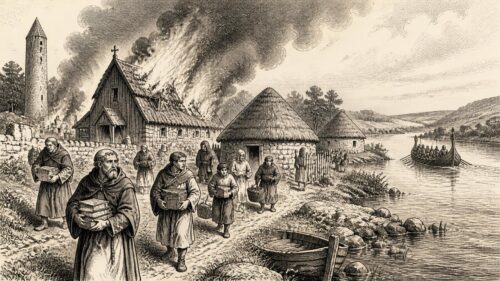
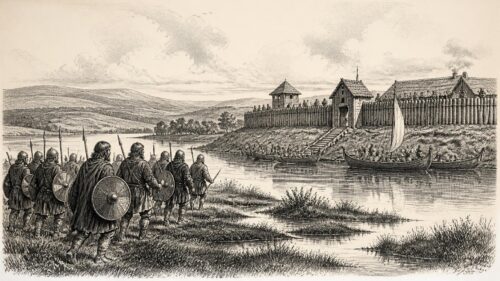
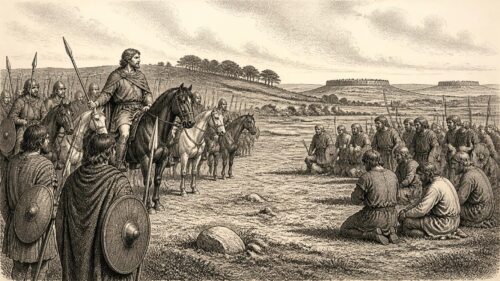
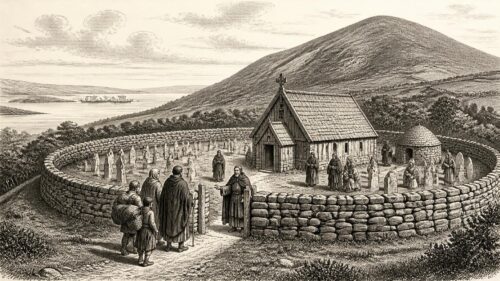
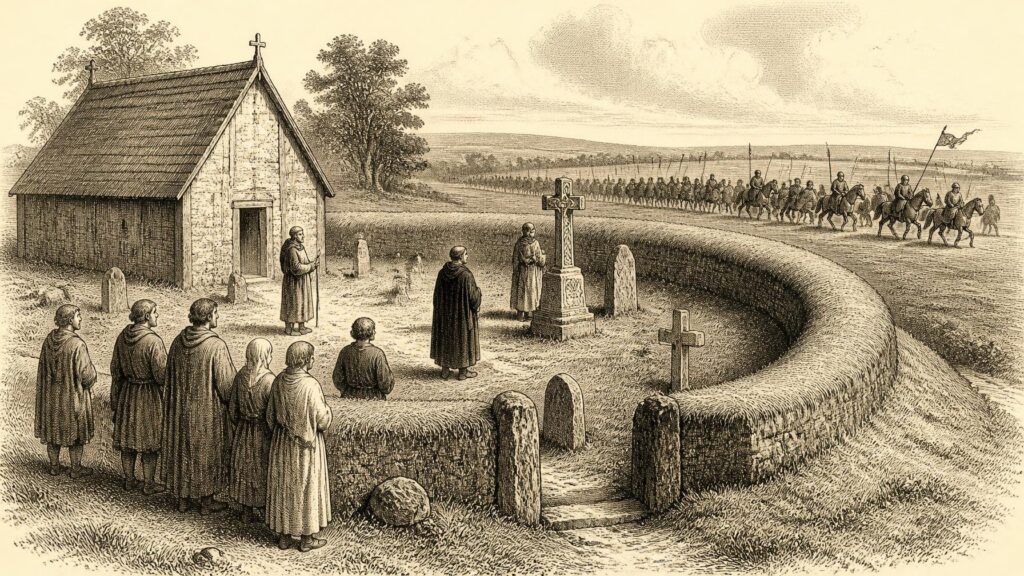
The same year brought an unmistakably violent assertion of royal power. Áed Findliath, son of Niall and king of Tara, led an army into Leinster. The Annals of Ulster say that his force profaned Cell Ausili and that other churches were burned with their oratories; Chronicon Scotorum likewise records an expedition into Leinster which despoiled Cell Ausili and other churches. Cell Ausili is generally identified with Killashee, near modern Naas in County Kildare, where an early ecclesiastical complex survived as a focus of worship long after the ninth century.
The annals give no battle, no casualty total and no explanation from Áed himself. They do, however, preserve the language of sacrilege. To “profane” a church was not a neutral description of military requisitioning. It marked a violation of a protected religious space, while the burning of oratories indicates damage to the smaller devotional buildings associated with church sites. The entry offers a rare glimpse of what a royal hosting could mean on the ground: armed men moving through a settled province, churches caught in the path of coercion, and religious communities exposed even when the attackers were fellow Christians.
Áed had held Tara since 862 or 863 and belonged to the northern Uí Néill, the Cenél nÉogain. His kingship did not make Ireland a unified kingdom in the modern sense. It rested on personal lordship, military reach, tribute, hostages and the difficult management of regional kings. Leinster was one of the territories in which those claims had to be repeatedly enforced. Áed had campaigned there before, and the 874 expedition should be understood as part of that continuing contest rather than as an isolated outburst.
Even so, the evidence does not allow a precise motive. The attack may have answered resistance, demanded submission or punished an opponent; none of the contemporary annals says which. Nor should the destruction be treated as evidence that Áed was hostile to Christianity. Kings depended on churches for prayer, prestige, literacy and diplomatic mediation. The point is harsher and more revealing: sacred status offered real protection in Irish political culture, but it did not guarantee safety when an overking chose to make an example of a province.
Churches, Land and Learning
The notices for 874 are unusually rich in clerical deaths. Áed son of Fiangus, superior of Roscommon, is described as both bishop and excellent scribe. Máel Mórda son of Diarmait, also a bishop and scribe, died; so did Torpaid, superior of Tamlacht, likewise called bishop and excellent scribe. These brief phrases are valuable. They show that writing was not an incidental accomplishment but a recognised quality of senior ecclesiastical office. In religious centres such as Roscommon and Tamlacht, clerics copied texts, kept records, taught students and maintained the intellectual connections on which Irish Christianity depended.
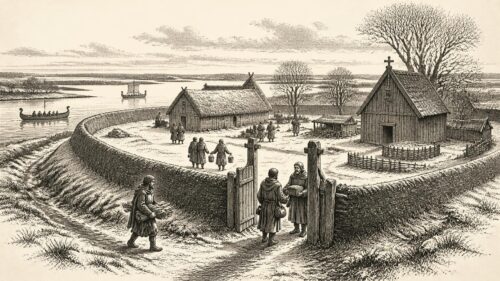
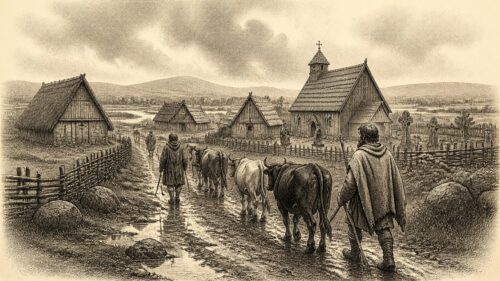
“Superior” is also a reminder that an Irish church community was an organised settlement, not merely a building. Its head oversaw people, lands and resources as well as worship. Churches received food-renders and gifts, owned livestock and cultivated land, housed clerics and visitors, and could serve as places where legal claims were negotiated. The loss of experienced leaders therefore affected the practical as well as the devotional life of their communities. Still, the annals do not tell us the size of the houses at Roscommon or Tamlacht in 874, what books their scribes wrote, or who replaced them. The year supplies evidence for the status of learning, not a detailed catalogue of its output.
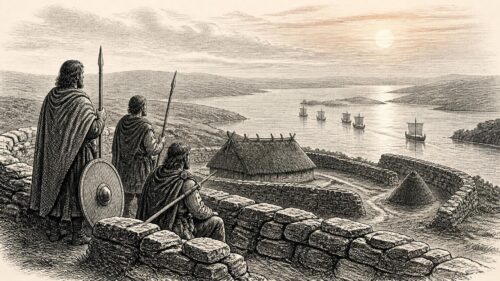
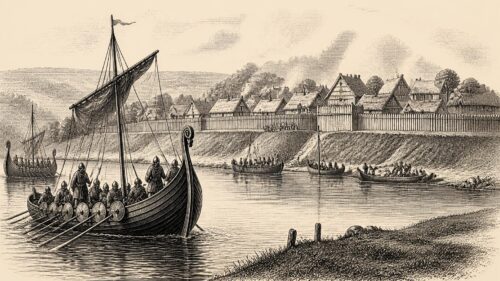
A more direct sign of insecurity appears in the report that Cell Mór of Mag Enir was plundered by “the foreigners”. The annal does not identify the raiders, date the attack within the year, list stolen goods or securely locate the church. It cannot therefore be tied to a named Scandinavian king or treated as proof of a campaign from Dublin. Nonetheless, it records a real feature of the age: ecclesiastical places remained attractive targets because they concentrated portable valuables, food, animals, skilled people and stores accumulated through patronage.
Foreign Power After Ímar
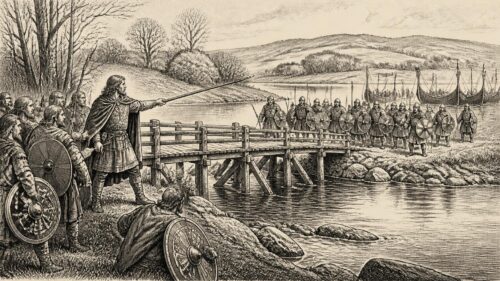
The raid on Cell Mór belongs in the wider Viking-age setting, but that setting requires care. Ímar, described in the Irish annals as king of the Norsemen of all Ireland and Britain, had died in 873. His death came just before the events of 874 and may have altered relationships among the foreign rulers and fleets active around Irish Sea routes. One scholarly reconstruction also places the death of Amlaíb, another major figure in Dublin’s earlier leadership, in Scotland during 874. That conclusion rests on difficult Scottish chronicle evidence and should be treated as plausible rather than certain.
There is no basis for claiming that either death caused the plundering of Cell Mór. The annals themselves make no such connection. What they do show is that foreign raiding had not ended with the death of a prominent ruler, while Irish politics continued to be shaped by both competition and occasional alliances involving Scandinavian forces. “Foreigners” in an annalistic entry is a useful contemporary category, but it should not be imagined as a single united people acting under one command.
A Province Under Pressure
For Leinster, the consequences of Áed’s hosting would have extended beyond the named church. An army needed food, animals, guides and temporary shelter; a destructive march could interrupt cultivation, displace dependants and weaken local rulers’ ability to reward followers. The sources do not permit calculations of lost harvests or population, and no weather disaster, famine or epidemic is specifically recorded for Ireland in 874. It would be wrong to invent one. Yet the burning of church buildings and the plundering of Cell Mór show that disruption was not an abstraction. It reached communities whose daily routines relied on fields, herds, storehouses, manuscripts and protected space.
The following year’s annals record Muiredach son of Bran, king of Leinster, harrying Uí Néill territory as far as Sliab Fuait. That later expedition cannot be proved to have been an immediate reprisal for Áed’s 874 campaign, but it confirms that the relationship between Leinster and the northern overking remained actively contested. The restored holding of the Fair of Tailtiu in 875 also suggests that royal ceremony and political bargaining continued alongside warfare.
Thus 874 was a year of concentrated vulnerability rather than national collapse. Armagh lost the man who embodied its Patrician authority. Leinster suffered a royal invasion in which churches were not spared. An unnamed ecclesiastical community was plundered by foreign raiders. Meanwhile, the obituaries of bishops and scribes reveal the dense network of learned church settlements that endured through such shocks. The record is sparse, but its pattern is clear: power in Ireland was exercised through force, sacred authority and control of communities whose religious and economic lives could not be neatly separated.
Primary Sources
- The Annals of Ulster
- CELT Project: The Annals of Ulster
- Annals of Inisfallen, Annals AI870–AI879
- CELT Project: Annals of Inisfallen
- Chronicon Scotorum, Annals CS873–CS877
- CELT Project: Chronicon Scotorum
- Chronicon Scotorum, Annals CS851–CS852
- Chronicon Scotorum, Annals CS858–CS860
- Chronicon Scotorum, Annals CS852–CS854
- Annals of the Four Masters, Part 70
- Annals of the Four Masters, Irish Text, Part 70
- Fethgna
- Áed Findliath
- Forannán
- The Vikings in Scotland and Ireland in the Ninth Century
- The Vikings in Ninth-Century Ireland: Sources and Settlements
- List of Published Texts, CELT
- Irish Texts at CELT
- Frequently Asked Questions About CELT
- Killashee Demesne, Kildare: Excavation Report 2006:963
- Killashee, A Short History of Naas
- The Earth Moved at Killashee
- Building on the Past: Early Medieval Period
- Early Medieval Ireland: Archaeological Excavations, 1930–2009