Tailtiu Renewed916 CE
In 916, Flann Sinna died on 25 May after ruling Tara since 879, ending a long southern Uí Néill ascendancy. His son Conchobar succeeded in Mide, while Niall Glúndub of Cenél nÉogain became king of Tara, reflecting dynastic alternation rather than unified monarchy. Niall renewed the neglected Fair of Tailtiu, publicly asserting royal authority and the capacity to organise exchange, obligations and assembly. Elsewhere, raiders from Loch Dá Chae harried Munster and Leinster, killing Ainnle of Uaithne. Deaths among leading ecclesiastics and a lightning fire at Armagh exposed institutional vulnerability amid ceremony, rivalry and Scandinavian pressure throughout much of Ireland.
Dateline
In 916, Ireland’s political centre of gravity shifted with unusual clarity. On 25 May, Flann Sinna, king of Tara and the dominant ruler of the southern Uí Néill for nearly four decades, died. His death was not merely the passing of an elderly king: it ended a long personal regime which had held together the kingship of Mide, influence in Brega, alliances with major churches, and a contested claim to island-wide precedence. Niall Glúndub of Cenél nÉogain succeeded to the kingship of Tara, renewing the Fair of Tailtiu in an emphatic public demonstration of authority. Yet, at the same time, raiders based at Loch Dá Chae continued to devastate Munster and Leinster. The year thus combined an orderly transfer at the summit of Uí Néill politics with grave insecurity in the south and east.
A Date Carefully Kept
The dating of Irish annals requires care. The Annals of Ulster place these entries beneath a heading corresponding to “AD 915 alias 916”, while both Chronicon Scotorum and the Annals of Inisfallen record Flann’s death and Niall’s accession under 916. The exact date of Flann’s death, however, is exceptionally secure: 25 May. Chronicon Scotorum adds that he died on a Saturday, in the thirty-seventh year of his reign, at Cenn Eich of the people of Cluain. The location should not be forced into a modern identification, but the precision itself is revealing. A royal death was an event worth fixing in time, and the annalists treated Flann as a ruler of the highest rank.
Flann belonged to Clann Cholmáin, the leading southern Uí Néill dynasty, and had ruled Tara from 879. Modern descriptions often call him “high king”, a useful shorthand for his exceptional standing, but Ireland was not a centrally governed kingdom. Its political landscape consisted of many regional kingships, ecclesiastical lordships and powerful kindreds. The king at Tara possessed prestige, tributary expectations and the capacity to lead hostings, but his authority depended upon negotiation and force. Flann’s career had shown both. He forged connections with churches including Clonard and Clonmacnoise, intervened in Leinster and Connacht, and used alliances—including, at times, alliances with Scandinavian leaders—to pursue Uí Néill interests. His later years had also been troubled by conflict among his own sons.
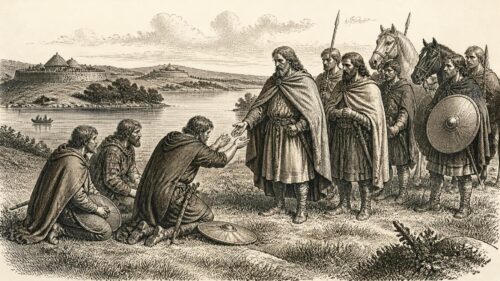
The succession divided rather than simply transferred Flann’s political inheritance. His son Conchobar took the kingship of Mide and the headship of Clann Cholmáin, whereas Niall Glúndub took Tara. Niall was not Flann’s son but a member of the northern Uí Néill, Cenél nÉogain, and son of the former king of Tara, Áed Findliath. He was nevertheless linked to the dead ruler through marriage to Flann’s daughter Gormlaith. That kinship could strengthen claims, but it did not eliminate rivalry. Niall’s accession represented the periodic alternation of power between northern and southern branches of the Uí Néill rather than the creation of a stable hereditary monarchy.
The Fair as Royal Statement
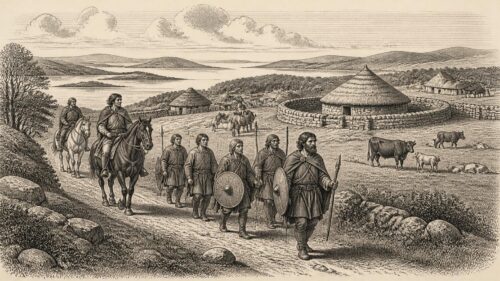
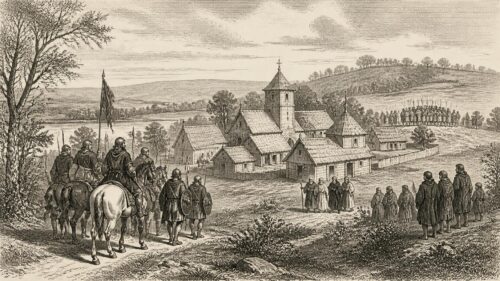
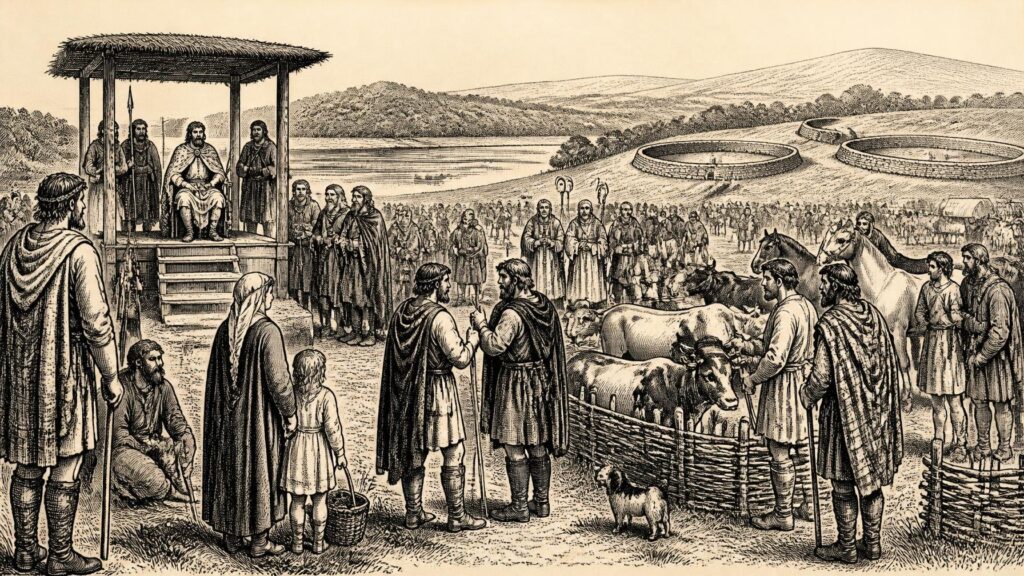
Niall’s first recorded act as king of Tara was to hold—or, in the wording of the annals, renew—the Fair of Tailtiu. This was far more than an occasion of games. Tailtiu, near modern Teltown in County Meath, was one of the great assembly places of early medieval Ireland. A fair brought together political ceremony, legal business, exchange, hospitality, competition and the performance of status. It also connected kingship to an older landscape of inauguration, meeting and public memory. For an incoming ruler, presiding over such a gathering was a practical means of making authority visible to nobles, clerics, traders, tenants and dependants who did not experience power merely through proclamations.
The annalist’s phrase that Tailtiu had been “neglected for a long time” gives the renewal special force. It suggests a lapse in the customary public expression of Tara’s claims, whether through political difficulty, insecurity, changing priorities or some combination of these. The sources do not permit a reconstruction of the fair’s programme in 916: they do not list contests, bargains, judgments or attendees. It would be unsafe to invent them. But the very decision to record its restoration shows that contemporaries regarded the assembly as a significant measure of royal competence. Niall was asserting that the king of Tara could once again gather Ireland’s leading interests at a recognised centre in the heart of Meath.
The fair also illuminates everyday political economy. Early medieval rule rested on the movement of food-renders, livestock, precious goods, labour and military service between local communities and their lords. Assemblies made exchange and obligation conspicuous. A large gathering required supplies, hospitality and safe routes; it created opportunities for buying, selling, arranging alliances and settling disputes. None of this proves that every such activity occurred at Tailtiu in 916, but it explains why the revival of a major fair mattered more than ceremonial display alone. It was a claim that the roads, relationships and resources required for lordship could be organised again under Niall’s protection.
Raiders from Loch Dá Chae
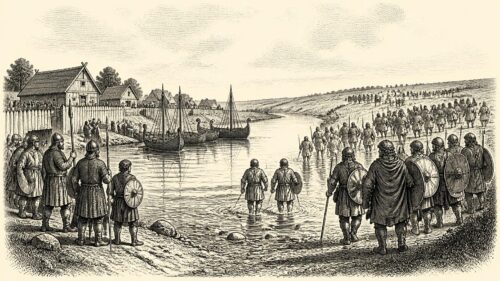
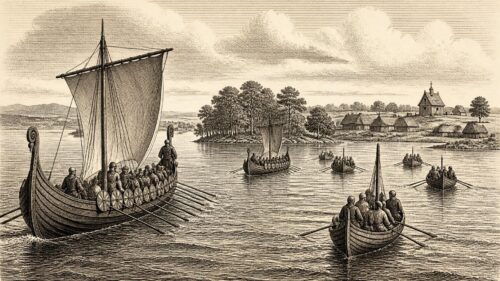
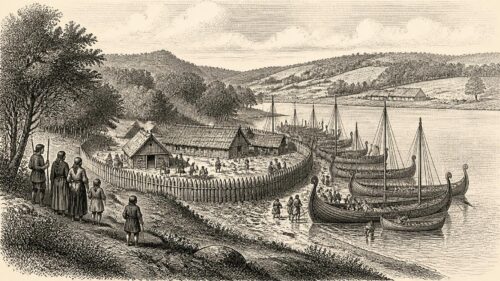
That claim stood in sharp contrast to conditions in the south. The Annals of Ulster report that the “foreigners of Loch Dá Chae” continued to harry Munster and Leinster, and that they put Ainnle son of Cathán, king of Uaithne of Cliú, to death. The entry does not provide a battle narrative, the route of the raiders or the circumstances of Ainnle’s killing. It does, however, show that their violence reached beyond isolated coastal seizures and could strike local rulers. Munster and Leinster were not passive borderlands of Tara: each contained powerful dynasties and rich ecclesiastical centres. Persistent raiding therefore unsettled regional politics, damaged estates and increased the pressure on kings to defend people and property.
Loch Dá Chae is closely associated in the annalistic record of the mid-910s with Scandinavian activity in the Waterford region, although the precise geography and its relationship to Port Láirge remain matters of scholarly discussion. Archaeology at Woodstown and wider research into Viking-age settlement show why riverine and harbour sites on the south-east coast were strategically important: they connected maritime forces with inland routes and resources. The evidence supports a picture of organised Scandinavian groups able to use secure waterside bases, but it does not justify treating every raider as a settler or imagining a fully formed town at a single named site in 916. What is firm is that a renewed Viking presence, noted from 914, remained an immediate and damaging fact of Irish life in 916.
Churches, Loss and Lightning
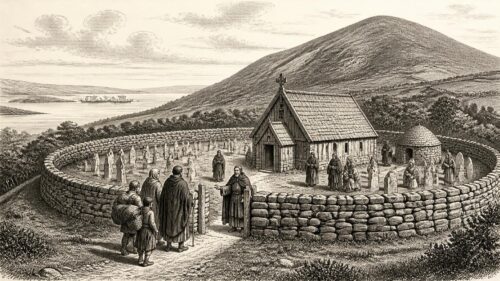
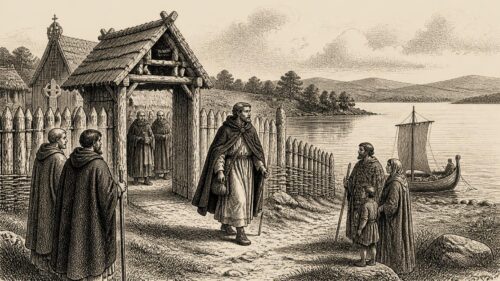
The year’s annalistic notices also reveal the density of Ireland’s ecclesiastical world. Aed son of Ailill, abbot of Clonfert; Martain, abbot of Roscommon; Máel Barrfhinn, priest of Clonmacnoise; and Coblaith daughter of Dub Dúin, successor of Brigit at Kildare, all died. These were not merely private obituaries. Major churches were landholders, centres of learning, patrons of craftsmen, places of hospitality and repositories of books, relics and legal memory. Their senior personnel often belonged to influential families and participated in regional politics. The separate notice for Coblaith is especially important: the office of Brigit’s successor at Kildare was one of the island’s most prestigious ecclesiastical positions, and its holder was a woman.
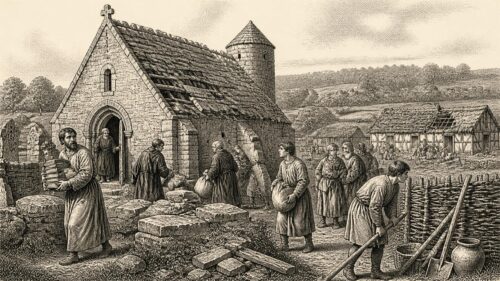
On 27 April, before Flann’s death, lightning set fire to the southern part of Armagh. The annalist names the Toí, the Saball, the kitchen and the whole of the abbot’s enclosure among what burned. Such detail conveys both the scale of the loss and the practical character of a major church settlement: Armagh was a community of buildings, domestic workspaces, food preparation, administration and worship, not simply a single sacred structure. Fire could destroy stores, housing and institutional resources as well as timber buildings. The record does not describe reconstruction, but the disaster would have required labour, materials and the mobilisation of Armagh’s extensive networks of support.
By the end of 916, then, Niall Glúndub had made a carefully chosen statement at Tailtiu, while the reach of Viking raiding, the death of leading churchmen and women, and a destructive fire at Armagh exposed the fragility beneath royal ceremony. The year did not settle Ireland’s rivalries or remove the Scandinavian threat. Its importance lies instead in the juxtaposition: a new king revived one of the great institutions of Tara at precisely the moment when security, ecclesiastical resources and regional authority were under visible strain.
Primary Sources
- The Annals of Ulster: Year U916
- The Annals of Ulster: Year U917
- Chronicon Scotorum: Annal CS916
- Chronicon Scotorum
- Annals of Inisfallen: Annals AI910–AI919
- Annals of Inisfallen: Irish Text, Annals I912–I919
- Annals of the Four Masters: Annals M913–M922
- Annals of the Four Masters
- Flann Sinna | Dictionary of Irish Biography
- Niall Glúndub | Dictionary of Irish Biography
- Vikings in Early Medieval Ireland: Church-Raiding, Politics and Kingship
- The Vikings in Ninth-Century Ireland: Sources and Settlements
- The Vikings in Ninth-Century Ireland: Sources and Settlements (full text)
- Preliminary Report on the Archaeological Excavation and Finds Retrieval Strategy of the Hiberno-Scandinavian Site of Woodstown 6, County Waterford
- The Archaeology of Ireland’s Viking-Age Towns
- Vikings in Irish Chronicles, 794–902: Introduction
- Vikings in Scotland and Ireland
- Decies 61
- Vikings in County Carlow
- Placenames of County Meath
- Early Medieval Period
- Early Irish Literature and Mythology