
Fractured Peace1017 CE
In 1017, three years after Clontarf, Ireland remained politically fragmented rather than settled under Máel Sechnaill mac Domnaill’s renewed overkingship. He defeated Dublin’s Hiberno-Scandinavian forces and Leinster men near Odhba, while dynastic killings eliminated several royal heirs and regional rulers in Ailech, Brega, Uí Méith and elsewhere. These internal conflicts reflected competitive succession among ruling kindreds. Church and learned communities also suffered: much of Glendalough burned, other ecclesiastical leaders died, and Inis Gaill Duib was destroyed as the scholar Anmchad drowned. Annals portray tense rebalancing, linking warfare, local lordship, monasteries, agriculture, and Dublin’s commercial power in post-Clontarf Ireland during 1017.
Dateline
In 1017 Ireland was living in the unsettled aftermath of Clontarf. Brian Bórama had been dead for three years, Dublin had survived, Leinster was still a force to be reckoned with, and Máel Sechnaill mac Domnaill of Mide had resumed the pre-eminent kingship he had lost to Brian. The annals do not describe a single nationwide crisis in this year. Instead, they record a pattern: deaths of royal heirs, killings within ruling peoples, a clash involving Dubliners and Leinstermen, and damage to important churches. Read together, these notices show a country not collapsing, but being re-sorted after the shock of 1014.
The evidence is brief and uneven. The Annals of Ulster and the closely related Annals of Loch Cé give the fullest political list for 1017; Chronicon Scotorum preserves a shorter version; the Annals of Inisfallen, written from a Munster perspective, add important southern and Shannon-side material. Exact days are not normally supplied. Where a notice can be placed only within the annal-year, it should not be made more precise than that.
Máel Sechnaill’s Authority
The most active named king in the year’s record is Máel Sechnaill mac Domnaill, king of Mide and claimant to the kingship of Ireland. In 1017 the annals credit him with inflicting a slaughter on the “foreigners” and the Laigin at or near Odhba. “Foreigners” in these entries normally means the Hiberno-Scandinavian population and forces of towns such as Dublin, while the Laigin were the men of Leinster. The notice is short, but politically suggestive: Máel Sechnaill was still campaigning against the Dublin-Leinster alignment that had been central to the struggle culminating at Clontarf.
Odhba, usually associated with the Meath region, placed the conflict close to Máel Sechnaill’s own sphere. If the annalistic wording is taken at face value, this was not a distant raid but a confrontation on terrain important to the midlands kingship. It also shows that Clontarf had not ended warfare between Irish dynasties and the Norse-Gaelic towns. Dublin remained wealthy, armed and politically entangled with Leinster; Máel Sechnaill remained determined to contain it.
This was a practical kingship more than an abstract national monarchy. A ruler’s power was measured in hostages, submissions, cattle, clients, church alliances and the ability to punish enemies. The year 1017 gives no evidence of a general assembly or island-wide settlement. It does show Máel Sechnaill acting as an overking in the old Uí Néill heartland, trying to make the balance of power created after Brian’s death work in his favour.
Deaths Of Royal Heirs
The most striking feature of 1017 is the number of men described as royal heirs or eligible successors. Aengus son of Carrach Calma, called heir-designate of Tara, died. Fergal son of Domnall son of Conchobor, heir-designate of Ailech, was killed by the Cenél Eógain themselves. Donnchad son of Donnchad Ua Congalaig, styled heir-designate of Ireland in the Annals of Ulster and Loch Cé, was killed by his own people; Chronicon Scotorum says more pointedly that he was killed treacherously by the men of Brega.
These notices are not ornamental genealogy. In early medieval Ireland a rígdamna, or “king-material”, was a man whose birth and standing made him a plausible candidate for kingship. Such men were valuable and dangerous. Their deaths could remove rivals, clear succession paths, or mark disputes inside dynasties. The repeated phrase “by his own people” is especially revealing. Much of the violence of 1017 was not simply border warfare but internal political management, often brutal.
The killing of Fergal within Cenél Eógain points to tension in the northern Uí Néill world. Flaithbertach Ua Néill, the leading northern figure of the period, also appears in 1017 as the killer of Muiredach Ua Duibeóin, king of Uí Moccu Uais of Brega. That act linked northern ambition with politics in the eastern midlands. Brega, lying between Dublin, Meath and the northern routes, was too strategically placed to be politically quiet.
Donnchad Ua Congalaig’s death is particularly important because of the title attached to him. “Heir-designate of Ireland” need not mean that a settled, universally accepted succession was in place. Rather, it signals that annalists regarded him as a man of exceptional potential in the contest for overkingship. His killing by the men of Brega suggests that local interests could overturn even the prospects of a figure with island-wide pretensions.
Local Kingdoms And Violent Politics
Below the level of Tara, Ailech and Brega, the annals name several regional rulers whose deaths show the same instability. Flann Ua Béicce, king of Uí Méith, was killed by his own people. Cormac son of Lorcán, king of Uí Echach, was killed by the Uí Threna. Gilla Críst Ua Lorcáin, king or lord of Caille Follamain, was killed at Cenannas, the important monastic town of Kells. The Annals of Loch Cé also record the deaths of Gilla Coluim son of Muiredach Ua Maeltrea and Aed Ua hErádáin, king of Uí Bresail Macha.
Such entries remind us that “Ireland” in 1017 was a layered political landscape. Provincial overkings mattered, but so did smaller kingdoms whose rulers controlled roads, tribute, churches and cattle wealth. Uí Méith lay in the north-eastern world between modern Louth, Monaghan and Armagh. Caille Follamain belonged to the midland orbit of Clann Cholmáin. Kells, where Gilla Críst was killed, was not merely a settlement but a Columban ecclesiastical centre with political weight.
The prevalence of killings within a people or kindred should not be mistaken for lawlessness in the modern sense. Irish political society had law, status and recognised rights, but it also allowed intense competition among eligible male kin. Kingship did not pass by simple primogeniture. A capable adult from the royal dynasty was expected, and that expectation made brothers, cousins, uncles and nephews into possible contenders. The annals of 1017 preserve the sharp edge of that system.
Churches, Learning And Fire
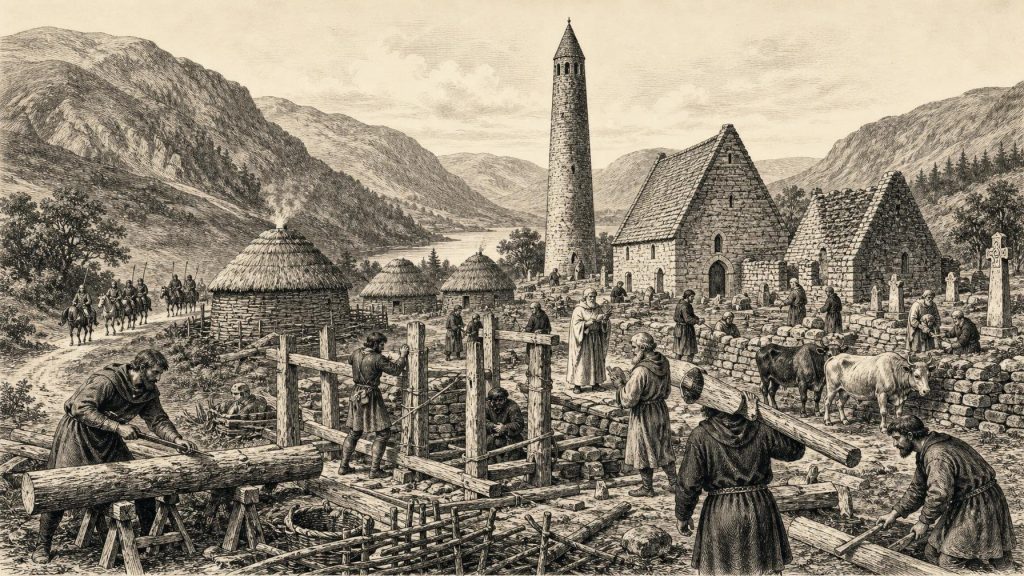
Religion and learning appear in 1017 both through obituary and disaster. The Annals of Ulster state that the greater part of Glenn dá Locha, Glendalough, was burned. Glendalough was one of Ireland’s great monastic landscapes, associated with St Kevin and with a dense settlement of churches, dwellings, workshops and pilgrims in the Wicklow mountains. A burning there need not mean the destruction of every stone building visible today. Much of an early medieval ecclesiastical settlement consisted of timber, wattle, stores, domestic ranges and roofing, all vulnerable to accidental or hostile fire.
The notice matters because monastic sites were not isolated from politics. They held relics, books, food stores, tenants and prestige. Burning could be caused by warfare, accident or a combination of crowded settlement and combustible buildings; the annal does not say which in this case. Responsible history must therefore stop short of naming attackers. What can be said is that a major ecclesiastical centre suffered serious damage in the same year that secular politics elsewhere was marked by killing and reprisal.
Several churchmen also died. Aengus son of Flann, superior of Lann Léire, and Cormac Ua Maíl Mide, superior of Druim Raithe, are named in the Annals of Ulster and Loch Cé. Chronicon Scotorum records the death of Diarmait Ua Maíltelcha, a bishop, though the dating of this figure varies across annalistic traditions. The title “superior” points to heads of ecclesiastical communities, men responsible not only for worship but for property, dependants, teaching and relations with lay patrons.
The Annals of Inisfallen add a vivid cultural loss: Inis Gaill Duib was burned, and Anmchad son of Murchad, chief ollam of Leth Moga Nuadat, drowned in the lake. Leth Moga was the traditional southern half of Ireland. An ollam was a learned master, especially in poetry, history and law. The drowning of such a figure, in an entry linked with a burning, hints at how fragile learned communities and their personnel could be. Ireland’s culture in 1017 was deeply literate in monasteries and deeply oral among learned families; both depended on patronage and peace.
Everyday Life And The Economy
The annals rarely describe ordinary households unless famine, plague or marvel intrudes, and no such island-wide condition is firmly recorded for 1017. Still, the year’s political entries help us glimpse everyday pressures. Warfare meant the movement of armed retinues through farming districts. Even when annalists record only elite deaths, campaigns usually affected cattle, crops, hostages and captives. The clash near Odhba, the killings in Brega and Kells, and the burning of church property would all have had consequences beyond the named men.
Most people lived from mixed farming. Cattle remained central to wealth, status and compensation, while pigs, sheep, oats and barley also mattered. Churches and royal sites drew food rents and labour from surrounding lands. Roads and rivers connected inland lordships to ports, especially Dublin. By 1017 Dublin was not a transient Viking camp but a major Hiberno-Norse town of merchants, craftsmen, ships, silver exchange and long-distance contacts. Its alliance or cooperation with Leinster made economic as well as military sense: the town needed hinterlands, and Irish kings needed access to its wealth.
Coinage had begun in Dublin under Sitriuc Silkbeard around the end of the tenth century, but coin did not replace cattle and customary renders in most rural dealings. Silver, slaves, textiles, hides, metalwork and imported goods moved through overlapping systems of gift, tribute, plunder and trade. That is the economic world behind the terse phrase “foreigners and Laigin”: urban Dublin and rural Leinster were not separate civilisations, but interdependent political partners and rivals within Irish affairs.
A Year Of Rebalancing
What, then, was 1017? It was not a year with a single famous battle or reforming synod. Its importance lies in cumulative evidence. Máel Sechnaill was still strong enough to strike Dublin-Leinster forces near the midlands. Northern and midland dynasties were pruning their own lines of succession, sometimes violently. Brega remained a contested hinge between Tara, Dublin and the north. Monastic centres such as Glendalough, Kells, Lann Léire and Inis Gaill Duib show how closely church, learning and politics were woven together.
The year also cautions against a simple “Irish versus Viking” story. The “foreigners” of Dublin acted with the Laigin; Irish kings fought other Irish kings; royal heirs were killed by their own peoples; learned men and monasteries were caught in the same world as warriors. Three years after Clontarf, Ireland was neither unified under a peaceful high king nor dominated by Scandinavian towns. It was a competitive, Christian, aristocratic society in which old Uí Néill claims, Dublin’s commercial power, Leinster resilience and local dynastic rivalries all still mattered.
In 1017 the annalists wrote mainly of deaths, burnings and slaughter. Yet beneath those brief notices lay a living country: farmers tending stock, craftsmen in Dublin workshops, monks rebuilding after fire, poets preserving genealogies, and kings bargaining for advantage. The surviving record is narrow, but it is enough to show a year of tense recovery, when the political order after Brian Bórama was still being tested in the fields, churches and royal kindreds of Ireland.
Primary Sources
- The Annals of Ulster: Year U1017
- Chronicon Scotorum: Annal CS1017
- CELT: Annals of Inisfallen Project Page
- Annals of Loch Cé: LC1017
- Annals of Loch Cé A.D.1014–1590: Irish Text
- Annals of the Four Masters: Part 12
- CELT: The Annals of Ulster Project Page
- CELT: Chronicon Scotorum Project Page
- CELT: Annals of Loch Cé Project Page
- Glendalough | Monastic Ireland
- Kells Monastic Site | Heritage Ireland
- Viking | National Museum of Ireland
- 950–1450: Vikings, Normans and Medieval Mints | National Museum of Ireland
- The Economy of Early Medieval Ireland
- Early Medieval Ireland: Archaeological Excavations, 1930–2009
- Ua Néill, Flaithbertach | Dictionary of Irish Biography
- Sitriuc Silkbeard | Dictionary of Irish Biography
- Brian Bórama | Dictionary of Irish Biography
- Maelsechlainn II | Dictionary of National Biography
- Dún Léire/Dunleer | Placenames Database of Ireland
- Hill of Ward/Tlachta and Tara Search Results | Placenames Database of Ireland
- The Life and Work of Cúán Ua Lothcháin | University of Galway
- Regnal Succession in Early Medieval Ireland | Journal of Medieval History