Niall’s Silver at Kildare964 CE
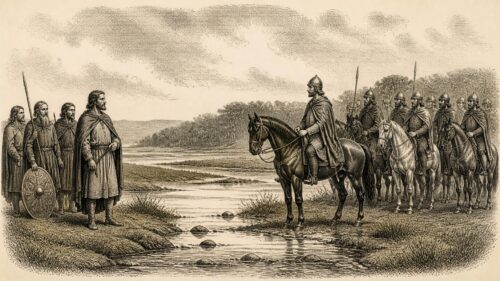
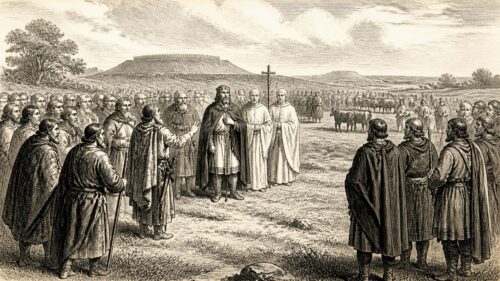
In 964, Dublin’s foreigners, led by Amlaíb Cuarán, plundered the wealthy ecclesiastical settlement of Kildare, demonstrating Dublin’s ability to project power into Leinster. Annals report that many captured clerics were ransomed by Niall ua Eruilb, whose silver-funded intervention restored people and enhanced his standing as protector of Brigit’s community. Muirenn, Kildare’s abbess or related female church officer, also died, though no source links her death directly to the raid. Chronicon Scotorum records cold, scarcity and grain dearth, while killings among northern kings and heirs reveal wider political instability. The selective record portrays a year of violence, hardship, patronage and survival.
Dateline
A Raid Clearly Recorded
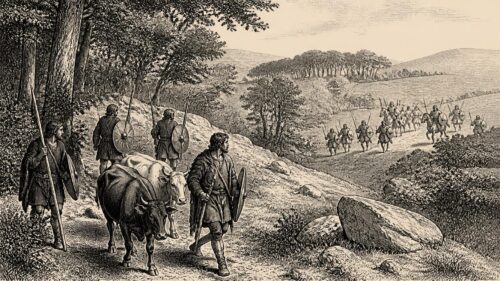
The most securely attested Irish event of 964 was the plundering of Cell Dara, modern Kildare, by the foreigners of Áth Cliath, Dublin. The Annals of Inisfallen, whose entry is explicitly placed under 964, records both the attack and the death in the same year of Kildare’s female erenagh, or hereditary church officer. Chronicon Scotorum gives a fuller version: the attackers were the Dublin foreigners led by Amlaíb son of Sitric, usually known as Amlaíb Cuarán. Neither source supplies a month, the route taken, a battle narrative or a list of goods seized. Yet their agreement leaves no doubt that Kildare, one of Ireland’s foremost ecclesiastical communities, suffered a serious assault in this calendar year.
That agreement matters because Irish annals do not always align neatly. Their surviving manuscripts were copied and compiled later, and their year headings can drift against one another. The Annals of Ulster place the Kildare episode in an entry labelled 963/964, while later compilations sometimes distribute related material differently. For 964, therefore, the raid itself is firmer ground than attempts to assign every associated death, battle or political change to a precise season. The annals preserve vivid evidence, but not a modern diary of events.
Cell Dara and Its Wealth
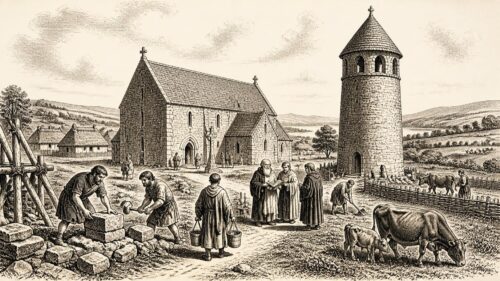
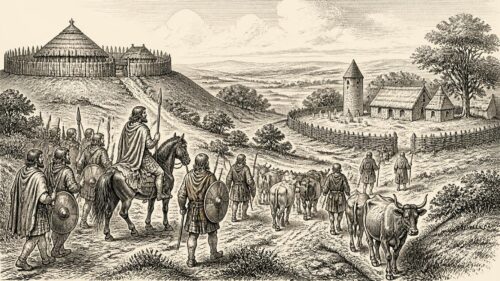
Kildare was not an isolated chapel that happened to be robbed. It was a major religious settlement associated with Brigit, possessing churches, clergy, dependent lands, hospitality and a powerful place in Leinster’s political world. Like Armagh, Clonmacnoise and Glendalough, it was a centre where devotion, learning, lordship and material resources met. Such establishments maintained buildings and livestock, received gifts and dues, employed tenants and craftsmen, and sheltered travellers. Its religious prestige was inseparable from its economic importance.
The raid consequently struck more than liturgical objects. Plundering could mean the loss of food stores, portable wealth, animals, clothing, books, ecclesiastical vessels and people. The wording of the sources does not permit all of those losses to be itemised for 964, and it would be wrong to imagine a complete destruction of the settlement. Kildare continued. But the choice of target demonstrates that the community remained worth attacking, despite generations of earlier raids on major Irish churches. Its position in the Leinster plain, accessible from Dublin’s sphere of power, made its wealth and vulnerability closely connected.
Captives and a Remarkable Ransom
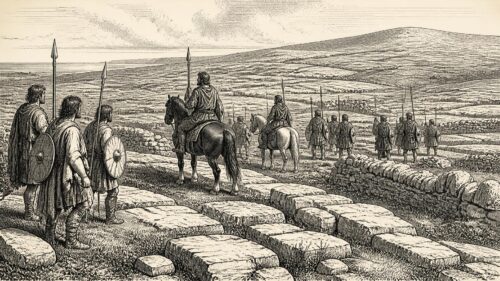
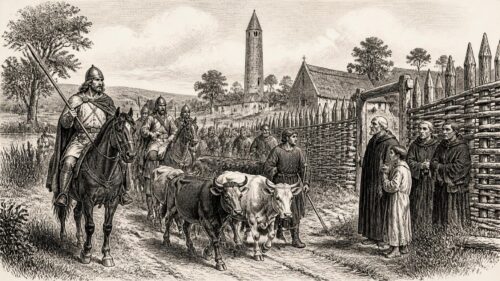
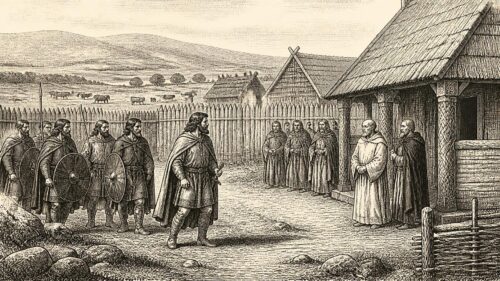
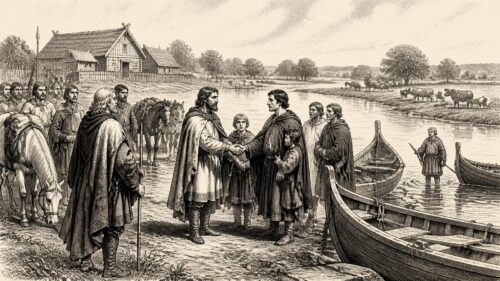
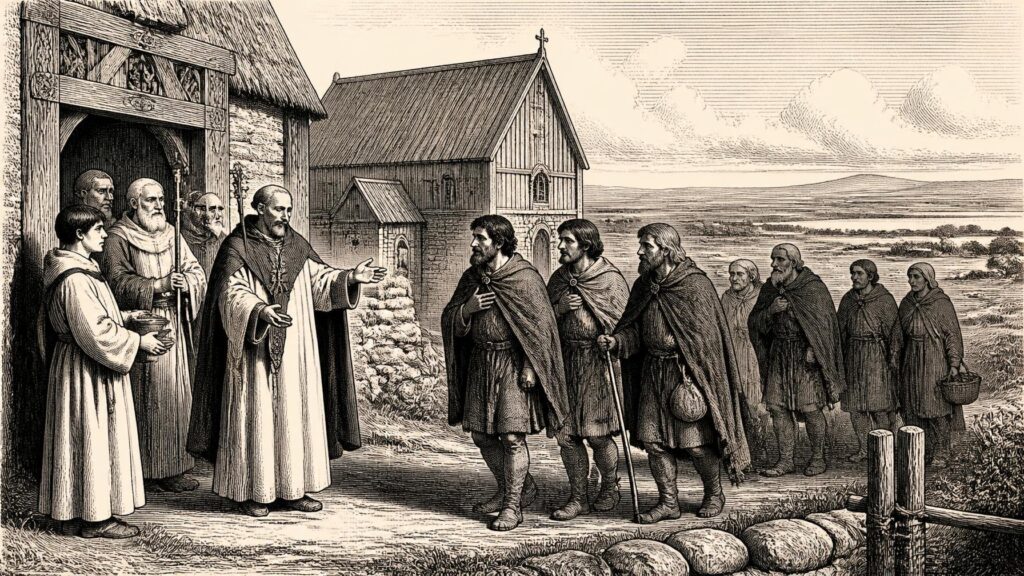
The Ulster annalist adds the most human detail. Almost all the clerics taken in the raid, it says, were ransomed through the “wonderful kindness” of Niall ua Eruilb. He paid with his own silver for as many as could fill Brigit’s great house and its oratory. The language is shaped by admiration and religious purpose, not by neutral accounting; the comparison is surely intended to convey scale rather than provide a headcount. Nevertheless, it records a collective captivity and an exceptionally large intervention to secure release.
Niall’s identity is not wholly straightforward. His kindred name has been debated, and scholars have considered whether Clann Eruilb had Irish, Scandinavian or mixed associations. That uncertainty is itself revealing. Mid-tenth-century Ireland cannot be reduced to two sealed communities, “Irish” and “Viking”. Dublin’s rulers, their allies and their rivals operated across Gaelic-speaking and Scandinavian-speaking worlds, while people of varied backgrounds entered service, marriage, trade, warfare and ecclesiastical patronage. What the annal firmly presents is Niall’s action: silver was mobilised to recover Kildare’s clergy and honour its saint.
The episode also shows that human beings were a valuable prize of war. The record calls the released people clerics, but their removal would have disrupted worship, administration, hospitality and the management of church lands. Ransom restored persons as well as status. In a society where political protection was expected from kings, patrons and leading kindreds, Niall’s payment advertised both resources and piety. The annalist’s praise suggests that rescuing a saint’s community was an act with public, not merely private, significance.
Muirenn’s Office
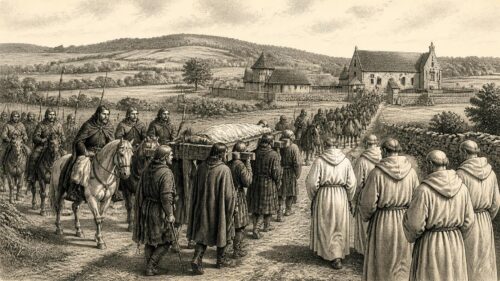
Chronicon Scotorum names Muirenn, granddaughter of Colmán, as abbess of Cell Dara and records her death in 964. Inisfallen’s reference to a female erenagh who died in the same year is very likely connected with the same institutional world, although the sources do not explicitly explain the relationship between the two descriptions. Either way, the notices are an important reminder that women could hold senior, recognised authority within early medieval Irish churches. Kildare’s association with Brigit gave female office-holders particular prominence, even where abbots, bishops and male aristocratic families also exercised power there.
Muirenn’s death, so close in the record to the plundering, must not automatically be treated as a death caused by the raid. The annals do not say that. Its importance lies elsewhere: 964 brought Kildare both external violence and the loss of a leading office-holder. Replacing an abbess or hereditary ecclesiastical superior involved questions of kinship, patronage, rights over land and the standing of the community. The surviving notices are brief, but they expose how deeply the governance of a monastery was entwined with the governance of a region.
Cold, Scarcity and Grain
Against this background of violence, Chronicon Scotorum records “great scarcity and cold and dearth of corn”. This is the clearest contemporary statement about conditions affecting ordinary life in Ireland during 964. Its economy was overwhelmingly agricultural. Grain was needed for food, brewing, dues and hospitality; shortages could affect households, religious communities and warbands alike. Cold weather might damage crops, delay growth or worsen the burdens of an already poor harvest. The annal does not identify a specific weather event, crop disease, regional pattern or duration, so none should be invented. It does, however, place want at the centre of the year’s remembered experience.
Scarcity made political and military disruption more dangerous. A raid on a well-provisioned church could seize stores at exactly the time when food was dear, while the protection and ransom of captives demanded silver and social obligations. Yet the evidence does not allow a simple claim that the Kildare raid was caused by famine, or that the shortage was nationwide in a modern statistical sense. The safer conclusion is that the chronicler linked cold, reduced grain supply and hardship in the same annalistic year, and that communities such as Kildare faced the consequences amid insecurity.
Dublin’s Reach
Amlaíb Cuarán was a ruler of Dublin with a career extending into the Irish Sea world, including Northumbria. In 964 his name beside the foreigners of Áth Cliath shows the capacity of Dublin’s political leadership to project force into Leinster. Dublin was by then more than a seasonal raiding base. Archaeology reveals a developing Hiberno-Norse town with houses, craft activity, overseas contacts and a hinterland whose extent changed with politics and war. Its ships and commercial links supplied opportunity, but its rulers also depended on raiding, tribute, alliances and control of routes beyond the settlement.
The attack on Kildare should therefore be understood neither as an encounter between strangers nor as proof that all Dubliners were alike. The Irish annals use labels such as Gall, “foreigner”, but their political landscape contained shifting coalitions. Amlaíb’s raid was a calculated act by a Dublin-based power against a wealthy Leinster institution. It also exposed the limits of that power: captives could be redeemed, local patrons could turn a disaster into a demonstration of protection, and religious communities could preserve the memory of both injury and rescue.
Violence Beyond Leinster
The same year’s entries in Chronicon Scotorum convey a wider instability. Muirchertach son of Canannán, king of Cenél Conaill in the north-west, was killed by his own people; Máel Ruanaid, also described as king of Cenél Conaill, likewise died at the hands of his own people. Muirchertach son of Congalach, an heir to Tara, was killed by his brother Domnall. These notices are terse and do not furnish motives, locations or sequences. They cannot be expanded into a single coordinated civil war. They do show, however, that succession and kinship could be lethal political arenas in several parts of Ireland at once.
For the communities of 964, this was not an abstract constitutional problem. Kings and royal heirs supplied military leadership, extracted dues, protected clients and patronised churches. Their violent removal could unsettle alliances far beyond the immediate killing-place. The death of Dub Scúile son of Cinaed, successor of Colum Cille, recorded in the same chronicle, adds another reminder of the country’s interconnected ecclesiastical networks. Kildare’s crisis belonged to a year in which political and religious leadership was repeatedly interrupted.
A Year Remembered Through Institutions
What survives for 964 is not a complete picture of every Irish household. It is a set of carefully selected memories, mostly written within ecclesiastical traditions: a famous church plundered, clerics redeemed, an abbess or female church superior dead, grain scarce in cold conditions, and prominent men killed in dynastic conflict. Precisely because the evidence is selective, it should be read closely. Kildare was attacked because it was rich, sacred and politically meaningful; its captives were redeemed because people, institutions and saintly prestige carried value; scarcity mattered because agricultural production underpinned them all.
Niall ua Eruilb’s silver is the year’s most striking image. It points to a world in which wealth could be weighed not only in plunder seized, but in people restored to their community. In 964, Kildare endured a blow from Dublin’s rulers, but the annals chose also to preserve an act of recovery. That balance—damage, deprivation, patronage and survival—is the clearest way to understand Ireland in this difficult year.
Primary Sources
- The Annals of Ulster
- Chronicon Scotorum
- Chronicon Scotorum: Annal CS964
- Annals of Inisfallen: Annal AI964
- Annals of the Four Masters: Annal M964
- Chronicon Scotorum: Bibliographical and Editorial Information
- Amlaíb (Óláfr) Cuarán
- Clann Eruilb: Irish or Scandinavian?
- County Kildare Urban Archaeology Survey
- High Crosses
- The Vikings in County Kildare
- Viking Activities in Ireland by County as Described in the Annals
- Vikings in Ireland and Scotland
- Cogad Gaedel re Gallaib in the Book of Leinster
- Early Medieval Archaeology Project Report 2.1
- Early Medieval Ireland: Archaeological Excavations, 1930–2009
- Viking Age Migration: Evidence of Viking Activity in Ireland by County
- Viking Age Settlement in Ireland: Publications and Bibliography
- The Vikings in Ireland
- Medieval Irish Chronicles Reveal Persistent Volcanic Forcing of Severe Winter Cold Events, 431–1649 CE
- Annals of Inisfallen
- The Annals of Ulster