Ruaidrí at Sláine946 CE
Dateline
The year 946 sits in a difficult but revealing stretch of Irish history. It was a time when the claim to be king of Ireland was real enough to inspire campaigns, alliances and tribute, but not strong enough to make the island a single kingdom. Power rested in regional dynasties, church federations and the new Hiberno-Scandinavian town of Dublin. In the midlands and north-east, two Uí Néill contenders, Congalach Cnogba of Brega and Ruaidrí ua Canannáin of Cenél Conaill, were testing one another’s strength. Dublin’s ruler, Amlaíb Cuarán, was not an outsider to that contest: his forces could be allies, enemies or both, according to the political calculation of the moment.
For 946, the evidence needs careful handling. The Annals of Ulster place the principal campaign in an entry headed “AD 946 alias 947”; modern reference works conventionally describe it as occurring in 947. It is therefore responsible to treat the conflict near Sláine as firmly connected with 946 and its immediate chronological horizon, rather than to assign it an unwarranted exact day or season in that calendar year. This uncertainty is not a defect in the story. It shows how medieval annals were compiled, copied and later synchronised, and why a year-by-year history must distinguish the event itself from the dating systems through which it survives.
A Contest for the Midlands
Congalach Cnogba was the leading ruler of Brega, the rich and politically charged country around the lower Boyne and the approaches to Tara. His byname linked him to Cnogba, modern Knowth, within the Brú na Bóinne landscape. Following the death of Donnchad Donn, king of Tara, in 944, Congalach advanced a claim to wider Uí Néill leadership. He was no passive guardian of an inherited office: his authority had to be made visible through alliances, hostages, military success and recognition from important churches.
Ruaidrí ua Canannáin, king of Ailech and head of the Cenél Conaill, offered a formidable alternative. His lineage belonged to the northern Uí Néill, but it had been excluded from the highest level of power for generations. By the middle of the decade, Ruaidrí was exploiting weakness among rival northern and midland dynasties to press southwards. The struggle was not simply north against south. It involved kindreds with overlapping claims, local rulers concerned for their own territories, and religious communities whose land, dues and protection were bound up with the fortunes of kings.
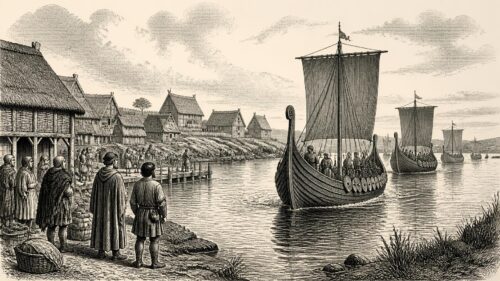
Dublin made the balance still more changeable. Amlaíb Cuarán had returned from political struggles in Britain and was again active in Irish affairs by 945. The annals call his people “foreigners”, but that label should not conceal the depth of their Irish connections. Dublin’s rulers made alliances with Gaelic kings, fought beside them and against them, and drew wealth from Irish as well as overseas networks. In the campaign associated with 946, Congalach and Amlaíb stood together against Ruaidrí. The alliance was practical, not permanent: shared danger, rather than ethnic identity, determined the sides.
The Encounter Near Sláine
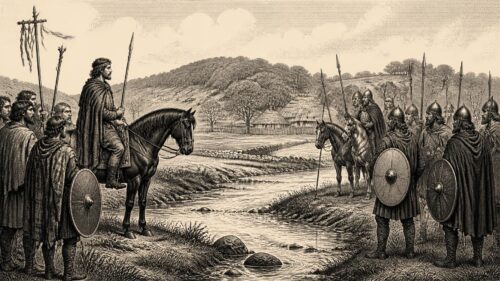
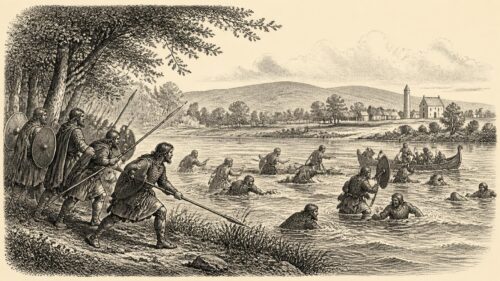
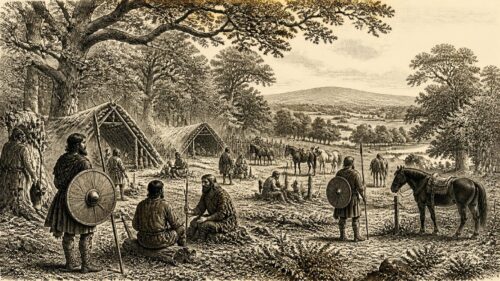
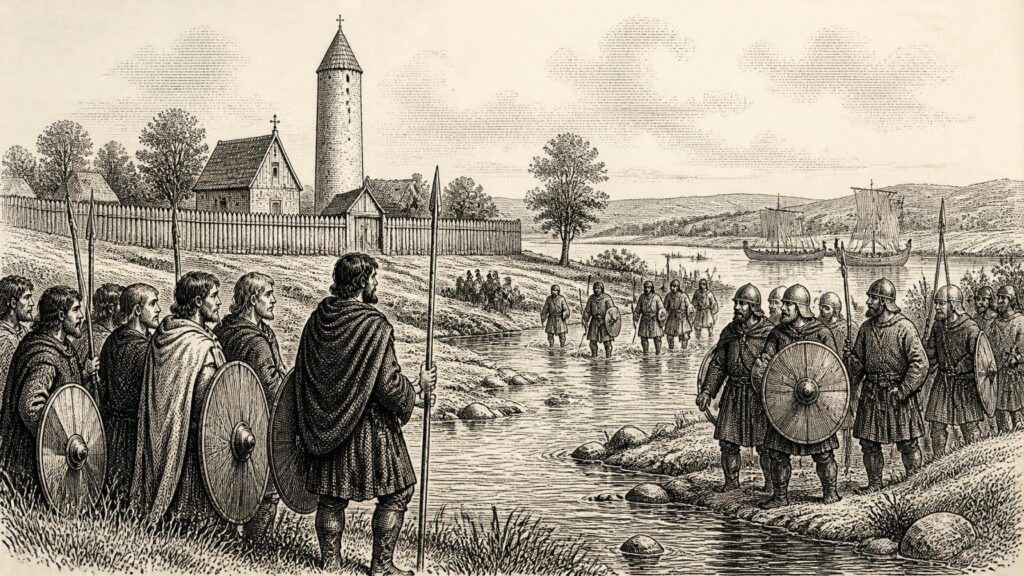
The Annals of Ulster report that Ruaidrí led an army to Sláine. Congalach and Amlaíb then came upon him, and the Dublin force was defeated; many were killed or drowned. The notice gives no detailed battle narrative, no trustworthy total of casualties and no description of weaponry or manoeuvre. It does, however, preserve the essential political fact: Ruaidrí had carried the contest into the Boyne region, and the allied king of Brega and ruler of Dublin tried to stop him there.
Sláine was a potent setting for such a confrontation. Its monastery stood near a major crossing and route through the Boyne valley, not far from the royal and dynastic landscapes of Tara, Knowth, Dowth and Kells. An army moving there could threaten Brega while remaining close to churches and estates capable of supplying provisions, intelligence and political legitimacy. Yet the annal does not permit a modern map-maker to pinpoint the battlefield. “At Sláine” or “near Sláine” is safer than any claim to identify a particular field, ford or hill.
The reported drowning is a reminder that warfare in Ireland’s riverine east was shaped by water as well as dry ground. Rivers, marshes and fords could divide a force, obstruct retreat and turn a defeat into a disaster. It would be wrong to imagine the engagement as an isolated clash between neatly separate Irish and Viking armies. Ruaidrí’s host was an Irish royal force; Congalach’s army represented Brega and allied interests; Amlaíb’s Dubliners belonged to a settled, commercially connected but militarily powerful town. Loyalties crossed cultural boundaries, while the fighting exposed the vulnerability of every group caught in the struggle.
Churches, Silver and Authority
The same annalistic sequence records a gift from Cenél nÉogain: the full measure of the Finnfaídech, described as pure silver, was given to Patrick. This was not loose charity. “Patrick” meant the ecclesiastical community centred on Armagh and its claims of patronage, jurisdiction and tribute. The act demonstrates that church wealth and royal authority were entwined. Silver could serve as portable wealth, a political offering and a statement that a dynasty acknowledged the standing of Patrick’s church.
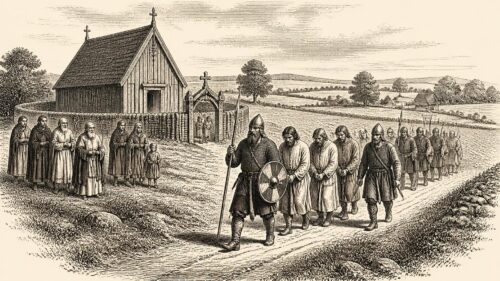
For ordinary communities, monasteries were much more than secluded houses of prayer. Major foundations held land, livestock, workshops, food stores and learned personnel; they received visitors and travellers, and linked local districts to wider networks of devotion and exchange. Their leaders came from aristocratic families and their offices could matter intensely in regional politics. That helps explain why a campaign near Sláine had implications beyond the warriors present. Military movement through a church-rich landscape could mean requisitioning food, threatening dependants, disrupting travel and forcing local ecclesiastics to judge which ruler was best able to protect their interests.
The fragility of that protection had recently been demonstrated in Meath. An Annals of Ulster entry with its own overlapping 945/946 date records the plundering of Clonmacnoise and other churches of Mide by the Dublin foreigners. Clonmacnoise, on the Shannon, was one of Ireland’s foremost ecclesiastical centres, while the churches of Meath lay close to the theatre of competition for Tara. The notice should not be stretched into a securely dated event of 946 itself, but it is indispensable context for the insecurity felt by church communities in the years around Sláine.
Dublin Beyond the Annals’ Label
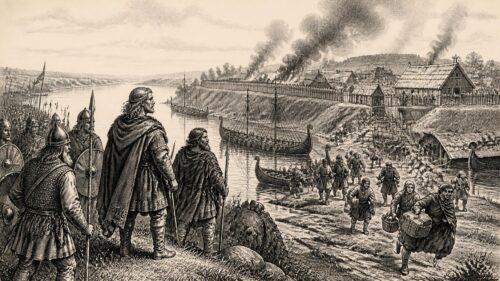
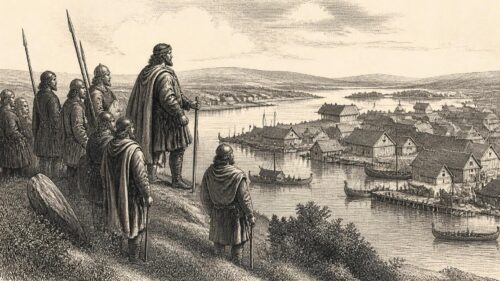
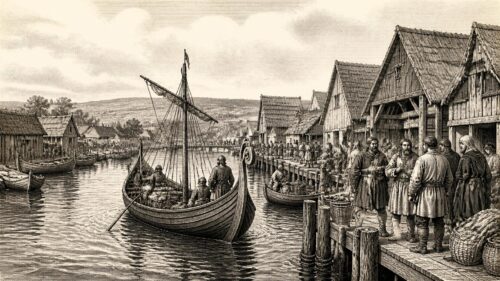
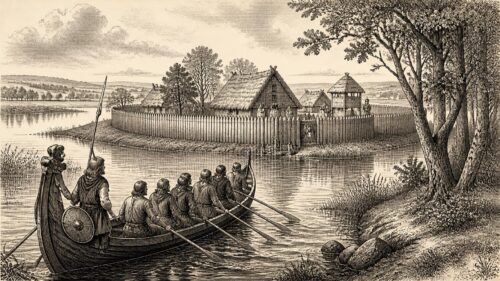
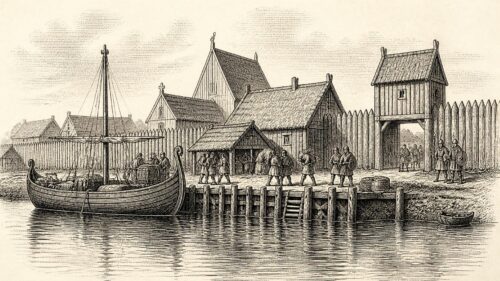
The Dubliners who fought in this political contest came from a town that was becoming one of Ireland’s most consequential settlements. Archaeology at Fishamble Street and elsewhere shows tenth-century Dublin as a place of timber houses, lanes, plots, animal enclosures, storage, craftworking and middens. Artisans used imported and local materials including bone, antler, leather, metals and timber. Overseas connections brought goods and ideas, while the surrounding Irish countryside supplied food, people and products. Its rulers could field ships and fighting men because the town was also an economic hub.
This does not make Dublin an entirely separate world from Gaelic Ireland. Intermarriage, diplomacy, trade and service joined town and hinterland, even as raiding and enslavement scarred those connections. Nor should its inhabitants be reduced to a single identity. The annals’ “foreigners” is an important contemporary category, especially in a record of warfare, but tenth-century Dublin was already a Hiberno-Scandinavian society whose fortunes depended upon engagement with Irish rulers and territories.
Limits and Legacy
The annals also associate this period with the killing of Bróen, king of Leinster, on a foray in Osraige, and with deaths among the political and ecclesiastical elite. Their sparse notices reveal a landscape in which a royal expedition, a raid or the death of an abbot could alter local calculations quickly. They do not provide a harvest report, a population count or a full account of household life for 946. It is better to acknowledge that silence than to invent a general crisis or prosperity for the year.
What can be said is that the contest around Sláine exposes Ireland’s political structure at a moment of strain. Congalach’s claim to pre-eminence was challenged from the north; Ruaidrí could reach the Boyne heartland; Amlaíb’s Dublin was a decisive military partner; and Armagh’s silver offering shows that ecclesiastical recognition remained part of the language of power. Later events would rearrange these alliances again. For the year 946 and its disputed annalistic horizon, the enduring image is not of a settled high kingship, but of rival rulers converging on Sláine, where control of routes, churches and alliances could matter as much as victory in battle.
Primary Sources
- The Annals of Ulster
- Part 516 of The Annals of Ulster
- Part 517 of The Annals of Ulster
- Annals of the Four Masters
- Part 5 of Annals of the Four Masters
- Part 5 of Annals of the Four Masters (Irish text)
- Chronicon Scotorum
- Annals of Inisfallen
- The Annals of Tigernach
- Irish texts at CELT
- Exploring the Irish Annals
- Ua Canannáin, Ruaidrí | Dictionary of Irish Biography
- Congalach Cnogba | Dictionary of Irish Biography
- Amlaíb (Óláfr) Cuarán | Dictionary of Irish Biography
- Blacair (Blakkr) | Dictionary of Irish Biography
- Muirchertach na Cochall Craicinin | Dictionary of Irish Biography
- Early Medieval Ireland: Archaeological Excavations, 1930-2009
- Early Medieval Dwellings and Settlements in Ireland, AD400-1100. Vol. 1: Text
- Brú na Bóinne Research Framework: Full Report
- Rathbeagh Ringfort, Co Kilkenny | The Heritage Council
- Early Christian Monasteries
- Viking Dublin
- Viking Ireland
- Annals of the Kingdom of Ireland | National Library of Ireland Catalogue