Sláine’s Drowned Foreigners947 CE
In 947, Ruaidrí ua Canannáin of Cenél Conaill defeated Congalach of Brega and Dublin’s Amlaíb Cuarán at Sláine near the Boyne, killing or drowning many Dublin warriors. The encounter formed part of competing claims to Tara, not a national war, and highlighted Dublin’s role in Irish politics. Elsewhere, Osraige routed Leinster, killing King Braen and other leaders, while northern nobles also died in obscure conflict. Cenél nÉogain made a notable silver gift to Armagh, affirming political and religious ties. Annals recorded ecclesiastical deaths, a travelling preacher, and marvels, revealing intertwined warfare, patronage, Christianity, and Irish Sea connections during the year.
Dateline
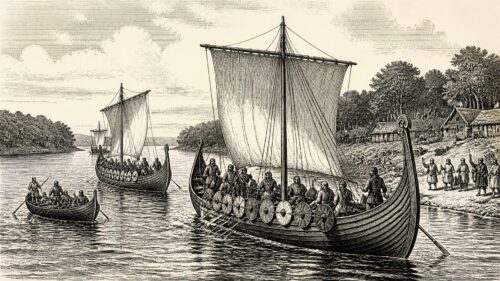
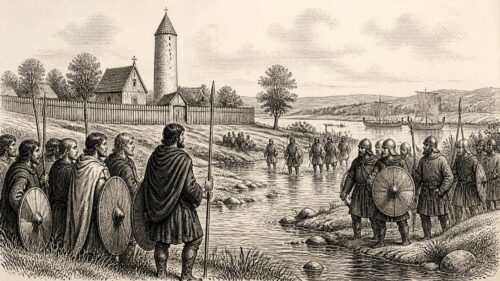
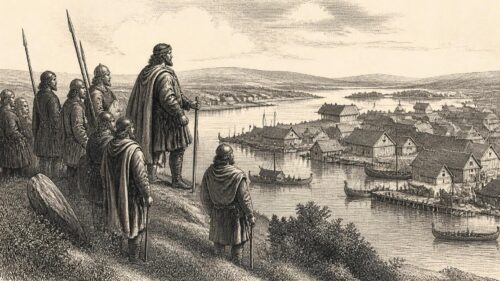
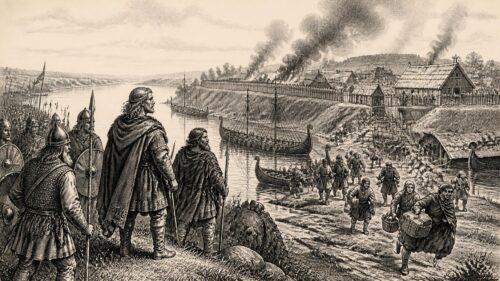
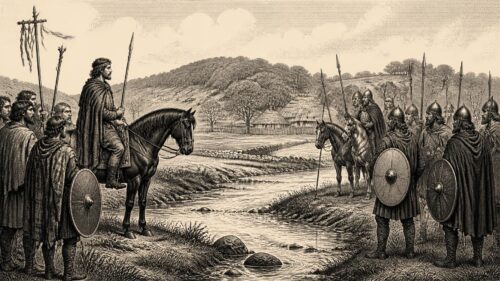
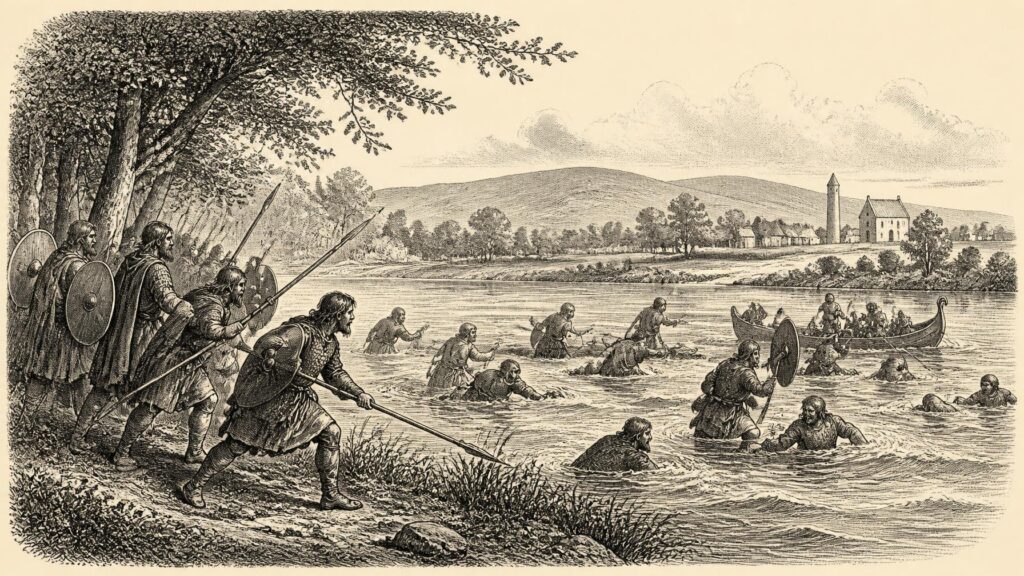
The most consequential recorded clash connected with Ireland in 947 occurred at Sláine, beside the Boyne in the heart of Brega. The Annals of Ulster state that Ruaidrí ua Canannáin led an army there, where he was met by a coalition of “foreigners and Irish”: Congalach son of Máel Mithig and Amlaíb Cuarán. The Dublin contingent was defeated, and many of its men were killed or drowned. No day, season or detailed battlefield narrative survives. Yet the entry is unusually revealing. It places the struggle for pre-eminence in Ireland at a river crossing and political centre close to Tara, and shows a Norse-Gaelic ruler of Dublin fighting alongside an Irish claimant to wider authority against a rival from the north-west.
A Contest at Sláine
Ruaidrí belonged to Cenél Conaill, the leading branch of the Northern Uí Néill in what is now Donegal. Congalach Cnogba, his opponent, was king of Brega and a member of Síl nÁedo Sláine, a Southern Uí Néill dynasty based around Knowth and the Boyne valley. Both men had reason to seek the kingship of Tara, the most prestigious Irish overkingship, after the deaths of Muirchertach of Cenél nÉogain in 943 and Donnchad Donn of Clann Cholmáin in 944. Neither ruled a united country in a modern sense. Authority rested on kinship, military following, tribute, hostage-taking, alliances with churches, and the ability to make rivals acknowledge superiority.
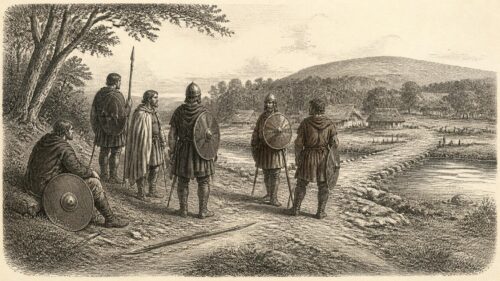
The battle recorded under 947 therefore belonged to a wider contest, but it should not be inflated into a decisive national war. Ruaidrí’s advance to Sláine was a bold southern intervention. Congalach and Amlaíb came against him together; the annalist explicitly separates the defeated “foreigners of Áth Cliath” from their Irish allies. The report that many drowned suggests fighting near the Boyne or its approaches, perhaps amid a disordered retreat, but it does not permit a reconstruction of formations, numbers or tactics. What can safely be said is that the Dublin force suffered heavily, while Ruaidrí emerged from the encounter with a major political success.
Sláine was a fitting place for such a confrontation. It stood on an important route through the Boyne valley, close to royal and ecclesiastical landscapes in Meath. The hill and church settlement carried strong Patrician associations in later tradition, while the river route linked the interior with the Irish Sea. Control of movement through this district mattered as much as possession of a single fort. An army at Sláine could threaten Brega, approach the Tara region, or obstruct opponents moving between Dublin and the midlands.
Dublin in Irish Politics
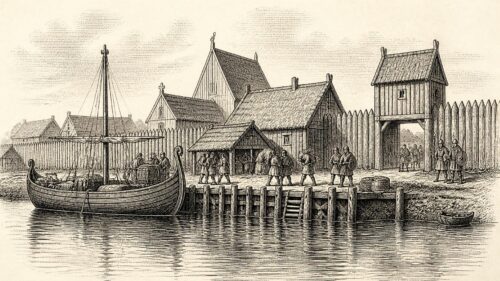
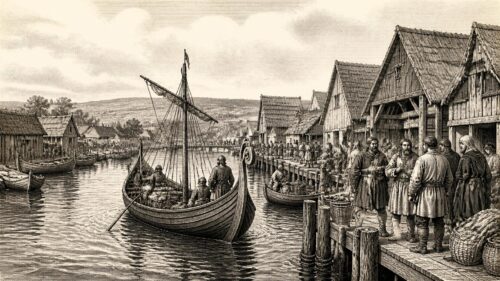
The “foreigners” in this account were not simply transient raiders arriving from abroad. By the mid-tenth century Dublin was an established Scandinavian-founded port, ruled by dynasts who operated in a mixed Irish Sea world extending to Northumbria, the Isles and western Britain. Amlaíb Cuarán had recently returned from England and allied himself with Congalach. Their partnership made strategic sense: Congalach gained mobile military support and access to Dublin’s resources, while Amlaíb acquired an influential Irish ally against competitors within the Dublin dynasty and against hostile neighbouring kingdoms.
That alliance nevertheless proved vulnerable at Sláine. Ruaidrí’s victory exposed the limits of Congalach’s authority and the risks undertaken by Dublin’s rulers when they entered inland politics. The annals’ wording is important: it records the defeat of the Dublin men rather than a straightforward defeat of Congalach himself. This may indicate that the coalition did not collapse completely, or simply reflect the annalist’s interest in the foreigners’ losses. Either way, the episode demonstrates that alliances were personal and contingent. Amlaíb was not a subordinate foreign auxiliary to an Irish king, nor was Congalach a client of Dublin. Each pursued his own claims in a shifting field of rivals.
Later developments underline the instability. The Annals of Inisfallen, compiled in Munster, place the death of Blacair, a rival Dublin ruler, under 947. The Annals of Ulster and Chronicon Scotorum instead record his killing by Congalach in their following annal, conventionally dated 948. Modern reference works consequently date Blacair’s death to 948. It should not be presented as a firmly dated event of 947, although the disagreement itself is instructive: medieval annals preserve precious contemporary or near-contemporary notices, but their year headings cannot always be treated as identical calendar labels across every compilation.
Violence in Leinster and the North
Other annalistic notices assigned to 947 show that conflict was not confined to Brega. The Annals of Ulster record the deaths of Scolaige ua hAedacáin, king of Dartraige; Gairbíth son of Muiredach, heir apparent of Uí Chremthainn; and Áed son of Tigernán ua Ruairc, in a counterattack. The terse notice does not name the place, opponents or political cause. It is a reminder of the narrowness of the evidence: three high-ranking men were killed, but their story has survived only as a compressed memorial.
The same annal records that Braen son of Máel Mórda, king of Leinster, was killed on a foray in Osraige. Chronicon Scotorum, under 947, gives the encounter more shape: Donnchad son of Cellach, king of Osraige, inflicted a rout on the Leinstermen; Braen and Cellach son of Cináed, king of Uí Chennselaig, fell with many others. Taken together, the notices show a serious reverse for Leinster in its western borderlands. Osraige, situated between Leinster and Munster, could be both a contested frontier and an assertive kingdom in its own right. Braen’s death was not merely a personal loss but a disruption in Leinster’s senior leadership.
These killings illuminate the practical scale of tenth-century politics. Kingship was distributed among many regional rulers, each dependent on relatives, clients, ecclesiastical connections and armed followers. Raiding was not random lawlessness: it could secure cattle, supplies, prestige, submission or hostages, while also devastating the households that lay in an army’s path. The annals chiefly name kings and churchmen, not the farmers, herders, boatmen and craftsmen who bore the material cost. Still, the deaths recorded in 947 imply the mobilisation of local communities for warfare and the disruption of routes, grazing lands and food stores.
Silver for Patrick
One of the year’s most striking notices is peaceful in form but political in meaning. The Annals of Ulster say that Cenél nÉogain gave “the full measure of the Finnfaídech of pure silver” to Patrick. The wording probably refers to a quantity of silver measured by, or associated with, the Finnfaídech, generally understood as a bell connected with St Patrick and the church of Armagh. The precise object and transaction remain uncertain. What is clear is that a powerful northern people made a conspicuous gift to Patrick’s institutional community.
Such a donation was more than private devotion. Armagh’s claim to Patrician authority reached across Ireland, and gifts of valuable metal expressed relationships of patronage, status and protection. Silver was portable wealth: it could be made into ecclesiastical vessels, ornaments or bullion, and its public presentation carried symbolic weight. Cenél nÉogain’s offering may therefore be read cautiously as an act of religious allegiance with political resonance. In a year when rival Uí Néill dynasties fought for influence, association with Patrick’s leading church was an asset worth displaying.
The death of Cathusach son of Ailche, bishop of Cenél nÉogain, also appears in the annal. His title points to the close entanglement of church office and regional society. Bishops, abbots and heads of church communities were not remote figures outside politics; they administered landed institutions, received gifts, preserved learning and could serve the interests of major kindreds. Yet it would be unsafe to turn Cathusach’s brief obit into a biography. The record confirms his standing and death, not his individual policies.
Marvels and Preaching
For the same year, Chronicon Scotorum calls it a “year of wonders”. It reports that a leaf fell from heaven and that a céle Dé came overseas from the south to preach to the Irish. The Annals of Inisfallen similarly locates a heavenly leaf on the altar of Imlech Ibuir, the important church centre at Emly in Munster, adds a speaking bird and mentions other marvels. These should not be treated as verifiable meteorological or zoological events. They are evidence for how annalists and their communities interpreted extraordinary signs within a Christian world.
The travelling céle Dé is equally elusive. The phrase literally means “servant” or “client of God” and could describe a religious devotee rather than a member of a precisely defined organisation. The notice securely indicates a preacher arriving by sea and a remembered act of religious teaching; it does not securely identify his homeland, doctrine, audience or lasting effect. Even so, it hints at the maritime connections of Irish Christianity. Churches in Ireland were linked to routes across the Irish Sea and beyond, through travellers, books, pilgrims, clergy and precious goods.
947 was thus a year in which military power, church patronage and sacred interpretation were closely interwoven. At Sláine, Ruaidrí ua Canannáin dealt a costly blow to the Dublin element in Congalach and Amlaíb’s alliance. In Osraige, Leinster’s king fell during a disastrous campaign. Elsewhere, silver was offered to Patrick’s church and unusual happenings were entered into the historical record as signs. The surviving evidence is sparse, regional and sometimes chronologically uneven. Read carefully, however, it reveals an Ireland of competing kingships, influential ecclesiastical centres and Irish Sea connections, where a battle on the Boyne could alter political calculation far beyond the field itself.
Primary Sources
- The Annals of Ulster: Year U947
- The Annals of Ulster
- Chronicon Scotorum: Annal CS947
- Chronicon Scotorum: Irish Text, Annal CS947
- Annals of Inisfallen: Annal AI947
- Annals of the Four Masters: Annal M947
- Congalach Cnogba
- Ua Canannáin, Ruaidrí
- Amlaíb (Óláfr) Cuarán
- Blacair (Blakkr)
- Ua Néill, Domnall
- Chronological Synchronisation of the Irish Annals
- The Dating of the Irish Annals
- The Relic Cult of St Patrick between the Seventh and Twelfth Centuries
- Clonmacnoise Visitor Guide
- Clonmacnoise Monastic Site
- High Crosses
- Hill of Slane
- Slane Historic Trail
- The Vikings in Ninth-Century Ireland: Sources and Settlements
- Raiding and Warring in Monastic Ireland
- The Kings of Aileach and the Vikings, AD 800–1060