Hostages at Athlone1002 CE
In 1002 Brian Bórama transformed Irish politics by bringing an army to Athlone and taking hostages from Connacht and Mide, publicly demonstrating Máel Sechnaill mac Domnaill’s submission. Annals differ slightly in dating and emphasis, but confirm the event. Brian’s earlier successes over Leinster and Dublin enabled wider mobilisation, including Norse-Gaelic allies. Yet his subsequent northern expedition to Dundalk failed to secure hostages from Áed of Ailech and Eochaid of Ulaid, ending in truce. Raids, captives and ecclesiastical deaths reveal regional conflict. Coastal towns, trade and church institutions underpinned power. Brian emerged as leading king, but his island-wide overlordship remained incomplete.
Dateline
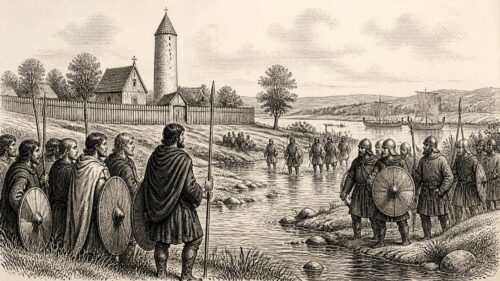
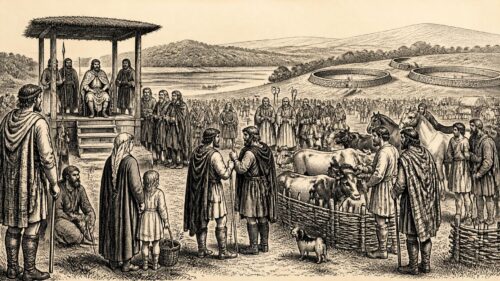
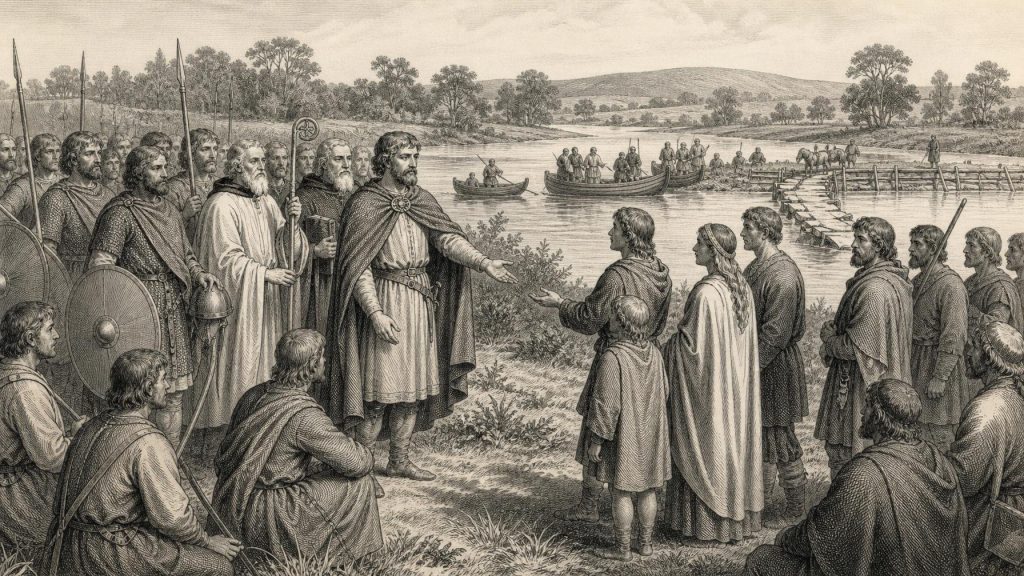
The year 1002 stands out in Irish history because a political order long dominated by the Uí Néill was visibly broken. The firmest annalistic notice is brief but weighty: Brian son of Cennétig brought an army to Áth Luain, modern Athlone, and took the hostages of Connacht and of Mide. In the language of early medieval Ireland, hostages were not ceremonial ornaments. They were living guarantees of submission, peace and future obedience. Their transfer marked a ruler’s public acknowledgement that another king could compel him.
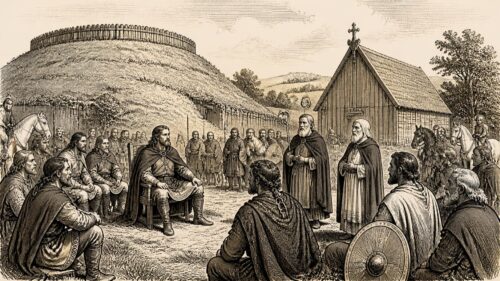
For Brian Bórama, king of Munster and leader of the Dál Cais, this was the decisive step from powerful provincial overking to claimant of the kingship of Ireland. For Máel Sechnaill mac Domnaill, king of Mide and long-standing Uí Néill high-king, it was a negotiated defeat rather than a battlefield catastrophe. The sources do not give a single dramatic day, and later storytelling should not be mistaken for contemporary record. Yet the political meaning of 1002 is clear: Brian had forced the ruler of Mide, and the Connacht powers linked to him, into a new hierarchy.
A Year in the Annals
The main evidence comes from Irish annals, which are terse, selective and sometimes differ in chronology. The Annals of Ulster place the Athlone expedition under U1002, while the Annals of Inisfallen, Chronicon Scotorum and the Annals of Tigernach preserve closely related notices. The Annals of the Four Masters, compiled much later, place some corresponding events under 1001 and then label 1002 as Brian’s first year in sovereignty over Ireland. This is not unusual: medieval Irish annalistic dating often drifts by a year, and the safest approach is to read the entries comparatively rather than force them into modern exactness.
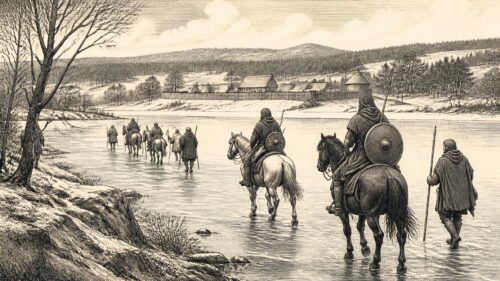
What can responsibly be said is that in or closely connected to 1002 Brian advanced to Athlone, a crucial Shannon crossing between Mide and Connacht. The Annals of Ulster say that he took the hostages of the Connachta and the men of Mide. The Annals of Inisfallen, written from a Munster perspective, say that the men of Munster entered Connacht and took the Connacht hostages at Athlone, as well as the hostages of Máel Sechnaill. Chronicon Scotorum and the Annals of Tigernach also record Brian’s army at Athlone and the taking of hostages.
The emphasis varies, but the underlying event is secure. Brian was no longer merely pressing Mide from the south and west; he had reached the strategic hinge of the island and compelled submission at the place where river, road and provincial politics met.
Brian and Máel Sechnaill
The confrontation had deep roots. In 997 Brian and Máel Sechnaill had agreed a division of authority, often described as a partition between the southern and northern halves of Ireland. That arrangement recognised Brian’s dominance in Munster and much of the south, while Máel Sechnaill retained the prestige of Tara and the Uí Néill sphere. It was an uneasy settlement between two ambitious rulers, not a constitutional pact.
Brian’s victory over the combined forces of Leinster and Dublin at Glenn Máma at the end of 999 had strengthened his hand. Dublin submitted, and its ruler Sitriuc Silkbeard was restored within a political order in which Brian could call upon Dublin and Leinster forces. By 1002, Brian could mobilise not only Munstermen but allies, dependants and Norse-Gaelic contingents from the great coastal towns. His military reach had become island-wide in ambition, even if not yet island-wide in obedience.
Máel Sechnaill’s position was more difficult. He remained a formidable ruler of Mide, and the annals show him still killing opponents and acting independently. In 1002 he killed Meirlechán, king of Gailenga, and Brotud son of Diarmait. But he could not prevent Brian from taking hostages from the very heart of his political world. The submission was not the end of Máel Sechnaill’s career; after Brian’s death in 1014 he would return to the high-kingship. In 1002, however, he yielded practical supremacy.
The Northern Check
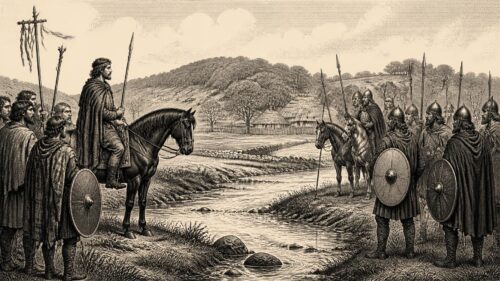
Brian’s triumph at Athlone did not instantly unite Ireland. The same year’s entries show the next problem: the north. After the Athlone submission, Brian and Máel Sechnaill led an army north-east to Dún Delca, modern Dundalk, in Conaille Muirtheimne. Their purpose, according to the annals, was to demand hostages from Áed son of Domnall Ua Néill, king of Ailech, and Eochaid son of Ardgar, king of Ulaid.
The expedition’s composition is revealing. Chronicon Scotorum says the army included Munstermen, Connachta, Leinstermen and foreigners; the Annals of Inisfallen names the men of Munster, Connacht, Mide, Leinster, and the foreigners of Dublin and Waterford. This was the political map of Brian’s new power translated into a marching host. Former rivals and recently subordinated groups were expected to serve in a campaign against those still outside his obedience.
The northern coalition held firm. Áed of Ailech and Eochaid of Ulaid, with the Ulaid, Cenél nEógain, Cenél Conaill and Airgialla, met the army and prevented it from advancing. The annals stress that the opposing forces parted under truce, without hostages or pledges. This is as important as the earlier success at Athlone. Brian had gained the submission of Mide and Connacht, but the northern Uí Néill and Ulaid were not yet brought to heel. The high-kingship he claimed in 1002 was therefore a project as much as an accomplished fact.
Raids, Captives and Regional Violence
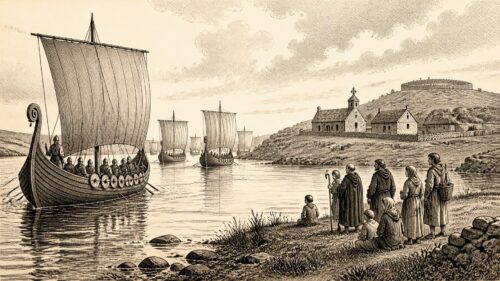
Other notices for the year remind us that royal politics unfolded amid constant local violence. Áed son of Domnall raided Connacht. Cernachán son of Flann, king of Luigne, went on a foray into Fernmag and slew Muirchertach ua Ciarda, heir designate of Cairpre. The Annals of Tigernach add that Sitriuc son of Amlaíb, king of the Dublin foreigners, went by ship on a raid into Ulaid, plundering Cell Cleithe and Inis Cumscraig and carrying away many captives.
These entries are not background noise. Raiding was a political language. Cattle, captives, movable wealth and hostages all mattered because power was measured in people and resources as much as in titles. A king who could protect churches, clients and grazing lands enhanced his authority; a king who failed invited rivals to test him. The capture of people in Sitriuc’s raid also reflects the darker economy of the Irish Sea world, where slavery, ransom and forced movement remained part of warfare and trade.
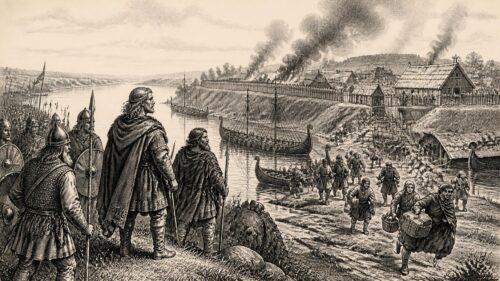
In the rural landscape, most people did not experience 1002 as a constitutional turning point. They lived in ringforts, unenclosed farms, crannogs, church settlements and small communities tied to kin, lordship and ecclesiastical estates. Cattle remained central to wealth, diet, rent and compensation. When armies moved, ordinary households risked billeting, requisitioning, crop damage and the loss of livestock. The annals record kings; the consequences were borne widely.
Churches and Learned Men
Religion and learning appear in the year’s notices through deaths and violence involving churchmen. The Annals of Ulster record the killing of Tréinfher son of Céilecán, prior of Armagh, by Mac Léiginn son of Cairell, king of Fernmag. The same source notes the deaths of Colum, superior of Imlech Ibair, and Cathalán, superior of Daiminis. Chronicon Scotorum records the death of Flann son of Eógan, chief jurisconsult of Leth Cuinn, and also mentions a disturbance involving Ua Begulán at Clonmacnoise.
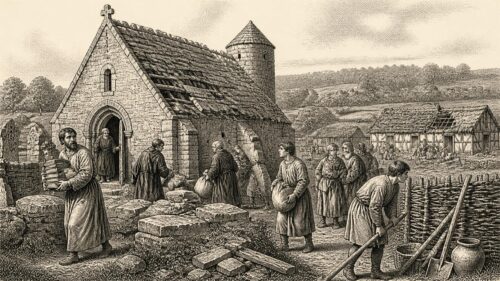
These brief notices point to a society in which churches were not separate from politics. Armagh, Clonmacnoise, Emly, Daiminis and other ecclesiastical centres possessed land, clients, relics, schools and prestige. Their leaders were spiritual figures, landlords, diplomats and, at times, casualties of secular conflict. Learned specialists such as judges, poets and historians helped preserve law, genealogy and royal memory. Their deaths were annal-worthy because knowledge itself was a form of power.
Brian would later cultivate Armagh spectacularly, most famously in 1005, when his association with the church was recorded in the Book of Armagh. That later moment should not be pushed back into 1002, but the conditions were already present: any king seeking island-wide authority needed ecclesiastical recognition as well as hostages.
Towns, Trade and the Irish Sea
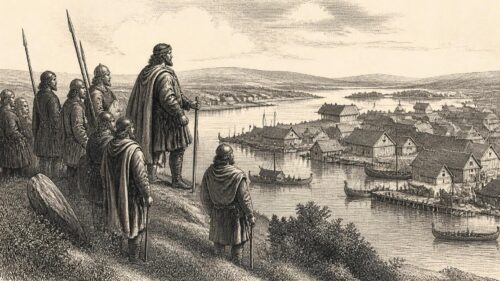
By 1002 Ireland’s coastal towns were essential to politics. Dublin, Waterford, Limerick, Wexford and Cork had grown from Viking bases into centres of craft, exchange and maritime power. Dublin was especially important. Archaeology at Wood Quay reveals dense urban occupation, craft production, imported goods and defensive works around this period. Sitriuc Silkbeard’s Dublin had also begun minting silver pennies around 997 or 998, the first coinage struck in Ireland.
Brian’s ability to include the foreigners of Dublin and Waterford in his northern expedition shows how far the old opposition between “Irish” and “Viking” fails to explain the politics of 1002. Norse-Gaelic rulers could fight Brian, submit to him, marry into Irish dynasties, mint coins, raid churches and serve in Irish royal armies. Dublin’s merchants, shipmen and craftsmen were not passive subjects; they were part of the machinery that made large-scale kingship possible.
A New High-Kingship
The most important development of 1002 was therefore not a single coronation, nor a conquest of all Ireland, but a change in what could be imagined and enforced. Brian’s taking of the hostages of Mide and Connacht ended Máel Sechnaill’s immediate supremacy and broke the expectation that the high-kingship belonged by tradition to the Uí Néill. Yet the truce at Dún Delca proved that Brian still had to win, bargain for or compel northern obedience.
The year left Ireland with two realities. Brian was now the leading king in Ireland, strong enough to command former rivals and to claim a status no Munster ruler had previously sustained. At the same time, Ireland remained a landscape of regional kingships, church powers, maritime towns and local conflicts. The transformation of 1002 lay precisely in that tension: a new high-king had emerged, but the work of making his overlordship real had only begun.
Primary Sources
- The Annals of Ulster: Year U1002
- Chronicon Scotorum: Annal CS1002
- The Annals of Tigernach: Annal T1002
- Annals of Inisfallen: Annal AI1002
- Annals of the Four Masters
- CELT: The Annals of Ulster, Background Details and Bibliographic Information
- CELT: Annals of Inisfallen, Background Details and Bibliographic Information
- Brian Boru: imperator Scotorum
- What the Sources Say
- Network Analysis of the Viking Age in Ireland as Portrayed in Cogadh Gaedhel re Gallaibh
- ‘Emperor of the Irish’: Brian Boru and the Battle of Clontarf 1014 — Rise to Power
- ‘Emperor of the Irish’: Brian Boru and the Battle of Clontarf 1014 — The Combat
- Brian Bórama (Bóruma, Boru) | Dictionary of Irish Biography
- Máel-Sechnaill | Dictionary of Irish Biography
- Sitriuc Silkbeard (Sitric, Sigtryggr Ólafsson Silkiskeggi) | Dictionary of Irish Biography
- Ua Néill, Áed | Dictionary of Irish Biography
- Gormlaith | Dictionary of Irish Biography
- Viking | National Museum of Ireland
- 950–1450: Vikings, Normans and Medieval Mints | National Museum of Ireland
- Clonmacnoise, County Offaly | National Monuments Service
- Clonmacnoise Monastic Site | Heritage Ireland
- Agriculture, Settlement and Society in Early Medieval Ireland | Queen’s University Belfast
- The Archaeology of Livestock and Cereal Production in Early Medieval Ireland, AD 400–1100
- The Archaeology of Early Medieval Ireland, c.400–1169: Settlement and Economy