

Tech Giurann Ambush956 CE
Dateline
A King Killed in Leinster
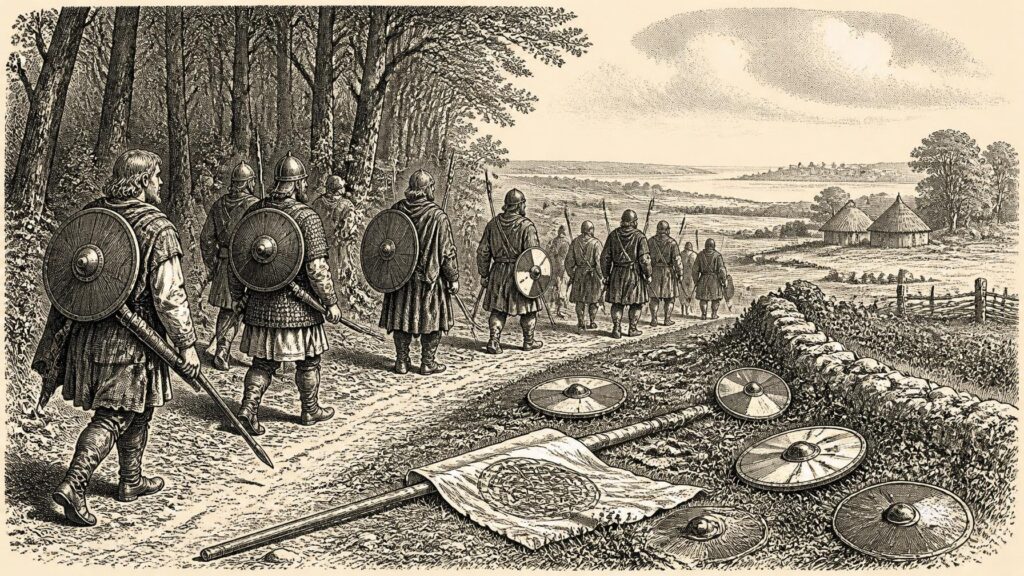
The decisive Irish event conventionally placed in 956 was the killing of Congalach Cnogba, king of Ireland, at Tech Giurann in Leinster. The Annals of Ulster name his attackers as the foreigners of Áth Cliath—Dublin—and the Laigin, or Leinstermen; they also record the death of Áed son of Aichid, king of Tethbae, and “many others”. Chronicon Scotorum makes the disaster still more explicit: Congalach fell with his royal household, and names Matudán son of Áed son of Máel-mithig and Cormac son of Cathalán, king of Fir Arda, among the dead. This was not a routine raid or a minor dynastic killing. A king styled rí Érenn, king of Ireland, had been destroyed with leading followers in a combined Leinster–Dublin attack.
The date needs one caution. Irish annals were compiled and copied through different chronological systems, and the Ulster entry itself is headed “AD 955 alias 956”. The Annals of the Four Masters, moreover, begin Domnall Ua Néill’s first regnal year under 955 and call 956 his second. Modern reference works normally place Congalach’s death in 956, and that convention is followed here; neither the month nor day of the encounter is known. The evidence is firm about the killing and its participants, but not about the precise sequence of campaigning or the exact location of Tech Giurann, generally placed somewhere near Dublin.
Congalach’s Fatal Assertion of Authority
Congalach was a ruler of the southern Uí Néill, from the Síl nÁedo Sláine lineage of Brega. His byname, Cnogba, connected him with Knowth in the Boyne valley, a region dense with older monuments and early medieval settlements. He had gained the kingship of Tara after the deaths of powerful rivals in the 940s and had, for a time, projected authority into Leinster and Munster. Yet an Irish “high kingship” was not a centrally governed kingdom with fixed borders or a standing national army. It rested on personal lordship: receiving hostages, securing submissions, leading military followings, protecting allies and obtaining food-renders and service from subordinate rulers.
A scholarly reconstruction of the crisis gives the ambush a political setting. In 956 Congalach appears to have subdued Leinster and then held the Óenach Colmáin, an important fair on the Liffey plain associated with a prerogative of the Leinster overking. Such a public act was more than ceremonial. Fairs brought together commerce, legal business, religious observance and displays of political precedence. For an outside king to preside over one could proclaim mastery; it could equally humiliate those expected to control it. The sources do not preserve speeches, negotiations or a battle narrative, so motives cannot be stated as certainty. But the alliance that struck Congalach suggests that a recent submission did not amount to durable consent.
The attacking partnership is particularly revealing. Dublin’s rulers and inhabitants were not simply transient Viking raiders. By the mid-tenth century Dublin was a Hiberno-Norse port and political power, connected to the Irish Sea world while deeply involved in Irish dynastic politics. Its military resources, ships, trading links and alliances made it an indispensable neighbour to Leinster and a formidable opponent for any claimant to island-wide supremacy. Congalach had earlier worked with Dublin interests; in 956, according to the annalistic record, the foreigners of Dublin helped kill him. Alliances were pragmatic rather than permanent.
Domnall Ua Néill Takes the Kingship
The immediate beneficiary was Domnall Ua Néill of Cenél nÉogain, the northern Uí Néill dynasty centred on Ailech. The Annals of Ulster tersely state that “Domnall begins to reign” after reporting Congalach’s death. This short notice marks a major redistribution of prestige. Congalach was the last member of his Síl nÁedo Sláine branch to hold the kingship of Tara, whereas Domnall’s accession transferred the paramount claim to the northern Uí Néill.
That transition should not be mistaken for an orderly constitutional succession. Domnall had already been Congalach’s principal rival and had campaigned beyond his northern base. Nor did the death at Tech Giurann make Dublin or Leinster obedient to him. The killing instead demonstrated how vulnerable an overking could be once regional rulers and urban allies combined against him. Domnall acquired the senior title and its opportunities, but he still had to establish influence province by province through travel, hostages, military pressure and negotiated accommodation.
The year’s records contain another glimpse of coercive dynastic politics. The Annals of Inisfallen say that two grandsons of Máel Sechnaill were blinded by “the son of Muirchertach”. The compressed notice does not identify the victims, locate the act, or securely explain its immediate cause. It should therefore not be inflated into a detailed episode. Even so, blinding was a meaningful political punishment: in a world in which bodily wholeness could affect eligibility for high office, it could remove or diminish rivals without killing them. The entry belongs beside the death of Congalach as evidence of a year in which succession and rank were contested with exceptional ruthlessness.
Connacht After Tadc
Political uncertainty extended westward. Tadc son of Cathal, king of Connacht, died in 956, an event independently noted in the Ulster, Inisfallen and Scotorum chronicles. The bare annals do not describe his death or name a successor. Later evidence nevertheless indicates why the vacancy mattered: Fergal grandson of Ruarc, a ruler from the Bréifne frontier, was able to advance a claim to the Connacht overkingship after Tadc’s death, assisted by marriage ties to Tadc’s family.
This was not merely a change of personnel. Connacht’s provincial kingship had long been associated with the Uí Briúin Aí of the central plain, while Bréifne lay to the north-east, towards the routes linking Connacht, Tethbae and Ulster. Tadc’s passing thus opened an opportunity for a competing regional power. It also occurred at a moment when Tethbae had lost its king alongside Congalach at Tech Giurann. The annals do not claim that these events formed one planned upheaval, but together they show how quickly established political balances could unravel across the middle of Ireland.
Churches, Learning and Institutional Memory
Deaths recorded in 956 also map the importance of ecclesiastical institutions. The Annals of Ulster note Máel Pátraic son of Cú Bretan, superior of Slane; Aengus son of Nocán, successor of Féichéne; and Gaíthéne, described as a learned man and bishop of Dún Lethglaise, modern Downpatrick. They also record Maenach, successor of Finnian and lector of Armagh, and Máel Brigte son of Erudán, successor of both Mac Nise and Colmán of Ela. These are not anonymous clerics. Their titles attached them to saints, churches, estates, books, teaching and remembered privileges.
“Successor” in this context meant the office-holder who inherited the institutional standing of a founding saint, not necessarily a direct religious successor in the modern sense. A lector was associated with learning and teaching. The annal’s designation of Gaíthéne as sui, “learned”, makes intellectual status unusually visible. Such notices cannot tell us which manuscripts were copied in 956, what was taught in a particular school, or how ordinary worshippers experienced the year. They do show, however, that churches from Slane and Armagh to Downpatrick remained networks of authority whose leading personnel were important enough to enter national historical memory.
A tradition concerning the poet Erard, or Urard, places a poem addressed to Domnall Ua Néill around this time. It is useful as cultural context rather than as a firmly dated event. Poets could articulate political reputation, genealogy and expectations of kingship; they belonged to the same wider world in which churchmen preserved learning and annalists recorded the fall of rulers. In 956, as power passed from Congalach to Domnall, the language of legitimacy mattered as much as force.
What the Annals Do Not Say
The annals for 956 do not report a famine, epidemic, weather disaster, new settlement, major building work or a particular commercial transaction. It would be misleading to manufacture such a story. Most people lived in a heavily managed rural landscape of farmsteads, enclosures, fields, trackways and waterways. Their work revolved around cattle, sheep, pigs, crops, milling, dairying, food preservation, spinning and weaving. Cattle and agricultural produce underpinned status and political obligation as well as subsistence.
That background helps explain why kingship mattered so directly to everyday life. A king’s following had to be fed; military expeditions required labour, animals and provisions; a change of overlord could alter the demands placed on local communities. Yet the surviving sources do not quantify the cost of Tech Giurann to households in Leinster, Brega or Tethbae. The responsible conclusion is narrower and stronger: 956 brought a spectacular collapse at the top of Irish politics, while the rural and ecclesiastical systems that sustained political power continued around it.
By the year’s close, Congalach’s kingship and the paramount ambitions of his branch were finished. Domnall Ua Néill had begun his long reign, but not inherited peace. The ambush at Tech Giurann exposed the limits of personal supremacy in tenth-century Ireland: a king who could impose himself at a Leinster assembly could still be trapped and killed by a coalition of local rivals and Dublin’s Hiberno-Norse power.
Primary Sources
- The Annals of Ulster, Year U956 (English translation)
- The Annals of Ulster, Year U956 (Irish text)
- Chronicon Scotorum, Annal CS956 (English translation)
- Chronicon Scotorum, Annal CS956 (Irish text)
- Annals of Inisfallen, Annal AI956
- Annals of the Four Masters, Annals 955–960 (Irish text)
- Annals of the Four Masters: Edition and Bibliography
- Irish Texts at CELT
- Congalach Cnogba
- Ua Néill, Domnall
- Tuathal
- Fergal
- Erard (Iorard, Urard)
- Donnchad Donn
- The Archaeology of Livestock and Cereal Production in Early Medieval Ireland, AD 400–1100
- The Economy of Early Medieval Ireland
- Early Medieval Dwellings and Settlements in Ireland, AD 400–1100
- Mapping Social, Ideological and Economic Transformations: Settlement and Landscape in the Early Medieval Kingdom of Brega, AD 400–1100
- Hill of Tara
- Brú na Bóinne Visitor Centre: Newgrange, Knowth and Dowth