Domnall’s Lough Oughter Armada955 CE
In 955, according to annalistic chronology, Domnall son of Muirchertach led ships from northern waters through Lough Neagh, Airgialla, Lough Erne and Lough Oughter into Bréifne, where he plundered and took hostages from Ua Ruairc. The expedition demonstrated the political importance of waterways and coercive overlordship. Dates and claims to high kingship remain disputed: Congalach Cnogba was still campaigning before his recorded death in the following annalistic year. Other notices record Leinster fighting and Domnall’s raid, Fearghal’s fleet on Loch Cé, and deaths among secular and ecclesiastical leaders. Together, they depict Ireland where forces, lordship, monasteries and networks shaped power.
Dateline
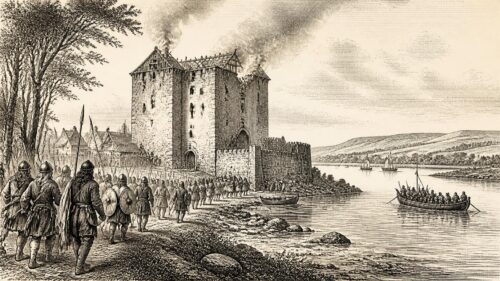
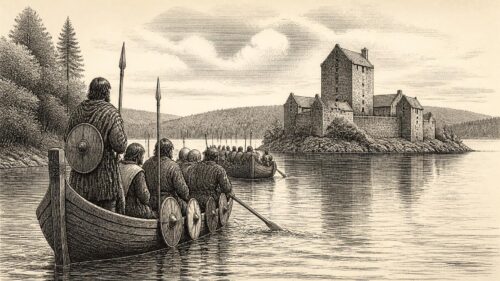
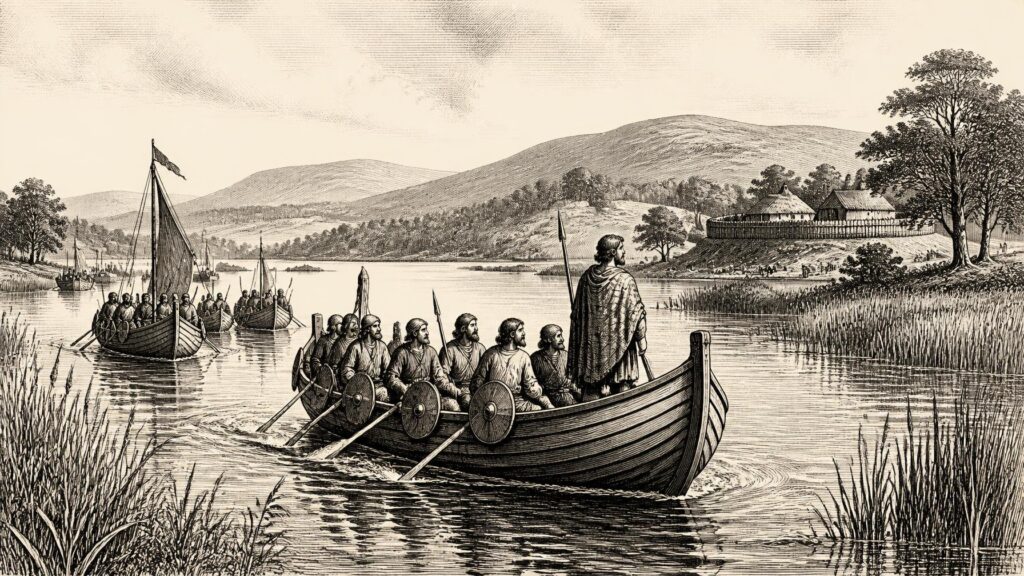
In the annalistic record, 955 was a year in which control of Ireland’s waterways mattered as much as control of its roads and plains. Domnall son of Muirchertach, of Cenél nEógain in the northern Uí Néill, led a force with ships through a remarkable sequence of lakes and waterways: from Tuag Inbir to Lough Neagh, along the Daball, across Airgialla, on Lough Erne and finally on Lough Oughter. From there, the expedition struck Bréifne and took hostages from Ua Ruairc. The journey is one of the most vivid military notices surviving for the year. It also reveals an Ireland in which lakes, rivers and portages connected distant political worlds rather than separating them.
A Year of Uneven Dates
955 must, however, be handled with chronological care. The Annals of Ulster head their entry U955 “AD 954 alias 955”, an explicit sign that the surviving annalistic systems do not always align neatly with a modern calendar. Their notice of Domnall’s waterborne hosting is therefore securely attached to the annalistic year conventionally labelled 955, but cannot responsibly be assigned to a particular month or season. The seventeenth-century Annals of the Four Masters, drawing on older materials but using a different chronology, call 955 Domnall’s first year “in sovereignty over Ireland”.
That statement should not be mistaken for evidence of a universally accepted transfer of power on 1 January 955. Domnall’s rival Congalach Cnogba still appears in the Ulster record campaigning towards Connacht in U955. The following Ulster year, headed “AD 955 alias 956”, records Congalach’s death at Tech Giurann in Leinster at the hands of the Dublin foreigners and the Leinstermen, and only then says that Domnall began to reign. The discrepancy is historically useful: it shows that kingship over Ireland was a contested supremacy, recorded differently by traditions with their own chronological arrangements, rather than a simple office passing automatically on a fixed date.
The Route Into Bréifne
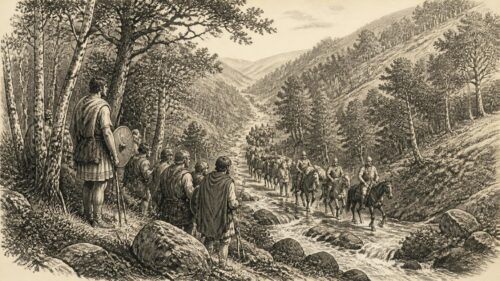
The Ulster annalist’s compact route is unusually informative. Tuag Inbir lay at the northern end of the expedition; Lough Neagh and Lough Erne were major inland waters; Airgialla was the broad zone of kingdoms between them; and Lough Oughter formed a watery complex in the Bréifne region. Domnall’s force did not simply sail from one open coast to another. It passed through territories controlled by other rulers and crossed the boundaries of several lake systems. The record says that the force went “with ships”, but it does not explain how the vessels were moved between waters. We should therefore resist adding an unrecorded story of portage, boat type or naval battle. What is certain is that transport by water was integral to the campaign’s reach.
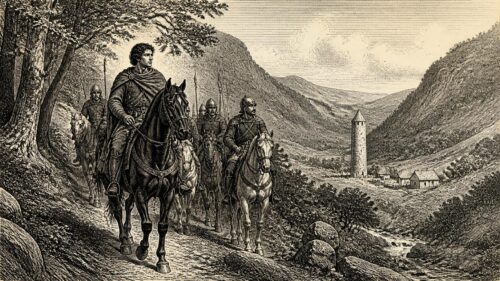
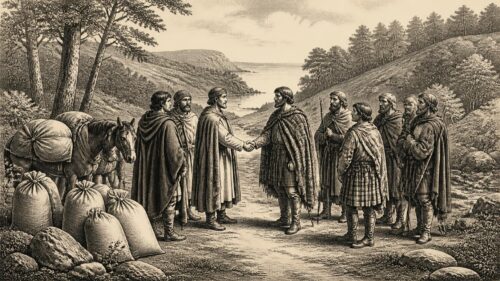
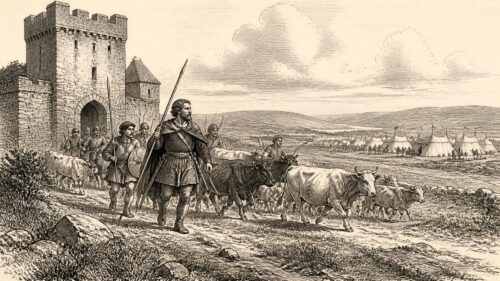
The target was Bréifne, and the result was plunder and hostages taken from Ua Ruairc. In tenth-century Irish political language, hostages were not incidental captives. They were guarantees by which a subordinate ruler or community underwrote an agreement, submission or temporary settlement. Their seizure advertised Domnall’s capacity to compel obedience beyond his own northern base. Plunder, meanwhile, could mean the taking of movable wealth, especially livestock and food supplies, as well as the destruction that made resistance costly. The annal does not enumerate losses, name a battlefield or record an enduring settlement. Yet its conclusion is clear: Domnall had forced Ua Ruairc to provide the security expected by a more powerful overlord.
This intervention mattered because the contest for Connacht and its approaches was already active. In the same Ulster year Aléne, king of Mugdorna Maigen and Mugdorna of Brega, and Innéirge son of Mochán fell while accompanying Congalach on a march into Connacht. No battle narrative survives, and the annalist gives no reason for their deaths. Even so, the notice places Congalach and Domnall on intersecting western horizons. Modern biographical scholarship likewise sees Domnall’s Bréifne expedition as part of his rivalry with Congalach and of the pressure that northern Uí Néill rulers could exert upon Connacht and its borderlands.
Leinster Under Pressure
The Four Masters add a different but compatible picture of conflict in 955. They report that Tuathal son of Ugaire won a battle over the Uí Chennselaig in which many people were killed. They also record a hosting by Domnall into Leinster: Mag Liffe and the Comainns were plundered as far as Dún Salach. These notices should be read closely. They establish violence, mobilisation and raiding, but do not justify a detailed reconstruction of a campaign route, a precise location for every engagement, or a claim that Domnall had conquered Leinster.
They do show why Leinster was central to the struggle for wider authority. The Liffey plain was a productive and politically exposed zone between the midlands, the Irish Sea coast and the Leinster dynasties. A king able to lead a hosting there could demand recognition; a local ruler able to defeat a rival kindred could alter the balance within the province. Domnall’s raid was consequently both an economic attack and a political message. It could damage resources, reward his followers with spoil and demonstrate that his armed following could penetrate territory beyond Cenél nEógain. The entry offers no suggestion of a permanent garrison or bureaucratic occupation. Power was exercised through movement, intimidation, negotiated submission and the capacity to return.
Fleets, Lords and Local Loss
Another terse entry preserves “the fleet of Fearghal son of Art upon Loch Cé”. It is tempting to turn this into a battle or a raid, but the annal provides neither opponent nor outcome. It is safer to say that Fearghal’s naval presence on the lake was notable enough to enter the record. Alongside Domnall’s expedition, it confirms that boats and lake fleets were instruments of regional politics in the west and north-west as well as on the great northern lakes.
The year’s obituary notices convey the fragility of local authority. Mocoluim Ua Canannáin, lord of Cenél Conaill, died; so did Máel Fothartaig son of Flann, king of Cashel, Muiredach Ua Lachtnáin of Tethba, Eochaid of Loch Cál, Máel Sechnaill son of Dubcenn of Uí Briúin Cualann, Riacán Ua Lorcáin and Máel Sechnaill son of Aimirgín of Uí Fhailge. Cairbre Finn Ua Bruadair and his son Áed were mortally wounded. The annals rarely tell us whether deaths followed sickness, feud, accident or fighting unless that fact served their purpose. Still, this concentration of named losses is a reminder that political communities were personal networks. The death or wounding of a lord could open a succession dispute, unsettle alliances or invite a neighbour’s intervention.
Churches as Communities
Ecclesiastical deaths were recorded with equal care. Flann son of Aedagán, abbot of Glendalough, died, as did Máel Cellaig son of Áed, successor of Ailbe of Emly; Colmán son of Congal, successor of Molaise of Devenish; and Diarmait, anchorite of Glendalough. The term “successor” marked office and institutional inheritance: these men stood in the line of a revered founder and represented the rights, property and spiritual prestige of that saint’s community. Their obituaries are evidence that ecclesiastical centres were not peripheral to political life.
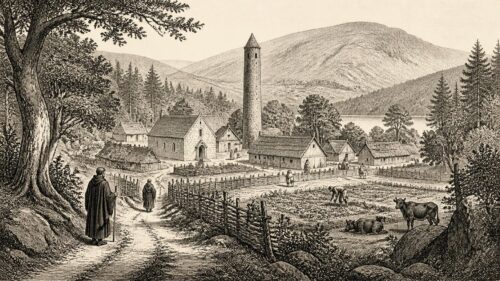
Glendalough, in its Wicklow valley, had long been a major religious foundation. Like other early medieval monasteries, it was more than a secluded group of praying clerics. Such communities brought together clergy, tenants, craft workers, visitors and dependants; they held land, received patronage and maintained learning, hospitality and worship. The deaths in 955 do not prove a building programme, reform or crisis at Glendalough, Emly or Devenish. They do, however, show the annalists treating their leadership as national news. In a society with few towns by later standards, these centres were important nodes of settlement, production, literacy and memory.
What 955 Reveals
The evidence for 955 is fragmentary, but its pattern is strong. Ireland was not a united kingdom administered from one capital. It was a landscape of competing dynasties, ecclesiastical federations and regional lordships, connected by routes on land and water. Domnall’s fleet on the Lough Oughter route, Congalach’s movement towards Connacht, fighting within Leinster and Fearghal’s fleet on Loch Cé all point to political power expressed through mobilised followers and command of access.
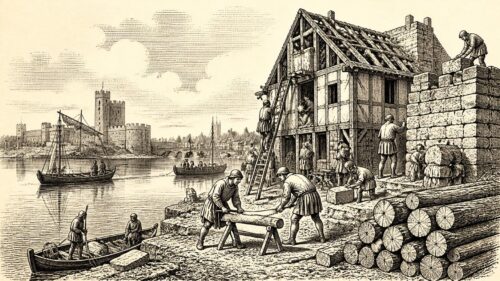
For ordinary people, these actions were not remote affairs. A hosting passed through cultivated country and drew on food, animals, labour and local knowledge. Plunder threatened household stores and herds; hostage-taking bound leading families to political bargains; the death of an abbot or lord could reshape obligations. Yet the annals preserve only the sharpest edges of those experiences. Their silence does not mean that rural work, worship, exchange and craft ceased. Rather, it reminds us that the written record was made to remember exceptional deeds, prominent deaths and changes in authority. In 955, the loudest such memory was of Domnall’s ships moving inland, turning Ireland’s lakes into a route towards supremacy.
Primary Sources
- The Annals of Ulster, Year U955
- The Annals of Ulster, Year U956
- The Annals of Ulster (Irish text)
- Annals of the Four Masters, Part 6 (English translation)
- Annals of the Four Masters, Part 6 (Irish text)
- Annala Rioghachta Eireann: Annals of the Kingdom of Ireland by the Four Masters
- Chronicon Scotorum
- Ua Néill, Domnall | Dictionary of Irish Biography
- Congalach Cnogba | Dictionary of Irish Biography
- Fergal | Dictionary of Irish Biography
- The chronology and sources of the early Irish annals
- The Origins and Rise of the Uí Néill
- Uí Ruairc and the Kingship of Connacht
- The Archaeology of Lake Settlement in Ireland
- Glendalough Monastic Site and Visitor Centre
- Life in Glendalough
- High Crosses
- Early Christian Monasteries
- Exploring the Irish Annals
- List of Published Texts at CELT
- The Annals of the Four Masters: Irish History, Kingship and Society in the Early Seventeenth Century
- Cogadh Gaedhel re Gallaibh: The War of the Gaedhil with the Gaill