Ua Ruairc and the Murrain954 CE
In 954, Irish annals record a great cattle murrain throughout Ireland, threatening wealth, food supplies, tribute and political power. Ua Ruairc inflicted a major defeat on Cairpre and Tethba, killing their king, amid wider instability in the midlands and north-west. Congalach of Tara faced growing pressure from Domnall ua Néill, supported by Dublin, while violence also affected Brega. Cellachán, king of Cashel, died, weakening Éoganacht prominence as Dál Cais influence grew. Numerous bishops, abbots and ecclesiastical successors also died, demonstrating church networks’ importance. Differing annalistic accounts require caution, particularly because Congalach’s death belongs to 956, not 954, in reliable records.
Dateline
The year 954 is remembered in the Irish annals less for one decisive battle than for a convergence of loss: a cattle murrain reported across the island, killing in the central midlands, pressure on the authority of the king of Tara, the death of Munster’s most conspicuous Éoganacht ruler, and the passing of senior churchmen attached to major ecclesiastical federations. The surviving notices are brief, and their chronology is not always identical from one annalistic compilation to another. Yet the entries securely assigned to 954 offer an unusually revealing view of how warfare, livestock, kingship and churches were bound together in tenth-century Ireland.
A Murrain Across Ireland
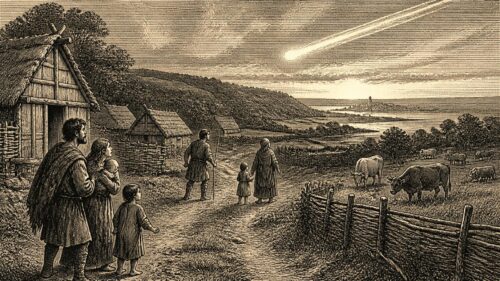
The Annals of Ulster record simply: “A great murrain of cattle throughout Ireland.” Its very brevity is significant. The annalist gave no name for the disease, no starting place, no duration and no tally of animals lost. It would be irresponsible to identify the outbreak with a particular modern pathogen, or to presume that it brought human epidemic disease with it. What can safely be said is that the record presents the problem as island-wide, rather than as a local failure of pasture or a single lordship’s misfortune.
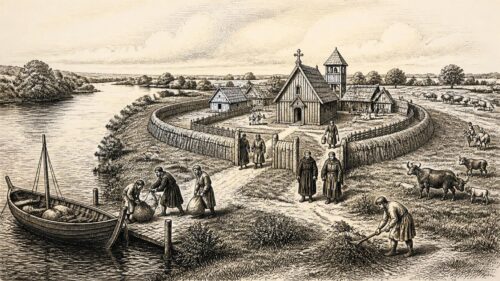
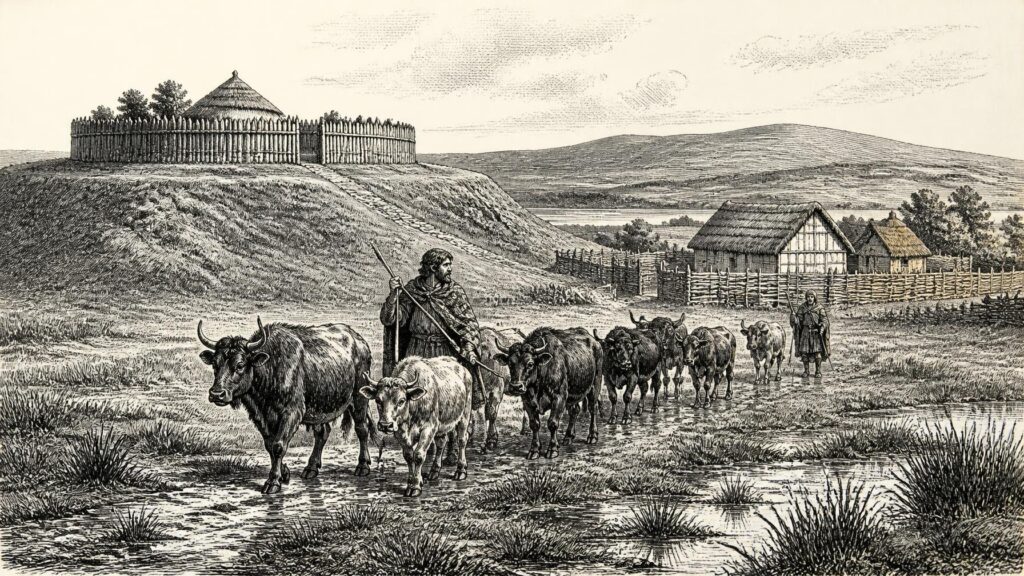
For contemporaries this was no marginal agricultural detail. Cattle were fundamental to early medieval Irish wealth and social ranking. They supplied dairy produce, meat, hides, manure and draft power; they were also central to tribute, lordship, compensation and the making of political alliances. A ruler’s ability to feed followers, reward service and exact renders depended heavily on access to livestock. Losses on the scale implied by a “great” murrain could therefore reach far beyond the byre: households might lose milk and breeding stock, landholders a means of meeting obligations, and kings a movable reserve of food and wealth.
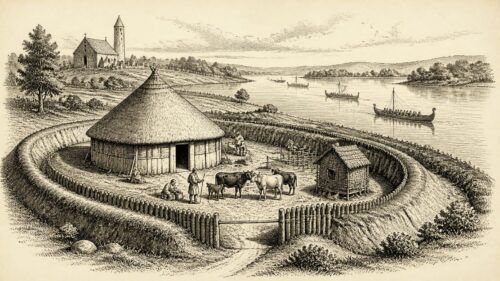
The rural Ireland affected by such a disaster was varied. Cattle grazed on lowland pasture, water meadows, uplands and marginal ground, while settlements and ringforts were often positioned with livestock protection in mind. Grain production was important too, and evidence suggests that arable cultivation and milling were gaining greater weight in parts of the early medieval economy. Nevertheless, the annal’s choice to preserve cattle mortality as a national event underlines the continuing centrality of herds. It does not allow a reconstruction of prices, famine or depopulation in 954; it does show that animal health was recognised as a matter of public consequence.
Slaughter in Cairpre and Tethba
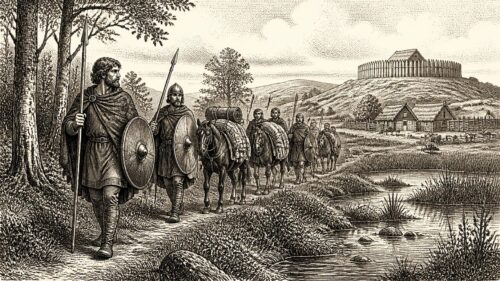
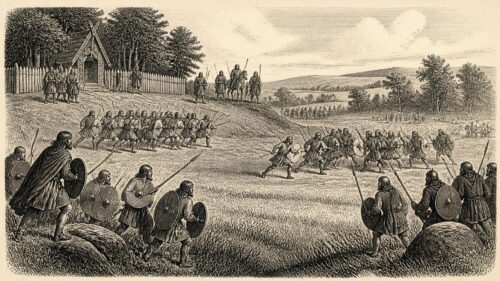
Against this background, the annalists placed a sharp episode of regional warfare. The Annals of Ulster state that Ua Ruairc inflicted “a great slaughter” on the peoples of Cairpre and Tethba, and that Ua Ciardai, king of Cairpre, fell. Cairpre and Tethba lay in the contested central zone west and north-west of the core lands of Mide, in territory whose routes connected the midlands with Bréifne, Connacht and the north-west. The notice does not name the Ua Ruairc commander personally, locate the fighting more precisely, or tell whether the dead were warriors, retainers, levies or a mixture of all three.
Those limits matter. The entry does, however, establish a major victory by an Ua Ruairc force over neighbouring peoples and the death of a local king. This was not a conflict between modern counties or a war for a unitary Irish state. It was a struggle among overlapping kingdoms and dynastic interests, in which cattle, hostages, access to land and the submission of local rulers could all be at stake. The coincidence of warfare and cattle disease must not be turned into a claimed cause-and-effect relationship: the sources do not say that the murrain prompted the attack. But a wide livestock mortality plainly formed a harsh setting for any community recovering from defeat.
Other annalistic traditions preserve related but not identical memories. Chronicon Scotorum, under 954, reports the killing by his own people of Áed son of Gairbíth, described as king of Cairbre Mór and Dartraige. The record should not be automatically fused with the Ulster annal’s death of Ua Ciardai: the names, wording and circumstances differ. Together, though, they indicate instability among the small kingships around the midlands and north-west. Such differences are also a reminder that medieval annals were compiled from regional records, not from a single contemporary national archive.
Rivalry Around Tara
954 also belonged to a wider contest for predominance among the Uí Néill. Congalach Cnogba, king of Tara and ruler from the southern Uí Néill dynasty of Síl nÁedo Sláine, remained a powerful claimant to island-wide authority. Yet Domnall ua Néill of Cenél nÉogain had emerged as his principal rival. Modern historical synthesis places a ravaging of Congalach’s Brega heartland, and pressure on Mide, in this year; Domnall’s advance was strengthened by an accommodation with the rulers of Hiberno-Norse Dublin.
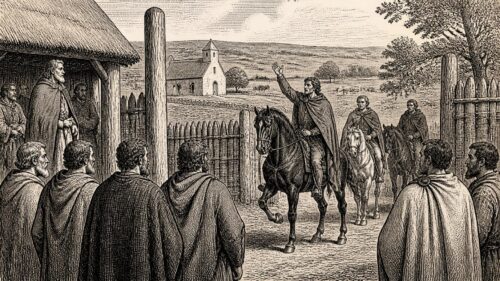
That alignment reveals the political reality behind titles such as “king of Ireland”. Such titles expressed ambition and recognised precedence, but they did not mean that one ruler administered the whole island directly. Congalach’s power rested on kinship, military following, hostages, alliances and influence over strategic churches and provincial kings. Domnall’s challenge drew on the resources of Cenél nÉogain and the northern Uí Néill, while Dublin was an established maritime and commercial power whose rulers could shape affairs far beyond its walls. In 954, the balance was moving against Congalach, though his death lay still in the future.
The distinction is important because the much later Annals of the Four Masters place Congalach’s death at Tech Giugrann in an entry labelled 954. Earlier annalistic witnesses, including the Annals of Ulster, Chronicon Scotorum and the Annals of Inisfallen, date his killing by Dublin’s foreigners and Leinster allies to 956. It should therefore not be presented as an event of 954. The discrepancy is an example of why calendar-year history must give priority to corroborated chronology rather than repeat every later annalistic date uncritically.
A local killing in Brega was securely entered for 954: Bran son of Domnall, king of Cenél Laegaire of Brega, was slain. His death points to the fragmented nature of rule even within the wider sphere of Congalach’s homeland. The annals do not identify his killer or connect the event directly to Domnall ua Néill’s campaign. It is best read as further evidence that the political landscape around Tara and Brega was unsettled, not as proof of a particular conspiracy or battle.
Cellachán’s Passing
The death of Cellachán, king of Caisel, was another major landmark. It is recorded in the Annals of Ulster, Chronicon Scotorum and the Munster-centred Annals of Inisfallen. Cellachán had been the last notably energetic overking produced by the Éoganacht federation that had long dominated Munster from Cashel. During his career he had sought influence beyond the province, raiding and campaigning in the midlands and competing within a political world that included the southern Uí Néill, Leinster rulers and Scandinavian settlements.
His death did not instantly erase the Éoganachta, nor did it immediately hand Munster to one coherent rival. It did, however, remove a ruler of established prestige at a time when the Dál Cais were becoming increasingly formidable in the north of the province. Later political writing celebrated Cellachán’s career in Cathréim Cellacháin Caisil, a much later literary work with a strong dynastic purpose. It is valuable evidence for his posthumous reputation, but not a simple contemporary chronicle. The secure contemporary point for 954 is plainer: the king of Cashel died, and the political field in Munster became more open.
Churches and Remembering
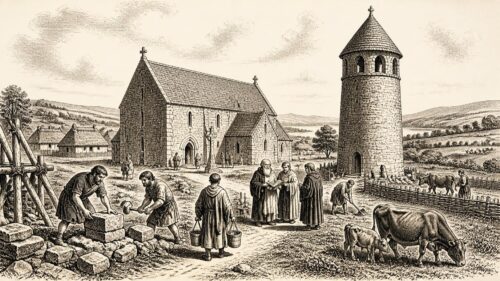
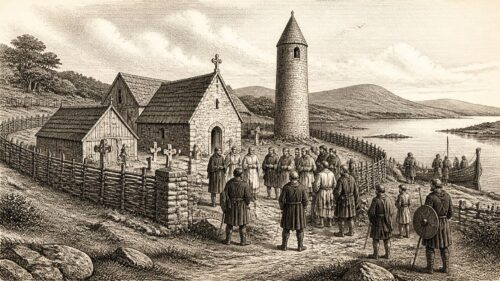
The year’s obituaries also illuminate the reach of ecclesiastical networks. The Annals of Ulster record the death of Flannacán son of Allchú, successor of Mac Nisse and Colmán of Ela; of Céilechair, successor of Ciarán and Finnian; and of Robartach, successor of Colum Cille and Adomnán. “Successor” here meant more than a devotional label. It denoted leadership within a saint’s ecclesiastical community, carrying claims to church property, revenues, learning and prestige. The saints named connected institutions as distant as Connor, Clonard, Clonmacnoise, Clonard’s associated traditions, Iona and its Columban inheritance.
The Annals of Inisfallen add further Munster and church obituaries, including Dub Inse, called a learned bishop of Ireland; Éladach, abbot of Ros Ailithir; Uarach, bishop of Imlech Ibuir; Lugaid, abbot of Domnach Pátraic; and the anchorite Cenn Faelad of Clonfert. These notices cannot supply biographies for each man, but they show what annalists considered worth preserving: learned clerics, bishops, abbots and ascetics, attached to institutions that were centres of worship, literacy, landholding and local influence.
Thus 954 was not merely a year of “kings and battles”. It was a year in which a livestock catastrophe touched the material basis of society; a regional ruler won bloodily in the midlands; rival overkings manoeuvred around Tara, Brega and Dublin; Cashel lost Cellachán; and churches marked the deaths of custodians of important saintly lineages. The annals leave silences as well as facts. Respecting those silences makes the surviving record more, not less, compelling.
Primary Sources
- The Annals of Ulster: Year U954
- The Annals of Ulster: Irish Text, U954–U956
- Annals of Inisfallen: Annals AI950–AI959
- Annals of the Four Masters: Annals M953–M962
- Chronicon Scotorum: English Translation, Annals CS951–CS958
- Annals of Tigernach
- Cellachán Caisil
- Congalach Cnogba
- Ua Néill, Domnall
- Amlaíb (Óláfr) Cuarán
- Cathréim Cellacháin Caisil
- Changing Human-Cattle Relationships in Ireland: A 6000-Year Isotopic Perspective
- Uí Ruairc and the Kingship of Connacht
- Vikings in Ireland and Scotland
- The Vikings in Ninth-Century Ireland: Sources and Settlements
- Exploring the Irish Annals
- CELT Project: Annals of Ulster
- CELT Project: Annals of Inisfallen
- CELT Project: Annals of the Four Masters
- Annals of Inisfallen to Go on Public Display in University College Cork