Clonmacnoise Under Munster959 CE
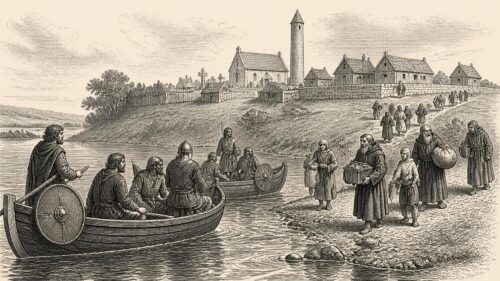
In 959, Irish annals record Munster men plundering Clonmacnoise, a wealthy ecclesiastical settlement strategically placed on the Shannon. The sources provide no commander, destruction or link to the killing of Dub dá Bairenn, king of Cashel, by his own people, but together indicate instability within Munster. In the north, Domnall son of Muirchertach led an expedition into Dál nAraidi and took hostages, demonstrating lordship through coercion. Deaths of senior churchmen, including successors of Caemgen and Colum Cille and Lismore’s superior Maenach, marked important ecclesiastical successions. Differing annalistic dates require caution, although the evidence supports securely assigning these events to 959.
Dateline
For 959, the Irish annals preserve a small but unusually revealing cluster of notices. Their central event was the plundering of Clonmacnoise by men of Munster. In the same annalistic year, Dub dá Bairenn, king of Cashel, was killed by his own people; several leading churchmen died; and a northern ruler took hostages in Dál nAraidi. These brief records do not yield a continuous narrative, but together they show an island in which royal violence, ecclesiastical wealth and regional military power were closely intertwined.
The dating deserves care. The Annals of Ulster head their entry “AD 958 alias 959”, while Chronicon Scotorum places the same core notices under 959 and the Annals of Inisfallen independently date the death of Dub dá Bairenn and that of Maenach of Lismore to 959. This gives good grounds for treating the events as belonging to this calendar year, while recognising that Irish annalistic systems do not always align neatly. The later Annals of the Four Masters preserve related material under different year-numbers and should therefore be used cautiously for exact dating.
A Raid at the Crossroads
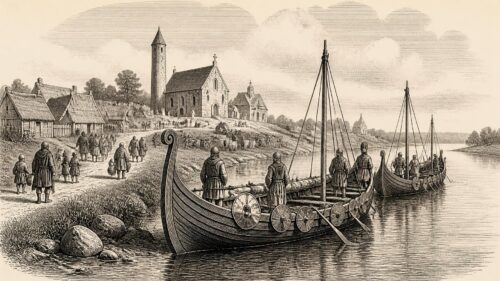
The clearest event is starkly expressed: Cluain Moccu Nóis, Clonmacnoise, was plundered by the men of Mumu, or Munster. Neither the Annals of Ulster nor Chronicon Scotorum gives a commander, a route, a battle, a number of casualties, or a list of objects taken. It would be unsafe to supply any of these missing details. The annal records a raid, not a siege or conquest; it does not say that the settlement was burned, permanently occupied, or destroyed.
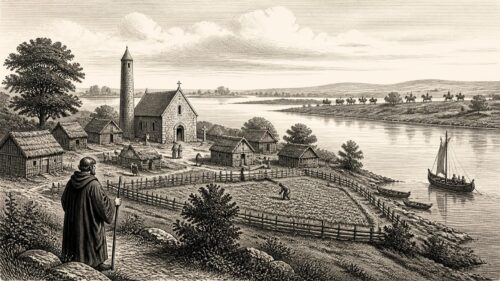
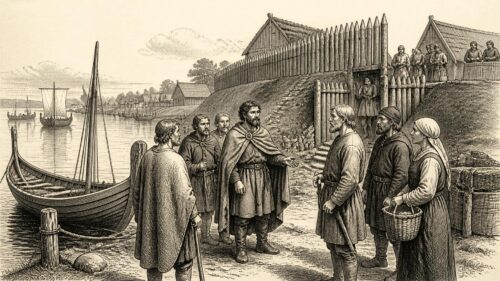
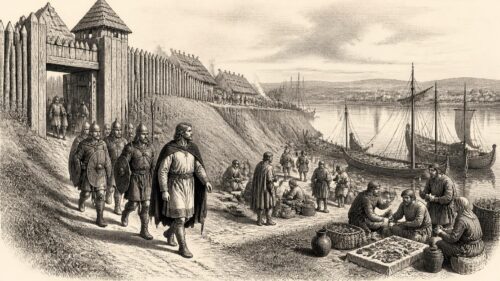
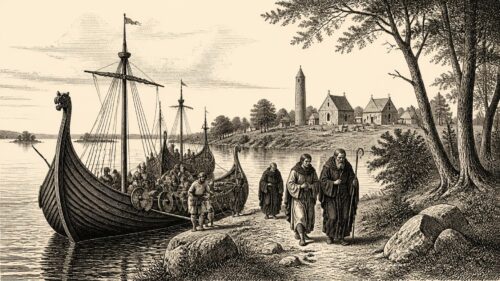
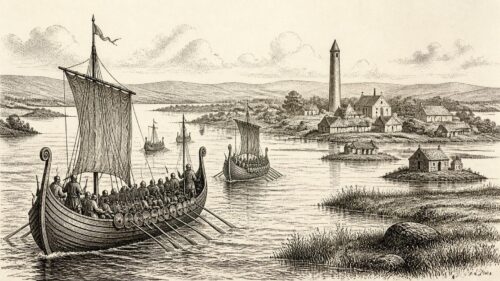
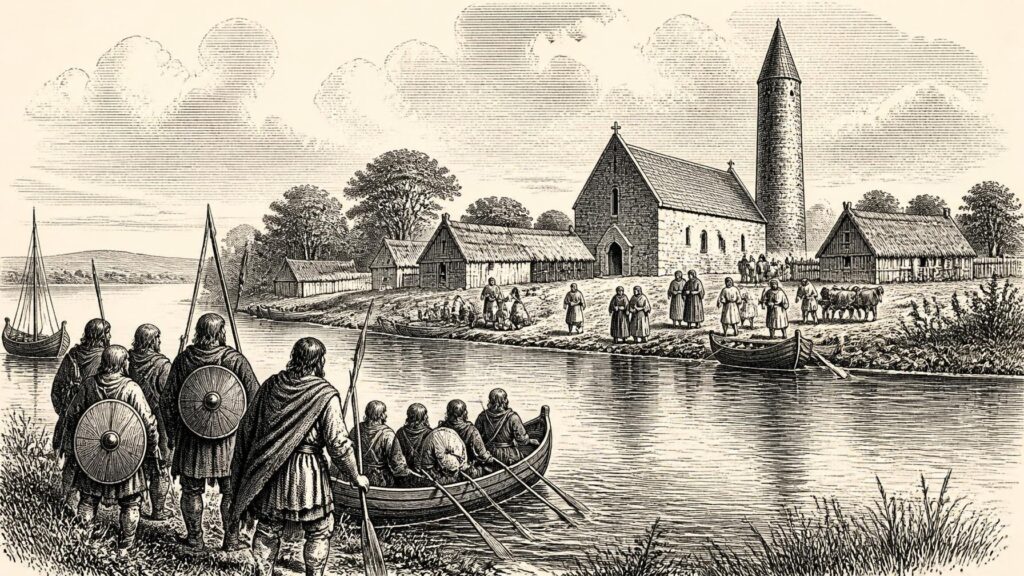
Even so, the choice of target was highly significant. Clonmacnoise stood beside the Shannon, close to the crossing of the river corridor and the great east–west route later known as the Esker Riada. Its position made it a place of pilgrimage, exchange, learning and political contact, rather than an isolated retreat. By the tenth century it was a substantial ecclesiastical settlement with churches, workshops, agricultural resources, dependants and a large lay population. Timber domestic buildings have vanished, but archaeology and the surviving stone monuments make clear that the community resembled a small town as much as a cloister.
A raid on such a place could bring immediate portable wealth—metalwork, food renders, livestock, storehouse goods and perhaps valuables held in the care of the church—while also making a public claim of force. Yet plunder was not simply a matter of secular attackers confronting helpless monks. Great monasteries were embedded in the politics of kings and regional dynasties. They held land, received patrons, controlled labour and hospitality, and preserved the reputations and genealogies on which rulers depended. To strike Clonmacnoise was consequently to disturb a powerful institution at the centre of Ireland.
The record is especially uncomfortable because the raiders were Irishmen from a Christian province, not Scandinavian outsiders. Earlier generations had known attacks on wealthy monasteries by Viking fleets, including raids connected with the Shannon. By 959, however, conflict within and between Irish kingdoms remained fully capable of threatening ecclesiastical sites. The annalists did not soften the notice: men of Munster had plundered the community of Ciarán. It is a useful corrective to any picture of early medieval Ireland divided simply between Irish Christians and foreign raiders.
Cashel’s Violent Loss
The year also brought a deadly rupture in Munster’s kingship. Dub dá Bairenn son of Domnall is called king of Cashel in the annals. The Annals of Ulster and Chronicon Scotorum go further, reporting that he was killed by his own people. The wording points to an internal killing, but it does not identify the perpetrators, explain their grievance, or describe a battle. The Annals of Inisfallen, whose surviving text is particularly valuable for Munster, merely records his death. The stronger claim of murder rests on the agreement of the Ulster and Scotorum records, not on an elaborated contemporary story.
This distinction matters. A king of Cashel was not an administrator of a stable territorial state, and “his own people” should not be read as a modern national community. It may denote followers, subjects or men of his political world. What can responsibly be said is that Dub dá Bairenn’s death created a fresh uncertainty at the summit of Cashel’s authority. It occurred in the same year that a Munster force plundered Clonmacnoise, but the sources do not explicitly connect the two. The raid must not be presented as either the cause or consequence of the king’s killing.
The juxtaposition nevertheless captures a wider condition in mid-tenth-century Munster. Cashel remained an important royal centre, but lordship was contested among powerful kindreds and local rulers. In the following decades, the sons of Cennétig of Dál Cais—notably Mathgamain and later Brian—would emerge as major competitors for dominance in Munster. That later ascent should not be projected backwards as a settled fact for 959. The annals for this year name neither Mathgamain nor Brian in connection with the Clonmacnoise raid. The political landscape was already changing, but its outcome was not yet known.
Hostages in Dál nAraidi
Chronicon Scotorum adds a northern military notice: Domnall son of Muirchertach led a hosting into Dál nAraidi and brought hostages away. Domnall belonged to the northern Uí Néill and exercised a commanding role in Irish politics after the death of Congalach Cnogba in 956. Dál nAraidi lay in the north-east, in the region of modern County Antrim and adjoining districts, and was one of the principal political groupings within Ulster.
Hostages were not incidental captives. In early medieval Irish politics, their surrender was a practical guarantee of submission, alliance or agreed obedience. Taking them advertised that Domnall had compelled recognition, at least for the moment, from those he confronted. The entry does not state whether the campaign met pitched resistance, whether territory changed hands, or how long the arrangement endured. Its significance lies in its economy of words: a royal army entered a neighbouring polity and returned with human pledges.
The notice also shows the geographical limits of any supposed all-Ireland unity. In 959, military power was exercised through personal lordship, hostages, client relationships and armed expeditions. A ruler could possess great prestige without directly governing every kingdom named in the annals. Domnall’s campaign in Dál nAraidi and the Munster raid at Clonmacnoise were separate events, but both demonstrate how movement, coercion and negotiated submission connected distant regions.
Successors of Saints
The annals also mark losses within the ecclesiastical order. The Annals of Ulster record the deaths of Martain, successor of Caemgen; Dub Dúin, successor of Colum Cille; and Aengus ua Lapán. Maenach son of Cormac, superior of Lismore, also died. The Annals of Inisfallen corroborate Maenach’s death in 959. These notices are short, but their titles are revealing. A “successor” or comarba was not simply a replacement cleric: he inherited authority associated with a saint, a church community, its estates, rights and spiritual prestige.
Martain’s title tied him to Caemgen, the saint of Glendalough, a major religious centre in the Wicklow mountains. Dub Dúin’s succession linked him to Colum Cille, whose cult and ecclesiastical federation extended across Ireland and the Irish Sea world. Maenach’s position at Lismore connected him with another influential Munster foundation. Their deaths did not necessarily cause institutional crises, but each required a succession within a community whose spiritual standing and material resources mattered to secular rulers.
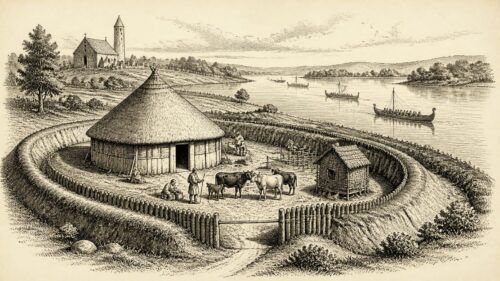
These communities sustained far more than prayer. Their people cultivated land, received travellers, maintained churches and enclosures, cared for relics, produced and copied books, and worked in wood, iron and precious metals. Scriptoria and schools were centres where Latin learning, liturgy, grammar and inherited Irish traditions could be transmitted. The record for 959 does not identify a particular manuscript or building project, but it shows the human framework that enabled such culture: offices attached to saints, remembered by annalists alongside kings and raids.
A Year of Connected Vulnerability
Nothing in the surviving record permits a full account of ordinary households in 959. No annal for the year gives a harvest report, market prices, epidemic or weather description securely associated with the events above. Yet the raid on Clonmacnoise brings everyday dependencies into view. A great church settlement could be plundered precisely because it accumulated food, goods, labour and status. Its location on the Shannon made it accessible as well as prosperous. The same river and routeways that carried pilgrims, students and trade also carried armed men.
Thus 959 was not defined by one island-wide battle or a change of high kingship. It is better understood through linked local pressures: a renowned central monastery attacked by Munster men; a king of Cashel killed from within his own political sphere; a northern ruler enforcing authority through hostages; and senior ecclesiastical offices passing at Glendalough, the Columban community and Lismore. The annals leave much unsaid, but what they do say is clear enough. In Ireland’s tenth century, sacred institutions, royal legitimacy and material wealth were inseparable—and all were exposed to the hazards of rivalry.
Primary Sources
- The Annals of Ulster: Year U959
- Chronicon Scotorum: Annal CS959
- The Annals of Inisfallen: Annals AI950–AI959
- Annals of the Four Masters: Annal M959
- Chronicon Scotorum: Annals CS955–CS964
- The Annals of Ulster: CELT Edition
- Annals of Inisfallen (MS. Rawlinson B. 503): Bibliographic Record
- Annala Rioghachta Eireann: Annals of the Kingdom of Ireland by the Four Masters
- The Chronology and Sources of the Early Irish Annals
- The Dating of the Irish Annals
- Irish Chronicles and Their Chronology
- The ‘Annals of Ulster’, 912–1100
- Clonmacnoise Visitor Guide
- Clonmacnoise Monastic Site
- Early Irish Monasticism
- Crossroads of Ireland
- Early Monastic Churches
- Irish School of Illumination, c. 650–1100
- High Crosses
- Glendalough Monastic Site and Visitor Centre Highlights
- Life in Glendalough
- The Road Itself: Rian Bó Phádraig
- Folklore: Rian Bó Phádraig and Lismore
- The Irish Annals: Their Genesis, Evolution and History