The Battle of the Pilgrim888 CE
In 888, annalistic evidence records a major setback for Flann Sinna, king of Tara, when Dublin-centred foreigners defeated his coalition at the Battle of the Pilgrim. The deaths of Connacht’s king Áed and prominent churchmen exposed the breadth and fragility of Flann’s alliances. Meanwhile, Norse king Sigfrith was killed by a kinsman, and Cerball of Osraige died, altering regional politics. Northern Uí Néill forces campaigned against the south, while Tailtiu’s royal fair was not held. The year also saw Armagh’s abbot die and noted a change affecting religious women, illustrating intertwined political, ecclesiastical and social authority in contemporary Irish society.
Dateline
The Irish annals make 888 a year of abrupt reversals rather than a year whose whole course can be reconstructed. Their brief notices preserve a defeat for Flann Sinna, king of Tara, the deaths of rulers in Connacht and Osraige, the killing of a Norse king by his own kinsman, an expedition across the old Uí Néill divide, and the failure to hold the fair of Tailtiu. They do not provide a campaign narrative, battlefield location or treaty text. Yet, read cautiously, these entries reveal how precarious power was in late ninth-century Ireland: a king’s authority rested on alliances among provincial rulers, churches and armed followings, while Dublin’s Scandinavian rulers were embedded in the island’s political contests rather than standing apart from them.
An Annalistic Year
Dating requires care. The principal events are conventionally assigned to 888, and that placement is supported by the Annals of Inisfallen, Chronicon Scotorum and the Annals of Clonmacnoise. In the surviving Annals of Ulster, however, the relevant material occurs under a sequence whose internal year-headings are one year out from the modern AD labels at this point. This is not a reason to discard the evidence, but it is a warning against claiming more precision than the sources allow. None gives a day or even a season for the battle which dominates the year. “The foreigners” is also the annalists’ contemporary category, not a reliable ethnic description of every fighter in the opposing force; in this context it ordinarily denotes the Scandinavian or Hiberno-Scandinavian political world centred on Dublin.
Flann Sinna Routed
The central recorded event was a defeat inflicted on Flann son of Máel Sechnaill, better known as Flann Sinna. He was king of Tara and the leading ruler of the southern Uí Néill, a status often represented by later writers as kingship of Ireland. It did not make him the unquestioned sovereign of a unified country. Ireland was composed of numerous kingdoms and lordships, with overlordship expressed through tribute, hostages, church patronage, marriage and the ability to assemble a successful army. Flann’s authority was therefore always something to be asserted and renewed.
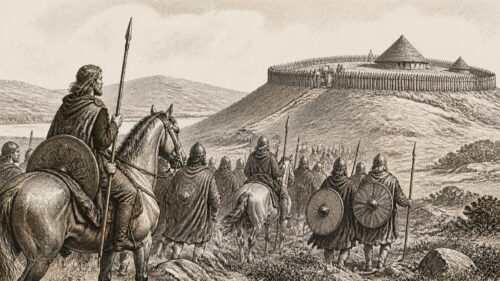
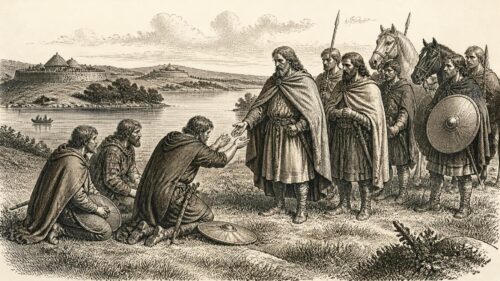
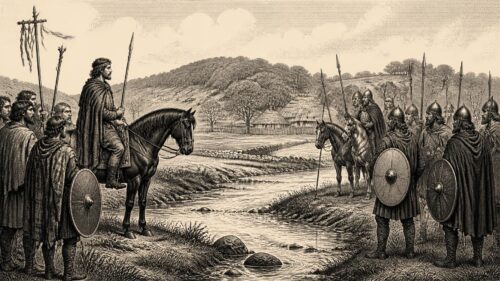
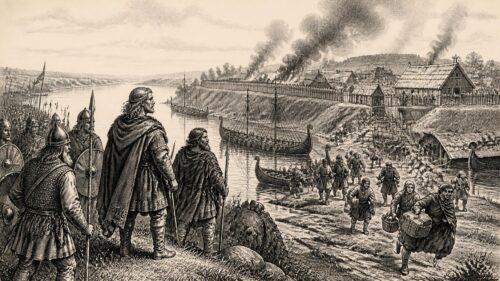
The Annals of Ulster state that the foreigners “inflicted a battle-rout” on Flann and name the encounter the Battle of the Pilgrim. The name is tantalising, but the record does not securely identify its location or explain whether it recalled a nearby ecclesiastical site, a route used by pilgrims, or some other association. Nor does it name the commanders on the Dublin side, estimate the numbers engaged, or describe the fighting. Any vivid account of shield-walls, ships or a particular manoeuvre would be invention. What is firm is the scale of the political loss: the defeat killed men whose presence shows that Flann’s host drew on allies beyond his own midlands heartland.
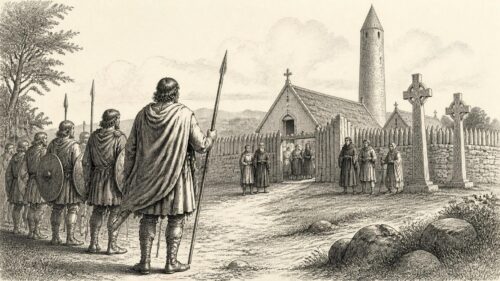
Among the dead was Áed son of Conchobar, king of Connacht. His death was independently noticed in the Annals of Inisfallen, which confirms its importance. A ruler of Connacht had joined Flann’s cause and died in a battle against the foreigners; this was not merely a local clash on Dublin’s fringe. Lergus son of Cruinnén, bishop of Cell Dara, modern Kildare, also fell. So did Donnchad son of Máel Dúin, described as superior of Cell Delca, modern Kildalkey, and of other monasteries. Their deaths show clerics participating in, or at least closely accompanying, a royal political coalition. Ecclesiastical leaders were not detached observers: major churches were landholders, centres of learning, employers and repositories of prestige, and their senior officers could be integral to the business of lordship and war.
The defeat damaged Flann, but it did not end his reign. His subsequent career demonstrates that a reverse in battle did not automatically remove a powerful ruler. Still, the loss of the king of Connacht and prominent churchmen must have narrowed his room for manoeuvre. It also exposed a hard reality of ninth-century politics. Dublin could furnish a military force able to defeat an army led by the foremost southern Uí Néill ruler, while Irish kings could draw provincial and ecclesiastical support into campaigns against the city’s rulers. Relations were not a simple contest between “Irish” and “Viking” blocs: alliances were contingent, and interests crossed the cultural boundary.
A Killing Within the Norse Leadership
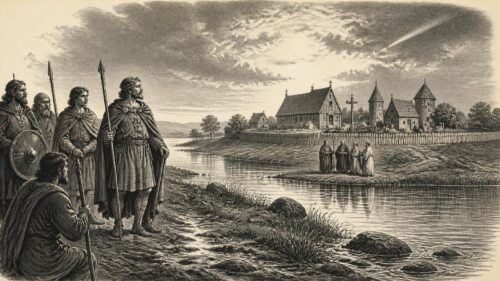
In the same year, Sigfrith son of Ímar, called king of the Norsemen in the Annals of Ulster, was “deceitfully killed by his kinsman”. This is among the clearest signs that military success did not equal political security within Dublin’s ruling elite. Ímar’s dynasty had been prominent around the Irish Sea for decades, and Sigfrith’s death belonged to the internal competition of that wider Scandinavian political world. The annal is explicit about treachery but silent about the killer’s name, motive and immediate successor. It cannot responsibly be turned into a full succession story.
It is tempting to make Sigfrith the architect of Flann’s defeat, or to see his killing as its direct consequence. The sources do not establish either connection. They do, however, place the two episodes together in a year when Dublin’s rulers proved militarily formidable but were themselves vulnerable to dynastic violence. For neighbouring Irish kings, that combination offered both danger and opportunity. Dublin was a settlement and power-centre linked to sea routes, raiding, exchange and diplomacy; it was not simply an external encampment that could be ignored once a battle was over.
Cerball’s Sudden Death
Another major death reshaped the political map. Cerball son of Dúngal, king of Osraige, died suddenly. Both the Annals of Ulster and the Annals of Inisfallen record the death, while later historical tradition remembered Cerball as one of the outstanding rulers of ninth-century Osraige. His kingdom occupied the strategic zone around the Nore valley, between the ambitions of Leinster and Munster. Cerball had long been a consequential figure in regional politics, and his influence reached beyond his own territory through warfare, kinship and dealings with rulers in Leinster, Dublin and the Uí Néill world.
The connection to Flann was especially close: Flann’s mother, Lann, was Cerball’s sister. That kinship did not produce a simple or permanent political partnership, but Cerball’s death removed a powerful maternal uncle from Flann’s network at precisely the moment when Flann had suffered defeat. The annals do not say that the king of Tara caused, benefited from or immediately intervened in the Osraige succession. They simply record a sudden death. Even so, the disappearance of such a durable regional ruler made future alignments in Leinster and the south-east less predictable. Cerball was succeeded in Osraige by his brother Riaccán, but the wider effects of the change unfolded over later years, not in a single documented settlement during 888.
North and South Uí Néill
The same annalistic sequence records an expedition by Domnall son of Áed with “the men of the north of Ireland” against the southern Uí Néill. Domnall was a son of Áed Findliath, the previous dominant northern ruler whose death in 879 had enabled Flann’s rise. The notice offers no outcome, route, battle or submission. It nevertheless matters because it records an open northern military intervention against Flann’s southern political sphere. The contest for predominance among the Uí Néill had not disappeared with Flann’s accession to Tara; it remained a live question, expressed through hostings as well as through claims of status and kinship.
For ordinary communities, such expeditions could carry consequences far beyond a battlefield. An army required food, animals, guides, transport and temporary shelter. Rulers measured power partly through their ability to gather and provision followers, while those followers expected reward in cattle, valuables or political advantage. The sources for 888 do not enumerate plunder or civilian losses, so it would be wrong to describe particular districts as ravaged. But the very fact of a northern hosting against the southern Uí Néill indicates continuing pressure on the resources and communications of the midlands.
Tailtiu Without a Fair
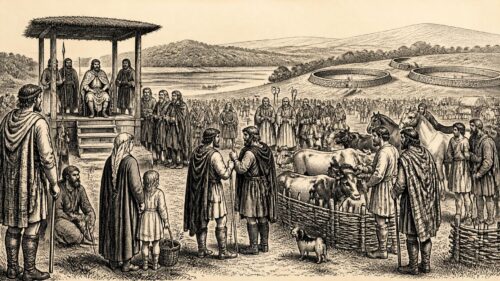
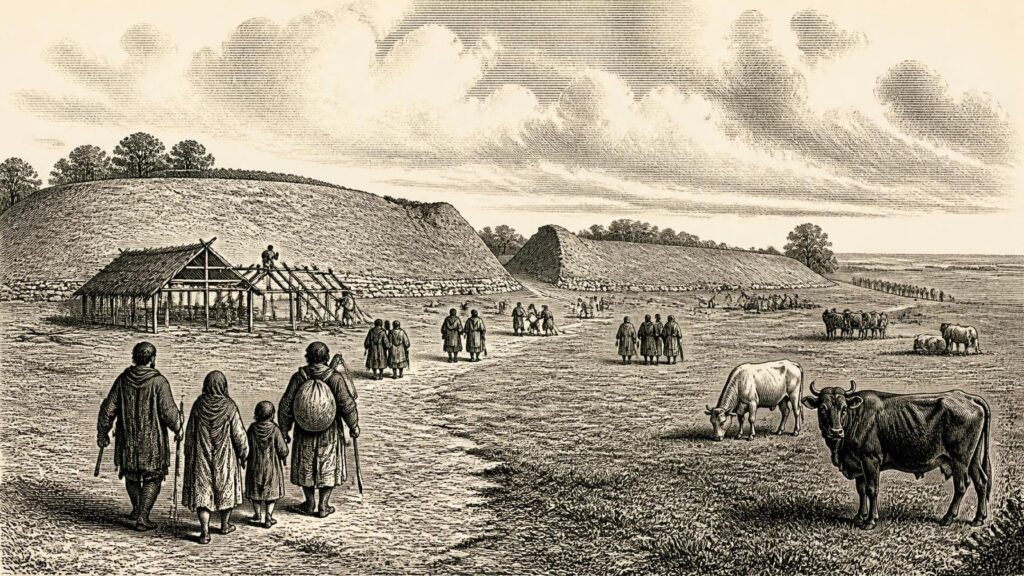
The failure to hold the fair of Tailtiu gives the year its most revealing domestic note. Tailtiu, at Teltown in modern County Meath, was an ancient royal gathering associated with the king of Tara. It combined ceremonial authority with assembly, competition and exchange. Modern scholarship rightly cautions against imagining it as a modern-style national parliament, but it was unquestionably an important public institution. Its holding advertised royal capacity: a ruler could summon people, guarantee a measure of order and oversee the business and display that such a gathering required.
The annals’ notice that the fair was not held should therefore not be treated as a minor item of festival administration. In the aftermath of Flann’s defeat, amid renewed northern pressure and the deaths of key allies, its omission marked a failure of public kingship in his own wider heartland. It did not prove that all commerce stopped, that every local market closed, or that Ireland had fallen into general chaos. It does show that the highly visible annual gathering linked to Tara could not, or did not, take place. In a society where political authority was performed as well as proclaimed, absence itself carried meaning.
Religion, Learning and a Small Notice of Change
888 also brought the death of Máel Coba son of Crunnmáel, abbot of Armagh. Armagh’s headship was a major ecclesiastical and political office, bound to the cult and institutional inheritance of Patrick. The annal calls Máel Coba an old man, a conventional but meaningful acknowledgement of seniority and standing. His death, like those of Lergus and Donnchad at the Battle of the Pilgrim, reminds us that church government and secular politics were interwoven at every level.
Chronicon Scotorum preserves an unusual social and religious notice for 888: a change in the cutting of the hair of the “virgins of Ireland”, understood by its editor as referring to women entering religious life. The terse wording leaves the precise rule and how widely it was observed uncertain. It should not be inflated into evidence for a centrally imposed reform across every female religious community. Yet it is valuable precisely because it records women’s religious profession as a matter significant enough to enter a chronicle otherwise dominated by kings, battles and deaths. Alongside warfare and succession, the year’s record retains a glimpse of disciplined communal life and its changing outward signs.
Thus 888 was not simply a Viking victory or a catalogue of obituaries. It was a year in which Flann Sinna’s claim to leadership was publicly shaken, Dublin’s rulers displayed force while suffering their own dynastic fracture, Osraige lost a formidable king, and Tailtiu’s unheld fair exposed the fragility of royal order. The evidence is laconic, but its pattern is clear: Irish politics remained deeply regional, intensely connected, and dependent on institutions whose interruption could be as eloquent as a defeat in battle.
Primary Sources
- The Annals of Ulster
- The Annals of Ulster, Year U889
- Annals of Inisfallen
- Annals of Inisfallen, Annals AI880–AI889
- Chronicon Scotorum
- Chronicon Scotorum, earlier CELT edition and editorial introduction
- Annals of the Four Masters
- Annals of the Four Masters, Annals M887–M890
- The Annals of Clonmacnoise, being annals of Ireland from the earliest period to A.D. 1408
- Flann Sinna
- Cerball
- The Fair of Tailtiu and the Feast of Tara
- The Metrical Dindshenchas
- Exploring the Irish Annals
- The Vikings in Ninth-Century Ireland: Sources and Settlements
- The Vikings in Ninth-Century Ireland: Sources and Settlements, Chapter 7
- Viking Kings of Britain and Ireland: The Dynasty of Ívarr to A.D. 1014
- Viking Kings of Britain and Ireland: The Dynasty of Ívarr to A.D. 1014
- Medieval Irish Medical Verse in the Nineteenth Century: Some Evidence from Material Culture
- Clonmacnoise and Clonard: The Relationship of Two Irish Monasteries
- The Vikings in Ninth-Century Ireland: Archaeology and Historical Sources
- Annals of Inisfallen to Go on Public Display in University College Cork