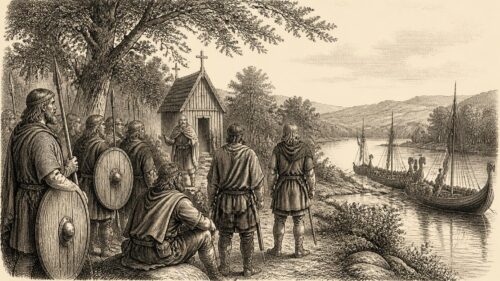
Dún Sobairche Stormed871 CE
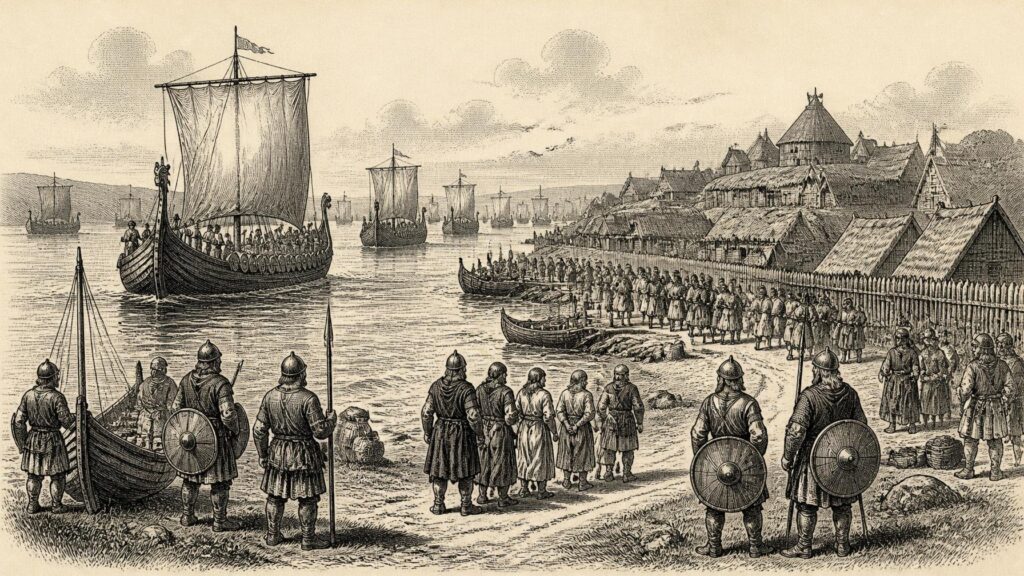
In 871, Amlaíb and Ímar returned to Dublin from Alba with an annalistically reported fleet of 200 ships and captives from Britain, demonstrating Scandinavian maritime power and forced human movement. Dún Sobairche, probably Dunseverick, was stormed in an unprecedented assault involving foreigners and Cenél nEógain, though its circumstances remain unclear. Cathalán, joint king of Ulaid, was deceitfully killed, while Ailill of Leinster died at Norse hands. Annals also recorded prominent ecclesiastical deaths, including the historian Cú Raí. These sparse, uneven records collectively depict regional political instability, enduring church networks, and Dublin’s growing role in Irish Sea warfare, commerce, and communication.
Dateline
In 871, Ireland’s annalists recorded a year in which sea power, dynastic violence and learned religious communities all came sharply into view. The outstanding event was the return of Amlaíb and Ímar, leading figures of the Scandinavian regime at Áth Cliath (Dublin), from Alba with an enormous fleet and a human cargo taken across the Irish Sea. In the north, Dún Sobairche was stormed in an assault the annalist declared unprecedented. Leinster lost its king to Norsemen, while Ulaid suffered another politically charged killing. Yet the same compact annal notices also preserve the deaths of abbots, a bishop, an anchorite, a pilgrim and a celebrated historian. Their juxtaposition is revealing: 871 was not a simple contest between “Irish” and “Viking” worlds, but a year in which warfare, lordship, maritime movement and ecclesiastical learning overlapped.
Dating a Year of Annals
The principal contemporary framework is supplied by the Annals of Ulster, supported in several essentials by Chronicon Scotorum. Neither source gives modern-style dates for the events: there is no securely recorded day or month for the fleet’s arrival, the northern assault or the royal deaths. Their annual headings are also products of medieval chronological systems, and modern editions conventionally place these notices under 871. That is sufficient to identify the year, but not to construct a precise sequence from spring to winter. Later compilations, especially the Fragmentary Annals and the Annals of the Four Masters, preserve related traditions and additional material, though their chronology and narrative framing require caution. The firm core for this year remains comparatively small, but it is exceptionally consequential.
A Fleet Returns to Áth Cliath
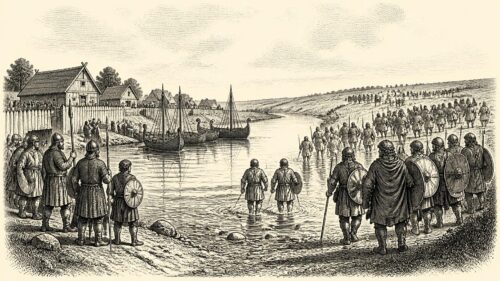
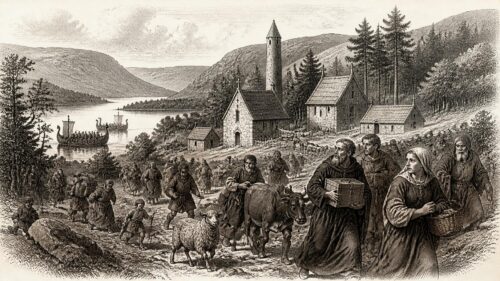
The most arresting notice states that Amlaíb and Ímar returned from Alba to Áth Cliath with “two hundred ships”, bringing captives described as Angles, Britons and Picts to Ireland. Chronicon Scotorum similarly names Saxons and Britons, while the Annals of Ulster adds Picts. The discrepancy should not be forced into false precision; what both records clearly establish is the arrival at Dublin of a very large seaborne force carrying people seized in Britain. The stated total of two hundred vessels should be retained as the annalist’s figure rather than treated as a count independently verified by archaeology. Even so, it conveys an operation on a scale far beyond a small raiding party.
This return followed the destruction of the fortress of Alt Clut, or Dumbarton Rock, after a four-month siege recorded for the preceding year. That earlier campaign provides the clearest immediate context for the prisoners in 871, though the Irish annals do not identify each captive’s place of origin or the precise route taken home. Amlaíb and Ímar were therefore operating across the Irish Sea rather than merely along Ireland’s coasts. Dublin was the base to which power, ships and captives could be brought back from a western British campaign, demonstrating the city’s importance within a maritime zone linking Ireland, Scotland, northern Britain and England.
Captivity and Maritime Wealth
The annalists’ language is stark: the people brought to Ireland were booty in captivity. It is an essential reminder that ninth-century warfare involved the taking and movement of human beings as well as livestock, precious objects and tribute. These captives were not anonymous in the record: their varied British identities were important enough to be listed. The sources do not say where they were housed after the fleet reached Áth Cliath, whether all were sold, ransomed, retained or transported onwards, or how many ships actually entered the harbour. It would therefore be irresponsible to imagine a specific slave market or a single destination for them. What can be said is that forced human movement was integral to the military economy displayed in 871.
Áth Cliath had been established as a Viking longphort in 841, three decades before this return. Archaeology indicates late ninth-century Scandinavian-associated occupation in the wider Dublin area, including buildings, burials and evidence of settlement activity, although it cannot be tied directly to the fleet of 871. The evidence nevertheless helps explain why the annalistic arrival matters. Dublin was no passing anchorage: it was becoming a durable riverside centre through which armed groups, goods and people moved. Its position on the Liffey estuary gave its rulers access both to Irish routes inland and to sea lanes across the Irish Sea.
The Taking of Dún Sobairche
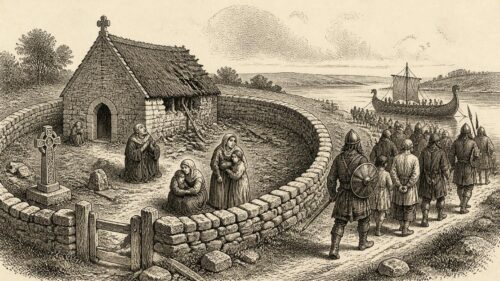
Far to the north, the annals report “the storming of Dún Sobairche, which had never been achieved before”. Dún Sobairche is generally identified with Dunseverick on the north Antrim coast, a dramatic defended headland overlooking the North Channel. The wording deliberately stresses the achievement: whatever the fort’s exact defences and condition in 871, its capture was remembered as something not previously accomplished. The entry then adds that “the foreigners were at it with the Cenél nEógain”. This compressed phrase does not safely tell us whether the foreigners and Cenél nEógain were allies, opponents or participants in a more complicated encounter. It does, however, place the assault within the politics of the powerful northern dynasty and shows that Scandinavian military activity reached into contested northern territory.
The event also illustrates why coastal forts mattered. Dún Sobairche stood near sea routes between north-east Ireland and western Scotland, precisely the waters through which ships, warriors and news travelled. Its storming cannot be reduced to a simple raid for plunder. A successful attack on such a place could alter local prestige, disrupt a regional power’s security and advertise the capacity of an armed force to overcome a supposedly formidable stronghold. The annals do not name a commander, describe a siege, or state the political result afterwards. Their silence sets the limits of the story, even as their emphatic wording establishes the assault’s importance.
Kings Killed and Authority Contested
Two other notices show how unstable kingship could be. Cathalán son of Indrechtach, described as one of the two kings of Ulaid, was “deceitfully” killed at the instigation of an Áed. The entry does not identify that Áed further, nor does it state the location or motive; it should not automatically be expanded into a proven intervention by Áed Findliath, the leading Uí Néill ruler of the period. Nevertheless, Cathalán’s designation as one of two kings points to shared or divided rule in Ulaid, and the accusation of deceit indicates political murder rather than an open battlefield encounter.
More plainly, Ailill son of Dúnlang, king of Laigin, was killed by Norsemen. This was a major loss for Leinster. The annals do not name his killers, connect them explicitly to Amlaíb and Ímar, or locate the killing, so those links remain unproven. But the combination of a Scandinavian fleet at Dublin and the death of Leinster’s king in the same annal year demonstrates the pressure exerted by armed foreign groups close to Leinster’s eastern approaches. Kingship in Ireland rested on personal lordship, kinship, hostages, tribute and military following; the killing of a ruler could rapidly unsettle all of them.
Churches, Memory and Learning
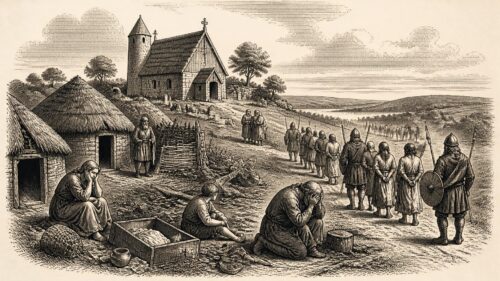
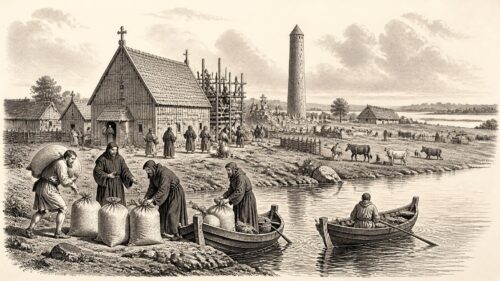
Violence did not eclipse Ireland’s ecclesiastical life. The Annals of Ulster mark the death of Ailill, bishop and abbot of Fobar; Cú Raí son of Aldnia, abbot associated with Inis Clothrann and Fochla in Mide; Colgu son of Máel Tuile, priest, anchorite and abbot of Cluain Chonaire Tómáin; Máel Mide, prior of Clonmacnoise; and Máengal, pilgrim and abbot of Bangor. The wording for Máengal is unusually warm: he ended his life happily in old age. These notices reveal a church made up not only of great saints of distant memory, but of identifiable office-holders leading communities across the island.
Cú Raí receives the most remarkable description. He was called learned and “the most expert in the histories of the Irish”. This is direct evidence that historical knowledge was recognised as a specialised accomplishment within an ecclesiastical setting. Irish monasteries and churches were centres of worship, hospitality, landholding, teaching and writing; in 871 they were also places where collective memory was maintained. The loss of such a scholar mattered beyond his own community. At the same time, the annals’ concentration on clerical deaths reflects their own institutional viewpoint. It tells us much about those whom literate communities chose to commemorate, and much less about the names and experiences of ordinary farmers, craftspeople or the captives arriving at Dublin.
An Uneven Record
No securely dated annal notice for 871 reports a harvest failure, epidemic, severe weather or island-wide environmental change. Nor is there evidence for a general peace, a national assembly or a single ruler governing all Ireland. The year’s surviving record is geographically uneven: Dublin and its maritime connections dominate one part of it; north Antrim, Ulaid and Leinster another; monasteries in Mide, Clonmacnoise and Bangor another. That unevenness is itself historically meaningful. Ireland was a landscape of regional kingdoms and ecclesiastical networks, increasingly connected to a Scandinavian-controlled sea power based at Áth Cliath.
What makes 871 memorable is not merely that violence occurred, but that several forms of authority were exposed at once. Amlaíb and Ímar demonstrated the reach of a Dublin-based fleet. Dún Sobairche’s fall showed that even renowned strongholds could be overcome. The deaths of Cathalán and Ailill revealed the vulnerability of kings. And the obituaries of abbots and scholars show institutions continuing to organise belief, learning and remembrance amid conflict. The year survives in only a handful of sentences, but those sentences capture an Ireland in which the sea had become a route of conquest, captivity and communication, while monasteries remained among the chief guardians of political and cultural memory.
Primary Sources
- The Annals of Ulster: Year U871
- The Annals of Ulster: Year U871 (Irish and Latin text)
- The Annals of Ulster
- Chronicon Scotorum: Annal CS871
- Chronicon Scotorum: Annal CS871 (Irish and Latin text)
- Chronicon Scotorum: Bibliography and Electronic Edition Details
- Fragmentary Annals of Ireland: Annals FA 389–400
- Fragmentary Annals of Ireland: 871–872
- Annals of Inisfallen
- Annals of the Four Masters: Annal M871
- Annals of the Four Masters: Annal M871 (Irish text)
- Vikings in Irish Chronicles, 794–902: Data
- Vikings in Irish Chronicles, 794–902: Introduction
- Vikings in Ireland and Scotland
- Church-Raiding And Politics In The Era Of Amlaíb And Ímar
- Early Medieval Ireland: Archaeological Excavations, 1930–2009
- Early Medieval Dwellings and Settlements in Ireland, AD 400–1100, Volume 1
- Early Medieval Archaeology Project Report 2.1
- Dublin City Urban Archaeology Survey, 1988
- Dublin City Urban Archaeology Survey: Archaeological Problems and Potential
- Archaeological Survey, National Monuments Service
- Irish Sagas: Acallamh na Senórach Names and Place-Names
- Quakers’ Island (or Inisclothraun)
- Folklore and Legend: Lough Ree