Áth Cliath’s Fallen Kings919 CE
Dateline
In 919, the struggle for Dublin produced one of the most consequential defeats of early medieval Irish politics. Niall Glúndub, king of Tara and leading figure of the northern Uí Néill, was killed when an Irish coalition attacked the Scandinavian rulers of the reoccupied settlement at Áth Cliath. The annals’ stark notice of a battle conceals a disaster of unusual scale: regional kings, royal heirs and noblemen from several northern dynasties died alongside him. Dublin’s rulers, led by Sitriuc Cáech, survived the assault. Their success did not make Ireland a Scandinavian kingdom, but it secured a major coastal power at the mouth of the Liffey and exposed the limits of any single Irish king’s authority.
A Battle Securely Placed in 919
The core event is firmly dated to 919, although the precise day needs care. The Annals of Ulster, whose regnal year is labelled “918 alias 919”, place the battle at Dublin on 14 September. The Annals of Inisfallen also enter the defeat under 919. A much later compilation, the Annals of the Four Masters, places its account under an earlier annal and supplies a different October date. For a year-by-year account, the responsible conclusion is that the battle belongs securely to autumn 919, while 14 September is the date preserved by the Annals of Ulster, not an uncontested modern certainty.
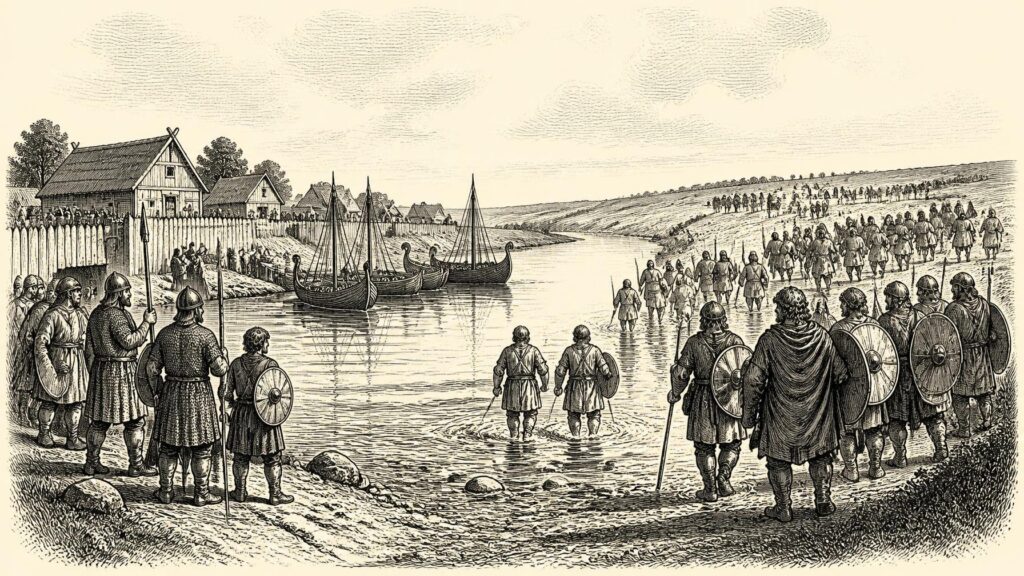
The annalists call the encounter the battle of Áth Cliath, the ford of hurdles, a name associated with the Dublin area. Later tradition identifies the place more closely with Cell Moshamóc and the ford near modern Islandbridge. That identification is plausible and widely repeated, but neither the surviving battlefield nor its exact limits can be recovered archaeologically. It is therefore better to picture fighting in the Liffey approaches to the settlement than to imagine a precisely mapped field. The very choice of ground mattered: a ford and river crossing connected Dublin with the inland routes by which an army from the north and midlands could threaten its harbour and defended enclosure.
Niall Glúndub’s Last Campaign
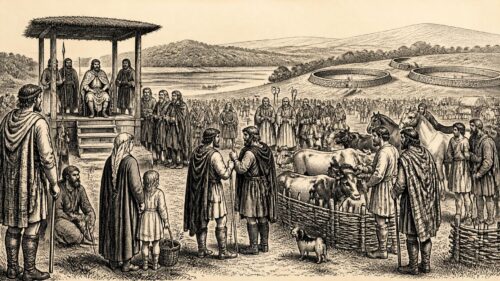
Niall was no accidental commander. Son of Áed Findliath, he belonged to Cenél nÉogain, the northern branch of the Uí Néill, and had become king of Ailech before succeeding Flann Sinna as king of Tara in 916. “High king” is a useful modern shorthand for that position, but it should not suggest a centralised Irish state. His authority depended on kinship, military followings, alliances, hostages and the recognition of other provincial rulers. The office was powerful precisely because it was contested. Niall’s kingship had already been shaped by the return of Scandinavian fleets to Ireland after the early tenth-century disruption of Dublin’s first Viking settlement.
In 917 Sitriuc, grandson of Ímar and member of the Hiberno-Scandinavian Uí Ímair dynasty, entered Áth Cliath. Warfare followed between Niall and Sitriuc during the next year. Niall had good reason to treat the revived Dublin power as more than a raiding nuisance. A ruler who held Dublin could draw on ships, river access, overseas connections and the wealth generated by trade, tribute and plunder. Sitriuc’s position also belonged to a wider Irish Sea world: the dynasty’s members moved between Ireland, Scotland, the Isles and northern England. Dublin’s fate was thus bound to politics beyond the island as well as to disputes among Irish dynasties.
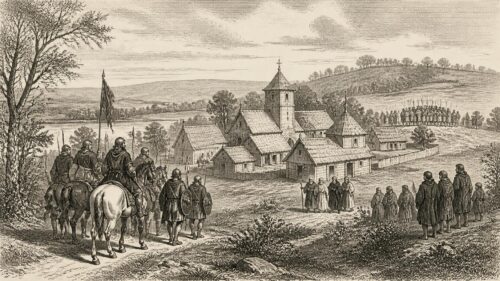
The force Niall brought south was a coalition, rather than an undifferentiated “Irish army”. The Annals of Ulster name Áed son of Eochucán, king of Ulaid; Máel Mithig son of Flannacán, king of Brega; Conchobar, grandson of Máel Sechnaill and heir-designate of Tara; Flaithbertach son of Domnall, heir-designate of the north; and Máel Craíbe of Airgialla among those killed. Chronicon Scotorum adds other local rulers, including Cellach of southern Brega, Máel Craíbe of Tortan and Éremón of Cenél Maine. These lists are more than obituary detail. They demonstrate that Niall’s expedition assembled leading men from Ulaid, Airgialla, Brega, Mide and the northern Uí Néill world.
The Rout at Dublin
The outcome was unequivocal. The Annals of Ulster say that “the heathens” won a battle over the Irish at Dublin; the Annals of Inisfallen say that the men of Ireland were defeated by In Cáech, Sitriuc. No contemporary narrative survives to explain formations, numbers, weather or the sequence of fighting, so these cannot responsibly be reconstructed. Nor should the victory be turned into a simple ethnic clash. Sitriuc’s followers were Scandinavians and people of mixed or local backgrounds operating from Dublin; Niall’s side united Irish dynasts whose own rivalries had repeatedly divided them. What is certain is the scale of the elite loss. The death of a king of Tara, a king of Ulaid, a king of Brega, an Airgialla ruler and heirs to major kingships made this a political catastrophe, not merely a failed raid.
The lament preserved after the Annals of Ulster presents Niall’s death as a bereavement for Ireland: its imagery of a sun no longer visible and a plain without its lord is conventional praise poetry, but it records how royal loss could be made meaningful in public language. Such verse did not offer neutral reportage. It transformed a defeated king into the centre of collective grief and stressed his capacity to command hostages, a key measure of political authority. The poetry is valuable precisely because it shows that kingship rested not only on victory in battle but on reputation, patronage and the ability to make dependants recognise one’s supremacy.
A Fractured Succession
The immediate consequences reached far beyond Dublin. Niall’s death removed the strongest northern claimant to the kingship of Tara, while the casualties weakened several allied kindreds at once. His young son Muirchertach did not inherit Ailech directly; Niall’s nephew Fergal became king there. Tara, meanwhile, passed into the orbit of the southern Uí Néill and Donnchad Donn. The process was neither automatic nor peaceful. In the same annalistic year, Donnchad, identified as king of Mide, blinded Áed grandson of Máel Sechnaill, an act that eliminated a close dynastic rival from kingship. The episode is a sharp reminder that defeat by Dublin intensified, rather than suspended, internal competition.
One later annalistic tradition also assigns to 919 the killing of Domnall, son of Flann Sinna, by his brother Donnchad at Bruighean Dá Choga. Because the Annals of the Four Masters were compiled centuries after the events and their chronology in this period does not align neatly with the earlier annals, this detail should be treated cautiously. It nevertheless conveys a sounder wider point confirmed by other evidence: the Clann Cholmáin dynasty of Mide was deeply divided, and the political vacuum following Áth Cliath offered ruthless men opportunities as well as dangers.
Dublin: Settlement, Trade and Power
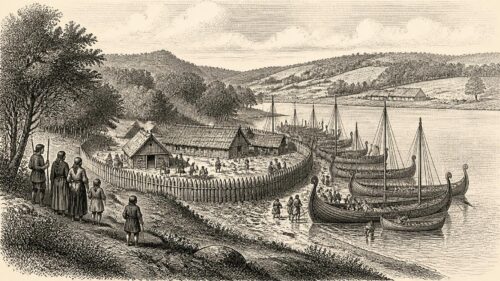
Victory in 919 helped protect Dublin’s renewed position, but it did not create the town from nothing. The settlement had earlier been abandoned after the expulsion of its Scandinavian rulers in 902; Sitriuc’s return in 917 marked a reoccupation. Archaeological work indicates a developing early tenth-century settlement around the Liffey–Poddle confluence, with organised plots, streets, dwellings and defences. Excavated evidence cannot be assigned to the very day of the battle, but it provides the essential setting: the prize was a durable riverine settlement, increasingly capable of concentrating people, craft production, exchange and armed power.
Nor were all those connected with the Scandinavian presence simply raiders. Viking-age graves at Islandbridge and Kilmainham have produced weapons, but also women’s dress fittings, craft tools, weights and scales. Hoards of silver, ingots and coins likewise point to exchange as well as violence. These finds broadly date to the ninth and tenth centuries, not specifically to 919, and should not be used to populate the battle itself with invented detail. They do, however, show the kind of community and commercial practice that stood behind a resurgent Dublin: households, artisans, merchants, ships and armed retainers were interwoven.
Pressure Beyond the Liffey
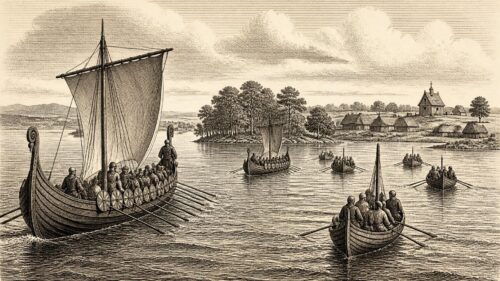
The year’s insecurity was not confined to Dublin. The Annals of the Four Masters record a fleet of thirty-two ships in Lough Foyle under Olbh and the plundering of Inis Eoghain. Fergal, lord of the North, is said to have destroyed one ship, killed its crew and taken its goods. The same source notes another twenty ships at Cenn Magair in eastern Tír Chonaill, though it explicitly says that they made no depredation on that occasion. These notices, preserved in a later compilation, should be read as evidence for maritime pressure in the north-west rather than as a full naval history. They nevertheless show how coastal communities faced threats independent of the decisive contest at Dublin.
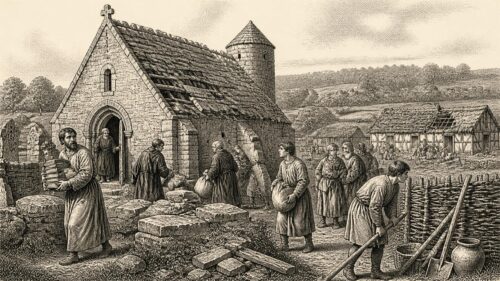
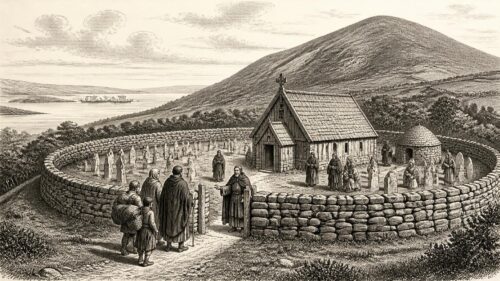
That compilation also credits foreigners with plundering Cluain Eidhneach, burning Mochua’s oratory and burning Ferns. Monastic churches were places of worship, learning, landholding and storage; an attack on one could therefore injure a local community in several ways at once. Yet 919 was not simply a record of destruction. The annals preserve the deaths of churchmen and scholars, including Máenach, abbot of Bangor, praised as the best scribe among the Irish, as well as bishops, abbots and an anchorite. Their commemoration shows the continuing importance of ecclesiastical networks as custodians of literacy, authority and memory in a year dominated by royal violence.
Scarcity and Memory
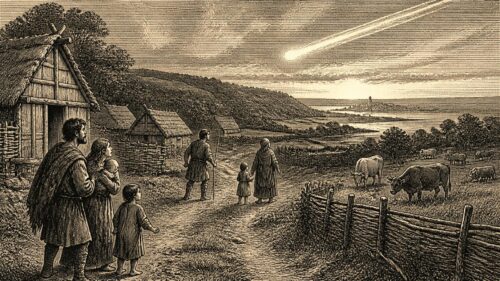
The Annals of Inisfallen add a terse but important notice: 919 was “a year of scarcity and hunger”. It gives neither cause nor region, so it would be wrong to attribute famine to the battle, weather, raiding or harvest failure without further evidence. For farming households, however, scarcity formed the material background to political and military events. Loss of cattle, disruption of labour, demands for food from travelling warbands and insecurity along waterways could all magnify a poor year. The annal does not permit a statistical picture, but it prevents the history of 919 from becoming solely a story of kings.
By the year’s end, Dublin had demonstrated that it could defeat an exceptionally broad Irish coalition, while the death of Niall Glúndub opened a new and violent phase in the rivalry between northern and southern Uí Néill. The battle at Áth Cliath was therefore a turning point not because it settled Irish politics, but because it ensured that neither Tara nor Dublin could dominate the other without sustained alliances, resources and force. Ireland in 919 remained a landscape of many kings and communities—yet the Liffey settlement had become impossible for any ambitious ruler to ignore.
Primary Sources
- The Annals of Ulster
- Chronicon Scotorum
- Annals of Inisfallen, Annal AI919
- Annals of the Four Masters, Volume 2, Annal M919
- The Annals in Cotton MS. Titus A. XXV
- Niall Glúndub | Dictionary of Irish Biography
- Sitriuc Cáech (Sigtryggr) | Dictionary of Irish Biography
- Donnchad Donn | Dictionary of Irish Biography
- Gormlaith | Dictionary of Irish Biography
- Viking | National Museum of Ireland
- The Viking Age: Ireland and Beyond
- Early Medieval Ireland: Archaeological Excavations, 1930–2009
- Dublin City Archaeological Archive/Temple Bar West, Dublin 2 (96E0245) Collection
- Werburgh Street SDRA Archaeology Report
- The Vikings in Ninth-Century Ireland: Sources and Settlements
- Viking Kings of Britain and Ireland: The Dynasty of Ivarr to A.D. 1014
- The Vikings | Waterways Ireland Archive Portal
- First Genome Sequences of Irish Vikings Reveal Ties to Norway and Interactions with the Locals
- Settlement, Industry and Change in the Irish Countryside, 800–1100
- Vikings in Ireland
- Viking Ireland: Afterthoughts
- Early Christian Ireland: An Introduction to the Sources