Ciarán’s Law at Cruachain814 CE
In 814, Muirgius son of Tommaltach, overking of Connacht, and Fairchellach, abbot of Clonmacnoise, campaigned through Uí Maine, killing many people described as innocents. Muirgius later promulgated Ciarán’s law at Cruachain, demonstrating cooperation between royal and ecclesiastical power. In Leinster, the sons of Bran defeated Uí Chennselaig. At Kells, completion of a Columban church preceded Iona abbot Cellach’s resignation and Diarmait’s appointment. Deaths included bishops, abbots, scribes and teachers, notably Fairchellach and the murdered Bishop Máel Dúin. Annals also recorded great distress and severe illnesses, without identifying their cause, revealing interconnected warfare, religious authority, construction, learning and hardship across Ireland.
Dateline
The record for 814 is unusually revealing because it joins violent action, ecclesiastical authority, building work and a grim notice of hardship. None of these entries offers a complete narrative, and the Irish annals rarely supply months or days. Yet, read with care, they show a country in which kings, church leaders and local communities were closely entangled. A raid in Connacht was followed by the public assertion of a saint’s law; a newly completed church at Kells marked the growing importance of a Columban foundation; and deaths among bishops, abbots, scribes and teachers make clear how much religious institutions depended upon particular people.
The events discussed here are securely attached to the annal-year conventionally treated as 814, although the surviving annalistic manuscripts have chronological irregularities. They should not be treated as a diary of a single season. Rather, they preserve notices of developments deemed important enough to enter the historical record, probably gathered from several regional traditions.
Violence South of the Suck
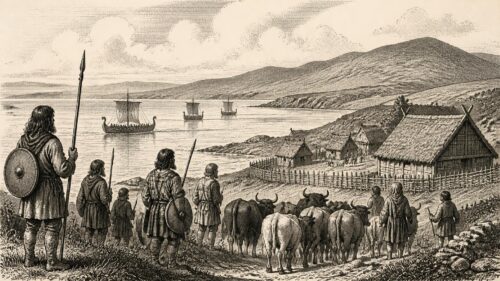
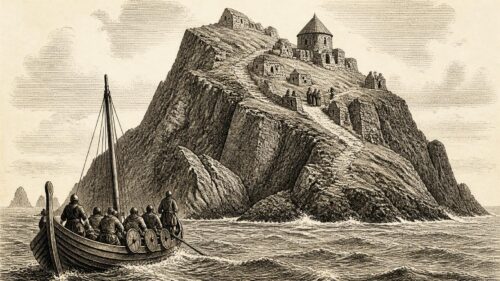
The year’s starkest political event occurred in Connacht. Muirgius son of Tommaltach, overking of Connacht, and Fairchellach, abbot of Clonmacnoise, led an army across Uí Maine, south of the River Suck. The Annals of Ulster add a disturbing qualification: many innocentes, rendered in translation as harmless or innocent people, were killed. This is not the language of a neat encounter between armed warbands. It draws attention to people who were not regarded as legitimate fighters and makes the human cost of the expedition impossible to ignore.
Muirgius was an experienced and forceful ruler from the Uí Briúin Aí of Mag Aí, in the Connacht heartland. His power had been made through repeated campaigns against rival Connacht dynasties and dependent peoples. Uí Maine, stretching across parts of modern east Galway and south Roscommon, lay on an important southern flank of his authority. The route south of the Suck brought Muirgius into territory where control could never simply be assumed. Armies lived from the country through requisition, seizure of livestock and destruction, so a hosting endangered households well beyond those who took the field.
Why did Muirgius march with Clonmacnoise’s abbot? A later reconstruction, based on the sequence and wider evidence, connects the expedition with the killing of Máel Dúin, bishop and superior of Echdruim, a Clonmacnoise dependency in the region; Uí Maine were held responsible. That explanation is plausible, but it remains a reconstruction rather than an explicit statement by the annalist. What is firm is that royal force and monastic leadership acted together, and that the victims included people whom the record itself presents as undeserving of slaughter.
A Saint’s Law Proclaimed
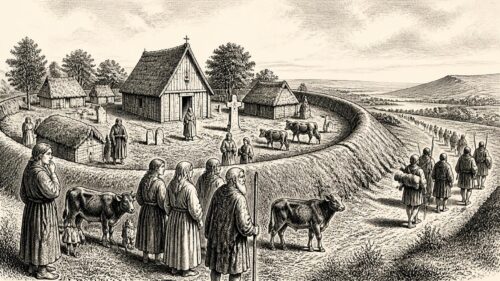
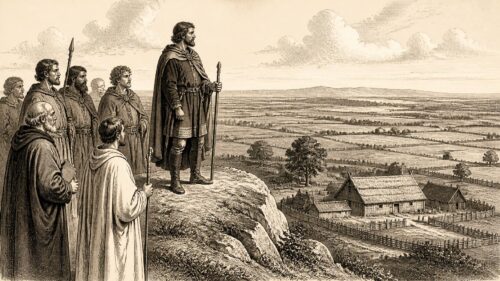
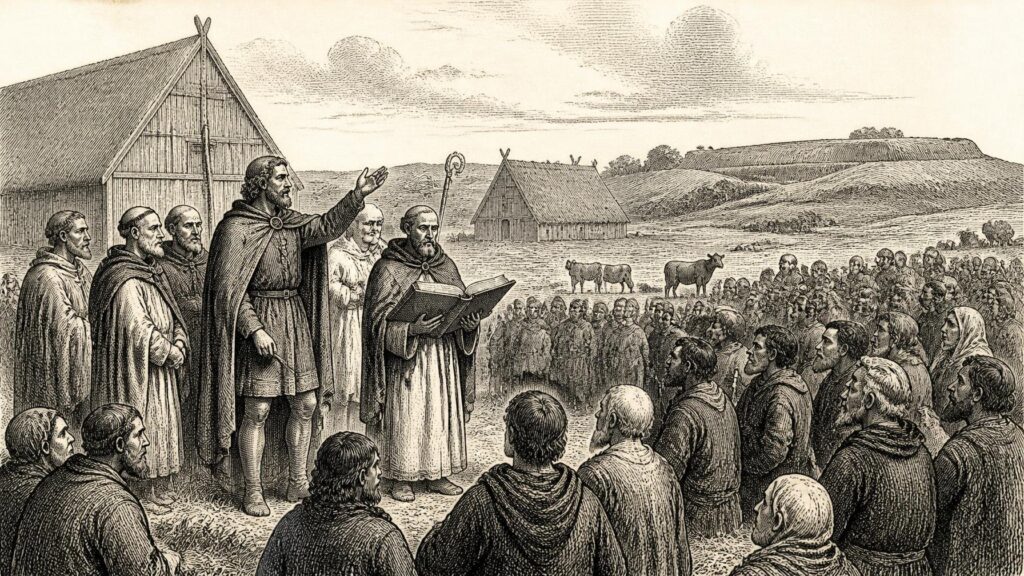
Later in the same annal-year Muirgius “exalted” or promulgated the law of Ciarán at Cruachain. Cruachain, the major royal and assembly landscape of Connacht near Rathcroghan in modern County Roscommon, was an apt setting. An óenach, or assembly, was not merely a political gathering: it could bring together rulers, churchmen, legal specialists, traders and the wider public. To enact a saint’s law there gave it visibility across a province divided among many small kingdoms and lordships.
Such a law was not legislation in a modern parliamentary sense, and the precise clauses of Ciarán’s law of 814 have not survived. In early medieval Ireland, however, a cáin could be issued under combined royal and ecclesiastical sponsorship, backed by sanctions, pledges and the prestige of a saint. It extended the influence of a church federation beyond its immediate enclosure while allowing a king to represent himself as protector and enforcer of sacred order. Ciarán of Clonmacnoise was therefore not simply a devotional figure: his name carried institutional authority.
The juxtaposition is telling. The annals do not say that the law was a response to the deaths in Uí Maine, and it would be wrong to claim that it repaired the damage. Nevertheless, the two notices illustrate a political world in which coercion and sacral authority could reinforce each other. Fairchellach’s participation in the campaign and Muirgius’s subsequent sponsorship of Ciarán’s law offered Clonmacnoise and its associated churches a powerful provincial patron. Fairchellach himself died later in the year, so the assertion of the law was among the last recorded acts of this influential abbot.
Leinster’s Internal Contest
Another annal records a battle among the Laigin, the peoples of Leinster. The Uí Chennselaig were defeated, while the sons of Bran gained victory. The entry is concise and does not identify the battlefield, numbers or immediate cause. It nevertheless shows that Leinster’s politics remained unsettled beneath the larger claims of Áed Oirdnide, king of Tara. Kingship was not a single national office with an administrative reach over the whole island. It was a shifting hierarchy of provincial overkings, lesser kings and competing kindreds, maintained through alliances, hostages, tribute and armed followings.
The death of Braen son of Ruaidrí, described as a Leinster nobleman, belongs in this atmosphere of competition, though the annals do not connect his death directly with the battle. So too does the unexpected death of Niall son of Áed, king of Uí Chormaic. Such notices mattered because a ruler’s death opened questions of succession, clientship and control of land. For communities living within these territories, changes at the top could alter obligations of food-rent, military service and protection.
Cenannas Completed
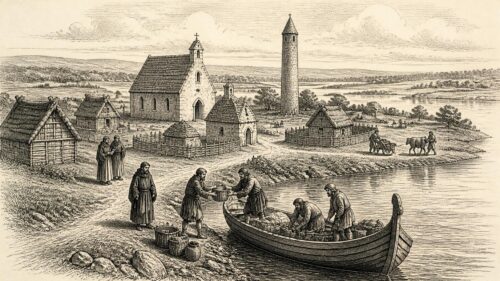
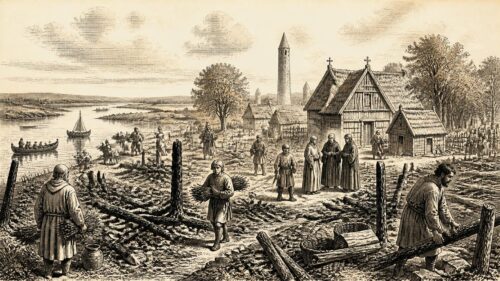
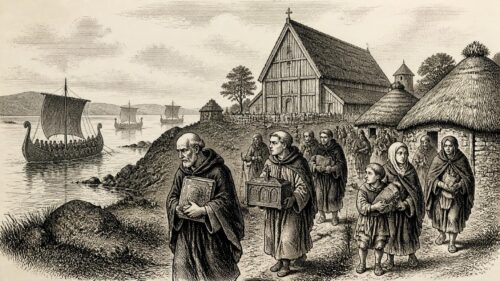
A less violent but enduring development took place at Cenannas, now Kells in County Meath. Cellach, abbot of Í, or Iona, resigned his superior’s office when the building of the church at Cenannas had been completed. Diarmait, fosterling of Daigre, was appointed in his place. The annal does not describe the building’s dimensions, materials or decoration, and modern readers should resist imagining the later medieval ruins in their present form. Its importance lies instead in what completion signified: a major Columban church was ready for use within an expanding ecclesiastical settlement.
Kells had been developed by the Columban community in the opening years of the ninth century. Its situation in the Irish midlands gave it security, communications and access to royal patrons, while maintaining close ties with Iona across the Irish Sea. The completion notice demonstrates that Iona’s abbot remained directly involved in Irish affairs. It should not, however, be turned into a simple story of Iona’s abandonment. Iona continued as a religious community, and the relationship between Iona and Kells remained layered and contested over generations.
The event also offers a glimpse of labour usually invisible in the annals. A church required timber or stone, roofing, iron fittings, transport, skilled craftspeople and supplies for the workers. It stood within a settlement of clergy, dependants, tenants and visitors rather than in isolation. Kells was already associated with an older royal landscape, and its new church added to the institutional weight of the Columban federation. The Book of Kells is connected with this Iona–Kells world and dates broadly around 800, but neither its exact place of manufacture nor its stage of completion in 814 can be stated with certainty. The finished church is the securely dated achievement.
Losses of Learning and Office
Death notices give 814 a strongly ecclesiastical character. Feidlimid, abbot of Cell Moinne and steward of Patrick’s church in Brega, was remembered as an anchorite and an excellent scribe. Tuathal son of Dú-Dubtae, scribe and teacher at Clonmacnoise, also died. These descriptions identify specialised roles: copying texts, teaching students, administering property and performing ascetic devotion. Learning was not detached from society. A scribe or teacher worked in a community whose books, legal knowledge and liturgy underpinned its claims to status and land.
Other losses included Eterscél, bishop of Glendalough; Cináed, bishop and abbot of Trelec Mór; Orthanach, abbot of Cell Fhoibric; Rónán, a bishop; and two abbots named Blathmac, of Terryglass and Inishbofin. The killing of Bishop Máel Dúin stands apart from these peaceful deaths. Together, the notices reveal a dense network of churches from Wicklow to Brega, the midlands, Connacht and Munster. Their heads could be bishops, abbots, scribes, stewards and anchorites at once or in combination; early Irish ecclesiastical organisation did not follow the later pattern of territorially defined dioceses.
Distress Without Detail
The Annals of Ulster closes its principal notices for the year with “great distress and severe illnesses”. The phrase is grave but frustratingly unspecific. It does not permit a confident diagnosis of plague, famine or a particular weather disaster. Distress could involve sickness, scarcity, disrupted farming, insecurity or several hardships together. The recent military violence in Connacht makes the warning especially poignant there, but the annal does not explicitly link the two.
For most people, life still centred on scattered rural settlements, cattle, crops, kin and seasonal work. Churches and royal households were major consumers and organisers of resources, not separate worlds. In 814, the record preserves both the achievement of a completed church and the loss of skilled religious figures; both the public proclamation of sacred law and the killing of innocents. That uncomfortable combination is perhaps the year’s clearest lesson: authority in early medieval Ireland was built through worship, learning, patronage and construction, but also through the capacity to compel.
Primary Sources
- The Annals of Ulster, Year U814
- Annals of the Four Masters, Part 64
- Muirgius
- Áed Oirdnide
- Annals of Inisfallen
- The Annals of Tigernach
- Chronicon Scotorum
- CELT: Corpus of Electronic Texts
- Kells: Irish Historic Towns Atlas Text
- The Book of Kells
- Colm Cille’s Spiral: The Object
- Iona and the Shrine of Columba, c. 800–1200
- Iona v. Kells: Succession, Jurisdiction and Politics in the Columban Familia in the Later Tenth Century
- History and Stories: Iona Abbey and Nunnery
- Early Christian Monasteries
- Early Monastic Churches
- Early Irish Monasticism
- Law, Law-Books and Tradition in Early Medieval Ireland
- Early Irish Law
- Cáin Adomnáin and the Laws of War
- The Church and the World in Early Christian Ireland
- The Céili Dé and Ecclesiastical Government in Ireland in the Eighth and Ninth Centuries
- Sacred Calligraphy: The Chi Rho Page in the Book of Kells