Corann and October Mortality683 CE
In 683, Irish annals record the killing of Dúnchad Muirisce, king of Connacht, and the deaths of Colgu son of Blathmac and Fergus of Cenél Cairpri at Corann. Two unnamed strongholds were also besieged, though the sources give no participants or outcomes. In October, a ‘mortality of children’ began, reportedly lasting three years, but cannot be identified with a specific disease. The year also saw the deaths of ecclesiastical figures including abbots linked to Cráeb Laisre and Clonmacnoise. Despite chronological variations between annals, the evidence presents 683 as a troubled year of contested kingship, warfare and widespread disease.
Dateline
In 683 CE, Ireland’s surviving annalistic record places political violence, contested provincial authority and the first reported onset of a grave mortality within the same year. The entries are terse, but their conjunction is striking: Dúnchad Muirisce, king of Connacht, was killed; Colgu, son of the former Tara ruler Blathmac, fell in the battle of Corann alongside Fergus, king of Cenél Cairpri; two strongholds were besieged; and, in October, a disease described as the “mortality of children” began. For a society whose history was usually recorded through the fates of rulers, clerics and religious houses, this last notice points beyond elite politics to a crisis that reached households across Ireland.
Reading a Difficult Year
683 must nevertheless be approached with care. Irish annals preserve invaluable near-contemporary material, but their early chronological headings do not always align. The Annals of Tigernach and the Fragmentary Annals place Dúnchad’s death, Corann and the October mortality in 683. The corresponding section of the Annals of Ulster, conventionally labelled U683, has an internal Christian-era heading of 682. This is an acknowledged problem of annalistic chronology, not evidence that the events happened twice. The convergence of the other annalistic traditions, and especially the precise October notice, permits their responsible treatment as developments of 683 CE, while ruling out invented days, months or sequences for the fighting.
The entries also reveal the limitations of the evidence. No annalist explains why Dúnchad was killed, who won at Corann, who conducted the two sieges, or what disease struck in autumn. It would be tempting to turn several lines into a continuous national narrative of rebellion and epidemic. That would go beyond the sources. What can be said is that events recorded in Connacht, among the southern Uí Néill and at unnamed fortified places occurred against a background of numerous competing kingships, while an illness thought serious enough to date by month began in October.
A King Killed in Connacht
Dúnchad Muirisce son of Máel Dub was explicitly called king of Connacht in the Annals of Tigernach. His killing was therefore more than a local feud. Connacht was not a centrally administered province in the modern sense: its kingship depended on the standing of powerful dynasties, their client peoples and their ability to command military support. Dúnchad belonged to the wider Uí Fiachrach political world, one of the major Connacht groupings. His byname, Muirisce, links him with the western territory of Muirisc, but it should not be made to prove the site or circumstances of his death.
The Tigernach entry immediately names Fergal of Aidhne, son of Artgal, as king of Connacht. This strongly suggests that the killing initiated, or accompanied, a change in the provincial order. Yet the surviving king-list tradition is not simple: a poem on the kings of Connacht places Cellach son of Rogallach after Dúnchad and Fergal after Cellach. Rather than harmonising incompatible lists by force, the safest conclusion is that 683 exposed competition for Connacht’s kingship. The appearance of Fergal Aidhne in that year demonstrates the standing of the southern Uí Fiachrach branch of Aidhne; it does not give us a securely dated coronation or an uncontested succession.
The Unresolved Battle of Corann
The battle of Corann was the year’s other major political event. Two named dead give it unusual significance. Colgu son of Blathmac belonged to Síl nÁedo Sláine, the southern Uí Néill dynasty from which high kings at Tara had recently come. His brother Sechnasach, king of Tara, had been killed in 671, reportedly by a king of Cenél Cairpri. At Corann, Colgu fell with Fergus son of Máel Dúin, himself styled king of Cenél Cairpri. The encounter may therefore reflect a continuing conflict involving these kindreds, but the annals do not identify the armies, the instigator or the victor.
Corann is often tentatively associated with the barony of Corran in south County Sligo, a region on Connacht’s northern approaches. That identification is plausible rather than certain, and the article’s evidence does not justify locating the battle more precisely. Nor should this clash be confused with the far better documented battle of Corann in 703, fought a generation later. In 683, the annalist supplies only the deaths of Colgu and Fergus. Even so, their status indicates that Corann was not a minor encounter: it removed men attached to important royal lines at a moment when Connacht itself had lost its king.
Sieges Without a Story
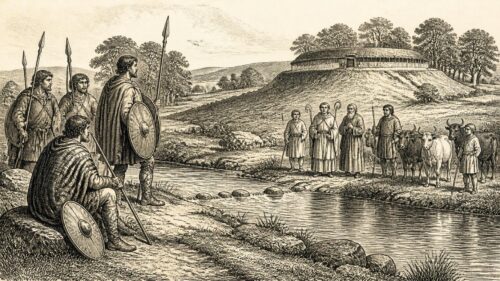
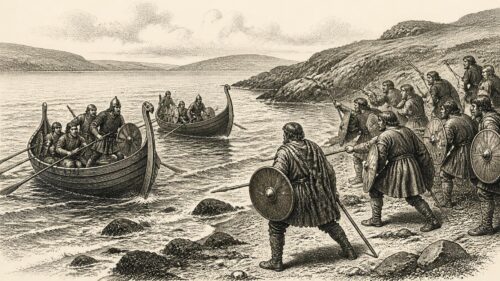
The Annals of Ulster alone add “the siege of Dún At and the siege of Dún Duirn”. No participants, locations, outcomes or relationship to Corann are given. These notices should therefore remain separate from the battle rather than being treated as its opening or aftermath. Their inclusion matters because they show that warfare was not confined to an encounter in open country. Control of defended places, whether royal residences, local centres or refuges, was part of the year’s conflict.
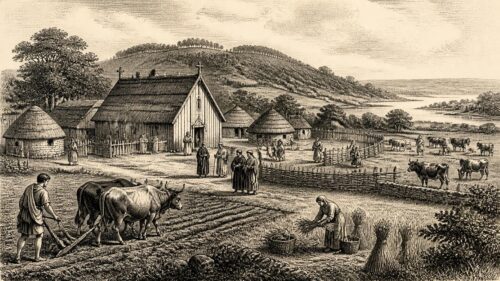
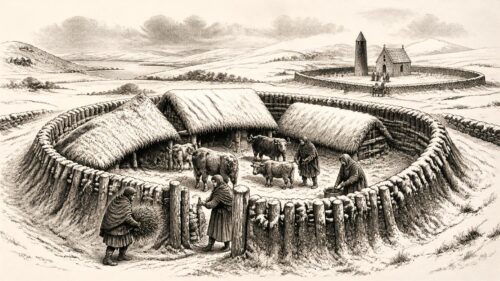
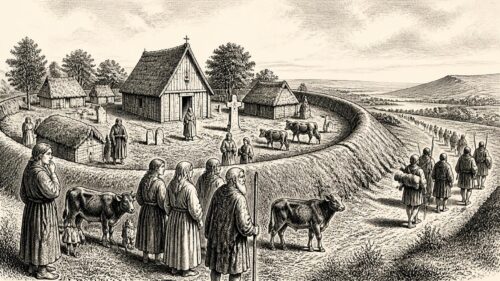
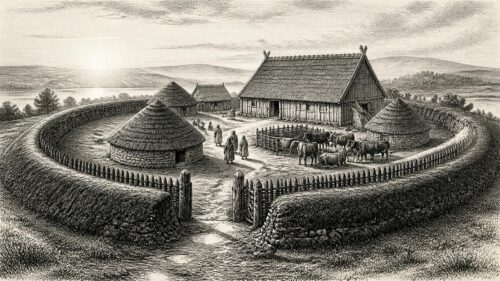
Most people in seventh-century Ireland lived not in towns but in dispersed rural settlements. Archaeology shows a landscape of enclosed farmsteads, commonly called ringforts or raths, with timber buildings, livestock pens, storage and working areas. A dún in an annal need not have been a standard ringfort, and neither siege can be reconstructed archaeologically from the text. But the vocabulary of siege reminds us that the security of people, animals, food stores and dependants was a practical concern, not merely a literary image of kingship.
An October Outbreak
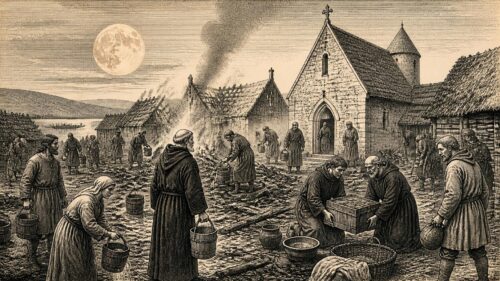
The most precisely dated notice of 683 is the beginning, “in the month of October”, of the mortalitas puerorum, conventionally translated as the mortality of children. The Fragmentary Annals says that it lasted for three years in Ireland, and the annalistic record continues to note child mortality in the following year. The wording does not provide symptoms, a place of origin, numbers of dead, or an explanation of transmission. It cannot responsibly be translated into a definite modern diagnosis.
Modern scholarship has considered whether this mortality belonged to the wider cycle of epidemic disease sometimes connected with the late antique or Justinianic plague pandemic. That remains a hypothesis, not a settled identification. “Children” may reflect a real concentration of deaths among the young, perhaps among people without immunity after earlier outbreaks, but an annalistic category is not a clinical case record. What is firm is narrower and still sombre: observers marked the outbreak’s beginning in October 683, and later tradition remembered it as prolonged and exceptionally destructive.
Its social implications would have been immediate. Children and young people were integral to households that depended on herding, cultivation, food processing and kin-based labour. Their sickness or death would have affected care, work and inheritance as well as grief. Yet no source for 683 reports a failed harvest, famine, livestock disease or collapse of trade. Early medieval wealth was substantially expressed in cattle, land, food renders and skilled labour, while cereals were grown and processed in kilns and querns. These are the conditions within which the mortality was experienced, not additional disasters that can be assigned to this particular year.
Churches, Communities and Memory
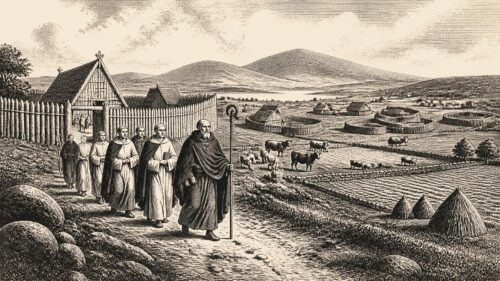
The year also brought the death of Airmedach of Cráeb Laisre, recorded in the respectful Christian formula “fell asleep”. Cráeb Laisre is identified with a monastery near Clonmacnoise, and later martyrological tradition calls Airmedach its abbot. The notice consequently preserves a small but meaningful link in the religious landscape of the midlands. It also records the death of Colmán of Airtech, abbot of Clonmacnoise, although that detail survives in the Annals of Tigernach rather than all annalistic versions.
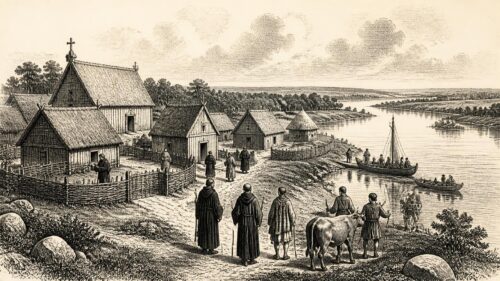
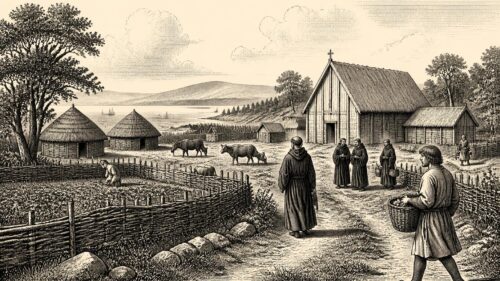
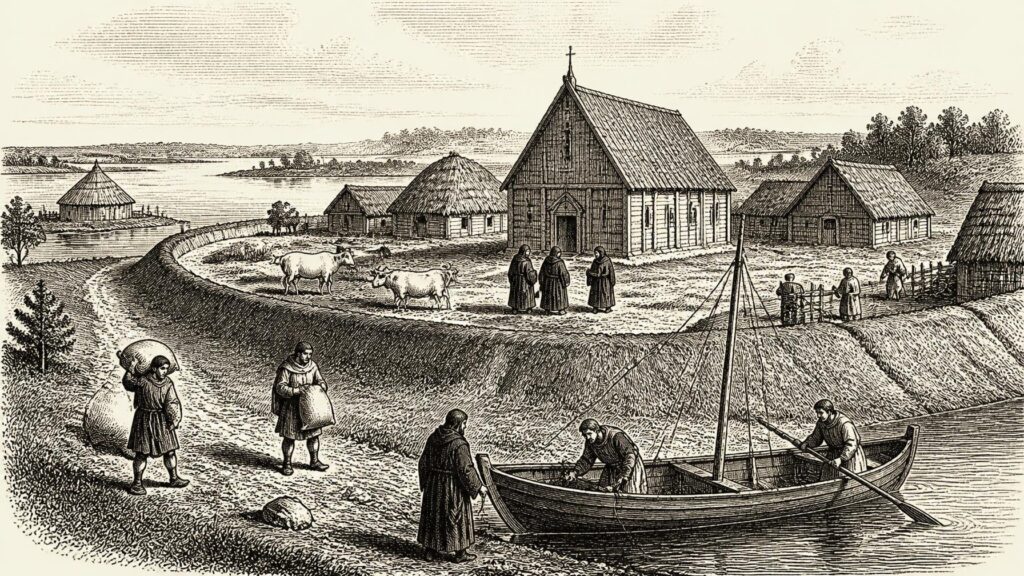
Clonmacnoise was already an important community on the Shannon, at a crossing of river and overland routes and on the meeting-ground of Connacht and Mide. Its early buildings and domestic structures were chiefly of timber, not the stone churches and round tower most visible there today. An abbot’s death therefore mattered not only devotionally. Such houses joined worship, learning, hospitality, craft production, estate management and political patronage. The notices of Airmedach and Colmán do not prove that the October disease caused either death, but they show that the same year’s record moved between royal killing, warfare, mortality and ecclesiastical leadership.
Thus 683 was not simply a year of isolated annal entries. It was a moment when the fragility of political rank and human life was unusually visible. Connacht lost a king; Corann claimed representatives of rival royal kindreds; unnamed strongholds endured siege; and an illness began in October whose effects outlasted the calendar year. The surviving record is too spare to yield a complete story, but it securely preserves the outlines of a troubled year in which conflict and disease touched both the ruling families of Ireland and the wider communities on which they depended.
Primary Sources
- The Annals of Ulster: Year U683
- The Annals of Tigernach: Annal T683
- Fragmentary Annals of Ireland: Annals FA 81–99
- The Annals of Ulster
- The Annals of Tigernach
- Fragmentary Annals of Ireland
- Chronicon Scotorum
- Annals of Inisfallen
- Annals of the Four Masters
- A Poem on the Kings of Connaught
- Genealogies from Rawlinson B 502
- Tírechán’s Motives in Compiling the Collectanea: An Alternative Interpretation
- The Definite Article in Irish Place-Names
- From blefed to scamach: Pestilence in early medieval Ireland
- The Plague and Its Consequences in Ireland
- The Chronology and Sources of the Early Irish Annals
- The Life of Columba, Written by Adomnán
- Clonmacnoise, County Offaly
- Clonmacnoise Visitor Guide
- Early Medieval Archaeology Project Report
- Ringforts / Ráthanna
- Farming and Archaeology: The Irish Historic Landscape
- Women and the Law in Early Ireland
- Exploring the Irish Annals