Cenn Fáelad’s Stormed House682 CE
In 682, Cenn Fáelad son of Colgú, king of Connacht, was killed when Ulcha Derg of the Conmaicne Cúile and his followers stormed his residence. The annals confirm the death but give no motive, location or account of its consequences. It illustrates the fragile, negotiated character of provincial kingship among competing kindreds. Another Connacht king was slain the following year, though no direct connection is recorded. Elsewhere, a battle at Ráith Mór in Mag Line involved Britons and northern Irish rulers, while Pictish forces devastated Orkney. Rural communities, dependent on farming, livestock and churches, sustained the political and literate world that preserved these events.
Dateline
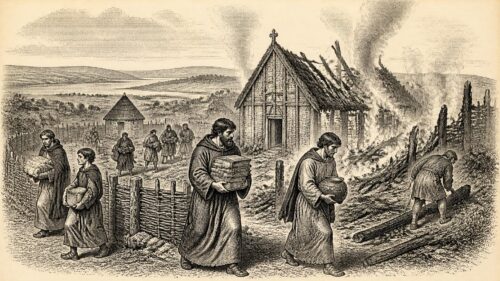
In 682 CE, the clearest Irish event is the killing of Cenn Fáelad son of Colgú, styled king of Connacht in the annals. The Annals of Ulster preserve the event in a terse entry; the related Annals of Tigernach and Chronicon Scotorum name his killer as Ulcha Derg, grandson of Caillide, of the Conmaicne Cúile. Tigernach adds the vivid but limited detail that Cenn Fáelad was slain after the Conmaicne had stormed his house. It is the year’s central fact: a provincial king died violently in his own residence, not in a named pitched battle. The sources provide neither a day nor season, no exact location for the house, and no trustworthy account of the immediate political settlement. Those silences matter as much as the striking image of a royal household overwhelmed.
An Annalistic Killing
The agreement of several annalistic traditions makes the death securely placeable in 682, although their wording differs. Ulster calls it simply the slaying of Cenn Fáelad, son of Colgú, king of Connacht. Chronicon Scotorum gives Ulcha Derg and the Conmaicne Cúile as his assailants. Tigernach preserves the additional statement about the house being taken. The Annals of Inisfallen place the same killing under their annal 681, but explicitly cross-reference the Ulster date; this reflects the familiar chronological offsets between Irish annals, not evidence for a second death or a different king. For a year-by-year account, 682 is therefore the responsible placement, while the episode’s finer chronology remains unknown.
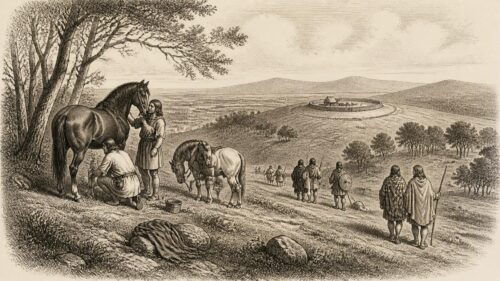
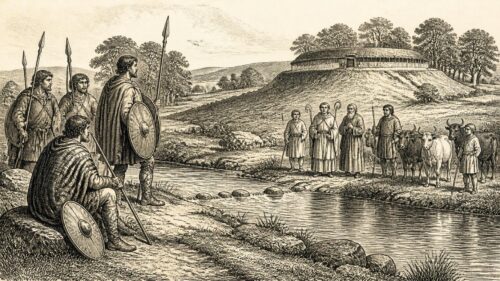
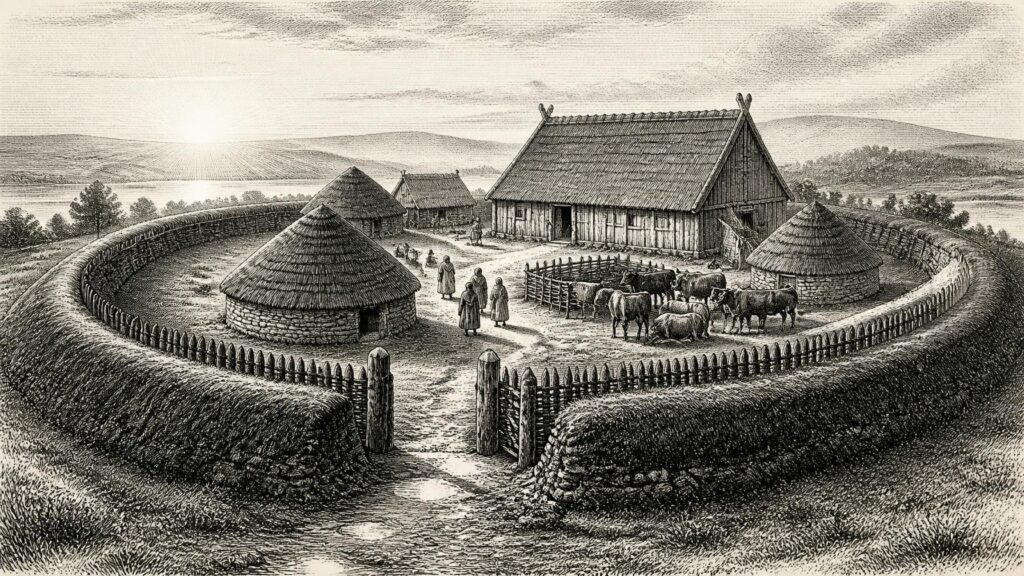
“Stormed house” should not be enlarged into a scene the record does not give. It does not tell us whether Cenn Fáelad’s residence was a timber hall, a farmstead enclosure, a lake-side stronghold, or a complex of several buildings. Nor does it say whether the attackers came after a siege, during a raid, or through treachery. Yet the wording does establish something important about kingship. A king’s residence was both domestic space and political centre: the place where dependants, food renders, livestock, weapons, hostages and visitors could be gathered under a ruler’s protection. To breach it was to challenge authority at its most immediate and vulnerable point.
Connacht’s Uneasy Political Map
Cenn Fáelad belonged to the Uí Briúin, one of the major Connacht dynastic groupings. Tigernach records him as king of Connacht in 663, and his prominence in the annals over the following years indicates that he was recognised beyond a merely local lordship. Modern reconstructions commonly associate his line with Uí Briúin Seóla, in south-central Connacht, although early Irish dynastic labels and genealogies must be handled cautiously: surviving pedigrees were copied and reshaped long after the seventh century, and later political identities should not be projected too neatly backwards.
Connacht was not a unified kingdom in the modern territorial sense. It was a landscape of competing kin-groups, client peoples, churches and petty rulers, linked by cattle tribute, fosterage, marriage, military service and negotiated submission. Royal claims could extend over wide areas without replacing local authority. The Conmaicne were among several population groups whose names endured in regional territories. The Conmaicne Cúile are associated by later geographical scholarship with Cúil Tolad, around the Kilmaine area of present-day south Mayo, east of Lough Mask and north of the River Robe. That identification gives the killing a western Connacht setting, but it cannot identify the king’s house or reconstruct the route of the attackers.
The annals do not state why Ulcha Derg and the Conmaicne attacked. It is tempting to describe the event as a revolt against Uí Briúin expansion, and the location of the named people makes local resistance plausible. But that remains interpretation, not an annalistic fact. The conflict might instead have arisen from a succession dispute, a broken alliance, an exaction of tribute, a feud among neighbouring elites, or a combination of these. What can be said firmly is narrower and more revealing: Connacht’s king could be killed by men identified with a smaller regional people, and the annalist judged their identity important enough to record. Provincial kingship rested on relationships that could be forcefully renegotiated.
A Succession Left Open
The killing did not end Connacht’s instability. The following annal, conventionally dated 683, records the slaying of Dúnchad Muirisci son of Máel Dub, himself called king of Connacht. It would be unsafe to claim that he succeeded Cenn Fáelad immediately, or that his death was direct revenge for 682: the sources do not connect the two notices. Still, their proximity demonstrates that the removal of one king did not produce a securely settled province. A sequence of killings among high-status men is a reminder that royal succession was competitive. Eligibility depended on descent and rank, but accession also required the support—or acquiescence—of powerful kindreds.
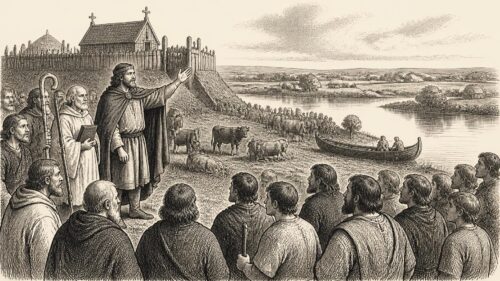
This was a political world in which a title such as “king of Connacht” expressed a claim to precedence rather than the administration of a centralised state. Kings maintained standing through progress, hospitality, judgements, alliance and the capacity to reward followers. Their authority depended on agricultural surplus and personal ties. A violent assault on a residence could therefore have consequences beyond one family: dependants needed new patrons, clients needed protection, ecclesiastical communities had to judge their relations with a new dominant lineage, and neighbouring rulers recalculated obligations. The sources do not permit those consequences to be traced household by household in 682, but they explain why the annal recorded Cenn Fáelad’s death at all.
War Beyond Connacht
The same 682 dossier places Ireland in a wider northern and Irish Sea world. Ulster and Chronicon Scotorum record a battle at Ráith Mór in Mag Line, in the north-east, “against the Britons”. Cathassach son of Máel Dúin, called king of the Cruithin or Picts, and Ultán son of Dícuill fell there. The notice is not detailed enough to identify the forces, causes or exact battlefield. It does, however, show that conflict involving Britons was significant enough to enter Irish historical memory, while the use of “Cruithin” reflects the complex overlapping vocabularies through which Irish writers described peoples in north-east Ireland and northern Britain.
Ulster also notes that the Orkneys were devastated by Bridei, king of the Picts. That was not an event in Ireland, and it should not be treated as one. Its appearance in an Irish annal nevertheless shows the geographical reach of the chronicle’s interests. Monasteries and ecclesiastical travellers connected Ireland, Iona, western Britain, Pictland and Northumbria through sea routes, books, kinship and religious controversy. Political news travelled along some of the same pathways. For Irish readers or hearers of annals, the northern seas were not a blank edge of the world.
Fields, Enclosures and Dependence
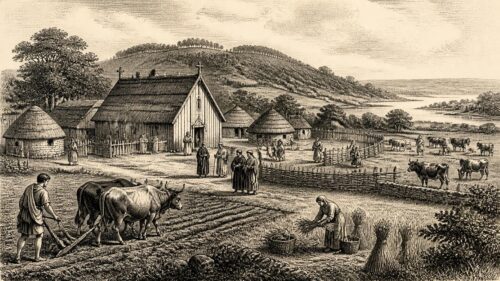
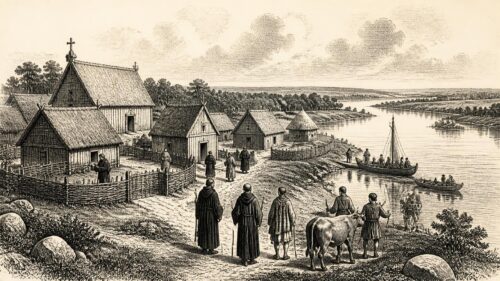
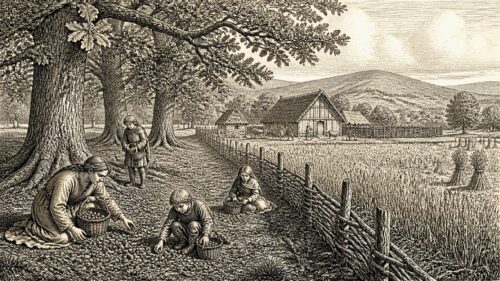
Beyond these named conflicts, 682 has left no reliable annual record of harvest, weather, prices or trade. Everyday life must therefore be described as wider seventh-century context, not as an event of this particular year. Ireland remained overwhelmingly rural. Most people lived in dispersed farmsteads, often within earthen or stone enclosures now conventionally called ringforts, alongside less common crannogs and unenclosed settlements. Archaeology indicates that the seventh century was a period when settlement enclosures and lake dwellings were widely occupied and, in some regions, newly constructed or remodelled.
Cattle were central to wealth, food and social ranking, but the economy was never simply pastoral. Households kept cattle, sheep and pigs, cultivated cereals, dried grain in kilns, processed dairy produce, spun wool and repaired houses, fences and trackways. Watermills had already appeared in Ireland by the early seventh century, though their most intensive construction lies later. Labour was strongly structured by status: free farmers, clients, dependants, hereditary unfree people and slaves did not share resources or security equally. A king’s political reach was ultimately grounded in this productive countryside—its food rents, livestock and people—and a raid on a royal residence was consequently an assault on a local system of extraction and protection.
Churches, Learning and Record
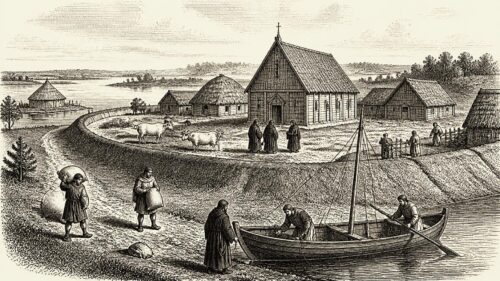
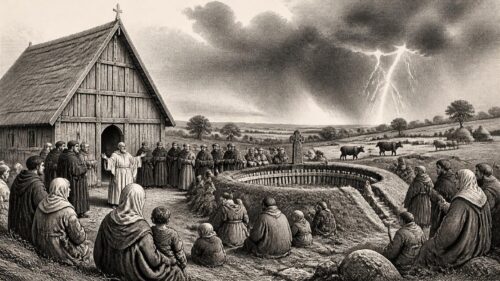
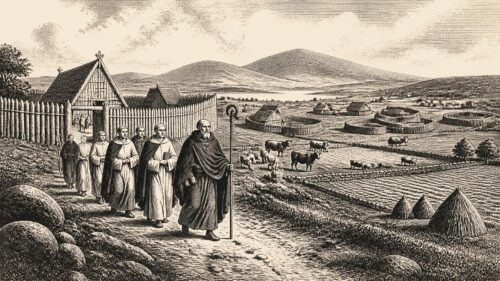
Christian institutions were embedded in that same rural order. Monasteries and churches were not isolated retreats from politics: they held land and cattle, drew tenants and craftsmen, offered burial and worship, educated clerics, and preserved connections between regions. Their enclosures could contain churches and graveyards, but also workshops, stores, fields and livestock. The language of the annals, with its compact notices of deaths, battles and celestial phenomena, emerged from literate ecclesiastical culture even though the surviving manuscripts are later than the events they record.
By 682, Latin literacy and Irish-language learning had long been established among clerical elites. Irish scholars worked within a book culture connected to Britain and the Continent, copying Scripture, calculating Easter, composing Latin and Irish texts, and preserving genealogical and historical knowledge. That intellectual activity does not prove that a particular manuscript was written in Connacht during this year. It does explain how the death of Cenn Fáelad, the battle in Mag Line and news from Orkney could be compressed into durable historical notices. The year survives not as a rounded national story but as a set of sharp fragments: a king’s house stormed, rival political worlds in motion, and rural ecclesiastical communities capable of making memory last.
Primary Sources
- The Annals of Ulster, Year U682
- The Annals of Ulster
- The Annals of Tigernach
- CELT project: Annals of Tigernach
- Chronicon Scotorum, Annal CS682
- CELT project: Chronicon Scotorum
- Annals of Inisfallen, Part 24
- Annals of Inisfallen, Part 21
- Annals of the Four Masters, Part 51
- Exploring the Irish Annals
- Genealogies from Rawlinson B 502, Part 25
- CELT project: Book of Leinster, formerly Lebar na Núachongbála
- Early Medieval Dwellings and Settlements in Ireland, AD 400–1100: Vol. 1 Text
- Early Medieval Ireland: Archaeological Excavations, 1930–2009
- The Archaeology of Livestock and Cereal Production in Early Medieval Ireland, AD 400–1100
- The Archaeology of Livestock and Cereal Production in Early Medieval Ireland, AD 400–1100
- Celtic Britain and Ireland in the Early Middle Ages
- The Literature of Medieval Ireland to c. 800: St Patrick to the Vikings
- Latin Handwriting in the Middle Ages
- Theodore of Tarsus and the Study of Computus at the Canterbury School
- Early Christian Monasteries
- Churches and Ecclesiastical Enclosures / Shéipéil agus Ráthanna
- List of Published Texts: Nation and Kingship in Medieval Ireland