Muirgius and Cluain Creamha815 CE
In 815, Irish annals recorded deaths, killings and the plunder of Cluain Creamha, revealing political and ecclesiastical vulnerability. Muirgius son of Tomaltach, dominant Uí Briúin overking of Connacht, died, ending a reign amid rivalries. Men of Bréifne and Síl Cathail attacked Cluain Creamha, killing people and despoiling an ecclesiastical community. Southern Brega lost kings Conall son of Niall and Fócarta son of Cernach. After Cenél Conaill killed his brother Colmán, Áed Oirdnide campaigned northwards. Annals also note deaths of churchmen at Cell Moinne, Lugmad and Iona, while no Viking raid is explicitly recorded for Ireland in the surviving annalistic sources.
Dateline
A Year of Recorded Losses
The surviving Irish annals give 815 a sombre character. They do not describe a single island-wide crisis, nor do they offer a continuous narrative of the year. Instead, they preserve a cluster of deaths, killings and one particularly stark attack on an ecclesiastical settlement. Taken together, these notices reveal a political order in which provincial kingship, local lordship and church institutions were closely entangled, and in which violence could strike both rulers and communities.
The most consequential death was that of Muirgius son of Tomaltach, overking of Connacht. Both the Annals of Ulster and Chronicon Scotorum place his death in 815, while the Annals of Inisfallen independently records it. This agreement makes the event secure, even though the sources do not provide a precise day or a full account of its circumstances. An added verse in the Annals of Ulster calls Muirgius a fierce, uncompromising king and attributes his end to a son of Cellach of Cuirrech, south of the River Barrow. The verse is valuable evidence of hostile political memory, but it is too compressed to reconstruct a campaign or identify every person and place with certainty.
The End of Muirgius’s Connacht
Muirgius had dominated Connacht from the 790s. He belonged to Uí Briúin Aí, a branch of the powerful Uí Briúin whose core territory lay around Mag Aí, the fertile plain spanning parts of present-day north Roscommon and north-east Galway. His rise had come amid competition between several Connacht dynasties: Uí Briúin kindreds, older Uí Fhiachrach rulers and other regional groupings. His career was therefore not the smooth rule of a settled province, but the hard-won pre-eminence of one dynasty over rivals.
That background matters in 815 because Muirgius’s death removed a ruler who had used warfare, alliances and ecclesiastical patronage to extend his authority. During his reign, Uí Briúin influence pressed towards Bréifne, the broad borderland stretching north and east from Connacht. He had also intervened in politics beyond his province, supporting opposition to Áed Oirdnide, the Cenél nÉogain ruler who held the paramount kingship of Tara. In 814, immediately before Muirgius’s death, the Law of Ciarán was proclaimed over Cruachain, an act that linked royal authority in Connacht to the prestige of Ciarán and the church of Clonmacnoise.
None of this proves that his death in 815 caused immediate disorder, and it would be unsafe to claim a direct connection between every subsequent conflict and his passing. Yet the succession was plainly not automatic. In later years Muirgius’s brother Diarmait would emerge as a major contender, while Máel-cothaid of the rival Síl Cathail also held provincial power. The year thus marked the end of an important Connacht reign without settling the balance between the kindreds that had struggled beneath it.
Cluain Creamha Plundered
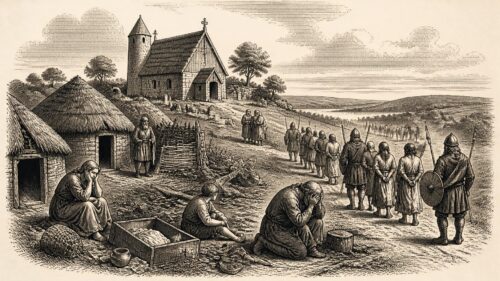
The year’s most vivid act of collective violence was the plundering of Cluain Creamha by men of Bréifne and the Síl Cathail. The Annals of Ulster adds that people were killed there; Chronicon Scotorum likewise records both the plunder and the deaths. This is not a Viking notice. The attackers were Irish forces, drawn from a region on Connacht’s north-eastern frontier and from a Connacht political lineage which had been among Muirgius’s rivals.
Cluain Creamha is usually associated with Clooncraff in modern County Roscommon, though identical or similar Irish place-names caution against treating that identification as beyond doubt. The name means a meadow or pasture of wild garlic. More important than the literal meaning is the first element, cluain, frequently found in the names of ecclesiastical settlements. The annals’ use of orgain, conventionally translated as plundering or devastation, implies more than a clash between armed parties. It signals an assault on a place possessing goods, people and recognised standing.
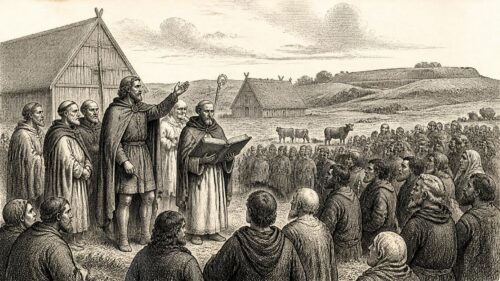
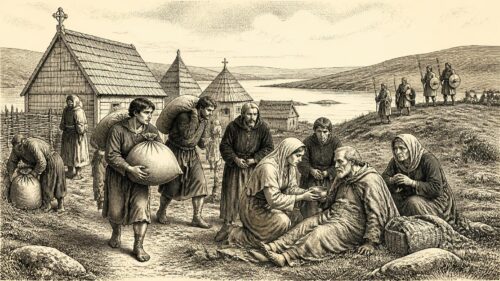
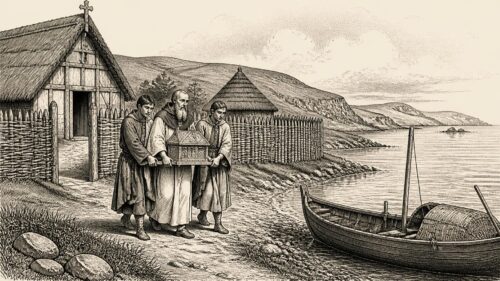
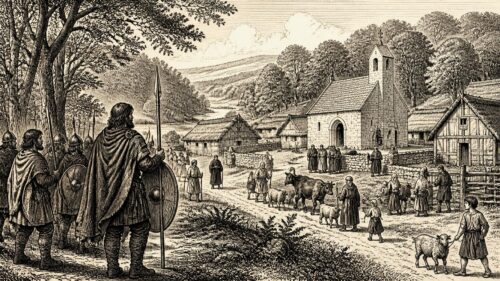
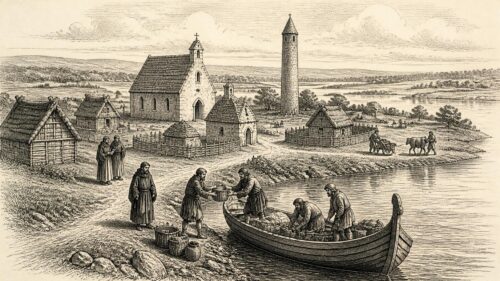
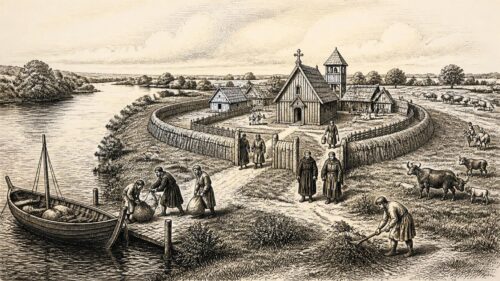
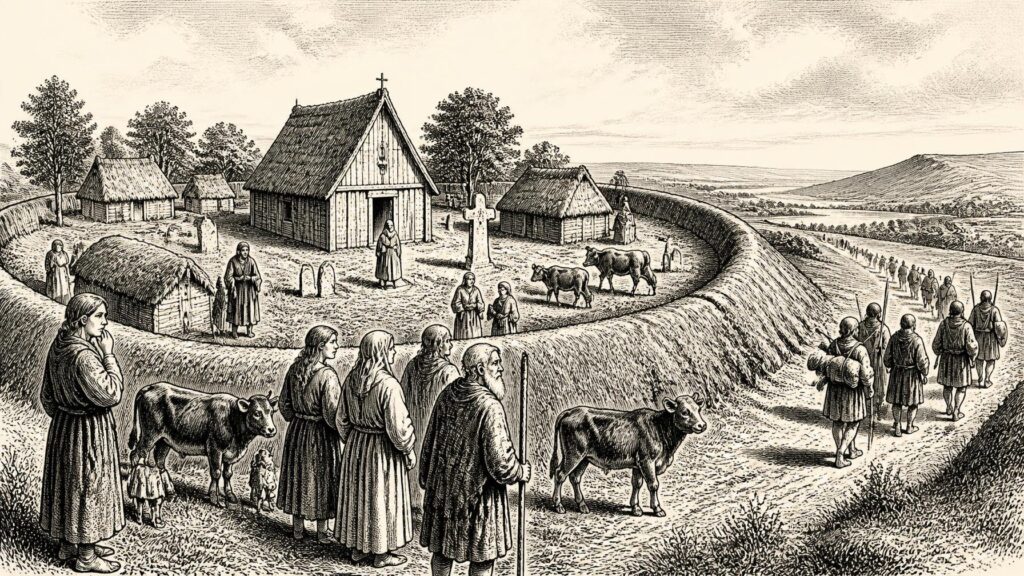
An early medieval Irish church site was rarely an isolated stone chapel inhabited only by clerics. Its enclosure could contain churches, dwellings, storehouses, workshops, burial ground and grazing or cultivated land; people connected with it included clergy, dependants, tenants, labourers and visitors. Cattle, grain, food renders, metalwork, books and other portable wealth could all be at risk in a raid. The annals do not identify the dead at Cluain Creamha, describe buildings destroyed, or say what was carried away. The responsible conclusion is therefore limited but significant: an ecclesiastical community in or near the Connacht–Bréifne zone was attacked, plundered and suffered fatalities in 815.
The choice of target also shows why church and politics cannot be separated too neatly. Religious communities possessed land, labour and symbolic authority. To raid one could enrich a war-band, punish a rival’s clients, demonstrate control over a district and challenge the protection claimed by a saint and his community. The involvement of Síl Cathail, a lineage competing for influence within Connacht, makes the attack especially resonant in the year that Muirgius died. It may reflect the unsettled political world exposed by his death, but the annals do not explicitly state motive, so that connection must remain an informed possibility rather than a fact.
Strain in Brega and the Northern Uí Néill
Political instability was not confined to Connacht. Conall son of Niall, king of southern Brega, died in 815. So too did Fócarta son of Cernach, described as one of the two kings of southern Brega. Their notices offer a rare glimpse of divided kingship: authority in this important region north of the River Liffey could be shared or contested between rulers rather than concentrated in one undisputed king. The annals do not specify whether either death was violent, nor do they name a successor. What they securely show is the removal of two men who held recognised royal rank in the same territory during the same year.
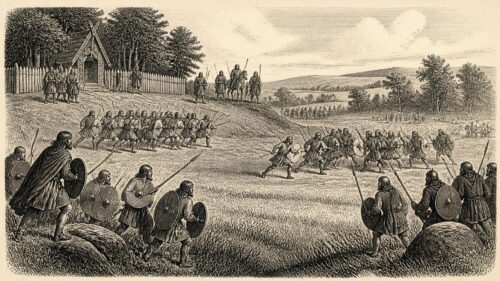
Further north, Colmán son of Niall was killed by the Cenél Conaill. He was a brother of Áed Oirdnide, king of Tara and head of the Cenél nÉogain. Áed responded with a hosting against Cenél Conaill, in which Rogaillnech son of Flaithgus was slain. The wording records an expedition and a death, not a named battle or a comprehensive victory. Even so, it demonstrates the reach expected of a powerful overking: the killing of a close kinsman brought armed retaliation between the two leading northern branches of Uí Néill.
The killing of Coscrach son of Fínnechta is also entered for 815, but without title, place or explanation. It is a useful warning about the annals themselves. Their brevity does not mean an event was unimportant to contemporaries; it means that later readers cannot honestly supply the missing story.
Church Networks Across the Sea
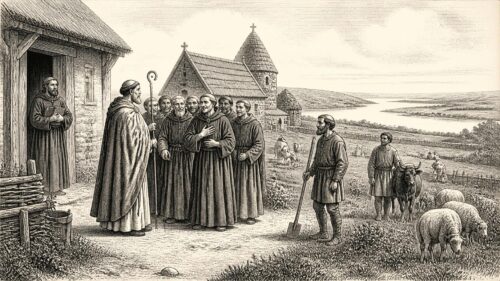
Three ecclesiastical deaths broaden the year beyond warfare. Céile Ísu, abbot of Cell Moinne, died; Máel Cánaig, anchorite of Lugmad, died; and Cellach son of Congal, abbot of Í, also died. Lugmad, modern Louth, was an important church centre in the north-east. Calling Máel Cánaig an anchorite indicates a recognised life of ascetic devotion, but it does not permit us to imagine his daily routine in detail. Anchorites remained part of wider religious and social networks, dependent upon communities for food, protection and commemoration.
Cellach’s death connected Ireland to the monastery of Í, now Iona, off the western coast of Scotland. Iona was geographically outside Ireland but was founded by Colum Cille and belonged to a Columban network whose religious, cultural and political life extended deeply into Ireland. The previous year’s annal reports that Cellach left leadership after the completion of a church at Cenannus, probably Kells, and that Diarmait succeeded him. Yet the 815 notice still styles Cellach abbot, reflecting the weight of his office and the continuing importance of Iona’s institutional memory.
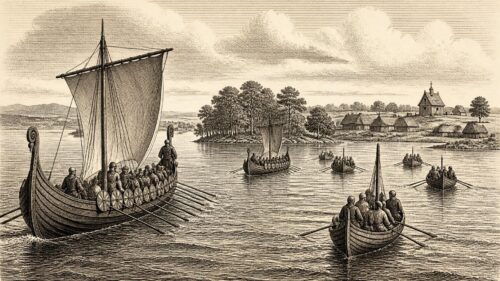
This was a generation living with the consequences of raids on Columban communities. Iona had been attacked in 802 and its community had suffered a devastating killing in 806. Those events should not be transferred carelessly into 815: the principal Irish annals record no new Viking raid in this particular year. Their silence is not proof that every coast was peaceful, but it does distinguish 815 from years in which raiding fleets and burned monasteries are explicitly recorded. The documented violence of this year was chiefly political and local, inflicted by Irish groups upon other Irish communities.
A Narrow but Revealing Record
The record for 815 is fragmentary, yet its fragments are unusually revealing. A dominant Connacht king died; a church settlement was despoiled and people killed; southern Brega lost two rulers; Áed Oirdnide retaliated for the killing of his brother; and churchmen from Louth to Iona passed from the scene. The annals preserve no harvest figures, prices, trading voyages or weather notices for the year, so everyday economic conditions cannot be reconstructed responsibly. What can be seen is a society in which farms, ecclesiastical settlements and royal households depended on networks of allegiance vulnerable to sudden violence. In 815, the death of Muirgius and the plunder of Cluain Creamha made that vulnerability plain.
Primary Sources
- The Annals of Ulster
- The Annals of Ulster: diplomatic edition
- Chronicon Scotorum
- Chronicon Scotorum: diplomatic edition
- Annals of Inisfallen
- Annals of Inisfallen: bibliographical information
- Annals of the Four Masters
- Annals of the Four Masters: diplomatic edition
- Muirgius
- Áed Oirdnide
- Í > Ioua > Iona
- Port nam Mairtir
- The Economy of Early Medieval Ireland
- Early Medieval Dwellings and Settlements in Ireland, AD 400–1100, Volume 1: Text
- Early Medieval Archaeology Project: The Early Medieval Church
- Irish Field Monuments
- Earthen Banks and Broken Walls
- The Place-Names of County Roscommon
- Gastro-Topography: Exploring Food-Related Placenames in Ireland
- Book of Leinster, Formerly Lebar na Núachongbála, Volume 4