Lough Neagh’s Northern Reach839 CE
In 839 Scandinavian raiders operated from Lough Neagh, plundering northern Irish communities and churches, revealing new inland reach though no base can be proven. The annals record burnings at Ferns and Cork, demonstrating violence across Ireland. Ecclesiastical deaths and Armagh’s disputed abbacy show churches remained centres of learning, property and political influence amid disruption. Killings of regional kings and church officials expose fragmented dynastic politics, while Máel Sechnaill’s role at Durrow foreshadowed rising Clann Cholmáin power. Viking destruction of Fortriu in northern Britain heightened the wider maritime threat. Together, these records portray vulnerable yet active societies confronting mobile overseas raiders.
Dateline
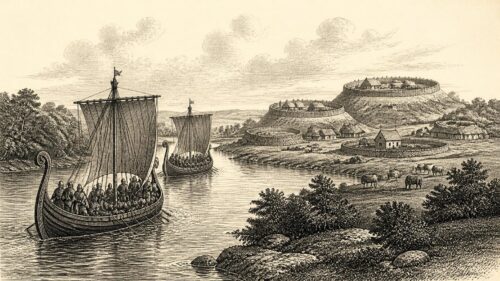
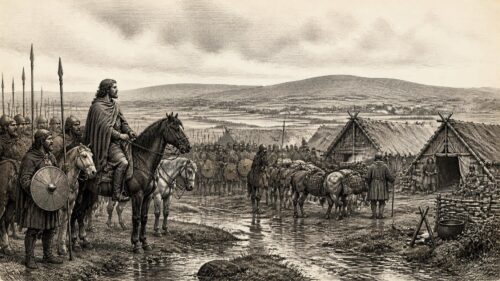
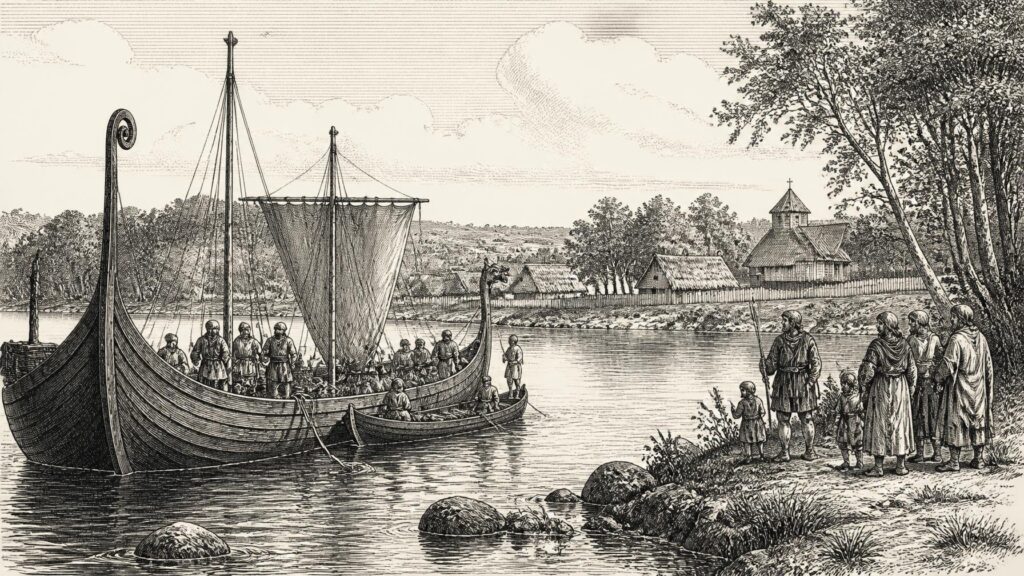
The most consequential Irish record placed in 839 is terse: a party of Gall, the annalists’ term for Scandinavian raiders, was on Loch nEchach—Lough Neagh—and from there plundered the peoples and churches of northern Ireland. The notice in the Annals of Ulster is matched by Chronicon Scotorum. Neither identifies a commander, counts ships, names the individual churches attacked or supplies a season. Yet its choice of location matters greatly. A fleet operating from Ireland’s largest lake had found a commanding inland position, able to menace communities around its shores and beyond. In a year otherwise crowded with local deaths, killings and ecclesiastical changes, Lough Neagh marked an alarming expansion in the reach of seaborne violence.
A Fleet on the Inland Waters
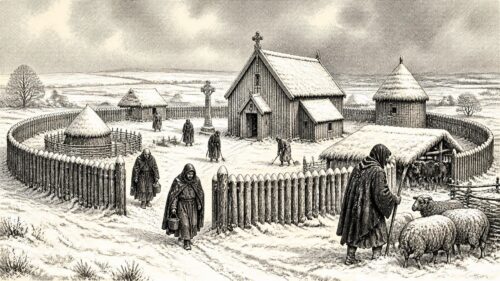
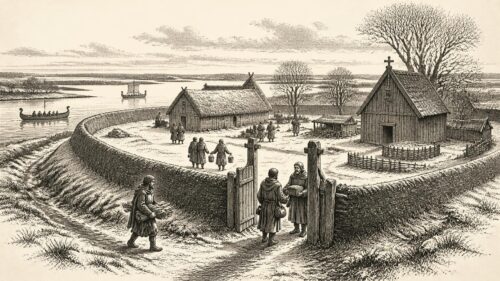
Lough Neagh lay at the heart of the northern provinces, touching territories associated with Ulaid and the powerful northern Uí Néill. It was not an open sea-road, but it connected the raiders to river systems, landing places and overland routes across a densely settled landscape of royal estates, farming communities and churches. The annals’ phrase that the foreigners plundered “states and churches” or “peoples and churches” is important. It presents the attack not simply as a strike against portable ecclesiastical treasure, but as a threat to the political communities—tuatha—whose rulers, clients, clerics and cultivators sustained one another.
That does not entitle us to imagine a permanent Scandinavian town at Lough Neagh in 839. The contemporary wording says only that a raiding force was on the lake. Later entries show the same zone remaining a focus of activity in 840 and 841, and historians have accordingly treated the episode as an early stage in the development of more sustained Viking bases. But “base”, “camp” and especially longphort should be used cautiously for 839 itself. The evidence securely establishes a fleet using Lough Neagh as an operational centre; its precise anchorage, defences and duration during this first recorded year remain unknown.
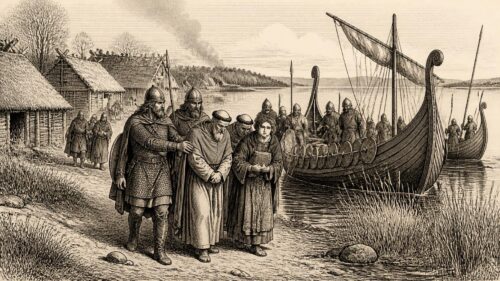
The immediate human consequences can nevertheless be understood in broad outline. Churches held livestock, food renders, metalwork, books, relics and skilled personnel; they were also places of worship, hospitality, education and local authority. A raid could therefore interrupt harvest storage, travel, religious observance and the exchange of protection and tribute between kings and ecclesiastical communities. Raiding parties also needed supplies, guides or captives, so the distinction between an attack on a monastery and an attack on its surrounding population was rarely neat. The annalists’ compressed language preserves precisely that wider disruption, while withholding the individual stories.
Churches Under Pressure
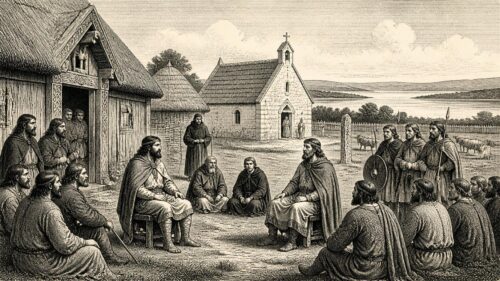
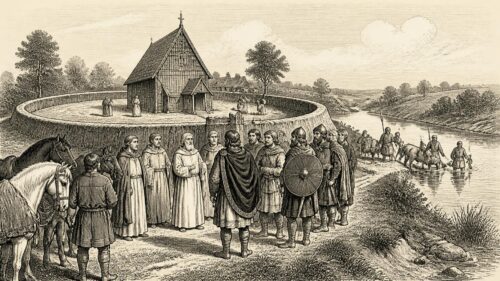
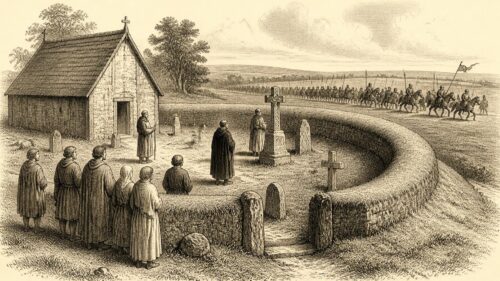
The church was not a detached victim standing outside politics. In 839 religious houses were major institutions embedded in dynastic society, and their heads could be scribes, landholders, negotiators and figures of regional influence. The Annals of Ulster records the death of Máel Gaimrid, described with unusual warmth as an excellent scribe, anchorite and abbot of Bangor. Bangor, on Belfast Lough, stood within the northern world endangered by the activity on Lough Neagh. The juxtaposition is not evidence that he died because of raiding; the annal makes no such claim. It does, however, show what was at stake in places exposed to the new pressure: learned communities depended upon people whose authority combined prayer, literacy and administration.
Other ecclesiastical deaths entered under the year reveal the geographical spread of these networks. Colmán, abbot of Slane; Aedán, abbot of Roscrea; Cormac, superior of Treóit; and Máel Ruanaid, prior of Lusk, all died, according to the Ulster annalist. These notices should not be read as a roll-call of a single epidemic or crisis, for no cause is supplied and the houses lay far apart. Rather, their appearance demonstrates the annals’ concern with the succession of churchmen across Ireland. A later compilation, the Annals of the Four Masters, adds further clerical deaths and gives 6 December for Berichtir of Tullach Léis. Such precise notices are reminders that, amid warfare, communities continued to organise worship, education, property and leadership.
Armagh, the foremost church of Patrick, experienced a recorded change of abbots: Diarmait, grandson of Tigernach, replaced Forannán of Ráith Meic Malais. The formula might suggest an uncomplicated succession, but wider evidence shows that the two men were rivals within Armagh’s leadership. Forannán was not erased from the institution’s history: later sources treat him and Diarmait as joint abbots. The 839 entry is best understood as a moment in an unsettled contest for authority, not proof that the community had quietly resolved all differences. Armagh’s internal politics mattered beyond its enclosure, because control of Patrick’s church brought prestige, connections and claims upon a wide ecclesiastical following.
Killings and Kingship
Violence within Irish political society was as visible in the annals as violence from overseas. Cumascach son of Congalach, king of the Cianachta, died. Muiredach son of Echaid, identified in Chronicon Scotorum as king of Ulaid, was killed by his own kinsmen, Áed and Óengus, with others involved. Cennétig son of Congalach, king of Uí Moccu Uais in Brega, was deceitfully killed by a kinsman named Céile. Such entries reveal no unified Irish state capable of responding automatically to a northern fleet. Kingship was distributed among many dynasties, and kinship supplied both the language of legitimacy and the immediate pool of rivals.
A further killing joined ecclesiastical administration to the politics of Mide. Crunnmael son of Fiannamail, steward of Durrow—Dairmag—was killed by Máel Sechnaill son of Máel Ruanaid. A steward managed resources in one of Ireland’s great Columban churches; his death was therefore not a minor household matter. Máel Sechnaill was still a prince rather than king of Tara in 839, but he belonged to Clann Cholmáin, the dominant Southern Uí Néill dynasty in Mide, and would become one of the century’s most formidable rulers. The entry offers a sharp glimpse of how local coercion, dynastic ambition and church wealth could overlap.
Above these regional struggles stood Niall Caille of Cenél nÉogain, king of Tara in modern historical terminology and a leading northern Uí Néill ruler. The surviving contemporary annals do not assign him a specific action in 839. The much later Annals of the Four Masters, under its year 839, attributes the plundering of Fir Chell and Delbna Ethra to Niall. Because that compilation’s chronology and selection do not always correspond exactly with the nearer annals, the incursion should not be presented as firmly dated evidence for this calendar year. It is safer to say that Niall’s kingship formed the political setting for the northern emergency: Lough Neagh lay close to the wider sphere in which he claimed pre-eminence, while rival local rulers retained real power.
Fires at Ferns and Cork
The annals also state that the heathens burned Ferna and Corcach: Ferns in Leinster and Cork in the south. Both the Annals of Ulster and Chronicon Scotorum place the burnings with the material for 839. The brief wording does not prove that the attackers were the same force recorded at Lough Neagh, nor does it establish a single island-wide campaign planned by one leader. It does establish that Scandinavian violence was felt in sharply different parts of Ireland during the year. Ferns had long been a major ecclesiastical and royal centre in the south-east; Cork was an important church settlement on the southern coast. Their burning showed that sea-borne raiders could strike communities distant from the northern lake.
The pattern is significant because it resists a simple story of helpless monasteries and foreign invaders. Irish rulers continued their own raids, murders and contests for succession; churches remained active centres of landholding and learning; and Scandinavian groups were mobile opponents rather than a single, unified army. Still, 839 represents a threshold in the northern record. Lough Neagh gave a raiding force access to an inland theatre where political communities and church settlements were closely interwoven. Subsequent years would make the danger more persistent, but the annal for 839 captures the moment when that possibility became unmistakable.
An Irish Sea Shockwave
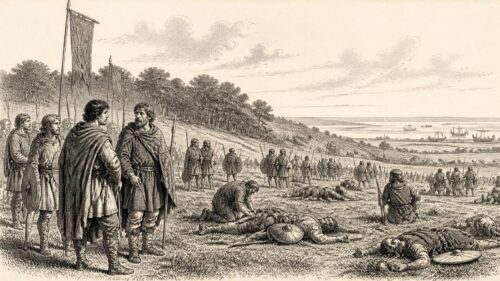
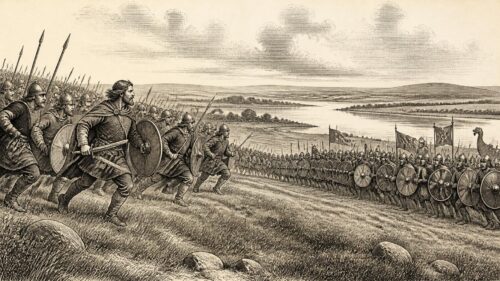
The same Ulster annal records a devastating Viking victory over the men of Fortriu in northern Britain, in which Eóganán son of Óengus, Bran son of Óengus, Áed son of Boanta and “others almost innumerable” fell. This was not an event in Ireland, but it belongs to Irish history’s immediate maritime setting. The Irish Sea and western Scottish waters connected monasteries, royal dynasties, traders and raiders. News of the collapse of leading Pictish and Dál Riata figures would have underscored that the danger was not local or temporary. It also cautions against trying to identify every raiding party in Ireland with certainty: forces moved through a wider archipelagic world, while the sources seldom provide names.
For ordinary people in 839, the year’s historical reality was experienced less through annalistic labels than through disrupted obligations: a ruler slain, an abbot replaced, a church community bereaved, stores taken, buildings burned, or a fleet reported on nearby water. The sources preserve those experiences unevenly, chiefly when they touched kings and religious institutions. They do not permit a detailed reconstruction of every household or raid. Yet they clearly show an Ireland in which local political fragmentation persisted even as overseas raiders gained the capacity to reach farther inland. Lough Neagh was therefore not merely a place-name in a chronicle. In 839 it became a warning that northern Ireland’s waterways could be turned against the communities living beside them.
Primary Sources
- The Annals of Ulster: Year U839
- The Annals of Ulster
- Chronicon Scotorum
- Chronicon Scotorum: Irish text and editorial introduction
- Annals of the Four Masters
- Annals of the Four Masters: Annal M839 in Irish
- Annals of Inisfallen
- Vikings in Irish Chronicles, 794–902: Data
- Vikings in Irish Chronicles, 794–902: Introduction
- The Vikings in Ninth-Century Ireland: Sources and Settlements
- The Vikings in Ninth-Century Ireland: Sources and Settlements (full text)
- The Vikings in Ulaid
- Vikings’ Settlements in Ireland Before 1014
- Niall Caille
- Niall mac Áeda [Niall Caille]: king of Ailech and high-king of Ireland
- Forannán
- Máel-Sechnaill
- Fedelmid (Feidlimid)
- Early Christian Sites
- County Louth Urban Archaeology Survey
- The Vikings
- Vikings in Ireland and Scotland