Clonfert’s Royal Claim838 CE
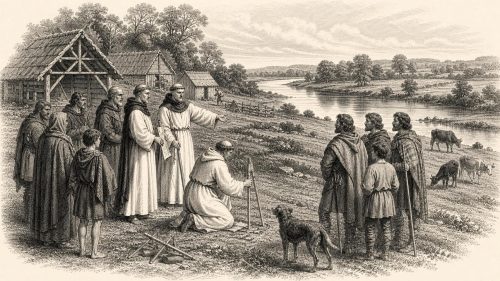
In 838, Feidlimid mac Crimthainn of Munster and Niall Caille of Tara confronted competing claims to supremacy at a royal conference remembered differently by the Annals of Ulster and Inisfallen. Ulster records an inconclusive meeting at Cloncurry; Inisfallen claims Niall submitted at Clonfert, making Feidlimid king of Ireland. Historians reject any settled all-Ireland outcome. Leinster’s succession was unsettled after King Bran’s death, while Connacht suffered a Viking defeat. Scandinavian raiders used Lough Neagh to plunder northern territories and churches, and burned Ferns and Cork. Annals also record clerical continuity and local killings, revealing an increasingly connected, contested, insecure Irish society.
Dateline
In 838, Ireland’s political landscape was shaped by two linked realities: the fierce competition of Irish rulers for precedence, and the growing ability of Scandinavian raiders to use waterways as routes into the island’s richest and most vulnerable regions. The year’s most revealing episode was not a battle but a disputed royal gathering. It brought together Feidlimid mac Crimthainn, king of Munster, and Niall Caille, king of Tara and leader of the northern Uí Néill. Yet the surviving annals do not agree on where it took place, or on what it achieved. That disagreement is itself important. It shows that royal authority in ninth-century Ireland was negotiated, performed and remembered differently in different political communities.
A Meeting with Two Accounts
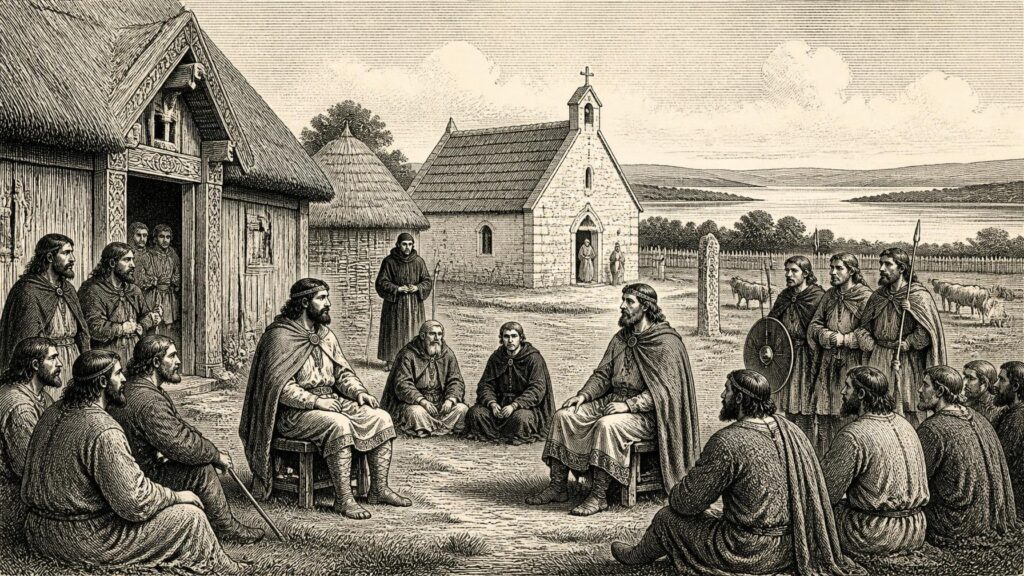
The Annals of Ulster record a “great royal conference” between Feidlimid and Niall at Cluain Chonaire Tómáin, generally identified with Cloncurry in north County Kildare. Their entry gives no outcome. In contrast, the Munster-centred Annals of Inisfallen place a great assembly of the men of Ireland at Cluain Ferta Brénainn, Clonfert in modern County Galway. Its claim is striking: Niall, described as king of Tara, submitted to Feidlimid; Feidlimid thereby became “full king of Ireland” and occupied Clonfert’s abbot’s chair.
Neither account can simply be treated as a neutral report. The difference in venue is substantial: Cloncurry lay on the Leinster–Mide borderland, while Clonfert stood in Connacht, within the northern half of Ireland conventionally called Leth Cuinn. The difference in result is greater still. Ulster reports a meeting; Inisfallen records a triumph. Modern historians therefore treat the claim of Niall’s submission with caution, while accepting that a significant encounter between the two rulers belongs to this period. The safest conclusion is that Feidlimid and Niall met, or that competing traditions remembered a major royal assembly in 838, but that no uncontested all-Ireland settlement emerged from it.
That restraint matters because Ireland was not a unitary kingdom. “King of Ireland” was an aspiration and a language of superiority, not an office backed by a permanent central administration. Kings exercised power through personal progress, armed followings, hostages, client rulers, ecclesiastical alliances and control of prestigious inauguration or assembly places. A rígdál, or royal conference, could settle a boundary, recognise a hierarchy, arrange peace or merely postpone a confrontation. The silence of the Ulster annalist about submission may indicate that its northern political world did not accept Feidlimid’s claim. Events soon showed that the rivalry remained unresolved.
Feidlimid and Niall
Feidlimid had ruled Munster since 820 and had combined royal ambition with unusually close involvement in church affairs. He had acquired or intervened in leading ecclesiastical houses, including Cork, and had campaigned beyond Munster into Leinster and the midlands. His activity made him the most formidable southern challenger to Uí Néill predominance in a generation. His clerical associations did not make him politically passive. In Ireland’s great churches, abbots, bishops, scribes, tenants, land and relics were bound into the same world of patronage and power as kingship.
Niall Caille, son of the former king of Tara Áed Oirdnide, represented Cenél nÉogain of the northern Uí Néill. His authority rested especially in the north, but Tara’s traditional prestige enabled him to claim a wider primacy. The conference brought these two claims face to face. It also placed Leinster in the middle. Feidlimid had cultivated allies there, while Niall had intervened in Leinster’s kingship. For both rulers, influence over Leinster was a practical question of routes, tribute and military access as well as a symbolic test of who could command the southern half of the island.
The annals associated with this moment also record the death of Bran son of Fáelán, king of Leinster. His death did not automatically decide the provincial succession: Leinster’s leading dynasties shared and contested kingship, while stronger neighbours sought clients among them. It nevertheless removed a ruler whose position had been shaped by Niall’s earlier intervention. In the same broadly dated annalistic sequence, Connacht suffered a defeat by the “heathens”, in which Máel Dúin son of Muirgius and many others were killed. The entry is terse, but its implications are not. Regional kings and their kindreds could be struck hard by mobile seaborne forces at precisely the moment when Irish overkings were preoccupied with one another.
Raiders on Lough Neagh
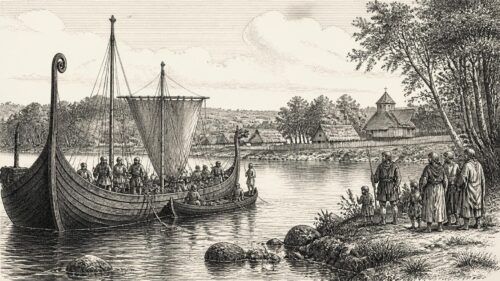
For the calendar year 838, the Annals of Ulster provide unusually clear evidence of Viking mobility in the north. A raiding force was on Loch nEchach, Lough Neagh, and from there plundered the territories and churches of northern Ireland. This was more than a coastal incursion. Lough Neagh connected raiders to the Bann system and to the political heartlands of Ulaid and the northern Uí Néill. Its shores and tributaries offered access to settlements, churches, food supplies and captives, while the lake itself could provide a protected operational base.
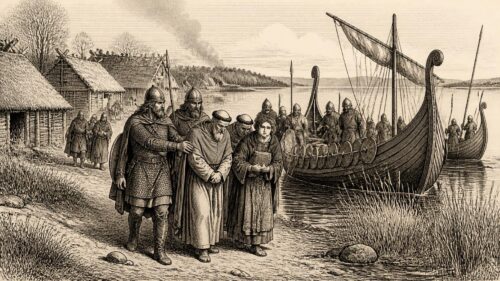
The annalist’s wording joins secular territories and churches as targets. That reflects the structure of early medieval Irish society. Major churches were not isolated retreats. They were landholders and places of worship, but also centres of learning, craft production, agricultural management, hospitality and lordship. Their communities included clergy, tenants, workers and dependants. To plunder such a place could mean taking livestock, food, metalwork, books or captives; it could also disrupt a local network of rents, obligations and protection. The record does not tell us which northern churches were attacked in 838, and it would be wrong to supply names. It does make clear, however, that the raids reached beyond a single shoreline or monastery.
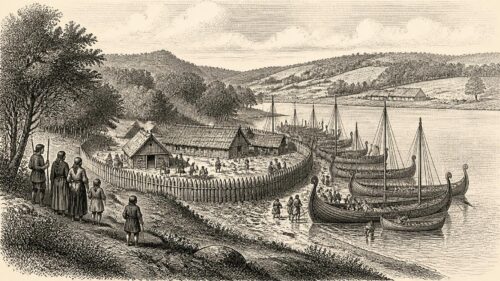
The presence on Lough Neagh belongs to a wider change visible across the later 830s. Scandinavian groups had already demonstrated that fleets could move along the Boyne, Liffey, Shannon and Erne systems. The following years would bring more explicit references to wintering and naval encampments. In 838, one should not project the later towns of Dublin, Waterford or Limerick backwards as if they already dominated Irish commerce. But the year does show the practical foundations for a more enduring Scandinavian involvement: knowledge of rivers and lakes, repeated access to provisions, and the capacity to raid inland political and ecclesiastical centres.
Ferna and Cork Burned
The same Ulster annal for 838 records that Ferna and Corcach were burned by heathens. Ferna, modern Ferns in County Wexford, was an important Leinster church; Corcach was Cork, then centred on a major ecclesiastical foundation rather than the later medieval city. The bald wording does not allow a reconstruction of the attacks: it does not identify the raiders, state whether they came by river or sea, name casualties, or describe the buildings destroyed. Still, the paired notice makes the geographic reach of Scandinavian violence unmistakable, extending from the south-east to Munster’s south coast.
Burning was devastating in a landscape where many domestic, agricultural and ecclesiastical structures were substantially timber-built, with roofs of organic materials. Yet “burned” should not be mistaken for permanent extinction. A church community was made up of people, claims to land, sacred associations and networks of patronage as well as buildings. Communities could rebuild, move valuables, seek protection from kings, and record their losses. Cork’s importance as a church was not ended by the raid; indeed, its vulnerability and recovery help explain why powerful kings such as Feidlimid sought influence there.
These raids also caution against a simple story in which foreign attackers alone made Ireland violent. Irish rulers regularly ravaged rivals’ lands and sometimes attacked churches when they were associated with opponents. Feidlimid himself had a record of forceful intervention against ecclesiastical communities. What distinguished the Scandinavian threat in 838 was its maritime reach and its ability to exploit waterways across several regions. The result was added insecurity for local populations already living amid dynastic rivalry, tribute demands and seasonal warfare.
Church, Learning and Local Continuity
Despite the drama of raids and royal claims, the annals also preserve quieter evidence of institutional continuity. They record the deaths of clerics such as Máel Gaimrid, described as an excellent scribe, anchorite and abbot of Bangor, and several church superiors connected with Slane, Roscrea, Trevit and Lusk. Such notices are selective rather than a complete record of Irish religious life. Even so, the titles reveal a dense landscape of communities in which scholarship, ascetic practice, administration and pastoral leadership overlapped.
The deaths and killings of secular figures in Brega and the midlands likewise show the scale on which politics normally operated. Cumascach, king of the Cianachta, died; Muiredach son of Echaid was killed by kinsmen; Cennétig of Uí Moccu Uais was deceitfully killed by a relative; and Crunnmáel, steward of Durrow, was killed by Máel Sechnaill son of Máel Ruanaid. Such entries do not describe an island collapsing into chaos. They show a political order in which kinship both secured and endangered power, and where control of a church office could matter in struggles among ruling families.
For ordinary people, the year’s pressures would have been felt locally: the loss or concealment of cattle, demands for food from travelling retinues, disruption of harvest and transport, fear along navigable waters, and the obligation to sustain churches and kings. Most households did not appear in the annals. Their labour nevertheless underpinned every royal conference, monastery and raiding expedition recorded there.
An Unsettled Balance
838 did not establish Feidlimid as an accepted ruler of all Ireland, whatever the proud wording of the Annals of Inisfallen. Nor did it end Niall Caille’s authority. The meeting remembered at Cloncurry or Clonfert was a moment of high political theatre in which two powerful kings tested one another’s standing. At the same time, raids from Lough Neagh and burnings at Ferns and Cork showed that the island’s established political order faced a challenge that no single conference could resolve.
The year is therefore best understood not as a decisive settlement, but as a revealing pause: a contested claim to island-wide kingship, regional succession under pressure, and Scandinavian forces learning how effectively Ireland’s rivers, lakes and church-centred settlements could be used. The records disagree about who won the royal encounter. They do not disagree that Ireland in 838 was becoming a more connected, more contested and more dangerous place.
Primary Sources
- The Annals of Ulster
- Annals of Inisfallen
- Chronicon Scotorum
- Vikings in Irish Chronicles, 794–902: Data
- Vikings in Irish Chronicles, 794–902: Introduction
- Fedelmid (Feidlimid), Dictionary of Irish Biography
- Niall Caille, Dictionary of Irish Biography
- The Vikings in Ninth-Century Ireland: Sources and Settlements
- The Vikings in Ulaid
- Vikings in Early Medieval Ireland: Church-Raiding, Politics and Kingship
- Vikings in Ireland and Scotland
- The History and Topography of Viking Cork
- The Chronology and Sources of the Early Irish Annals
- The Annals of Tigernach
- Translated Texts at CELT
- County Kildare Urban Archaeological Survey
- Cork City Urban Archaeological Survey
- Patrician and Early Christian Architecture
- Early Christian Monasteries
- The Origin and History of Irish Names of Places
- Waterways Corridor Study: Appendix 2 Cultural Heritage