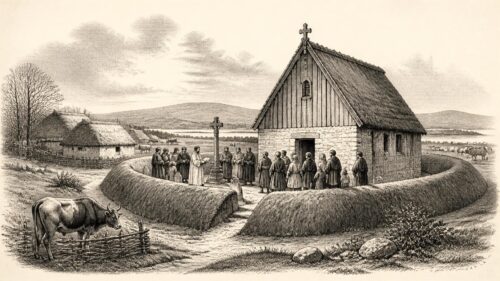
Cathan and the April Snow854 CE
In 854, Irish annals recorded the death of Cathan, abbess of Kildare, highlighting the influence of major ecclesiastical communities and female leadership. Exceptional snow fell on 23 April, probably disrupting travel, livestock care and spring farming, though no famine was reported. Áed son of Niall raided Ulaid, killing prominent opponents and many others, while Fínnechta was treacherously killed and Muiredach of Ard Cianachta died. Abbots at Monasterboice, Achad Bó and Inis Cáín Dega were also commemorated, including one who drowned. These local events reveal an Ireland shaped by regional conflict, church continuity, hazardous travel and unusual weather, amid Scandinavian influence.
Dateline
The surviving record for 854 is brief, but it is unusually revealing. It brings together the death of Cathan, abbess of Kildare; a remarkable late snowfall on 23 April; a northern raid by Áed son of Niall; killings within élite kindreds; and the deaths of churchmen and a local king. None is a grand, island-wide turning point. Taken together, however, they show how political power, religious institutions and the hazards of season shaped life in ninth-century Ireland.
Dating a Sparse Year
The chronology requires care. In the modern edition of the Annals of Ulster, the entries conventionally numbered U855 are explicitly assigned to AD 854. Chronicon Scotorum, another Irish annalistic compilation, places several of the same notices beneath its own heading for 855. This is not evidence for two separate years of events, but a reminder that medieval annals preserve different chronological systems. The following account therefore treats the Ulster annals’ corrected AD 854 attribution as the firm calendar framework, while noting where parallel records differ.
This caution matters because some dramatic happenings sometimes associated with “854” in later compilations — the freezing of lakes and rivers, the burning of the oratory at Lusk, and warfare involving Norse-Irish forces — belong to AD 855 or 856 in the corrected annalistic sequence, not securely to 854. They should not be drawn into this year merely because a later chronicle’s numbering happens to differ.
Cathan’s Kildare
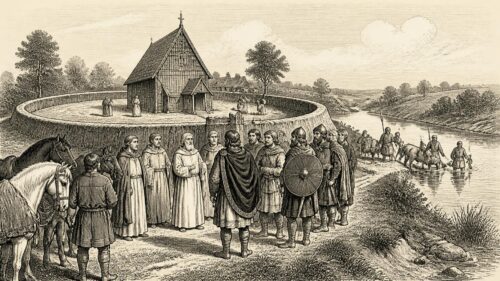
The year opens in the annals with the death of Cathan, abbess of Cell Dara, Kildare. Chronicon Scotorum calls her Catrian, probably a variant form of the same name. Nothing reliable is recorded of her family, age or individual acts, and it would be wrong to manufacture a biography from the bare notice. Her office itself, however, tells us much about the standing of Kildare.
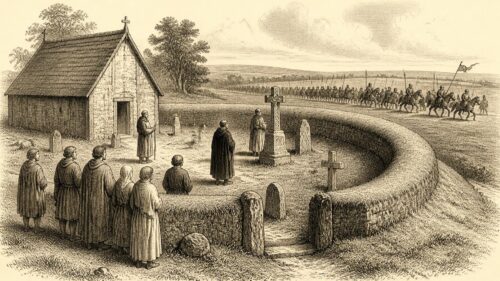
Kildare was among Ireland’s foremost ecclesiastical centres, associated with Brigit and deeply embedded in the political landscape of Leinster. It was no secluded house of prayer in the modern sense. Like other major Irish churches, it was a community with clergy, dependants, land and patrons; its leaders had religious authority and social weight. Earlier tradition represented Kildare as a community of women and men, while the continued recording of its abbesses demonstrates the prominence retained by female leadership. Cathan’s death was therefore important enough to enter a record otherwise highly selective about whom it commemorated.
The notice also hints at the institutional continuity on which Irish society depended. Kings could be killed in raids or treacherous attacks; an abbess’s death required the community to secure a successor, preserve its claims and maintain worship, hospitality and the management of its resources. The annals do not name Cathan’s successor, nor describe any dispute. Silence is not proof that succession was effortless, only that no crisis was chosen for record.
Snow After Easter
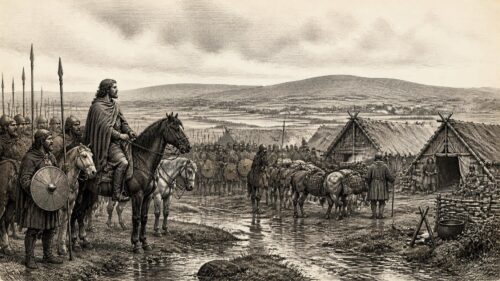
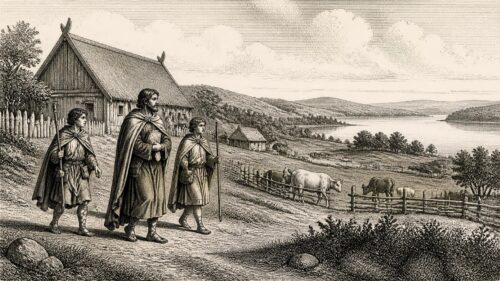
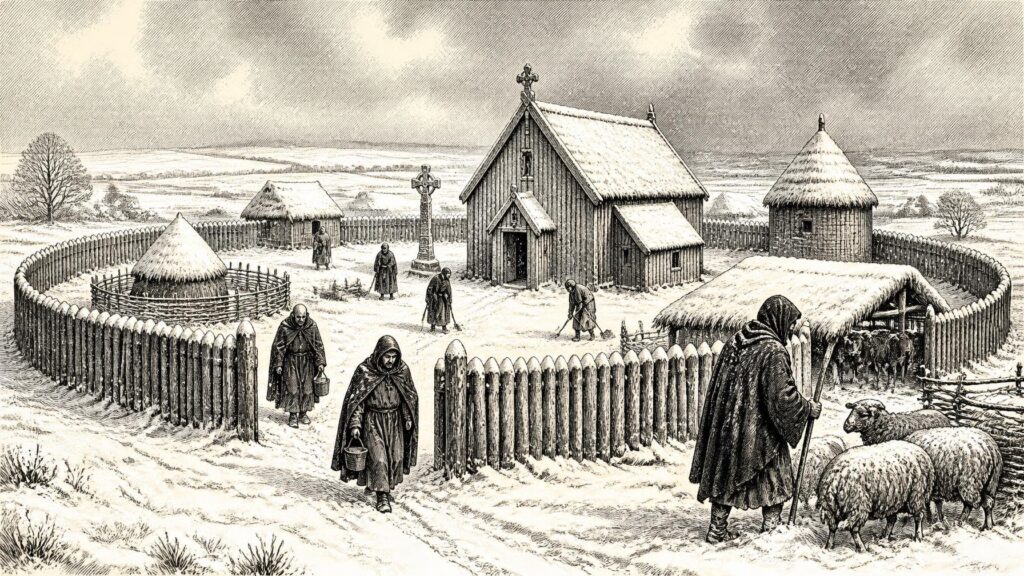
One event is dated with striking precision. On 23 April, the ninth day before the Kalends of May, snow lay to the height of men’s belts. The annalist’s formula conveys exceptional depth rather than a measured meteorological observation, but there is no reason to dismiss the report of a severe late-spring fall. In an overwhelmingly rural society, weather at this point in the agricultural calendar mattered acutely.
Livestock required fodder and shelter after winter stores would have been running down; movement along roads and tracks became more difficult; and spring work could be delayed. Yet the annals do not record crop failure, famine or mass mortality for 854. The responsible conclusion is narrower: people across at least the recorder’s horizon encountered an extraordinary cold-weather episode late in the season, while its local consequences remain unrecorded. The entry survives precisely because the weather was memorable enough to break the usual annalistic concentration on rulers and churchmen.
Áed’s Foray into Ulaid
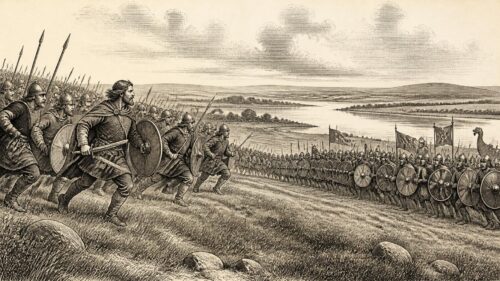
Conflict nevertheless remained the principal language of secular politics. Áed son of Niall made a foray against Ulaid, the group of kingdoms occupying much of the north-east. The annals say that he left Coinnecán son of Colmán, Flaithbertach son of Niall, and “a large number besides” dead. They do not identify the battlefield, state the immediate cause, or say whether Áed took cattle, captives or tribute. A foray could pursue any combination of intimidation, vengeance and political advantage; the text permits no more specific reconstruction.
Áed belonged to the northern Uí Néill world centred on Ailech and is generally identified with Áed Findliath, later a dominant claimant to the kingship of Tara. In 854, though, the annal gives no royal style and presents a hard fact rather than a royal programme: he led violence into Ulaid and his opponents suffered heavy losses. The named dead demonstrate that this was not a random skirmish. Kinship and rank structured warfare, and killing prominent men could reshape local alliances as surely as the destruction of a fort.
Other notices reinforce the impression of insecurity within the political class. Fínnechta, son of Máel Brigte, was “treacherously killed”. The phrase offers no setting or motive, but it distinguishes betrayal from an open encounter and suggests the dangers of factional politics. Muiredach, king of Ard Cianachta in the Boyne region, also died. Whether his death altered regional power cannot be recovered from the entry; it does show that even minor kingships were part of the annalists’ political map.
Churches, Waterways and Memory
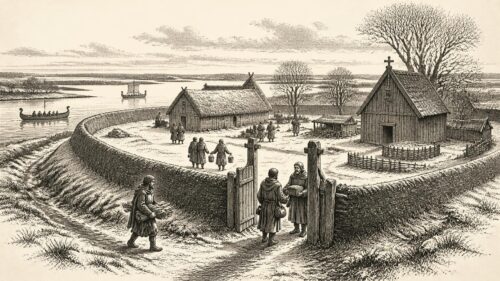
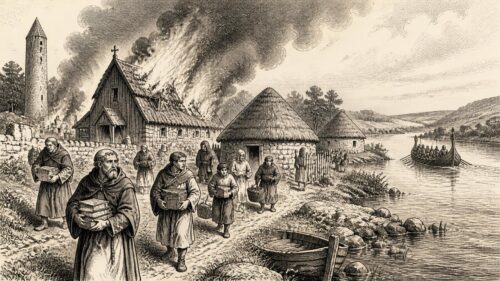
Several ecclesiastical deaths were recorded alongside Cathan’s. Ruidgus son of Maicnia, abbot of Mainister Buiti, Monasterboice, drowned. Ailill, abbot of Achad Bó, died, as did Robartach, abbot of Inis Cáín Dega and a scribe. These compact notices do not describe monasteries as places apart from society. They were centres of devotion, learning, lordship and production, connected by roads, rivers and sea routes. Ruidgus’s drowning is a small but tangible reminder that water travel and river crossings were ordinary necessities as well as risks.
Monasterboice, in what is now County Louth, was already an important church associated with St Buithe; its later stone monuments should not be projected unchanged into 854, but its prominence as an ecclesiastical centre has deep early-medieval roots. Likewise, the titles of abbot and scribe indicate offices within organised communities capable of maintaining books, schools and remembered succession. The annals preserve names principally at the point of death, but their survival is itself evidence of institutions that valued written commemoration.
A Wider, Unsettled Horizon
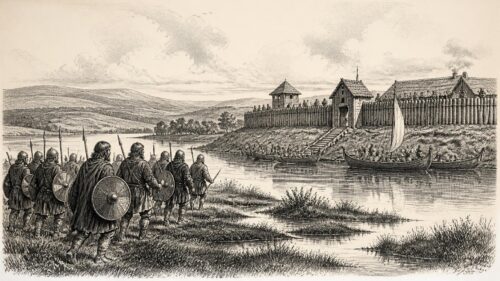
These Irish events unfolded amid a changing Irish Sea world. In 853, Óláfr, son of the king of Laithlind, had arrived in Ireland and received the submission of Scandinavian groups already present, while tribute was taken from Gaels. That firmly dated development belongs to the preceding year, but it explains why 854 cannot be treated as politically insulated from Viking power. Scandinavian bases and mobile war-bands had become factors in Irish calculations, not simply seasonal raiders appearing from beyond the horizon.
A later and more literary source, the Fragmentary Annals of Ireland, places a diplomatic episode in 854: a “Norwegian king” accepted Máel Sechnaill’s invitation to a feast and oath, then allegedly plundered his territories after leaving. The account is valuable as evidence for how later annalistic tradition understood relations between Irish rulers and Scandinavian leaders, but it names neither the king nor the place and lacks confirmation in the contemporary-style annal entries. It should therefore be treated as possible 854 context, not as a securely dated fact on the level of the April snow or Áed’s raid.
The same restraint applies to claims that 854 witnessed a decisive Viking assault, a national war, or a comprehensive political settlement. The corrected contemporary annals do not support them. What they show is a society in which powerful churches marked leadership through abbesses and abbots; regional rulers pursued advantage through raids; waterways linked communities but could kill; and unusual weather could force its way into the historical record.
An Ireland of Local Powers
854 was thus a year of local but consequential pressures. Cathan’s death mattered at Kildare; deep snow mattered to households facing the demands of spring; Áed’s raid mattered in Ulaid; and the deaths of church leaders mattered to communities whose lands, learning and worship depended upon continuity. Ireland was not a single administered kingdom, and its history cannot be measured only by island-wide campaigns. This sparse record preserves a more intimate truth: political violence, ecclesiastical succession and the natural world were intertwined in the everyday fabric of ninth-century life.
Primary Sources
- The Annals of Ulster, U855 (AD 854)
- The Annals of Ulster, U854 (AD 853)
- The Annals of Ulster, U856 (AD 855)
- The Annals of Ulster: Background Details and Bibliographic Information
- Chronicon Scotorum, CS854–CS857
- Chronicon Scotorum, CS855–CS856
- Chronicon Scotorum: Introduction and Manuscript Context
- Fragmentary Annals of Ireland, FA 242–246
- Fragmentary Annals of Ireland
- Annals of the Kingdom of Ireland by the Four Masters
- Vikings in Irish Chronicles, 794–902: Data
- Vikings in Ireland and Scotland
- The Vikings in Ninth-Century Ireland: Sources and Settlements
- County Kildare Urban Archaeology Survey
- Monasterboice, County Louth
- Theme and Variations: Christianity and Regional Landscapes in Early Medieval Ireland
- How Did Early Church Sites Differ from One Another? A Comparative Approach Within the Kingdom of Fir Maige, Ireland
- Monasticism and Its Limits: Rematerialising Monastic Space in Early Medieval Ireland
- Technological Change in the Agrarian Economy of Early Medieval Ireland: New Archaeological Evidence for the Introduction of the Coulter Plough
- Land Tenure and Farming in Early Medieval Kerry: A Survey of Field Systems in the Lough Currane Basin
- The Vikings in Ulaid