Mungret’s Burned Churches835 CE
In annalistic 835, Ireland experienced intertwined political, ecclesiastical and military pressures. Niall Caille, northern Uí Néill ruler, installed Bran son of Fáelán in Leinster and devastated Mide, asserting northern influence against rival powers. Deaths of regional kings and churchmen reflected widespread instability. Foreign raiders plundered Ferns, Clonmore and Druim Ing, while burning Mungret and other western Munster churches, exposing wealthy religious centres. On 6 March, one third of Clonmacnoise burned, though its cause remains unknown. Forannán succeeded Diarmait as abbot of Armagh. Fragmentary annals reveal communities whose political authority, resources and security were vulnerable to violence throughout the island alike.
Dateline
In the annalistic year conventionally placed in 835, Ireland saw pressures from several directions at once: the reach of a northern Uí Néill king into Leinster and Mide, violence against important ecclesiastical settlements, a change of leadership at Armagh, and a sequence of deaths among kings and churchmen. The record is brief, local and sometimes difficult to align perfectly with modern calendar years. Nevertheless, the entries headed 835 in the Annals of Ulster and Chronicon Scotorum preserve a coherent picture of a politically divided island in which churches were vital religious communities, economic centres and prizes of war.
Reading a Difficult Year
A warning is needed before the events themselves. Irish annals were compiled through a succession of manuscripts and chronological systems. Their year-headings do not always correspond neatly with a modern 1 January–31 December calendar, and later chronicles sometimes placed an event under a different year from the earlier annals. This account therefore treats as securely relevant those occurrences entered under 835 in the principal annals, while avoiding the common mistake of importing better-known attacks on Kildare, Glendalough and Connacht which the Annals of Ulster assign to the following annalistic year. The one precise date in the surviving 835 Ulster notice is 6 March, but even it requires care: the annalist records a fire at Clonmacnoise without naming those responsible.
The entries also reflect the interests of literate ecclesiastical centres. They do not offer a census of hardship or an impartial national chronicle. They preserve what communities considered worth recording: royal expeditions, deaths of office-holders, attacks on churches, fires and changes in senior ecclesiastical office. Silence about a place does not mean peace there; it means only that no surviving annal notice has reached us.
Niall Caille’s Southern Intervention
The most consequential political action recorded for the year was undertaken by Niall Caille, ruler of the northern Uí Néill and king of Tara in the language of later historians. He led an army into Leinster and “set up” Bran son of Fáelán as king over the Leinstermen. This was not an election in a modern sense. Kingship was negotiated within powerful dynasties, but an outside ruler with an army could determine which claimant prevailed. Bran belonged to Uí Dúnchada, one of Leinster’s principal royal kindreds; his installation advertised Niall’s capacity to intervene south of the midlands.
The move had a wider political edge. Leinster had recently lost its king, Cellach son of Bran, and the powerful Feidlimid son of Crimthann, king of Cashel, had cultivated influence there. Niall’s expedition was consequently more than a replacement of one local ruler by another. It was a declaration that the northern Uí Néill would not concede Leinster to Munster’s expanding king. The confrontation between Niall and Feidlimid would develop further in later years, but in 835 the evidence supports a more limited conclusion: Niall successfully made a military and dynastic intervention in Leinster.
The annals add that Niall invaded Mide and burned the country as far as Tech Máel Chonóc. Mide, the great central region associated with the southern Uí Néill, was not an empty corridor through which a high king moved at will. Burning was a deliberate instrument of coercion: it damaged crops, buildings, stores and status, compelling submission or punishing resistance. The notice gives no battle, treaty or list of hostages, so it cannot tell us whether Niall secured a lasting settlement. It does show, however, that royal power was enacted through mobile armed followings and through the ability to devastate an opponent’s resources.
Other notices underline the human cost of such politics. Cinaed son of Niall son of Áed was killed by the Ulaid. Fergus son of Bodbchad, king of Carraic Brachaide in the far north-west, was killed by Munstermen. Dúnadach son of Scannlán, king of Uí Fhidgeinte in Munster, died. None of these short statements supplies motive or battlefield detail. Together they demonstrate that conflict was not confined to the great contest between Niall and Feidlimid: lordship, kinship and territorial control were contested across Ireland.
Raids from East to West
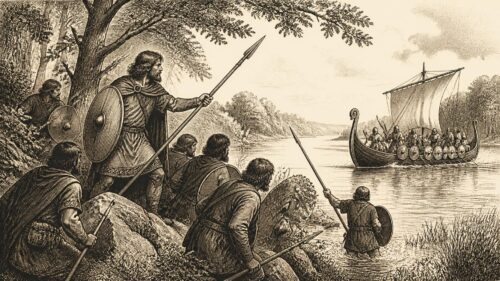
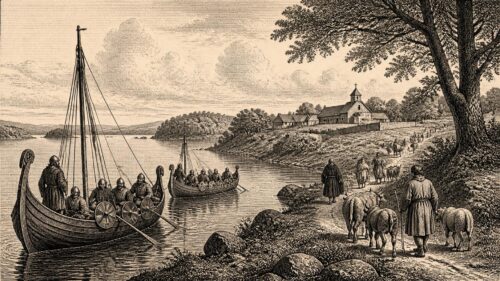
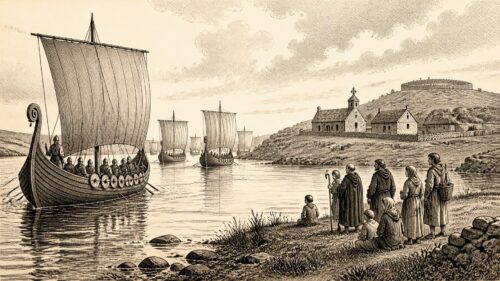
Amid these Irish struggles, annalists recorded attacks by people they called gentiles or foreigners. Modern historians generally understand these raiders within the wider Scandinavian activity in Ireland and the Irish Sea world, but the 835 notices do not name a leader, homeland or fleet. It is therefore safer not to attach every raid to a particular Viking force. The entries instead reveal the geographical reach and repeated targeting of wealthy and well-connected church settlements.
Ferna, identified with Ferns in present-day County Wexford, and Cluain Mór Máedóc, Clonmore in County Carlow, were plundered. Both were churches associated with Máedóc of Ferns, a sixth- or seventh-century saint whose cult linked the institutions. Their attack was not merely a blow against buildings used for worship. A major church held food renders, livestock, metalwork, books, vestments, service communities and the goods needed to accommodate travellers and maintain dependants. Plunder could mean the seizure of portable wealth and provisions as well as the destruction of structures.
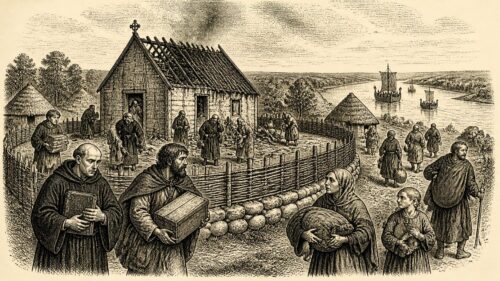
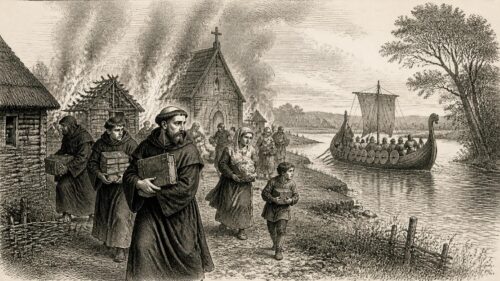
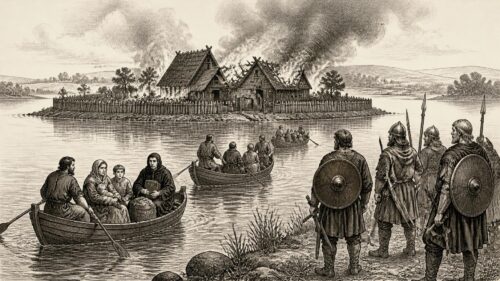
Further west, Mungairit—modern Mungret near Limerick—and other churches of Iarmumu, or western Munster, were burned. The plural wording matters. The annalist did not describe an isolated incident but a wider sweep through an ecclesiastical landscape. Mungret was an established religious centre, and its burning would have affected clergy, tenants, craftspeople, families seeking protection, and neighbouring settlements tied to it by dues and labour. Yet the record does not quantify casualties or say how much was rebuilt. It would be irresponsible to turn the terse notice into a story of total destruction.
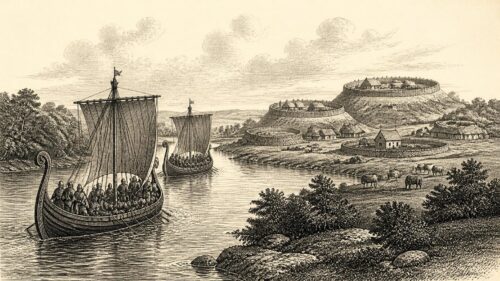
A third raid struck Druim Ing. The site is commonly identified with Dromin in Mide, though early medieval place-name identifications should be treated cautiously. If the identification is right, the entries trace attacks or plunder from the south-east through western Munster to the midlands. They do not prove that a single raiding party made every attack. What they do establish is that ecclesiastical wealth and river-and-coastal accessibility made communities across several provinces vulnerable.
Fire at Clonmacnoise
On 6 March, according to the Annals of Ulster, a third part of Cluain Moccu Nóis—Clonmacnoise—was burned. This is one of the rare notices from the year carrying a day of the month. Crucially, however, the annal does not attribute the fire to foreigners, to an Irish rival, or to accident. The cause is unknown. The entry must stand apart from the clearly labelled raids at Ferns, Clonmore, Mungret and Druim Ing.
The damage was grave whatever its cause. Clonmacnoise stood beside the Shannon at a major route through Ireland and was a renowned church, burial place, centre of learning and productive settlement. Its prior, Cumuscach son of Aengus, also died in the same annalistic year. Fire in a settlement dominated by timber buildings could spread rapidly; rebuilding demanded wood, labour, food for workers and the continuing support of patrons. The phrase “a third part” is vivid, but it should not be made to imply a measured survey of every house and enclosure.
Armagh and Ecclesiastical Power
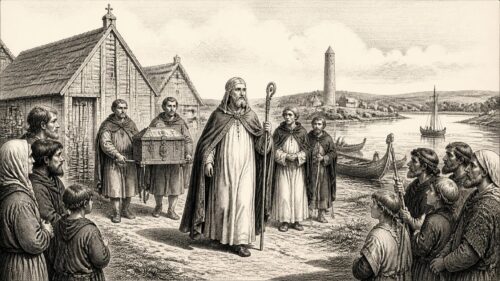
Religion and political authority were inseparable in 835. The annals record a change of abbots at Armagh: Forannán of Ráith Meic Malais replaced Diarmait grandson of Tigernán. Armagh was not simply one monastery among many. As the principal church of Patrick, it possessed an extensive network of dependent churches, claims to precedence and the prestige attached to Patrick’s relics, law and memory. Control of its abbacy mattered to rulers far beyond Ulster.
The surviving entry provides no explanation for the replacement, and it should not be embellished into a proven coup or a royal appointment. But its inclusion among campaigns and raids is revealing. The headship of Armagh was an office with religious, legal and political consequences. Elsewhere the annals mark the deaths of Echaid, king of Uí Thuirtri; Caenchomrac, steward of Kildare; Bresal, superior of Cell Dumai Glinn and other monasteries; and several other church figures. Such titles indicate a landscape administered through institutions whose leaders managed people, land, ritual and resources as well as prayer.
What Was at Stake
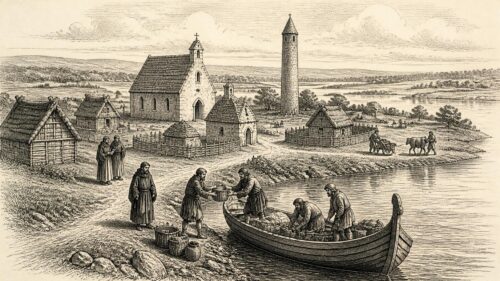
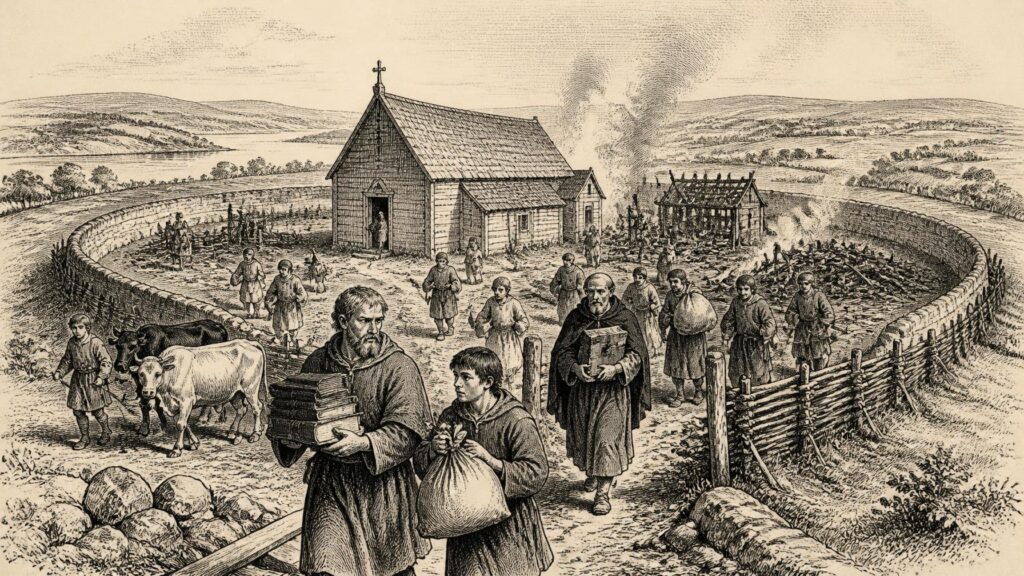
For most people, the year’s events were experienced not as an abstract struggle between “Ireland” and invaders, but through local obligations and losses. Early medieval Ireland remained overwhelmingly rural. Households depended on mixed farming, especially cattle, alongside grain, pigs, sheep, fishing and woodland resources. Monasteries were embedded in that world. Their enclosed precincts contained churches and burial grounds, but also dwellings, workshops, storehouses, guest facilities, fields and livestock. Clerics, lay tenants, craftsmen, scholars, labourers and visitors all belonged to their wider social economy.
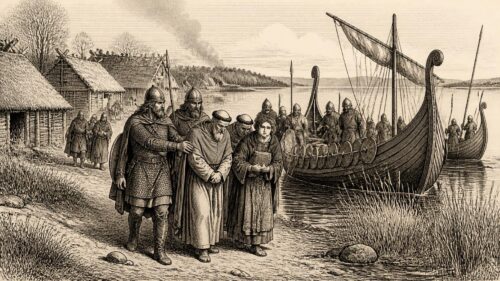
This explains why attacks on churches loom so large in the written record. Religious communities concentrated valuables and food, possessed boats and transport links, received renders, and offered symbolic targets to enemies. They also generated writing. A raid could interrupt worship and learning, destroy wooden buildings and food stores, scatter a community, and remove people into captivity, even where an annalist recorded only the single word “plundered”. Conversely, the survival of a named abbacy or prior reminds us that communities could recover, rebuild and retain their importance after disaster.
By the end of the year, no single event had resolved Ireland’s conflicts. Niall Caille had projected northern power into Leinster and Mide; foreign raiders had struck church centres in several regions; Clonmacnoise had suffered a major but unexplained fire; and Armagh had a new abbot. The notices are fragmentary, but their combined force is clear. In 835, political authority, ecclesiastical wealth and local security were tightly bound together—and all were exposed to violence.
Primary Sources
- Part 405 of The Annals of Ulster
- Part 82 of Chronicon Scotorum
- Part 66 of Annals of the Four Masters
- Annals of the Four Masters: Irish Text, Part 66
- Part 404 of The Annals of Ulster
- Part 406 of The Annals of Ulster
- Part 407 of The Annals of Ulster
- Part 39 of Annals of Inisfallen
- The Annals of Ulster
- Annals of Inisfallen
- Annals of the Four Masters
- Vikings in Irish Chronicles, 794–902: Introduction
- Vikings in Irish Chronicles, 794–902: Data
- Fedelmid (Feidlimid)
- Máedóc (Áed, Áedán, Mogue)
- The Vikings in Ninth-Century Ireland: Sources and Settlements
- Viking Raids and Monastic Plundering, 795–835
- Viking Activity in Ireland by County in the Annals
- Early Christian Monasteries
- Early Irish Monasticism
- Life in Glendalough
- Religion and Society in Ireland
- Reassessing the Irish ‘Monastic Town’
- Animals and the Economy of Medieval Ireland: A Zooarchaeological Analysis of the Faunal Remains from Caherconnell Cashel, Co. Clare