Seredmag’s Fallen Kings743 CE
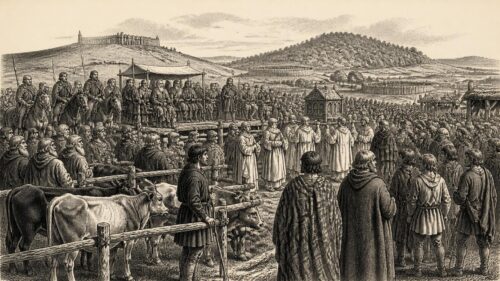
In 743, at Seredmag, probably Kells, Domnall Midi of Clann Cholmáin defeated and killed Áed Allán of Cenél nÉogain, king of Tara, with three Airgíallan allies. The victory shifted Uí Néill pre-eminence from northern to midland hands, though Ireland remained divided among kingships. Annalistic dating differs slightly, but denotes one battle. It occurred during a summer of conflicts across Brega, the midlands, Connacht and the north. Notices also record ecclesiastical law, relics on circuit, a widespread disease called bolgach, deaths of church leaders, and a later tradition of airborne ships. The year reveals contested authority, religious influence and social insecurity.
Dateline
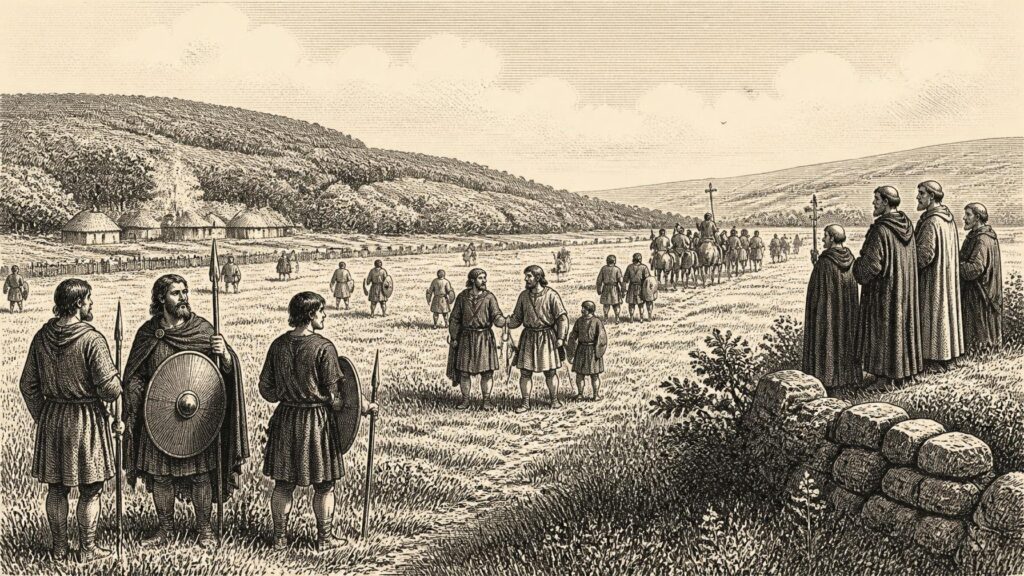
In 743 CE, a battle at Seredmag, identified in the annals with Cenannas or Kells in modern County Meath, transformed the balance of power among Ireland’s foremost dynasties. Áed Allán, king of Tara and leader of Cenél nÉogain, was defeated and killed by Domnall Midi of Clann Cholmáin. Three allied rulers also died with Áed: Cumuscach of Ind Airthir, Maenach of Uí Chremthainn, and Muiredach of Uí Thuirtri. The victory did not create a unified Irish kingdom in any modern sense, but it transferred the pre-eminent Uí Néill kingship from a northern branch to a midland one. It was the year’s central political event, recorded beside a striking cluster of lesser wars, ecclesiastical deaths, a relic procession and an outbreak described as bolgach.
A Date with Caution
Medieval Irish chronology needs handling carefully. The Annals of Tigernach place the battle in their entry for 743, and modern reference works conventionally date Áed Allán’s death to 743 CE. The parallel notice in the Annals of Ulster appears under U743, although its calendrical heading is offset to AD 742 in the modern edition. This is not evidence for two separate battles: it reflects a familiar difficulty in annalistic year-numbering. Seredmag can therefore responsibly be treated as belonging to 743 CE, but no month or day survives. The sources preserve the result, the principal dead and the victor, not a narrative of manoeuvres, troop numbers or the battlefield’s precise location.
Áed Allán had been king of Tara since the 730s. He belonged to Cenél nÉogain, the powerful northern branch of the Uí Néill centred in what is now Tyrone and Donegal. His rival Domnall Midi, ‘Domnall of Meath’, came from Clann Cholmáin, a southern Uí Néill lineage associated with the central midlands. Both men stood within the wider Uí Néill political world, but kinship did not prevent rivalry. Early medieval Irish kingship was not inherited automatically by the eldest son or held through a single state apparatus. It depended on military success, alliances, tribute, hostages, control of clients and recognition by other rulers and churches. Seredmag showed this system in its most lethal form.
The Battle at Kells
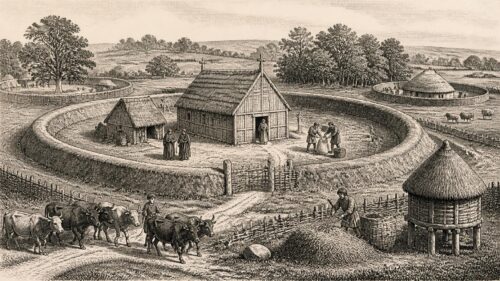
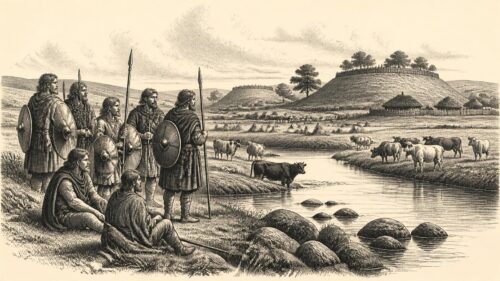
The annals call the encounter the battle of Seredmag and explicitly connect it with Cenannas, later Kells. Tigernach describes it as a conflict ‘between the two Teffias’, a phrase pointing to the politically divided territories around the upper Boyne and the midlands. The location mattered. Kells lay within a landscape of royal routes, prosperous agricultural land and ecclesiastical settlements, close to the contested ground from which a ruler of Tara could project influence north, west and east. Yet it would be wrong to picture a permanent capital or national battlefield. This was a confrontation within a dense patchwork of peoples and lordships, fought where rival networks met.
Áed did not fall alone. The deaths of the kings of Ind Airthir, Uí Chremthainn and Uí Thuirtri reveal that his force included important Airgíallan allies from the northern interior. Their presence underlines the reach that Cenél nÉogain had acquired. It also makes the defeat more consequential than the death of one overking. Several allied political communities lost their ruling figures at once. The annals do not explain whether these men were bound to Áed by tribute, negotiated alliance, shared interest or all three. They do, however, preserve a snapshot of a northern coalition broken on southern Uí Néill ground.
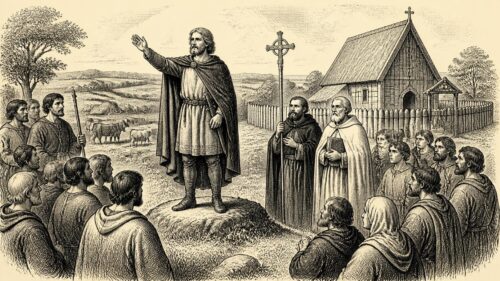
Domnall Midi emerged as victor and, in the annalistic formula, began to reign. Later historians identify this as his accession to the kingship of Tara. Such a title is often rendered ‘high king’, but it should not suggest direct administration of the whole island. Ireland remained a collection of provincial and local kingships, powerful churches and semi-independent client peoples. Domnall’s achievement was pre-eminence: he had defeated the ruler most widely acknowledged as senior among the Uí Néill, gained the prestige attached to Tara, and placed Clann Cholmáin at the centre of midland politics. The shift proved durable. Thereafter, the Tara kingship largely alternated between Clann Cholmáin and Cenél nÉogain, while the former Síl nÁedo Sláine predominance in the southern Uí Néill was not restored.
One Summer of Fighting
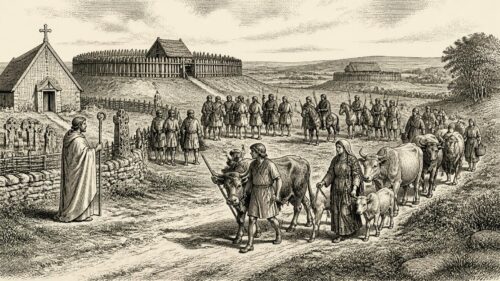
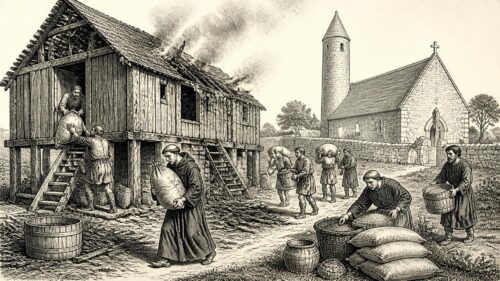
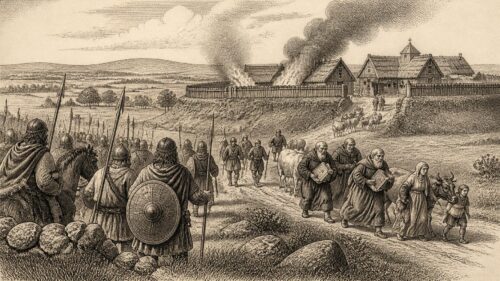
Seredmag was not an isolated eruption. The Annals of Ulster say that four battles were fought ‘almost in one summer’; Tigernach similarly says that four wars were nearly completed in a single summer. The wording is unusually revealing. It signals a season of connected or contemporaneous violence, while stopping short of proving a centrally directed island-wide campaign. Warfare was often seasonal because movement, pasture, harvest demands and supplies shaped what kings could do. A summer of conflict would have affected far more people than the named dead: retainers, levies, food-producers, hostages, dependants and clerics living near the routes used by armed groups.
At Dam Derg in Brega, Dúngal son of Flann, king of Fir Chúl, and Fergus son of Oistech were killed; Indrechtach grandson of Conaing was victor. Brega, the fertile region north of the Liffey and east of the Boyne, was politically fragmented but strategically important to every would-be overking of the midlands. Another battle set Uí Ailello against the Gailenga, groups whose territories lay farther west in the Connacht–midlands borderlands. A further conflict opposed Uí Maine and Uí Fhiachrach Aidne in Connacht. These notices are too concise to establish causes, but together they show that power in 743 was being fought for locally as well as at Seredmag.
The killing of Dub Doithre, king of Uí Briúin and of the Conmaicne of Bréifne, belongs to the same atmosphere of instability. Tigernach also records the death of Dluthach son of Fidchellach, king of Uí Maine. The careful conclusion is not that all these deaths formed one campaign led by Domnall Midi. The sources do not say so. Rather, 743 brought a concentration of lethal disputes across Brega, the midlands, Connacht and the north. The high political drama at Kells was embedded in a society where authority was continually made and unmade at smaller scales.
Law, Relics and Illness
One laconic entry says that the law of Suanach’s descendant was ‘in force’. The phrase almost certainly refers to an ecclesiastical law associated with the saintly lineage of Suanach, rather than to a newly written national code. Such laws could involve the public assertion of a saint’s protection and authority, the collection of dues, and the settlement or restraint of disputes under religious sanction. The annals do not identify its precise territory in 743 or spell out its provisions. Its appearance nevertheless shows that religious institutions could organise authority beyond their own enclosures, alongside and sometimes in partnership with kings.
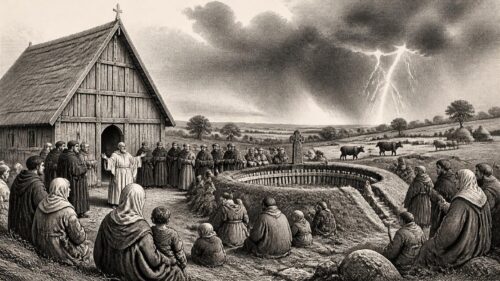
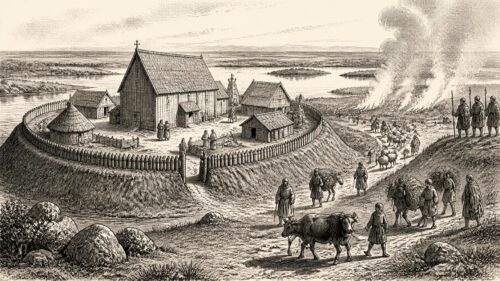
Another notice records the taking on circuit of the relics of Trian of Cell Delge. Relics were not passive devotional objects. Carried publicly by clerics, they made a saint’s presence mobile, drew communities into ceremonies and could reinforce a church’s claims to protection, revenue and honour. The record does not tell us the procession’s route, its participants or its immediate purpose. It does demonstrate that movement through the countryside was not confined to war-bands and royal messengers. Clerical parties, sacred objects and the obligations attached to them also connected settlements.
The relic circuit occurred while bolgach was said to be rampant. The word is often translated ‘smallpox’, but the brief annalistic notice cannot provide a clinical diagnosis in the modern sense. What can be said securely is that contemporaries recognised a widespread and alarming disease. In an overwhelmingly rural society, illness could imperil households through lost labour, interrupted food production and the strain placed on kin networks. Its juxtaposition with a relic translation may reflect religious responses to insecurity, although the source does not explicitly state that the procession was organised because of the outbreak.
Churches and Memory
The year also brought the deaths of several church figures: Affrica, abbess of Cell Dara, or Kildare; Cuiméne grandson of Ciarán, abbot of Rechru, probably Lambay; and Affiath, abbot of Mag Bile, usually identified with Movilla. Conchenn, daughter of Cellach of Cualu, also died. These short obits should not be mistaken for complete biographies, but their geographical spread is significant. Kildare in Leinster, Rechru off the Dublin coast and Movilla in the north-east belonged to a network of churches whose leaders managed land, learning, ritual and connections with political families. Women could hold conspicuous ecclesiastical office, as Affrica’s title of abbess makes plain.
A final, more elusive item belongs to the year’s later memory. The Annals of the Four Masters, compiled centuries after the events, place in 743 an apparition of ships and crews seen in the sky. Related annalistic traditions date a similar marvel differently. It should therefore be treated neither as a securely dated observation nor as evidence for a literal aerial vessel. Its value lies in showing how Irish chroniclers recorded wonders within history, alongside battles, deaths and disease. For those who shaped the annals, political upheaval, epidemic danger, sacred power and extraordinary signs all formed part of the meaningful texture of a year.
Thus 743 CE stands out not simply for the death of Áed Allán, but for the way one battle reordered the leading Uí Néill dynasties amid a wider summer of conflict. Domnall Midi’s triumph at Seredmag gave Clann Cholmáin a new position at Tara; the deaths of Áed’s Airgíallan allies exposed the cost of northern power; and the notices of law, relics, illness and church leadership reveal institutions trying to sustain order in unsettled conditions. The annals remain sparse, but they preserve a year in which authority changed hands decisively and ordinary security cannot have been taken for granted.
Primary Sources
- The Annals of Ulster: Year U743
- The Annals of Tigernach: Annal T743
- Annals of Inisfallen: Annal AI743
- Annals of the Four Masters: Annals M737–M738
- Annals of the Four Masters
- Áed Allán
- Domnall Midi
- Áed Allán mac Fergaile: (d. 743), high-king of Ireland
- Irish Kings and High-Kingship, c.700–900
- A Hundred Years Ago – A Royal Poet
- CELT Project: The Annals of Ulster
- CELT Project: The Annals of Tigernach
- CELT Project: Annals of Inisfallen
- CELT Project: Annals of the Four Masters
- Chronicon Scotorum
- Fragmentary Annals of Ireland
- Exploring the Irish Annals
- Sléibíne
- Murchad Midi
- Early Monastic Churches
- Monasteries
- Meath
- Early Medieval Ireland: Archaeological Excavations 1930–2004, Volume 2