Adomnán’s Last September704 CE
In 704, Ireland witnessed major political reversals and the death of Adomnán, abbot of Iona. On 12 July, Cellach mac Rogallaig of Connacht defeated and killed Loingsech mac Óengusso, king of Tara, with three sons, at Corann; Congal Cennmagair succeeded him. Later, Cellach Cualann of Leinster repelled a southern Uí Néill force at Clóenad, while instability affected neighbouring dynasties. Annals also note Dál Riata’s destruction at Glen Leven. Adomnán died on 23 September, leaving widely influential writings, diplomatic achievements and Cáin Adomnáin. These events reveal interconnected Irish, Scottish and Northumbrian worlds, though annalistic dating remains uncertain and their social consequences.
Dateline
In 704 CE, Ireland’s political map was shaken by defeat and succession, while the Irish-born abbot Adomnán of Iona died on 23 September. The year is unusually vivid because the principal events join the island’s internal rivalries to the wider Gaelic world of western Scotland and Northumbria. Yet it also requires care. Early medieval Irish annals were copied and reorganised long after the events they record, and their year-headings do not always align neatly with the modern calendar. The battle of Corann, for example, appears under a neighbouring annal year in some texts, but modern chronological work places it firmly on Saturday 12 July 704. Where a precise date is not secure, the evidence permits only the year or a broader context.
Corann and the Fall of Loingsech
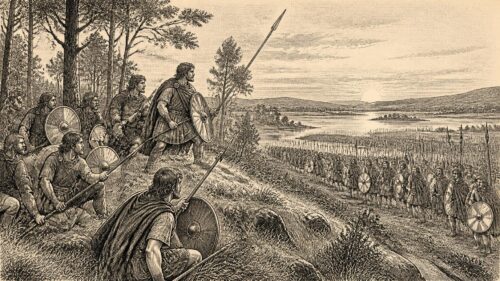
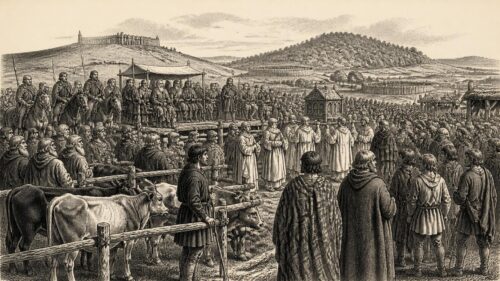
The most consequential event was the battle of Corann, fought in south-central County Sligo on 12 July. Loingsech mac Óengusso, king of Tara and a leading member of Cenél Conaill in north-west Ulster, led an army into Connacht. His opponent was Cellach mac Rogallaig, king of Connacht, whose forces stopped the advance in the territory of Corann. The annals present the encounter not as a small raid but as a disaster for the invaders. Loingsech was killed, together with three sons, Artgal, Connachtach and Flann Gerg, and a striking number of lesser rulers and leaders.
This was a decisive political reversal. Loingsech was among the rare early kings whom the annalistic tradition calls rí Érenn, king of Ireland, a title that signals an ambition and reach beyond ordinary dominance at Tara. His advance into Connacht may have been intended to reinforce Cenél Conaill authority westward after years in which famine and disease had placed severe strain on Irish societies. The sources do not allow a simple explanation of motive, however. What can be said is that the king’s death removed an exceptionally prominent northern Uí Néill ruler in one day, and that Cellach’s victory protected Connacht from a major external invasion.
Loingsech’s cousin Congal Cennmagair succeeded to the kingship of Tara. This did not create a unified Irish monarchy in any modern sense. The title attached to Tara represented pre-eminence negotiated through kinship, military success, tribute, hostages and alliances, not rule through a central state. Still, succession mattered. Congal’s accession kept the kingship within Cenél Conaill, the dynasty of Donegal with which both Colum Cille and Adomnán were closely associated. The battle therefore altered the personnel of power without ending the wider contest among the great Uí Néill kindreds, Connacht, Leinster and Munster.
Clóenad and Leinster’s Defence
Another conflict, probably later in 704 though no exact day survives, showed that Leinster could not be treated as a passive neighbour of the southern Uí Néill. At Clóenad or Claenath, generally identified with Clane in modern County Kildare, Cellach Cualann, overking of Leinster, defeated an invading force led by Fogartach, grandson of Cernach. Bodbchad of Mide, brother of the future Clann Cholmáin ruler Murchad Midi, was killed; Fogartach escaped from the field.
The surviving accounts are concise, but their implications are clear enough. Fogartach belonged to Síl nÁedo Sláine, a southern Uí Néill branch based in Brega, while Bodbchad represented Clann Cholmáin of Mide. Their cooperation points to a coalition of interests pressing south-eastward. Cellach’s victory preserved Leinster’s position and enhanced the standing of the Uí Máil dynasty, whose power was centred in the uplands and plains west of the Wicklow Mountains. Clane lay on an important approach between the midlands and Leinster; fighting there concerned movement, access and political influence as much as a single battlefield.
The annals also record the death in 704 of Feradach mac Máele Dúin, king of Cenél Laegaire, another southern Uí Néill people based around the Boyne valley. They do not explicitly connect his fall to Clóenad. It is tempting to make all these losses part of one campaign, but the evidence does not justify that certainty. The safer conclusion is that the year brought conspicuous violence and instability among the dynasties surrounding Tara and Leinster.
A Gaelic Sea World Under Pressure
One annal records the “destruction” of Dál Riata in Glen Leven in the same year. It supplies no fuller explanation: no named commanders, no casualty list and no reliable account of cause. Glen Leven was in western Scotland, but the event belongs directly to Irish history because Dál Riata was a Gaelic kingdom spanning the sea-world between north-east Ireland and Argyll, and because Iona stood within its political and ecclesiastical orbit. The notice is a reminder that the North Channel was a route, not a hard frontier. Clerics, students, messengers, traders and warbands moved across it, while setbacks in one shore’s kingdoms could quickly matter on the other.
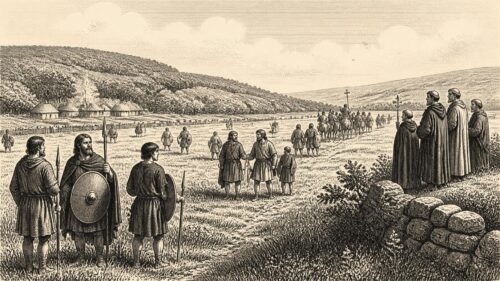
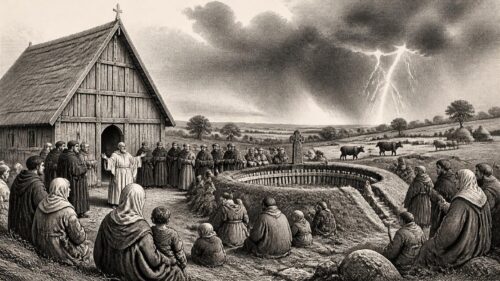
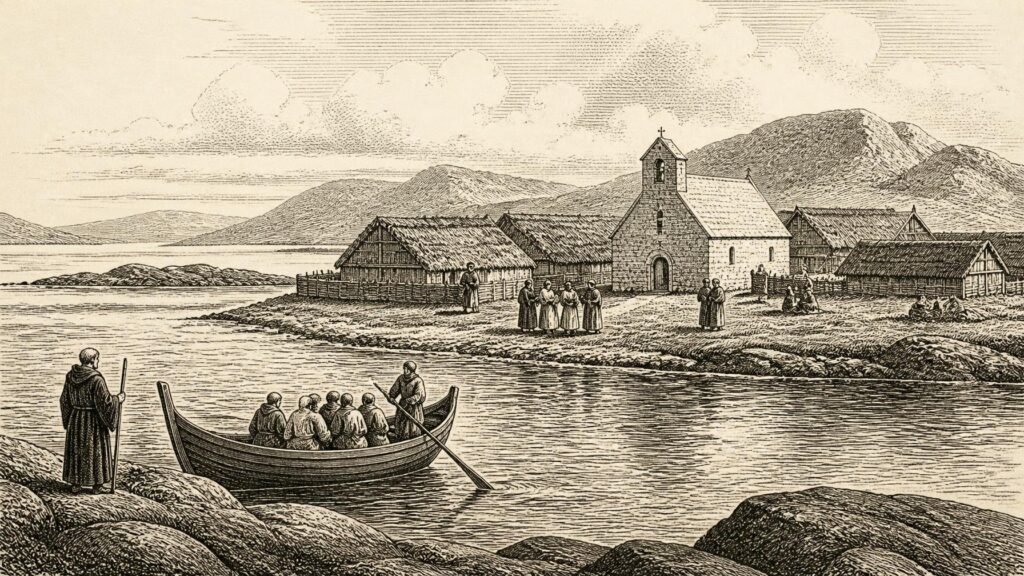
That maritime setting also makes the scale of Iona’s influence easier to understand. From its island monastery, a community founded by Colum Cille maintained religious, familial and cultural links with northern Ireland, Dál Riata, Pictland and Northumbria. Ships were indispensable to these networks, but travel was seasonal and hazardous. A crossing could carry books, news and diplomatic messages; it could equally expose a community to storms, military disruption and the fluctuating demands of secular rulers.
Adomnán’s Death
On 23 September, Adomnán, ninth abbot of Iona, died. The annals record him as abbot of Í, the Irish name for Iona, and give his age as seventy-seven; other later traditions offer different figures, so the age should not be treated as certain. The date of his death, however, is well established. His passing was an event of Irish as well as Hebridean importance. Adomnán was a Cenél Conaill churchman, probably from the Donegal region, who had headed Iona since 679 and had become one of the most learned and politically active figures in the Gaelic-speaking world.
His surviving Life of Columba was far more than a devotional commemoration of Iona’s founder. Written in polished Latin, it preserved traditions about Colum Cille, recorded places and peoples from Ireland to Pictland, and placed Iona at the centre of a sacred geography of islands, churches and royal courts. Adomnán also composed De locis sanctis, an account of the Christian holy places based principally on the testimony of the traveller Arculf. The work demonstrates that an Irish monastic centre could gather, assess and transmit knowledge reaching far beyond the Atlantic archipelago.
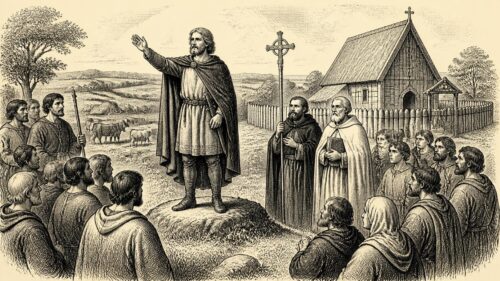
His public career had likewise crossed political boundaries. In the late 680s he travelled to Northumbria and secured the release of Irish captives taken in an earlier Northumbrian raid on Brega. He had also promoted Cáin Adomnáin, the Law of Adomnán, proclaimed at Birr in 697. That law, associated with the protection of women, clerics and children in conditions of violence, depended upon the support of kings and church leaders. It did not abolish warfare, as 704 itself demonstrates, but it shows the Church’s attempt to regulate conduct through assemblies, guarantors and sacred sanctions.
Learning, Observance and Ordinary Lives
Adomnán’s death came before Iona formally adopted the Roman method of calculating Easter. He appears to have favoured reconciliation with churches using that calculation, but Iona itself did not accept the new observance until 716. Thus 704 should not be presented as the year when the dispute ended. Rather, it marked the loss of an abbot who had engaged with the issue, travelled among communities with differing practices, and helped make Irish scholarship visible abroad.
The Irish annals place the death of the Northumbrian king Aldfrith close to Adomnán’s obituary and call him learned; Aldfrith had Irish ancestry and strong links with Irish learning. But Bede’s chronology puts Aldfrith’s death in 705, so it cannot responsibly be counted as a securely dated event of 704. The disagreement is instructive: it reveals both the density of Irish-Northumbrian connections and the need not to force every annalistic notice into an exact modern year.
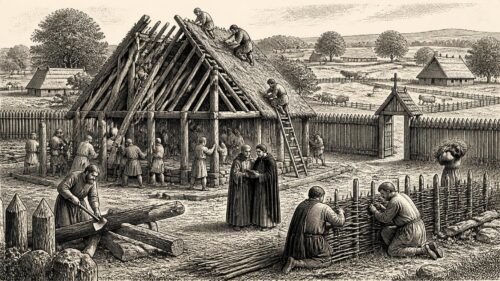
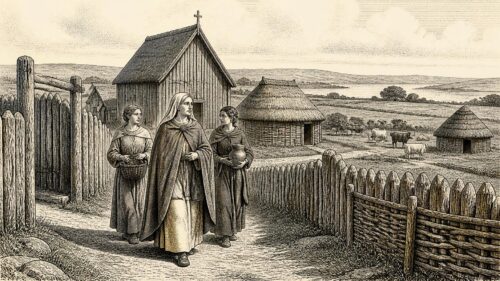
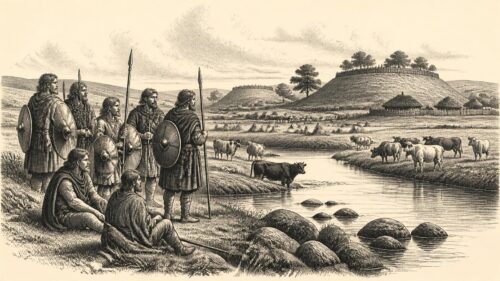
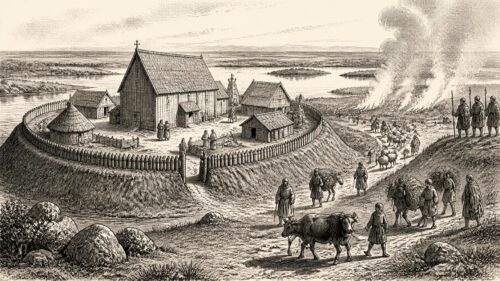
For most people, politics was experienced less through titles at Tara than through the demands of lordship and the vulnerability of food supplies. Farming households relied heavily on cattle, dairy produce and grain, supplemented by pigs, fishing, wild foods and local exchange. Settlements were dispersed: enclosed farmsteads, royal sites, ecclesiastical communities and lakeside dwellings formed a varied landscape rather than towns in the later medieval sense. Monasteries owned land, received renders, offered hospitality and trained literate specialists, but they remained tied to the same weather, harvests and cattle health as their neighbours.
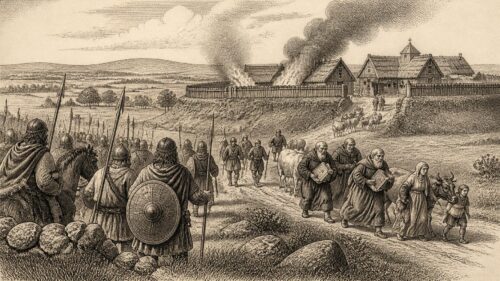
There is no securely dated environmental catastrophe recorded specifically for 704. Nonetheless, the recent background of famine and disease, together with the devastation caused by campaigning, made security precarious. An invading host needed food, animals, guides and transport; a defeated one left bereaved households and weakened political clients. At Corann and Clóenad, the deaths named by the annals were elite deaths, but their consequences extended through dependants, churches and local territories. In that sense, 704 was both a year of sharply documented turning points and a year in which the wider burdens of conflict fell upon people whose names were never written down.
Primary Sources
- The Annals of Ulster: Year U704
- The Annals of Ulster
- The Annals of Tigernach
- Chronicon Scotorum
- Fragmentary Annals of Ireland
- Annals of Inisfallen
- Annals of the Four Masters
- Adomnán
- Loingsech
- Congal Cennmagair
- Cellach Cualann
- Cellach mac Rogallaig
- Aldfrith
- Congal Cendmagair: (d. 710), high-king of Ireland
- Aldfrith: (d. 704/5), king of Northumbria
- Saints in Scottish Place-Names: Adomnán m. Rónáin of Iona
- Early Mechanisms of Abbatial Succession: The Case of Iona (563–704)
- Contested Succession at Iona (704–26)
- The Life of Columba, Written by Adamnan
- Life of St. Columba
- Lex Innocentium (697 AD): Adomnán of Iona – Father of Western Jus in Bello
- Where Was King Aldfrith of Northumbria Educated? An Exploration of Seventh-Century Insular Learning
- Bede, Ecclesiastical History of the English People, Book V