Rechru’s Burning795 CE
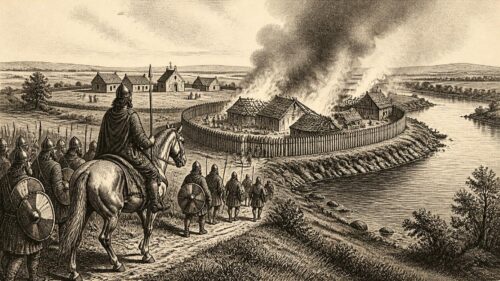
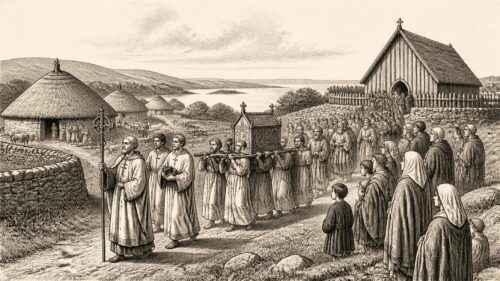
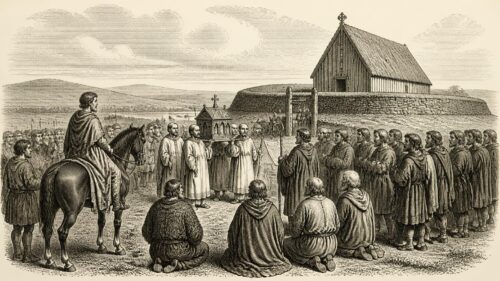
In 795, Irish annals recorded the burning of Rechru by heathens, generally identified as Scandinavian raiders and conventionally regarded as Ireland’s first surviving notice of Viking activity. Rechru’s location, possibly Rathlin or Lambay, and the raid’s scale remain uncertain; associated references may concern Skye or a shrine. The year also saw Leinster’s overking Bran Ardchenn and Queen Eithne killed by a rival dynast, weakening Donnchad Midi’s political alliances, and the death of Armagh’s abbot Faendelach. These events occurred within a rural, church-centred society connected by vulnerable seaways. They signalled emerging maritime insecurity, not immediate Scandinavian permanent settlement or Irish transformation.
Dateline
In 795, Ireland’s annalists recorded two sharply different kinds of violence: a killing at the heart of Leinster’s royal politics, and an attack from the sea that later generations would recognise as the opening recorded episode of the Viking Age in Ireland. Neither event permits an uncomplicated story of a peaceful island suddenly overwhelmed by outsiders. Irish kingdoms already knew dynastic murder, raiding and contests for supremacy. Yet the burning of Rechru introduced a new and ominous maritime threat into an Irish Sea world linked by monasteries, seaways and kinship. The year is therefore important not because it transformed Ireland overnight, but because it preserved the first surviving Irish notice of Scandinavian raiders.
A Burning on Rechru
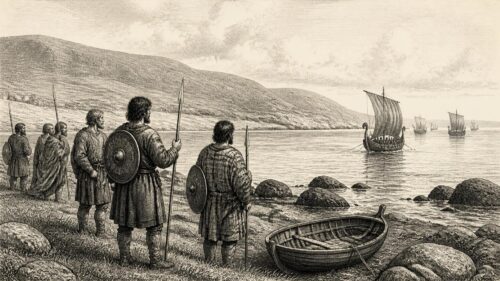
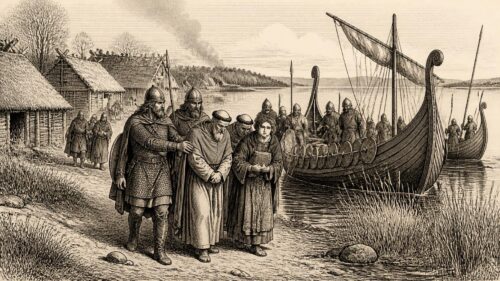
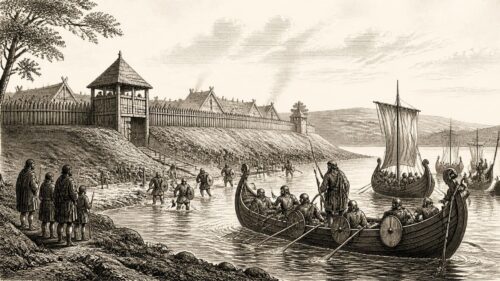
The Annals of Ulster place under this year the terse notice: “The burning of Rechru by the heathens.” The Irish term for the attackers, gennti, literally “gentiles” or heathens, is the annalist’s hostile Christian description, not a name supplied by the raiders themselves. Modern historians generally understand the perpetrators to have been Scandinavian seafarers, probably operating within the sea routes that connected western Scotland, the Hebrides, the Isle of Man and Ireland. It is conventional to call this Ireland’s first recorded Viking raid. That formulation matters: it is the first surviving written record, not proof that no earlier contact, trade, reconnaissance or violence had occurred.
Even the place is uncertain. Rechru has often been identified with Rathlin Island, off the Antrim coast, whose later Irish name Reachlainn is similar. Others identify it with Lambay Island, off the coast of modern County Dublin, known in Irish as Reachrainn. Both were offshore places in waters familiar to travellers, fishermen and religious communities; either identification would make geographical sense. The evidence does not allow a firm choice. It is best, therefore, to retain the annal’s name, Rechru, rather than assign the burning confidently to either Rathlin or Lambay.
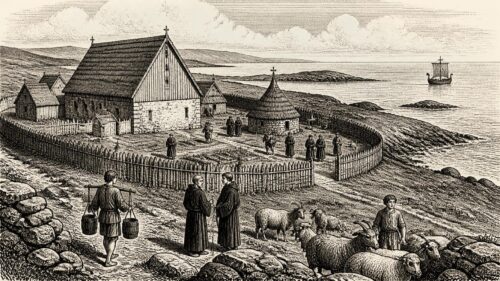
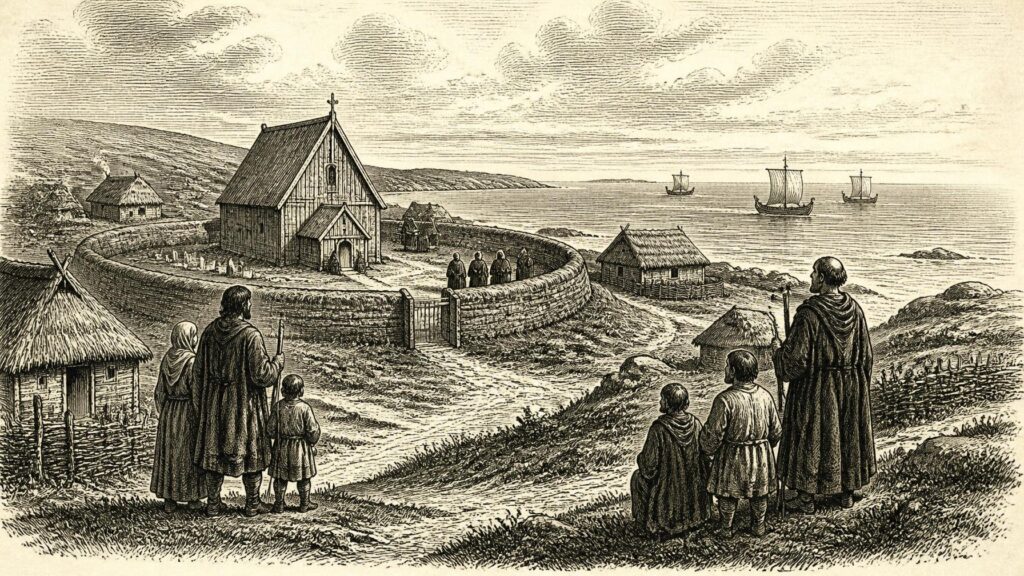
The raid’s scale is equally unrecoverable. The annal gives no number of ships, attackers, casualties or captives. It does not say whether a church, a settlement, a storehouse or several buildings burned, although Rechru is generally thought to have had an ecclesiastical association. It is tempting to supply a dramatic longship assault, plundered treasure and mass flight; none of that is securely recorded for this occasion. What can responsibly be said is that the destruction was serious enough to enter an annalistic record, and that Christian writers regarded the attackers as outsiders and enemies.
Islands, Shrines and Ambiguity
The same Annals of Ulster entry continues with wording usually translated as “Scí was overwhelmed and laid waste”. Traditionally, Scí has been taken as Skye, suggesting that the attack on Rechru belonged to a wider sweep through the islands between Ireland and northern Britain. That reading fits the wider pattern of late eighth-century attacks in the North Atlantic archipelago. The preceding annalistic year also reports devastation by heathens among the islands of Britain, while the Annals of Inisfallen associate plundering of Iona, the Columban monastery, with 795.
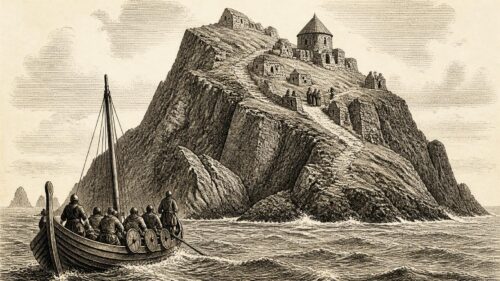
But this must not be converted into a precise itinerary. A scholarly reassessment has proposed that the difficult phrase may refer not to Skye but to a shrine at Rechru: in that interpretation, the annal records the burning of the island and the breaking or despoiling of its shrine. The alternative is significant because it underlines how much hangs on a few words copied through medieval manuscripts. Whether the entry describes two islands or an island and its reliquary, it conveys an assault upon a Christian place whose buildings, sacred objects and supplies were vulnerable from the sea.
Iona was not in Ireland, but it was directly relevant to Irish history. It stood within the Columban federation of churches whose personnel, books, relics and authority crossed the North Channel. News of danger in the Hebrides would have mattered in Irish ecclesiastical centres, just as threats to an Irish island could concern communities in Scotland. Still, the sources do not demonstrate that one fleet struck Rechru, Skye and Iona, nor that all damage occurred on the same day or even during one voyage. The responsible picture is of insecurity emerging across a connected maritime zone, not of a fully documented campaign.
Leinster’s Royal Murder
On Wednesday, 6 May 795, a far more precisely dated political killing took place at Cell Chúile Duma, probably near modern Abbeyleix in County Laois. Bran Ardchenn, overking of Leinster, was slain with his queen, Eithne daughter of Domnall of Mide, by Fínnechta Cetharderc. The annal’s unusual precision gives the date exceptional weight. Later tradition adds that Bran and Eithne were burned to death, but the contemporary-style annalistic notice itself simply says that they were killed. The difference is worth preserving: murder is secure; the exact manner of death rests on later testimony.
The deaths were politically consequential. Bran belonged to the Uí Muiredaig branch of Uí Dúnlainge, the dominant Leinster dynasty of the period. Eithne was closely connected to Donnchad Midi, king of Tara and leading ruler of the southern Uí Néill. Their marriage helped bind Leinster to the power centred in Mide. Donnchad had supported Bran, including in conflict involving Munster shortly before 795. The couple’s killing by a rival Leinster dynast was therefore more than a private feud: it struck at an alliance through which the king of Tara exerted influence east and south of his midland base.
It would be misleading, however, to describe Donnchad as ruler of a unified Irish state. The title “king of Tara”, later often rendered high king, expressed major prestige and real military reach, but authority was negotiated through local kings, allied kindreds, hostages, marriage and armed expeditions. Leinster itself contained competing branches of Uí Dúnlainge, while Munster, Connacht, Ulaid and the northern Uí Néill were political worlds with their own rulers and interests. Bran’s death exposed the limits of any settlement built upon one marriage alliance or one powerful patron.
The annals also record the killing of Conn, son of Donnchad, in Crích Ua nOlcán by Flann son of Congalach. No exact day is supplied, and the surviving notice does not explain motive or wider consequences. Yet the accumulation is striking: within one annalistic year, Donnchad’s political circle lost both a close Leinster connection and a son. It is not evidence that Ireland was collapsing into general war, but it does show how readily kingship could be endangered through targeted killing. Succession and influence depended on living people, not impersonal institutions.
Armagh and Ecclesiastical Society
795 also brought the sudden death of Faendelach son of Máenach, abbot of Armagh. Armagh was among Ireland’s foremost ecclesiastical centres, associated with Patrick and sustained by land, client communities, learning and political patronage. Its abbot was not merely the head of a secluded religious house. He stood within a network whose authority could shape regional relationships and whose resources made it important to secular rulers. The annal’s notice of Faendelach’s death is brief, but the vacancy would have required succession within a major institution.
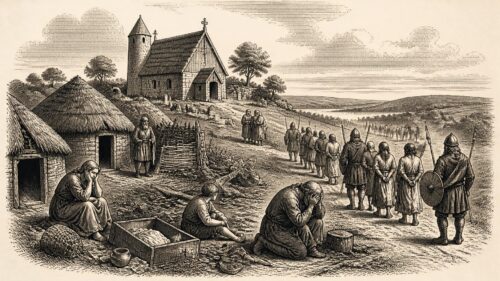
Other clerical deaths were noted as well, including Tipraite son of Ferchar of Clonfert Brénainn and Guaire, abbot of Cluain Fhata. Such entries reveal the density of Ireland’s church landscape. Monasteries and churches were places of worship, burial, schooling, manuscript production, craftwork and agricultural management. They were also embedded in local society. Their estates required herders, cultivators, food-renders and labour; their churches held liturgical objects and books; their leaders negotiated with kings and kindreds. The burning at Rechru was alarming precisely because ecclesiastical sites were not isolated refuges from the world, but important nodes within it.
The Ordinary Ireland Behind the Annals
The annals preserve the deeds and deaths of rulers, abbots and raiders, not the names of most people who lived through 795. Archaeology helps restore the setting. Ireland remained overwhelmingly rural, with settlements commonly organised around enclosed farmsteads, ringforts and, in some regions, crannogs. Cattle were fundamental to wealth, status and food-rent, but farming was mixed: people also grew cereals, kept sheep and pigs, processed dairy produce, repaired boundaries, cut fuel and made clothing and tools. Seasonal work structured everyday life more firmly than royal annals suggest.
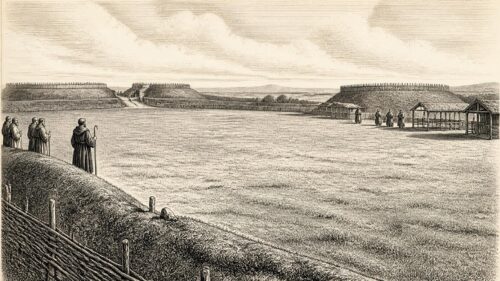
Monastic settlements belonged to that productive landscape. Their enclosures could contain churches and burial grounds, but also houses, workshops, fields, livestock and storage. Metalworking, milling and corn-drying are archaeologically attested at important ecclesiastical sites across early medieval Ireland. Coastal and island communities also participated in wider movement of people and goods. The same waters that carried pilgrims, clerics, traders and messages could carry hostile crews. In 795, that maritime reality became impossible for annalists to ignore.
A Beginning, Not Yet a Transformation
Nothing in the surviving evidence suggests that permanent Scandinavian settlement began in Ireland in 795. There were no Viking towns, longphuirt or established Irish-based fleets at this stage. Those developments belong to later decades. The early attacks were intermittent and coastal, and their immediate scale should not be exaggerated. Nevertheless, Rechru’s burning was a warning that Ireland’s island communities were exposed to a new kind of seaborne raiding within the Irish Sea world.
The year’s events should therefore be held together without being confused. In Leinster, a calculated dynastic killing disrupted the political arrangements of Donnchad Midi’s Ireland. At Rechru, attackers described as heathens burned a place whose precise location remains debated. At Armagh and other churches, deaths reminded communities that ecclesiastical leadership, like kingship, depended on fragile human succession. For contemporaries these may have been separate crises. In retrospect, 795 marks the moment when Ireland’s internal rivalries and its western seaways began to intersect with the expanding Scandinavian world.
Primary Sources
- The Annals of Ulster, Year U795
- Vikings in Irish Chronicles, 794–902: Data
- Bran Ardchenn
- Eithne
- Donnchad Midi
- Donnchad mac Domnaill (733–797), high-king of Ireland
- Cogadh Gaedhel re Gallaibh: The War of the Gaedhil with the Gaill
- Iona and the Shrine of Columba, c. 800–1200
- The Earliest Wave of Viking Activity? The Norwegian Evidence Revisited
- Narrating and Negotiating Difference in the Insular Viking Age
- The Vikings in Ninth-Century Ireland: Sources and Settlements
- Early Medieval Ireland: Archaeological Excavations, 1930–2009
- Early Medieval Dwellings and Settlements in Ireland, AD 400–1100, Vol. 1: Text
- The Archaeology of Livestock and Cereal Production in Early Medieval Ireland, AD 400–1100
- The Economy of Early Medieval Ireland
- Early Medieval Archaeology Project Report 2.1
- Early Christian Monasteries
- Crannogs / Cránnoga
- Christian Ireland, 5th–8th Centuries
- Clonmacnoise, County Offaly
- The Vikings in Ireland
- Early Medieval Ireland: Culture, Society and Politics