Daire’s Law and Umall812 CE
In 812, Irish communities faced Scandinavian raids along the western and south-western coasts. Men of Umall killed raiders, while heathens slaughtered Conmaicne; Cobthach, king of Loch Léin, also defeated a raiding party in Munster. These local successes did not end the threat, as later attacks showed. In Connacht, Muirgius son of Tomaltach plundered southern territories amid Uí Briúin expansion, while the Calraige of Lurg were slaughtered by the Uí Briúin. Daire’s law was promulgated in Connacht, reflecting ecclesiastical and political networks. Deaths of prominent church leaders emphasised churches’ administrative, scholarly and social importance throughout Ireland during an unsettled historical year.
Dateline
In 812, Ireland’s western and south-western coasts became the scene of some of the earliest clearly recorded fighting between Irish communities and Scandinavian raiders. The year is also marked by a different assertion of authority in Connacht: the promulgation of Daire’s law. These notices are brief, but together they reveal an island in which local rulers, churches and farming populations were responding to pressures both old and new. Internal rivalries remained fierce; ecclesiastical institutions remained central to public order; and seaborne raiders had become a danger that coastal peoples could neither ignore nor always repel.
A Cautious Date
The principal record is preserved in the annals conventionally cited under 812, especially the Annals of Ulster and Chronicon Scotorum. Their inherited chronological systems are not mechanically identical to modern calendar dating: the Annals of Ulster entry conventionally numbered U812 contains an internal year formula one year behind. Yet the same cluster of events appears under 812 in Chronicon Scotorum, while the Royal Frankish Annals independently report that a fleet of Northmen attacked Ireland in 812, fought the Irish and returned home after suffering substantial losses. It is therefore responsible to connect the Irish fighting recorded in this annalistic sequence with the calendar year 812, while avoiding claims about precise days, battle-sites or commanders where the sources give none.
Fighting on the Western Seaways
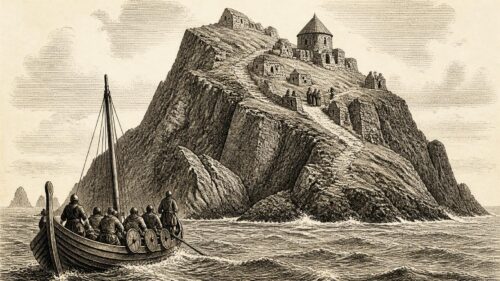
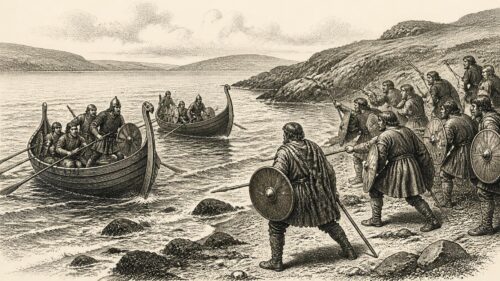
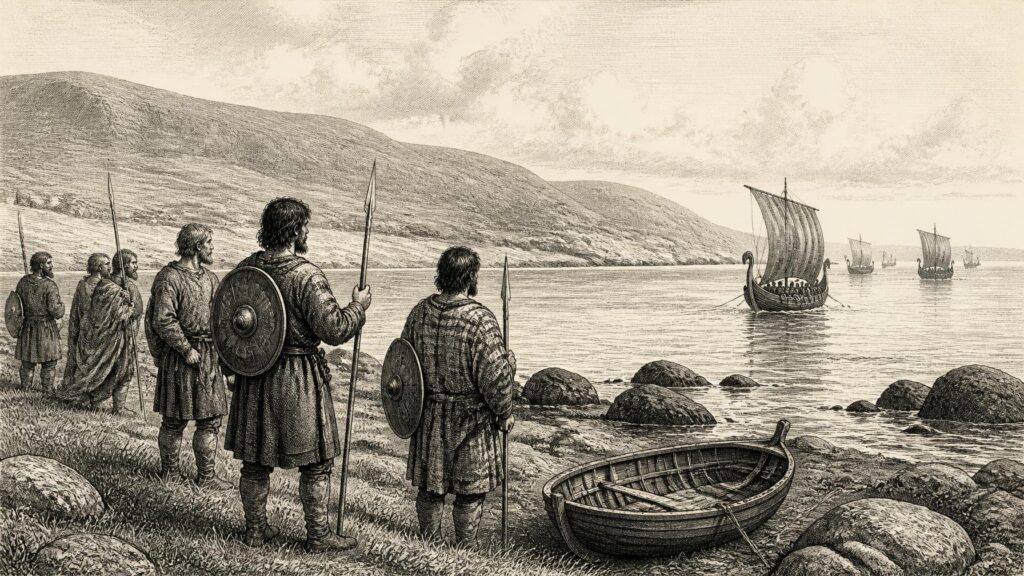
The most striking notice is succinct: “a slaughter of the heathens by the men of Umall”. Umall was a coastal kingdom in the broad region of modern north-west Mayo, associated in later geographical usage with the Burrishoole area and the shores around Clew Bay. The annalist calls the raiders gentiles, literally heathens: this was the normal Christian Irish label for Scandinavian incomers, not a statement that every individual’s beliefs had been investigated. Nothing in the entry permits a reconstruction of a dramatic beach landing, a named ship or a particular bay. It does establish, however, that the men of Umall killed a body of raiders rather than merely enduring their arrival.
This was no settled Viking colony and no conquest of Mayo. In 812 the newcomers were still operating through mobile maritime raids. Their advantages were speed, surprise and the ability to choose exposed islands, inlets and coastal settlements. But such parties were vulnerable when local forces assembled quickly enough, particularly in difficult coastal terrain. The victory at Umall was important precisely because it was limited and local: it demonstrates that the first generation of raids met organised resistance. It does not show that Ireland had found a general solution to the problem.
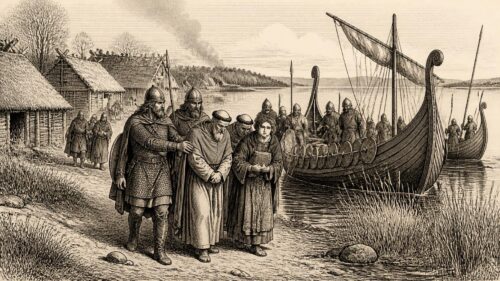
The next annal makes the limits of that success painfully plain. In the same year, “a slaughter of the Conmaicne by the heathens” is recorded. Conmaicne was not a single village but the name of several related territorial communities, particularly prominent in western Connacht. The annals do not identify which branch was attacked, where the fighting occurred, or whether the raiders were the same group defeated by Umall. Modern historians may reasonably see the two notices as part of a western seaboard crisis, but they cannot turn that possibility into certainty. What is firm is the contrast: Irish defenders killed raiders in Umall, while raiders killed Irish people elsewhere in Connacht.
The sequence continued into the following annal year, when raiders inflicted another slaughter in Umall and killed its king, Dúnadach, along with Coscrach son of Flannabra. That later reversal should not be projected backwards as though it happened in 812. It does, nevertheless, show that the struggle recorded in 812 was not an isolated encounter. Coastal communities were confronting repeat attacks, and one successful defence did not remove the danger of a return.
Cobthach at Loch Léin
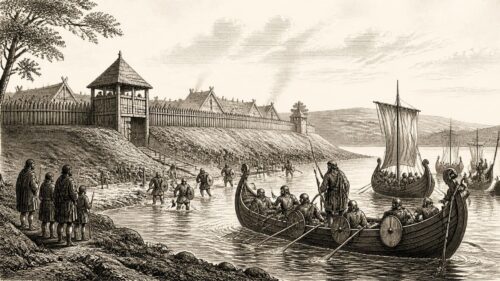
Munster, too, appears in the record. The annals report “a slaughter of the heathens in Mumu”, specifically attributing it to Cobthach son of Máel Dúin, king of Loch Léin. Loch Léin denotes the Killarney lake district and the territory of the Eóganacht Locha Léin, an important Munster dynasty. Here again the source is deliberately spare. It neither names the raiders nor places the encounter at a particular island, monastery or harbour. It is safest to say that Cobthach’s forces defeated or killed a raiding party in Munster during the year.
Even that spare statement matters. The encounter joins Umall in showing that Irish rulers did not simply watch Viking ships pass along the coast. Local kings could mobilise followers and use familiar waterways, shorelines and routes to meet raiders. Yet the year should not be narrated as a united national campaign. Umall and Loch Léin were distinct regional polities, acting in their own interests and within their own landscapes. The Ireland of 812 was a patchwork of kingdoms, churches and client communities, not a centrally governed realm with a standing coastal defence.
Muirgius and Connacht
While seaborne violence affected Connacht, its overking Muirgius son of Tomaltach was pursuing power on land. The annals say that “the south” was plundered by Muirgius. The phrase is not precise enough to support a claim that he invaded all southern Ireland. In its Connacht setting, it is generally understood as an assertion of authority over southern Connacht. Muirgius belonged to the Uí Briúin Aí, based around Mag Aí in what is now north Roscommon and north-east Galway, and had spent decades consolidating a provincial kingship amid rivalry between powerful Connacht dynasties.
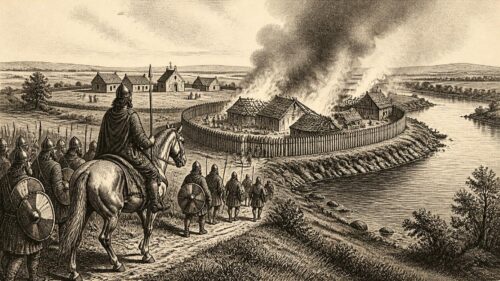
His campaign belongs beside another 812 notice: a slaughter of the Calraige of Lurg by the Uí Briúin. The annals do not expressly say that Muirgius commanded that killing, and it should not be stated as fact. The event nonetheless fits a wider pattern in which Uí Briúin power pressed towards Mag Luirg and Bréifne. For communities caught in such warfare, “plundering” was not an abstract political act. It could mean the seizure of cattle, foodstores and movable wealth, the burning or stripping of settlements, and the disruption of labour at a time when livestock and grain underpinned survival and status.
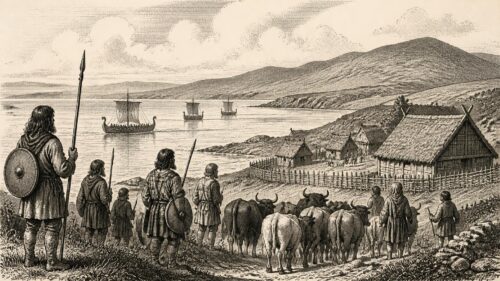
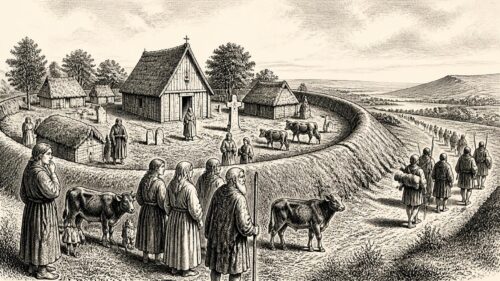
Ordinary life continued beyond the annals’ short notices. Most people lived in dispersed farming households, often in enclosed farmsteads now known as ringforts or, in stonier western districts, cashels. Cattle, dairying, crops and craft production sustained local economies; churches and monasteries were also landholders, workplaces and centres of learning. But no source reports an Irish harvest, weather event, market movement or general condition of trade specifically for 812. The year’s evidence instead shows why security mattered to everyday life: raiding and inter-dynastic plundering threatened people, animals, stored food and the connections between farms, churches and ruling households.
The Promulgation of Daire’s Law
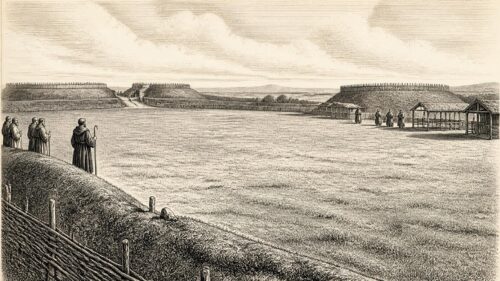
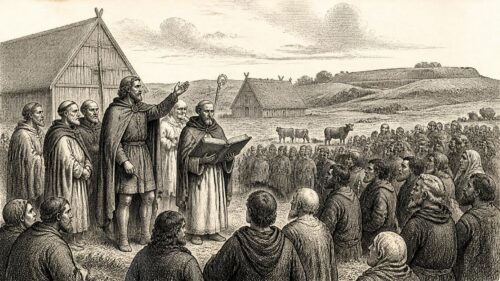
The last major Connacht entry is more peaceful in form but no less political: “Daire’s law was promulgated in Connacht.” A medieval Irish cáin, often translated “law”, was not necessarily a written statute in the modern sense. It could be a binding religious and legal settlement, associated with a saint or church, enforced through dues, protections, ritual authority and the backing of kings. The exact provisions of Daire’s law are lost. It would be wrong to invent rules about cattle, theft or sanctuary simply because another notice from Munster in 810 refers to a law concerning cows associated with Dáire and Adúar.
Nevertheless, the wider sequence is revealing. Daire’s law had been accepted in Munster by 810; it was promulgated in Connacht in 812; and the annals place its adoption among the Uí Néill in the following year. Scholars understand Dáire, or Dar Í, as the saintly figure behind this legal cult rather than a living ninth-century legislator. Its spread suggests negotiation across provincial boundaries and the ability of ecclesiastical authority to travel with political consent. In Connacht, Muirgius had already used the patronage of churches and saints’ laws to reinforce his position. The adoption of Daire’s law in 812 should therefore be seen as part of a broader programme of rulership, alliance-building and public order, though the annal does not name its sponsors or location.
Churches and Loss
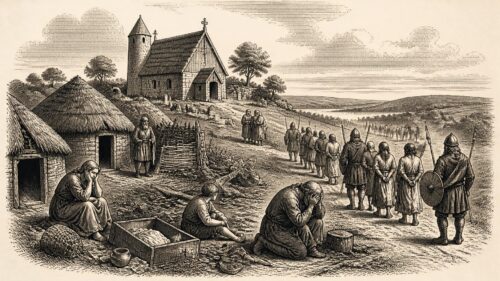
Several ecclesiastical deaths recorded by the Annals of Ulster give the year another dimension. Nuadu of Loch Uama, bishop, anchorite and abbot of Armagh, died; so did Echaid, bishop, anchorite and superior of Tamlacht, and Flann son of Cellach of Finnglas, described as abbot, scribe, anchorite and bishop. Such accumulated titles are a reminder that major churches were not isolated places of prayer. Their leaders could be scholars, scribes, administrators, teachers and guardians of institutional property as well as religious figures. Their deaths mattered to communities extending beyond a single enclosure.
Armagh in particular possessed island-wide prestige through its association with Patrick, while Tamlacht and Finnglas belonged to the dense ecclesiastical landscape around the central and eastern regions. A year earlier, Nuadu had travelled to Connacht with Patrick’s law and its cáin. His death in 812 thus came soon after an episode linking Armagh’s religious authority to Connacht politics. This connection should not be exaggerated into a claim that he personally sponsored Daire’s law; the sources do not say so. It does show, however, that laws of saints, relic-centred institutions and provincial rulers operated within overlapping networks.
Thus 812 was not merely an early Viking episode. It was a year in which western communities fought raiders with mixed results; a Munster king secured a victory of his own; Muirgius asserted Uí Briúin power in Connacht; and a saint’s law was extended across that province. The evidence is fragmentary, and its silences must be respected. But what survives captures an Ireland able to resist, negotiate, organise and remember—while facing a maritime threat that had only begun to reshape its history.
Primary Sources
- The Annals of Ulster, Year U812
- The Annals of Ulster: Text, Translation and Editorial Information
- Chronicon Scotorum, Annals CS810–CS812
- Chronicon Scotorum: Text and Editorial Information
- Annals of Inisfallen
- Annals of the Four Masters, Volume 1
- Muirgius, Dictionary of Irish Biography
- The Vikings in Ninth-Century Ireland: Sources and Settlements
- Vikings in Irish Chronicles, 794–902: Data
- The Nature of Early Irish Kingship
- A Misunderstood Annal: A Hitherto Unnoticed Cáin
- Annales Regni Francorum
- Narrating and Negotiating Difference in the Insular Viking Age
- Cogadh Gaedhel re Gallaibh: The War of the Gaedhil with the Gaill
- Translated Texts at CELT
- The Chronicle of Ireland
- Irish Field Monuments: Ringforts
- Early Medieval Farmsteads
- Ringforts / Ráthanna
- Churches and Ecclesiastical Enclosures / Shéipéil agus Ráthanna